Does Jeep Make an EV? The Short Answer
Yes. As of the 2025–2026 model years, Jeep sells two fully electric vehicles in the U.S. market:
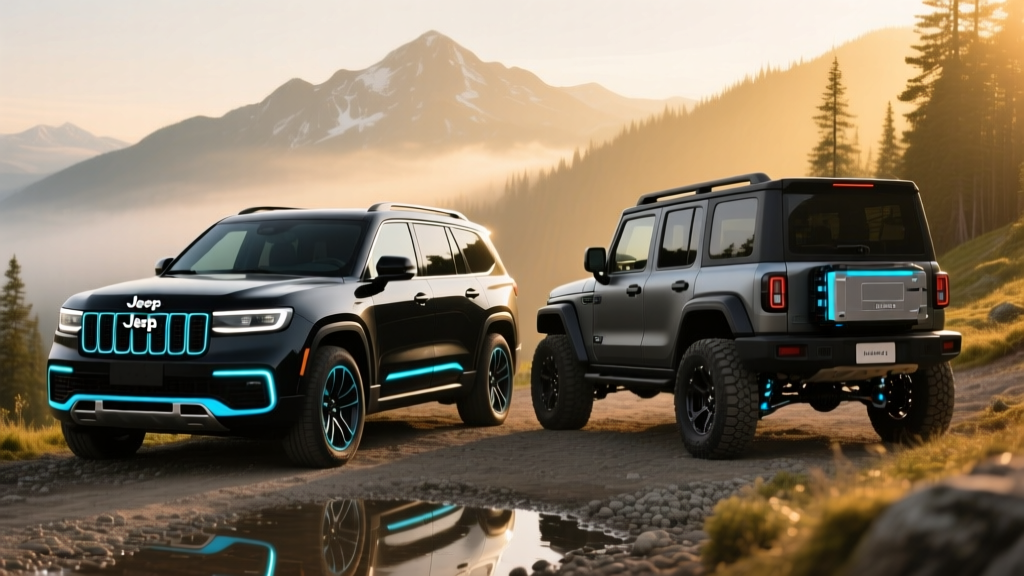
- Jeep Wagoneer S — a premium two-row electric SUV with up to 300+ miles of EPA-estimated range and 600 hp.
- Jeep Recon — a boxy, off-road-focused electric SUV with removable doors, expected to deliver roughly 300 miles of range.
Jeep also sells the Wrangler 4xe and Grand Cherokee 4xe, which are plug-in hybrids (PHEVs), not full EVs. These offer 25–26 miles of electric-only driving before the gas engine kicks in. If you want zero tailpipe emissions and no gas engine, the Wagoneer S is currently Jeep's most accessible battery-electric option, with the Recon joining the lineup for 2025/2026.
Jeep's Electric Lineup: Specs at a Glance
| Spec | 2026 Wagoneer S | 2026 Recon (Announced) | Wrangler 4xe (PHEV) |
|---|---|---|---|
| Powertrain | BEV (dual motor AWD) | BEV (dual motor 4x4) | PHEV (turbo I-4 + electric) |
| Horsepower | 600 hp | ~600 hp (est.) | 375 hp combined |
| 0–60 mph | 3.4 sec | ~4.0 sec (est.) | 6.0 sec |
| Battery Capacity | 100.5 kWh (NMC) | ~100 kWh (est.) | 17.3 kWh (usable) |
| EPA Range | 300+ mi (est.) | ~300 mi (est.) | 370 mi total / 26 mi EV-only |
| Max DC Fast Charge | ~200 kW peak | TBD | N/A (Level 2 only) |
| 10–80% DC Charge | ~23 min (est.) | TBD | ~2 hr (Level 2) |
| Base MSRP | ~$71,995 | ~$65,000 (est.) | ~$49,995 |
| Federal Tax Credit | Check §30D sourcing | Check §30D sourcing | Eligible (verify sourcing) |
| Battery Warranty | 8 yr / 100,000 mi | 8 yr / 100,000 mi (est.) | 8 yr / 100,000 mi |
Sources: Jeep.com Wagoneer S, fueleconomy.gov. Recon specs are preliminary and subject to change. Always verify current-year EPA figures and IRS eligibility.
Wagoneer S Deep Dive: Range, Charging, and Real-World Expectations
The Wagoneer S is Jeep's first ground-up battery-electric vehicle built on the Stellantis STLA Large platform. It's positioned as a performance luxury SUV, competing with the BMW iX, Audi Q8 e-tron, and Tesla Model X rather than the Wrangler.
EPA Range vs. Real World
EPA Estimate: 300+ miles (official figure pending final EPA certification for 2026)
Real-World Expectation: Plan for approximately 250–270 miles during sustained highway driving at 70–75 mph. In cold weather (below 32°F), expect a further 15–25% reduction, bringing effective range to roughly 200–230 miles. The 100.5 kWh NMC battery provides a large buffer, but aerodynamic drag at highway speeds and cabin heating draw significant energy.
Charging Speed and the Curve Reality
The Wagoneer S supports DC fast charging at up to approximately 200 kW. However, peak charge rate is not sustained across the entire session. Here's what a typical charging curve looks like:
- 10–30% SoC: Near peak ~200 kW — fastest portion of the charge
- 30–60% SoC: Sustained ~150–175 kW
- 60–80% SoC: Tapers to ~100–120 kW
- 80–100% SoC: Drops sharply below 50 kW — avoid charging past 80% on road trips
At a 150+ kW DC fast charger (like Electrify America or EVgo), expect a 10–80% session in roughly 23 minutes. For daily driving, a home Level 2 charger (9.6 kW / 48A) will replenish the battery in about 10–11 hours from empty — ideal for overnight charging.
Level 2 Home Charging Setup
| Charging Level | Power (kW) | Miles Added per Hour | Best For |
|---|---|---|---|
| Level 1 (120V outlet) | 1.4 kW | ~3–4 mi/hr | Emergency / overnight trickle |
| Level 2 (240V, 48A) | 9.6–11.5 kW | ~28–34 mi/hr | Daily home charging |
| DC Fast Charge | Up to ~200 kW | ~500+ mi/hr (peak) | Road trips |
Installing a Level 2 home charger typically costs $1,200–$3,500 depending on whether your electrical panel needs an upgrade (200A service recommended). Factor in a $500–$800 wall connector and $700–$2,500 for electrician labor and permits. If you live in an apartment or lack garage access, public charging reliance will increase your per-mile cost significantly.
Wagoneer S vs. Gas SUV: 5-Year Cost Comparison
Let's compare the Wagoneer S against a similarly priced gas SUV — the Jeep Grand Cherokee Summit (MSRP ~$65,000, 19 MPG combined) — over 5 years and 60,000 miles.
| Cost Category | Wagoneer S (EV) | Grand Cherokee (Gas) |
|---|---|---|
| Purchase Price (MSRP) | $71,995 | $65,000 |
| Federal Tax Credit (§30D) | Up to $7,500 (verify eligibility) | $0 |
| Effective Purchase | ~$64,495 | $65,000 |
| Fuel/Energy (60K mi) | ~$3,600 (home charging at $0.14/kWh) | ~$9,950 (at $3.50/gal, 19 MPG) |
| Maintenance (5 yr) | ~$1,200 (no oil, fewer brake jobs) | ~$3,500 (oil, filters, brakes) |
| Insurance (5 yr avg) | ~$12,500 (EV premium ~15% higher) | ~$10,800 |
| Estimated Depreciation | ~$28,000 | ~$24,000 |
| 5-Year Total Cost | ~$110,795 | ~$113,250 |
Key takeaway: The Wagoneer S's fuel and maintenance savings of roughly $8,650 over five years can offset its higher insurance and depreciation, making total cost of ownership competitive with a loaded gas Grand Cherokee. However, the EV's value equation depends heavily on your access to cheap home charging, annual mileage, and whether you qualify for the federal tax credit. Always check current IRS §30D rules for battery sourcing and income requirements.
Recon: The Off-Road EV Jeep Enthusiasts Are Waiting For
If the Wagoneer S is Jeep's luxury play, the Recon is its heritage play. Designed to evoke the Wrangler's boxy, rugged character, the Recon features:
- Removable doors (a first for an electric SUV)
- Selec-Terrain traction management with off-road modes
- High ground clearance and aggressive approach/departure angles
- Estimated ~300 miles of range with a ~100 kWh battery
- Expected MSRP starting around $65,000
The Recon is targeted at buyers who want Wrangler-like capability without a gas engine. However, off-road driving is energy-intensive — low-speed rock crawling and sand driving can cut effective range by 30–40%. For serious trail use, plan routes around charging infrastructure or bring a portable generator as backup.
Note: As of early 2026, final EPA certification and pricing for the Recon are still pending. Treat all specs as preliminary.
Common Misconceptions About Jeep EVs
| Myth | Fact |
|---|---|
| "The Wrangler is electric." | The Wrangler 4xe is a plug-in hybrid — it has a gas engine and a 26-mile electric-only range. It is not a BEV. |
| "Jeep EVs can't off-road." | Electric motors deliver instant torque at 0 RPM, which is excellent for low-speed crawling. The Recon is engineered specifically for trail use, though range on technical terrain drops significantly. |
| "I'll get the full $7,500 tax credit automatically." | The §30D credit requires meeting critical mineral and battery component sourcing thresholds, MSRP caps ($80K for SUVs), and buyer income limits ($300K joint / $150K single). Many buyers qualify for less than $7,500 or nothing at all. Check before committing. |
| "EV batteries need replacing every few years." | Modern NMC batteries are warrantied for 8 years / 100,000 miles with a guaranteed minimum capacity (typically 70% SoH). Data from Tesla, Hyundai, and others shows most packs retain 85–90% capacity at 100K miles. |
| "Home charging isn't necessary." | Public DC fast charging costs 2–3× more per mile than home Level 2 charging. Without home charging, your fuel cost advantage shrinks substantially. Budget $0.35–$0.50/kWh at public chargers vs. $0.12–$0.16/kWh at home. |
Decision Framework: Is a Jeep EV Right for You?
Choose the Wagoneer S if:
- You want a premium electric SUV with serious acceleration (3.4-sec 0–60) and 300+ miles of range
- You have access to Level 2 home charging (garage or driveway with 240V)
- Your daily commute is under 100 miles round-trip, and you road-trip 3–5 times per year
- You're cross-shopping the BMW iX, Audi Q8 e-tron, or Tesla Model X and want something less common
- You qualify for some or all of the §30D federal tax credit
Choose the Recon (when available) if:
- Off-road capability and open-air driving are non-negotiable
- You want Wrangler energy but zero tailpipe emissions
- You accept that trail driving will significantly reduce effective range
- You're willing to plan charging stops on longer off-road excursions
Choose the Wrangler 4xe (PHEV) if:
- You want electric commuting (26 mi EV-only) but unlimited gas range for remote adventures
- You don't have reliable home charging or live in an area with sparse DC fast-charging infrastructure
- You want proven Wrangler aftermarket support and a lower starting price (~$49,995)
- Range anxiety on trails is a deal-breaker for a full BEV
Skip Jeep EVs entirely if:
- You need three rows of seating (the Wagoneer S is a two-row; look at the Kia EV9 or Rivian R1S)
- Your budget is under $50,000 (consider the Hyundai Ioniq 5, Chevy Equinox EV, or a used EV)
- You tow more than 5,000 lbs regularly (EV towing cuts range by 40–50%)
What First-Time EV Buyers Should Know Before Purchasing a Jeep EV
- Install your Level 2 charger before the car arrives. Get a quote from a licensed electrician early. If your panel needs upgrading from 100A to 200A, that alone can cost $1,500–$3,000 and take weeks to schedule.
- Preconditioning matters. The Wagoneer S can warm or cool its battery while plugged in, optimizing fast-charge speed and preserving range in extreme temperatures. Always precondition before a DC fast-charge stop.
- Understand the charge curve. Don't plan road-trip stops assuming you'll charge at peak kW the entire time. Budget for the taper above 80% — charge to 80%, then move on.
- Insurance is higher. EV insurance premiums run 10–20% above comparable gas vehicles due to higher repair costs and battery replacement risk. Get quotes before signing a purchase agreement.
- Verify tax credit eligibility yourself. Don't rely solely on the dealer. Cross-reference the VIN against IRS guidance and confirm battery sourcing compliance. The credit can be applied at point of sale as a price reduction, but only if the vehicle qualifies.
- Cold weather is real. If you live in the upper Midwest or Northeast, budget for 20–25% winter range loss. A heat pump (check if included on your trim) helps, but resistance cabin heating is a significant energy draw.
Frequently Asked Questions
Does Jeep make a fully electric Wrangler?
No. The Wrangler 4xe is a plug-in hybrid with a 2.0L turbo gas engine paired with an electric motor and 17.3 kWh battery. It offers 26 miles of electric-only range but is not a full EV. Jeep has not announced a battery-electric Wrangler as of early 2026.
How much does it cost to charge the Wagoneer S at home?
With a 100.5 kWh battery and an average U.S. electricity rate of $0.14/kWh, a full charge from 0–100% costs approximately $14.07. That works out to roughly $0.047 per mile at the rated 300-mile range. Compare that to a gas Grand Cherokee at $3.50/gal and 19 MPG — about $0.184 per mile.
Can the Jeep Recon handle serious off-road trails?
Jeep is engineering the Recon with Selec-Terrain modes, high ground clearance, and off-road-tuned torque delivery. Electric motors provide instant torque at zero RPM, which is ideal for rock crawling. However, sustained trail driving drains the battery faster than highway cruising — plan accordingly and know where the nearest charger is.
What's the battery warranty on Jeep EVs?
Jeep provides an 8-year / 100,000-mile battery warranty on its electric vehicles, covering defects and excessive capacity loss (typically below 70% state of health). This is consistent with federal requirements for EV battery coverage.
Do I qualify for the $7,500 federal EV tax credit on a Jeep EV?
Maybe. The §30D credit depends on your income (≤$300K joint / ≤$150K single), the vehicle's MSRP (≤$80K for SUVs), and whether the battery meets critical-mineral and component-sourcing thresholds for the current tax year. Some Jeep EVs may qualify for the full $7,500, a partial credit, or none at all. Verify at IRS.gov and consult a tax professional.
Is the Wagoneer S a good first EV?
It's a capable first EV if you have home charging access and your budget supports a $65K–$75K vehicle. The large battery means forgiving range, and the STLA Large platform is proven. However, first-time buyers on a tighter budget may find better value in the Hyundai Ioniq 5, Tesla Model Y, or Chevy Equinox EV.