Quick Answer: Does Honda Make an Electric Car?
Yes. As of 2026, Honda sells one fully electric vehicle in the U.S.: the Honda Prologue, a midsize SUV with up to 296 miles of EPA range, starting at approximately $48,795. It uses General Motors' Ultium battery platform and qualifies for partial federal tax credits depending on your income and the vehicle's battery sourcing. Honda has also announced its next-generation 0 Series EVs (expected late 2026–2027), built on a proprietary Honda platform. If you need a Honda today but can't charge at home, Honda's strong hybrid lineup — CR-V Hybrid, Accord Hybrid — remains a practical bridge.
The 2026 Honda Prologue: Honda's Current Electric SUV
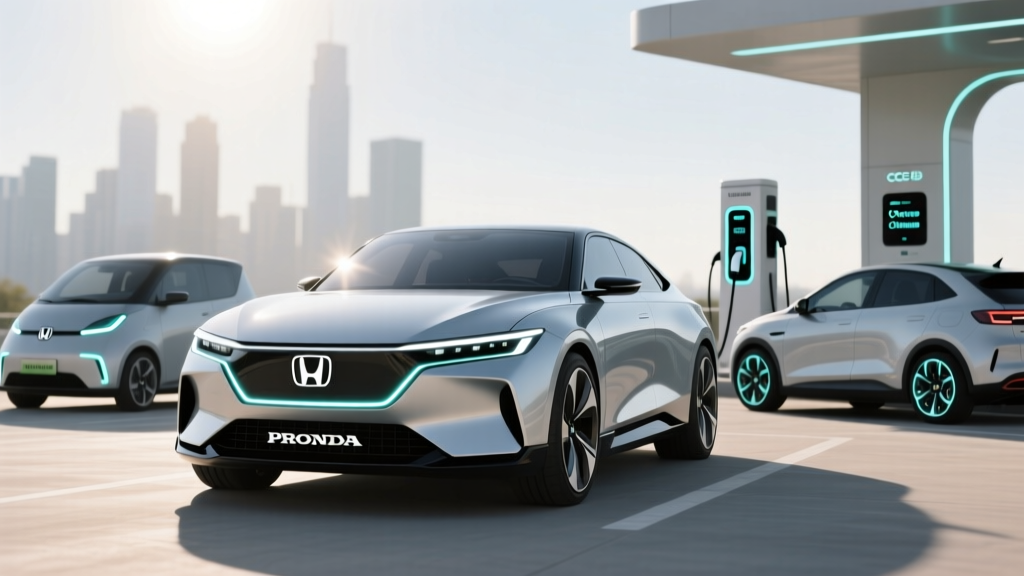
The Prologue is Honda's only battery-electric vehicle (BEV) currently available in the U.S. It's a midsize, two-row SUV co-developed with General Motors, riding on GM's Ultium platform — the same architecture underpinning the Chevrolet Blazer EV and Cadillac Lyriq. For buyers asking "does Honda make an electric car," this is the concrete answer you can drive home today.
| Spec | FWD (EX/EX-L) | AWD (Touring) |
|---|---|---|
| EPA Range | 296 miles | 281 miles |
| Battery (usable) | 85 kWh, NMC (Ultium) | 85 kWh, NMC (Ultium) |
| Horsepower | 220 hp | 288 hp |
| 0–60 mph | ~7.2 sec | ~5.9 sec |
| Peak DC Fast Charge | 150 kW | 150 kW |
| 10–80% DC Charge | ~33 min | ~33 min |
| Level 2 Charge Rate | 11.5 kW (7.7 kW std) | 11.5 kW (7.7 kW std) |
| EPA Efficiency (combined) | 99 MPGe | 94 MPGe |
| Cargo Volume | 25.2 cu ft (rear seats up) | 25.2 cu ft |
| Starting MSRP | $48,795 (EX) | $57,395 (Touring) |
| Battery/Powertrain Warranty | 8 years / 100,000 miles | |
Real-World Range vs. EPA Sticker
The Prologue's 296-mile EPA estimate (FWD) is competitive for the class, but real-world results depend heavily on conditions. Expect approximately 250–270 miles on sustained highway driving at 70+ mph, and 210–240 miles in freezing temperatures (below 32°F) due to battery chemistry and cabin heating demands. The NMC chemistry in the Ultium pack is energy-dense but more temperature-sensitive than LFP. Preconditioning the battery before DC fast charging is essential to hit that 150 kW peak — without it, charge rates may start below 50 kW.
Prologue Charging Speed and Daily Ownership
Charging is where many first-time EV buyers need the most clarity. Here's what the Prologue looks like in practice, broken down by charging level. Note: kW (kilowatts) measures power — how fast energy flows. kWh (kilowatt-hours) measures energy — how much the battery stores. They are not interchangeable.
| Level | Power | Miles Added per Hour | Best For |
|---|---|---|---|
| Level 1 (120V household) | ~1.4 kW | ~3–4 mi/hr | Overnight top-offs, emergencies |
| Level 2 (240V home) | 7.7–11.5 kW | ~22–34 mi/hr | Daily home charging (full in ~8–11 hrs) |
| DC Fast Charge | Up to 150 kW | ~190 mi in 30 min | Road trips, quick stops |
The Prologue uses a CCS1 connector for DC fast charging and a J1772 connector for Level 1/2 AC charging. Honda does not currently include a NACS (Tesla-style) port, though adapters may be available for Supercharger access — verify current compatibility with your dealer.
Charging curve reality: The 150 kW peak only applies between roughly 10–40% state of charge. Above 60%, the rate tapers significantly to protect the NMC battery. A 10–80% session takes approximately 33 minutes, but 80–100% can add another 40+ minutes. Plan road-trip stops around the 10–80% window for efficiency.
Honda EV vs. Honda Hybrid: Which Saves You More?
Not every Honda buyer is ready for a full EV — and that's fine. Honda's hybrid lineup is among the strongest in the industry. Here's how the Prologue stacks up against the CR-V Hybrid and Accord Hybrid on cost and efficiency, based on 15,000 miles driven annually.
| Vehicle | Starting MSRP | Fuel/Energy Cost (5 yrs) | Maintenance (5 yrs) | Est. Total (5 yrs) |
|---|---|---|---|---|
| Prologue EX (FWD, EV) | $48,795 | $3,200 (home charging)* | $1,800 | ~$53,795 |
| CR-V Hybrid (AWD) | $36,045 | $7,500 (gas @ $3.40/gal) | $3,200 | ~$46,745 |
| Accord Hybrid | $34,095 | $6,100 (gas @ $3.40/gal) | $2,800 | ~$42,995 |
*Home charging cost assumes $0.14/kWh national average. Public DC fast charging costs 2–3× more. Actual savings depend on local electricity rates and driving patterns. Source: fueleconomy.gov and manufacturer MSRP.
Key takeaway: The Prologue has a higher upfront price but dramatically lower running costs. Over 5 years, you'll save roughly $4,000–$5,000 on energy and maintenance compared to a hybrid — but the initial price gap means the EV doesn't "pay for itself" purely on fuel savings alone. The federal tax credit (up to $7,500, subject to eligibility) can close that gap substantially. Hybrids win for buyers who lack home charging access or drive in extreme cold frequently.
Federal Tax Credit: Does the Prologue Qualify?
The Prologue may qualify for the IRS §30D Clean Vehicle Credit — up to $7,500 — but eligibility is not automatic. The rules are specific and change periodically. As of 2026, here's what you need to verify:
- MSRP cap: SUVs must be priced at or below $80,000. The Prologue qualifies across all trims.
- Buyer income cap: AGI must not exceed $150,000 (single), $225,000 (head of household), or $300,000 (joint filers).
- Battery sourcing: A percentage of critical minerals and battery components must be sourced from the U.S. or free-trade-agreement countries. This requirement tightens annually. Because the Prologue uses GM's Ultium platform with North American assembly, it has historically qualified for at least partial credit — but verify the exact amount for your model year at IRS.gov.
- Point-of-sale transfer: You can now transfer the credit to the dealer at purchase, reducing your out-of-pocket cost immediately rather than waiting for tax filing.
Never assume a flat $7,500. The actual credit depends on the specific VIN's battery sourcing compliance and your personal tax situation. Consult a tax professional and check the latest IRS guidance before purchasing.
What's Coming: Honda 0 Series (Announced, Not Yet On Sale)
Honda has announced its next-generation EV family called the 0 Series, built on a new proprietary Honda EV platform (not GM's Ultium). These vehicles are expected to feature:
- Thinner, lighter battery packs with improved energy density
- Target range exceeding 300 miles EPA
- Level 3 automated driving capability in limited scenarios (eyes-off, hands-off in traffic jams — not full self-driving)
- Expected U.S. launch: late 2026 to 2027
Important: As of early 2026, no 0 Series vehicle is available for purchase. All specs are preliminary and subject to change. If you need an electric Honda today, the Prologue is your only option.
Real-World Ownership: Is the Prologue Right for You?
Buying an EV is as much about your lifestyle as the vehicle's specs. Here's a practical framework for deciding whether the Prologue (or any Honda EV) fits your situation.
Honda EV Decision Framework
Choose the Prologue EV if:
- You have access to Level 2 home charging (garage or driveway with a 240V outlet)
- Your daily commute is under 80 miles round-trip (easily covered by overnight charging)
- You take road trips 4–6 times per year and are comfortable planning DC fast-charge stops
- You qualify for the federal tax credit, bringing the effective price closer to $41,000–$44,000
- You want zero tailpipe emissions and lower maintenance (no oil changes, fewer brake replacements due to regenerative braking)
Choose a Honda Hybrid (CR-V Hybrid, Accord Hybrid) if:
- You live in an apartment or lack reliable home/workplace charging access
- You regularly drive in sub-freezing climates where EV range drops 20–30%
- You frequently tow (the Prologue is rated for only 1,500 lbs; the CR-V Hybrid handles similar loads without range anxiety)
- Your budget is under $40,000 and you can't absorb the Prologue's higher MSRP even with incentives
- You want the simplicity of gas station refueling with excellent fuel economy (CR-V Hybrid: 40 MPG combined)
Home Charging Installation: What It Actually Costs
Don't assume you can plug into a standard outlet and be satisfied. Level 1 (120V) charging adds only ~3 miles per hour — fine for a 30-mile commute, frustrating for anything more. Most Prologue owners will want a Level 2 home charger.
| Item | Typical Cost Range |
|---|---|
| Level 2 EVSE (charger unit, 32–48A) | $400–$700 |
| Electrician labor (240V circuit, 50–60A breaker) | $600–$1,500 |
| Permit and inspection | $100–$300 |
| Panel upgrade (if needed — older homes with 100A service) | $1,500–$3,000 |
| Total (no panel upgrade) | $1,100–$2,500 |
| Total (with panel upgrade) | $2,600–$5,500 |
Always hire a licensed electrician for a final assessment. Your home's panel capacity, wiring distance, and local code requirements will determine the exact cost.
Common Honda EV Misconceptions — Fact-Checked
| Myth | Fact |
|---|---|
| "Honda doesn't make real EVs — they only have hybrids." | The Prologue is a full BEV with 296 miles of range and DC fast charging. It's a legitimate electric SUV, not a compliance car. |
| "The Prologue is just a rebadged Chevy." | While it shares GM's Ultium platform, Honda designed the exterior, interior, suspension tuning, and infotainment independently. Driving dynamics and cabin materials differ from the Blazer EV. |
| "EV batteries need replacing every 5 years." | Honda warranties the Prologue's battery for 8 years/100,000 miles against degradation below ~70% capacity. Real-world data from Ultium-platform vehicles shows minimal degradation in the first 3–5 years. |
| "I'll save money immediately by going electric." | Higher upfront cost means breakeven takes 3–6 years depending on mileage, electricity rates, and tax credit eligibility. EVs save on fuel and maintenance, but the purchase price is still a barrier. |
| "Honda's hybrids are basically the same as EVs." | Hybrids still burn gasoline (CR-V Hybrid: 40 MPG), require oil changes, and produce tailpipe emissions. They're a bridge technology — excellent for some use cases, but fundamentally different from a BEV. |
Frequently Asked Questions
Does Honda have a fully electric car in 2026?
Yes. The Honda Prologue is a midsize electric SUV with up to 296 miles of EPA range, starting at $48,795. It's Honda's only current BEV in the U.S. market.
Is the Honda Prologue eligible for the $7,500 federal tax credit?
It may qualify for the full or partial §30D credit, depending on battery sourcing requirements and your personal income. Verify the specific VIN's eligibility at IRS.gov and consult a tax professional. The credit can be transferred at the point of sale to reduce your purchase price immediately.
How does the Prologue compare to the Tesla Model Y?
The Model Y Long Range offers ~320 miles of range, faster DC charging (250 kW peak, ~15 min 10–80%), and access to the Supercharger network. The Prologue counters with a more traditional SUV design, Honda's reputation for build quality, and available federal credits. The Model Y starts around $44,990 (before credits), making it slightly cheaper upfront.
Can I charge the Prologue at Tesla Superchargers?
The Prologue uses a CCS1 connector, not NACS. As of 2026, Honda has not announced native NACS adoption for the Prologue. Some CCS-to-NACS adapters exist, but verify compatibility and safety certifications before relying on one for Supercharger access.
What Honda EVs are coming next?
Honda's 0 Series EVs are announced for late 2026–2027, built on a new Honda-developed platform. Details are preliminary. The Prologue remains the only Honda EV you can purchase today.
Is the Prologue good in cold weather?
Expect 20–30% range reduction in sustained sub-freezing temperatures (typical for NMC batteries). That means ~210–240 real-world miles from a 296-mile EPA rating. Preconditioning the battery while plugged in helps preserve range and improves charging speed. If you live in a harsh-winter climate, a hybrid may be more practical unless you have reliable indoor/garage charging.
How much does it cost to charge the Prologue at home?
At the national average of $0.14/kWh, fully charging the 85 kWh battery from empty costs approximately $11.90. For a typical 40-mile daily commute (~12 kWh), you'll spend about $1.70 per day — roughly one-third the cost of gasoline for the same distance in a CR-V Hybrid.
Bottom line: Honda does make an electric car — the Prologue is a capable, well-equipped midsize EV SUV. It's not the cheapest or longest-range option in its class, but it delivers Honda's traditional strengths: solid build quality, intuitive controls, and strong dealer support. Pair it with home charging and the federal tax credit, and it's a compelling choice. If you can't charge at home or live in extreme cold, Honda's hybrid lineup remains one of the best in the business.