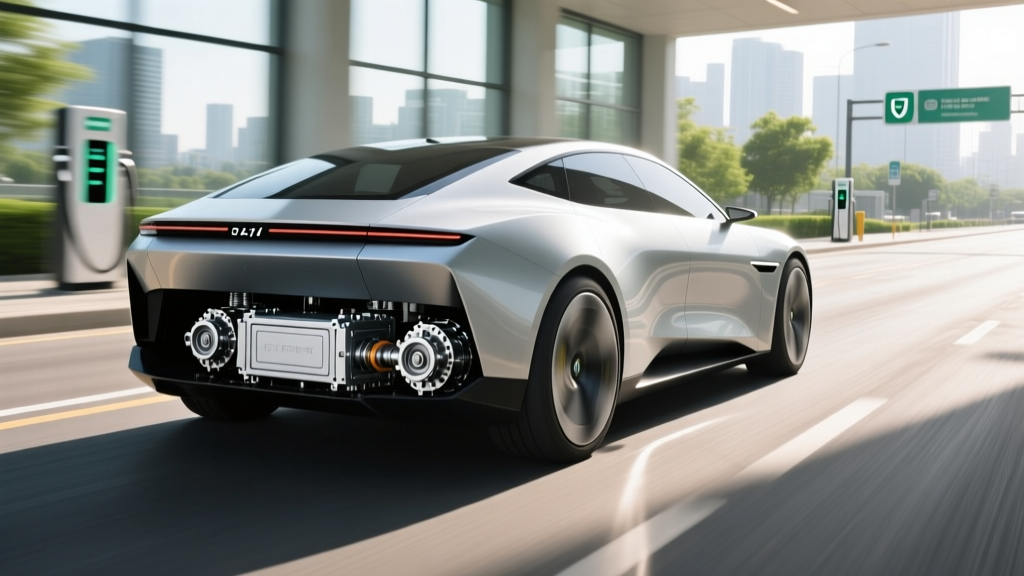
If you've ever wondered whether an electric vehicle uses a traditional transmission, the short answer is: most EVs do not have a multi-speed transmission. Instead, the vast majority of battery-electric vehicles on the road in 2026 use a single-speed reduction gear — a fixed-ratio gearbox that transfers torque from the electric motor to the wheels without shifting. A handful of performance-oriented models, like the Porsche Taycan and Audi e-tron GT, use a two-speed rear axle for optimized launch and highway efficiency, but these are exceptions, not the rule.
The Quick Answer
Most EVs use a single-speed reduction gear (often around a 9:1 to 12:1 ratio), not a multi-speed automatic, manual, or CVT. Electric motors produce peak torque from 0 RPM and rev to 15,000–20,000+ RPM, eliminating the need for multiple gear ratios. Hybrids (HEVs and PHEVs) often do retain multi-speed transmissions because they must manage both a gas engine and electric motor.
Why Most EVs Don't Need Multiple Gears
Internal combustion engines have a narrow power band — typically producing useful torque between roughly 1,500 and 5,000 RPM. A multi-speed transmission (6-, 8-, 9-, or even 10-speed automatics) is necessary to keep the engine in its sweet spot across varying speeds. An electric motor, by contrast, delivers maximum torque instantly from standstill and maintains a broad, flat power curve up to extremely high rotational speeds.
Take the Tesla Model 3 Long Range (2026): its rear permanent-magnet synchronous motor produces peak torque from 0 RPM and revs past 18,000 RPM. A single fixed-ratio reduction gear (approximately 9.73:1) is all that's needed to multiply that torque and send it to the wheels. This translates to seamless, uninterrupted acceleration — no shift shocks, no torque gaps, no hunting for the right gear on a hill climb.
The Physics Behind Single-Speed EV Drivetrains
Electric motors can operate efficiently across an RPM range that spans roughly 20x (from a few hundred RPM to 18,000+). A gasoline engine's efficient range spans maybe 3-4x. Because the motor's usable band is so wide, a single gear ratio can cover 0–130+ mph without the motor falling out of its efficient operating window. The trade-off is that top speed is limited by motor RPM rather than gearing — but for any road-legal speed in the U.S., one ratio is sufficient.
Exceptions: EVs That Do Use Multi-Speed Transmissions
A few high-performance EVs employ a two-speed transmission on the rear axle. The Porsche Taycan was the first production EV to popularize this approach. Its rear motor uses a two-speed gearbox: first gear has a short ratio (~16:1) for explosive off-the-line acceleration, and second gear (~8:1) optimizes efficiency and top-end performance at highway speeds.
| Attribute | Typical BEV (Single-Speed) | Porsche Taycan (2-Speed) | Gas Car (8-10 Speed Auto) | Toyota Hybrid (e-CVT) |
|---|---|---|---|---|
| Number of Gears | 1 (fixed ratio) | 2 (rear axle) | 6–10 | Planetary e-CVT (no fixed gears) |
| Shift Interruptions | None | Minimal (1 shift) | Noticeable on hard accel | None (continuously variable) |
| Transmission Fluid Changes | Every 60k–100k mi or lifetime | Every ~40k–60k mi | Every 30k–60k mi | Every 60k–100k mi |
| Typical Drivetrain Efficiency | ~95–97% | ~94–96% | ~85–90% | ~90–94% (combined ICE+electric) |
| Weight (drivetrain only) | ~30–50 lbs (reducer) | ~70–90 lbs | ~180–250 lbs | ~150–200 lbs (e-CVT + motor-generators) |
The Audi e-tron GT shares the Taycan's J1 platform and two-speed rear axle. Hyundai's Ioniq 5 N uses a simulated multi-speed feel via software (called "N e-Shift") for driver engagement, but mechanically it still uses a single-speed reducer. As of 2026, no mass-market, non-performance EV has adopted a multi-speed gearbox because the cost, weight, and complexity outweigh the marginal gains.
What This Means for Maintenance and Ownership Costs
The single-speed reduction gear is one of the biggest — and most underappreciated — reasons EVs cost less to maintain than gas vehicles. Here's the breakdown:
| Maintenance Item | EV (e.g., Tesla Model 3) | Gas Sedan (e.g., Toyota Camry) |
|---|---|---|
| Transmission fluid service | $0–$150 (lifetime or 100k interval) | $300–$600 (2–3 changes at $150–$200 each) |
| Engine oil changes | $0 | $350–$750 (5–10 changes) |
| Air/filter/spark plugs | $0 (no engine) | $200–$500 |
| Brake pads (regen extends life) | $0–$200 (often last 80k–100k+ mi) | $400–$800 (2–3 replacements) |
| Coolant service | $100–$200 | $150–$300 |
| Estimated 5-Year Total | $200–$550 | $1,400–$2,950 |
According to Consumer Reports, EV owners spend roughly 50% less on maintenance and repair over the vehicle's lifetime compared to gas-car owners. The absence of a complex multi-speed transmission — with its clutch packs, torque converters, valve bodies, and bands — eliminates one of the most failure-prone and expensive-to-repair components in a traditional car.
A replacement automatic transmission for a gas vehicle typically costs $3,000–$7,000 installed. An EV reduction-gear replacement, while rare, runs $500–$1,500 — and most will never need one over the life of the vehicle.
EV vs. Gas vs. Hybrid: The Real Cost and Driving Experience
The transmission difference is just one factor in the EV ownership equation. Let's look at a concrete comparison using a popular EV, its hybrid counterpart, and a gas equivalent — all midsize sedans available in 2026:
| Spec | Hyundai Ioniq 6 SE (BEV) | Toyota Camry Hybrid (HEV) | Honda Accord 1.5T (Gas) |
|---|---|---|---|
| MSRP (base) | $37,500 | $29,995 | $29,295 |
| Federal Tax Credit (§30D) | Up to $7,500 (eligibility varies) | $0 | $0 |
| Effective Price After Credit | ~$30,000 | $29,995 | $29,295 |
| EPA Range / MPG | 361 mi / 140 MPGe | 51 MPG combined | 33 MPG combined |
| Annual Fuel/Energy Cost | ~$550 (home charging, $0.14/kWh) | ~$900 (gas at $3.20/gal) | ~$1,400 (gas at $3.20/gal) |
| Transmission Type | Single-speed reducer | e-CVT (planetary gearset) | CVT |
| 0–60 mph | 5.1 sec | 7.2 sec | 7.5 sec |
| 5-Year Maintenance Est. | ~$400 | ~$1,200 | ~$1,800 |
| Drivetrain Warranty | 10 yr / 100,000 mi | 10 yr / 100,000 mi (hybrid system) | 5 yr / 60,000 mi |
Sources: fueleconomy.gov, manufacturer spec sheets. The Ioniq 6's §30D eligibility depends on battery-component and critical-mineral sourcing requirements per IRS guidelines, plus buyer income caps ($150k single / $300k joint) and the $55,000 sedan MSRP cap. Always verify current-year eligibility before purchasing.
Common Misconceptions About EV Transmissions
| Myth | Fact |
|---|---|
| "EVs have no gears at all." | EVs use a reduction gear (typically 9:1 to 12:1). It's a fixed-ratio gear set, not a "no gear" system. It reduces motor RPM to usable wheel RPM while multiplying torque. |
| "EVs need transmission fluid changes just like gas cars." | Most EV reduction gears use a small amount of gear oil that's either sealed for life or serviced at 60,000–100,000+ mile intervals — far less frequent and far cheaper than automatic transmission fluid (ATF) service on gas vehicles. |
| "Single-speed means EVs can't go fast." | The Tesla Model S Plaid (1,020 HP, single-speed) hits 200 mph. The Rimac Nevera (1,914 HP, single-speed) tops 258 mph. A broad-RPM electric motor doesn't need multiple gears for high speed. |
| "EVs will stall on hills without a transmission." | Electric motors produce maximum torque at 0 RPM. Hill starts are effortless — there's no clutch to slip, no gear to find, no rollback. |
| "Regenerative braking replaces the transmission." | Regen braking is a function of the motor acting as a generator, not the gearbox. The single-speed reducer is always engaged; regen modulates how much energy the motor recovers during deceleration. |
What First-Time EV Buyers Should Know About the Drivetrain
The single-speed drivetrain fundamentally changes the driving experience in ways that matter for daily ownership:
Instant Torque, No Shift Lag
When you press the accelerator, response is immediate. There's no downshift delay, no turbo spool-up, no torque-converter slip. Even a modestly powered EV like the Chevrolet Equinox EV (213 HP, single motor) feels quicker in city driving than its 0–60 time (8.4 seconds) suggests because torque delivery is instantaneous from a stop.
One-Pedal Driving and Regen
Most EVs offer adjustable regenerative braking. At the highest setting, lifting off the accelerator slows the car significantly — enough to come to a complete stop in many models (Hyundai, Kia, Tesla). This reduces brake wear dramatically. Expect original brake pads to last 80,000–120,000+ miles in typical mixed driving.
Noise and Refinement
Without gear shifts, engine noise, or exhaust drone, EVs are exceptionally quiet at all speeds. Wind and tire noise become the dominant sounds above ~40 mph. Some buyers find this unsettling at first; most adapt within a week.
Tire Wear Consideration
The instant torque and higher vehicle weight (EVs are typically 500–1,000 lbs heavier than equivalent gas cars due to the battery) accelerate tire wear. Budget for replacement tires every 25,000–40,000 miles instead of the 40,000–60,000 miles typical for gas cars. EV-specific tires (like the Michelin Pilot Sport EV or Hankook iON evo) are engineered for the load and torque characteristics of electric vehicles and typically cost $200–$350 per tire.
Decision Framework: What the Drivetrain Means for Your Purchase
Choose a Single-Speed BEV If:
- You want the lowest long-term maintenance costs (no oil changes, minimal transmission service, extended brake life).
- You have access to home Level 2 charging (a 48-amp, 11.5 kW charger adds ~35–44 miles of range per hour of charging).
- You prioritize smooth, uninterrupted acceleration and quiet operation.
- Your daily driving is under 250 miles round-trip (well within the 250–370 mile real-world range of most 2026 EVs).
Consider a Hybrid (with e-CVT/Multi-Speed) If:
- You lack reliable home charging access and can't install a Level 2 charger.
- You regularly drive 300+ miles in a day through areas with sparse DC fast-charging infrastructure.
- You live in a region with extreme cold (below 0°F) where EV range drops 20–40% and charging speeds are reduced until the battery warms.
- Your budget is under $30,000 and you want to avoid the EV price premium before incentives.
Consider a Multi-Speed Performance EV (Porsche Taycan, Audi e-tron GT) If:
- Track performance and sustained high-speed driving are priorities (the 2-speed axle keeps the motor in its peak-efficiency zone at 100+ mph).
- You're willing to accept higher maintenance complexity and cost for marginal performance gains.
- Budget exceeds $90,000.
Frequently Asked Questions
Do Tesla vehicles have a transmission?
No multi-speed transmission. All current Tesla models (Model 3, Model Y, Model S, Model X, Cybertruck) use a single-speed reduction gear. The Model S Plaid's dual-motor setup uses one reducer per motor. Tesla has never produced a multi-speed EV.
Do electric cars have a clutch?
No. A clutch is used in manual (and some automatic) transmissions to engage and disengage the engine from the drivetrain. Since EVs don't idle and produce torque from 0 RPM, there's no need to disconnect the motor from the wheels at a stop.
How long does an EV reduction gear last?
In most cases, the life of the vehicle. Reduction gears have very few moving parts — typically just two or three helical gears on bearings. Failures are extremely rare. Some manufacturers (Hyundai, Kia) cover the reduction gear under their 10-year/100,000-mile powertrain warranty.
Why do some EVs have a "gear selector" if there's no transmission?
The P-R-N-D selector controls motor direction and engagement, not physical gears. "Drive" tells the motor controller to apply forward torque. "Reverse" reverses the motor's rotation electronically — the motor simply spins the opposite direction. No mechanical reverse gear is needed.
Does the single-speed design limit towing capacity?
Not meaningfully. The Ford F-150 Lightning (single-speed reducers, dual motor) tows up to 10,000 lbs. The Rivian R1T (single-speed, quad motor) tows 11,000 lbs. The high torque at 0 RPM and broad power band make single-speed EVs excellent tow vehicles — though towing significantly reduces range (expect a 40–60% range reduction when towing near max capacity).
Will future EVs adopt multi-speed transmissions?
Unlikely for mainstream models. As electric motors continue to improve in efficiency and RPM range, the case for added gearbox complexity weakens. Multi-speed designs may persist in niche performance applications, but for the 95%+ of EVs sold, single-speed remains the engineering consensus through at least 2030.