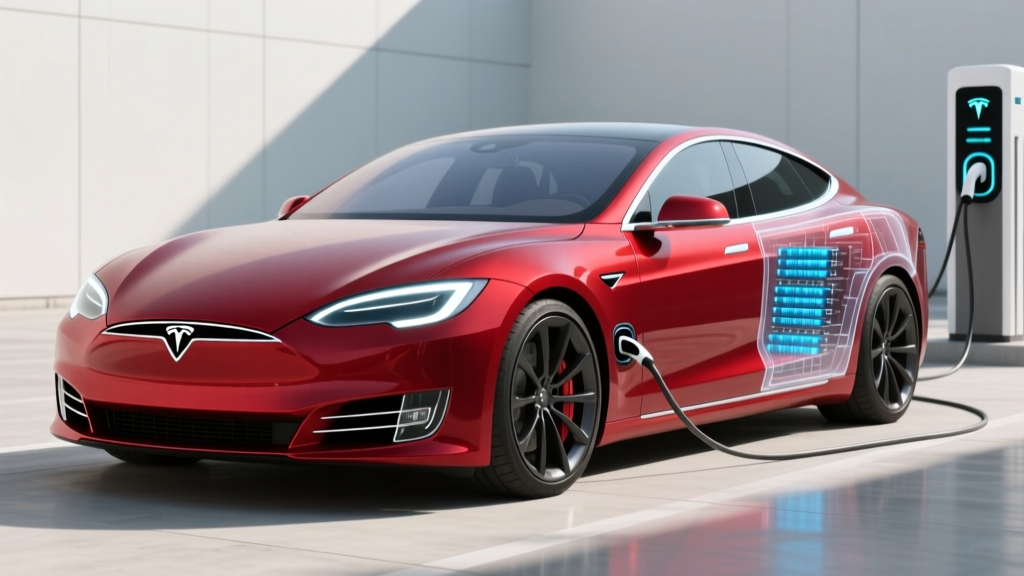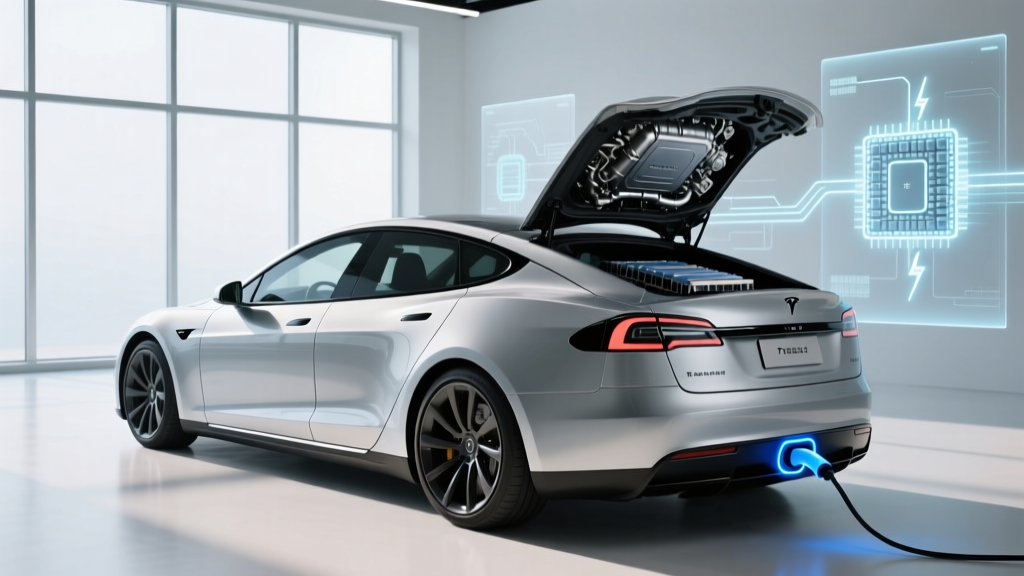
If you're new to electric vehicles, one of the most common questions is deceptively simple: does a Tesla have an engine? The short answer is no. Teslas don't have internal combustion engines — no pistons, no spark plugs, no exhaust system, no transmission with gears to shift. Instead, every Tesla uses one or more electric motors powered by a large lithium-ion battery pack.
But understanding what replaces the engine — and how it changes everything from maintenance to performance to what you'll actually pay at the charger — matters far more than a yes-or-no answer. Below, we break down the electric powertrain across Tesla's 2026 lineup, with exact specs on range, charging speed, pricing, and federal tax credit eligibility.
What Powers a Tesla: Electric Motors, Not Engines
A conventional car uses an internal combustion engine (ICE) to burn fuel, creating controlled explosions that drive pistons, turn a crankshaft, and route power through a multi-speed transmission. A Tesla skips all of that.
Here's what a Tesla powertrain actually contains:
- Battery pack — stores electrical energy in kilowatt-hours (kWh). Think of kWh as the size of your "fuel tank." Tesla uses both NMC (nickel manganese cobalt) and LFP (lithium iron phosphate) chemistries depending on model and trim.
- Electric motor(s) — converts electrical energy into rotational force instantly, with zero lag. Teslas use permanent magnet synchronous reluctance motors (PMSRM) on the rear axle and induction motors on the front axle of dual-motor variants.
- Inverter — converts DC power from the battery into AC power for the motor, while precisely controlling frequency and voltage.
- Single-speed reduction gear — most Teslas use a single-ratio gearbox (roughly 9:1 reduction). No shifting, no clutch, no torque converter.
- Thermal management system — liquid cooling and heating loops keep the battery and motors in their optimal temperature range, critical for both range and fast-charging speed.
The result is a drivetrain with roughly 20 moving parts in the motor versus 2,000+ in a typical ICE powertrain. That simplicity is why Teslas don't need oil changes, transmission fluid swaps, or timing belt replacements.
2026 Tesla Lineup: Motor Configurations and Performance
Tesla currently sells four consumer vehicles in the US. Each offers different motor setups that directly affect acceleration, efficiency, and price. Here's the complete spec breakdown:
| Model | Drivetrain | Horsepower | 0–60 mph | EPA Range | Battery (usable) | Base MSRP |
|---|---|---|---|---|---|---|
| Model 3 RWD | Rear single motor | 271 hp | 5.8 sec | 272 mi | ~60 kWh (LFP) | $38,990 |
| Model 3 Long Range AWD | Dual motor AWD | 346 hp | 4.2 sec | 363 mi | ~79 kWh (NMC) | $44,990 |
| Model Y RWD | Rear single motor | 295 hp | 6.5 sec | 277 mi | ~60 kWh (LFP) | $39,990 |
| Model Y Long Range AWD | Dual motor AWD | 384 hp | 4.8 sec | 337 mi | ~79 kWh (NMC) | $46,630 |
| Model S Dual Motor | Dual motor AWD | 670 hp | 3.1 sec | 402 mi | ~100 kWh (NMC) | $79,990 |
| Model X Dual Motor | Dual motor AWD | 670 hp | 3.8 sec | 335 mi | ~100 kWh (NMC) | $79,990 |
Sources: EPA / fueleconomy.gov, Tesla.com official specs. Specs reflect 2025–2026 model year data; Tesla frequently adjusts pricing and specs mid-year.
Real-World Range: What the EPA Sticker Doesn't Tell You
The EPA range is tested on a mix of city and highway driving at moderate temperatures. Real-world results vary significantly:
Highway driving (70–80 mph): Expect 10–15% less than the EPA sticker. A Model 3 Long Range rated at 363 mi will deliver roughly 310–325 mi at sustained highway speeds.
Cold weather (below 32°F): Range drops 20–30% due to battery chemistry resistance and cabin heating demands. That same Model 3 Long Range may show 250–280 mi in freezing conditions.
City / stop-and-go: This is where EVs shine — regenerative braking recovers energy, often matching or exceeding the EPA estimate.
Practical takeaway: Plan road trips using 80% of the EPA figure as your safe buffer. Preconditioning the battery (warming it before driving or charging) mitigates cold-weather losses.
Tesla's efficiency is among the best in the industry. The Model 3 Long Range AWD achieves 132 MPGe combined (miles per gallon equivalent), which translates to roughly 25 kWh per 100 miles. That efficiency comes partly from the motor design — electric motors convert 85–90% of electrical energy into motion, compared to 20–35% for a gasoline engine.
Charging Speed: DC Fast Charging and Home Level 2
Without an engine, your "refueling" experience is entirely electrical. Tesla uses the NACS (North American Charging Standard) connector across its lineup — the same connector now being adopted by Ford, GM, Rivian, Hyundai, and most major automakers through 2025–2026.
| Charging Method | Max Power | Speed (mi/hr added) | 10–80% Time | Notes |
|---|---|---|---|---|
| Level 1 (120V outlet) | ~1.4 kW | 3–5 mi/hr | N/A (days) | Emergency/trickle only |
| Level 2 (240V home) | 11.5 kW | 37–44 mi/hr | 8–10 hours | Overnight full charge; requires 48A circuit (60A breaker) |
| Tesla V3 Supercharger | 250 kW peak | ~1,000 mi/hr peak | ~25–30 min | Sustains peak briefly, tapers above 50% SoC |
| Tesla V4 Supercharger | Up to 350 kW (Cabinet) | ~1,000+ mi/hr peak | ~20–25 min (capable models) | Newer architecture; Model 3/Y Long Range can leverage higher rates |
Critical nuance on charge curves: The "250 kW peak" number only applies at a low state of charge (SoC), typically 10–20%. As the battery fills, the charging rate tapers to protect cell health. You'll see 250 kW at 15% SoC, but it may drop to 100 kW by 60% and 40 kW by 85%. The 10–80% time is the practical metric — not peak kW alone.
For home charging, Tesla's Wall Connector ($420) on a 240V/60A circuit delivers 11.5 kW to the vehicle, adding roughly 37–44 miles of range per hour. A full overnight charge from 20% to 80% takes about 5–6 hours for a Model 3 Long Range. Installation costs typically run $800–$2,000 depending on panel capacity and conduit distance — factor in a possible $1,500–$3,000 panel upgrade if your home has a 100A service panel.
Pricing, Tax Credits, and What You'll Actually Pay
Tesla's 2026 pricing has shifted multiple times, but here's the current landscape as of early 2026:
| Model / Trim | Base MSRP | §30D Credit | Effective Price | Eligibility Notes |
|---|---|---|---|---|
| Model 3 RWD | $38,990 | Up to $7,500 | ~$31,490 | LFP battery — sourcing rules apply; see below |
| Model 3 Long Range | $44,990 | Up to $7,500 | ~$37,490 | Under $55,000 sedan MSRP cap ✓ |
| Model Y RWD | $39,990 | Up to $7,500 | ~$32,490 | Under $80,000 SUV/truck cap ✓ |
| Model Y Long Range | $46,630 | Up to $7,500 | ~$39,130 | Under $80,000 SUV cap ✓ |
| Model S / X | $79,990+ | $0 | $79,990+ | Exceeds MSRP cap — NOT eligible |
The federal EV tax credit is not automatic. To claim up to $7,500, you must meet ALL of these requirements:
- Income caps: Modified AGI ≤ $150,000 (single), $225,000 (head of household), $300,000 (joint)
- MSRP caps: ≤ $55,000 for sedans (Model 3); ≤ $80,000 for SUVs/trucks (Model Y)
- Battery sourcing: Critical minerals and battery components must meet phased-in US/free-trade-partner sourcing thresholds (increasing yearly through 2029)
- Point-of-sale transfer: As of 2024+, you can transfer the credit to the dealer for an upfront price reduction — you don't have to wait until tax filing
- FEOC exclusion: Vehicles with battery components from a "foreign entity of concern" (e.g., certain Chinese suppliers) may lose partial or full credit
Always verify current eligibility at IRS.gov §30D page and consult a tax professional. Tesla lists credit eligibility per configuration on its website, but final determination rests with the IRS.
For the Model 3 RWD with its LFP battery, the critical minerals sourcing requirement has been a moving target. Tesla shifted some supply chains to qualify, but buyers should confirm eligibility at the time of purchase — the rules tighten annually.
Cargo Space, Interior, and Daily Practicality
Without a large engine block up front, Teslas gain a frunk (front trunk) that adds meaningful cargo flexibility. Here's how the lineup stacks up:
- Model 3: 23 cu ft total cargo (trunk + frunk); 42.2" front legroom, 35.2" rear legroom. The refresh (Highland) improved rear-seat comfort and added ventilated front seats and ambient lighting.
- Model Y: 76 cu ft with rear seats folded (34 cu ft behind second row) + 4.1 cu ft frunk. This is the volume leader and a primary reason it became the world's best-selling vehicle in 2023. Rear legroom: 41.6" front, 36.5" rear.
- Model S: 28 cu ft cargo (hatchback-style liftgate + frunk); 42.4" front, 35.4" rear legroom.
- Model X: Up to 88 cu ft with both rear rows folded (in 5-seat config). Falcon Wing rear doors require overhead clearance but offer excellent curb-side access in tight parking.
The absence of an engine and transmission tunnel also means a completely flat floor in the cabin, improving footroom and making the center rear seat more usable than in most ICE vehicles.
Standout Tech, Driver Assistance, and Drawbacks
What Tesla does exceptionally well:
- Supercharger network: 17,000+ V3/V4 stalls in North America with industry-leading uptime (~98%). Plug-and-charge with no app swiping or RFID cards.
- Over-the-air updates: Teslas receive regular software updates that add features, improve efficiency, and refine the driving experience — no dealer visit needed.
- 15.4" center touchscreen (Model 3/Y): Controls everything from climate to glovebox release. Fast, responsive, and continuously updated.
- Heat pump: Standard on all current Teslas, dramatically improving cold-weather efficiency versus resistive cabin heaters.
- Sentry Mode and Dashcam: Built-in camera system records surroundings when parked — no aftermarket hardware needed.
Notable drawbacks:
- No physical stalks (Model 3 Highland / Model Y Juniper): Turn signals are on the steering wheel rim; gear selection is via the touchscreen. This is polarizing and takes genuine adaptation time.
- Minimalist interior isn't for everyone: No instrument cluster, no physical buttons for climate or volume. Everything routes through the center screen.
- Insurance costs: Tesla insurance premiums run 15–30% higher than comparable ICE sedans/SUVs due to repair costs and sensor density. Get a quote before committing.
- Build consistency: While improved significantly since 2022, panel-gap variation and minor trim misalignment still surface on some deliveries. Inspect before accepting.
Tesla's Autopilot (standard) and Full Self-Driving Supervised ($8,000 option or $99/mo subscription) are both SAE Level 2 driver-assistance systems. This means the driver must remain fully engaged — hands on or near the wheel, eyes on the road — at all times. Tesla's camera-based system handles lane centering, adaptive cruise, and in FSD's case, city-street navigation with stop-sign and traffic-light recognition. However, it requires continuous supervision and is not autonomous. Only Level 4 services like Waymo operate without a human driver — and those are geofenced robotaxis, not consumer vehicles.
Battery Warranty and Longevity
Tesla's battery and drive unit warranty is one of the longest in the industry:
- Model 3 RWD (LFP): 8 years / 100,000 miles, whichever comes first, with minimum 70% capacity retention
- Model 3 Long Range / Model Y (NMC): 8 years / 120,000 miles, minimum 70% retention
- Model S / Model X: 8 years / 150,000 miles, minimum 70% retention
Real-world degradation data from Tesla's fleet shows most packs retain 85–90% capacity after 100,000 miles. LFP batteries (Model 3 RWD) have a longer cycle life and tolerate regular 100% charging — Tesla actually recommends charging LFP packs to 100% at least weekly for calibration. NMC packs (Long Range, Model S/X) benefit from daily charging limits of 80% with occasional 100% for long trips.
Out-of-warranty battery replacement costs range from $12,000–$16,000 for a Model 3/Y pack to $18,000–$22,000 for Model S/X. However, full replacements are rare — most degradation issues involve individual module replacements at lower cost.
Who Should Buy a Tesla (And Who Shouldn't)
- You want access to the most reliable DC fast-charging network in North America
- You can install a Level 2 home charger (this is non-negotiable for a good ownership experience)
- You value OTA software updates and a minimal, tech-forward cabin
- Your daily commute is under 200 miles round-trip (covers nearly all Model 3/Y trims)
- You want strong performance without a performance-car price tag (Model 3 LR at 4.2 sec 0–60 for ~$37K after credit)
- You can't charge at home and your area has sparse public charging
- You prefer physical buttons, an instrument cluster, and a traditional cockpit layout
- You need a truck bed or serious towing capacity (Cybertruck aside, Teslas aren't work trucks)
- You want a dealer service network for in-person support — Tesla's mobile-ranger and service-center model works differently
- You need third-row seating (Model X offers it but at $80K+; consider the Kia EV9 or Rivian R1S instead)
Frequently Asked Questions
Does a Tesla have an engine?
No. Teslas use electric motors powered by a battery pack. There is no internal combustion engine, no gasoline, no exhaust system, and no multi-speed transmission. The electric motor delivers instant torque from 0 RPM, which is why even a base Model 3 RWD hits 60 mph in 5.8 seconds.
What is the real-world range of a Tesla?
The EPA rates the 2026 Model 3 Long Range at 363 miles, but expect roughly 310–325 miles at highway speeds and 250–280 miles in freezing weather. The Model Y Long Range (337 mi EPA) delivers about 285–300 mi highway. City driving with regenerative braking often matches or slightly exceeds the EPA number.
How fast does a Tesla charge?
On a V3 Supercharger, most Teslas peak at 250 kW and charge from 10–80% in about 25–30 minutes. At home on a 240V Level 2 Wall Connector (11.5 kW), a full overnight session adds roughly 37–44 miles per hour of charging. Level 1 (standard 120V outlet) adds only 3–5 miles per hour and is best for emergencies.
Does a Tesla qualify for the $7,500 federal tax credit?
The Model 3 (sedan, under $55K MSRP cap) and Model Y (SUV, under $80K cap) can qualify for up to $7,500 under IRS §30D, provided the buyer meets income limits ($150K single / $300K joint) and the vehicle's battery meets critical-mineral and component-sourcing requirements. The Model S and Model X exceed MSRP caps and are not eligible. Always verify at IRS.gov before purchasing.
Do Teslas need oil changes?
No. Without an engine, there's no oil to change. Tesla maintenance is limited to cabin air filter replacement (~every 2–3 years), brake fluid checks (regenerative braking reduces pad wear dramatically), tire rotation every 6,250 miles, and windshield washer fluid. Tesla estimates annual maintenance costs at roughly $300–$500 versus $1,000–$1,500 for a comparable ICE vehicle.
Is a Tesla worth it versus competitors?
Tesla's advantages remain the Supercharger network, software experience, and efficiency. But competition has closed the gap: the Hyundai Ioniq 6 offers 361 mi EPA range and 800V fast charging, the Ford Mustang Mach-E provides a more traditional interior, and the Chevy Equinox EV undercuts on price. If Supercharger access matters most to you, Tesla is still the strongest pick. If you want physical controls or a more plush interior, test-drive the alternatives before committing.