The Dodge EV Truck in 60 Seconds
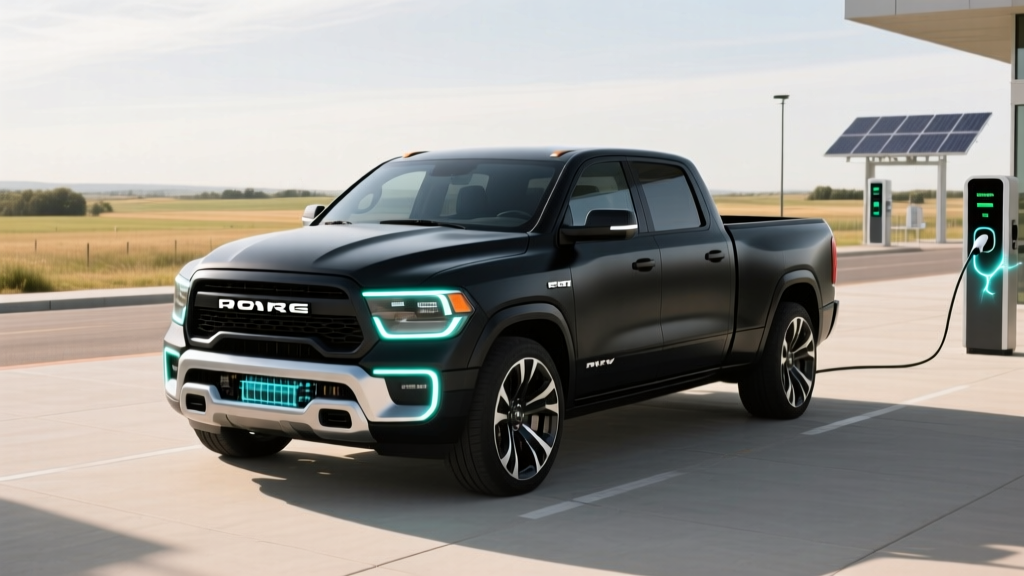
The "Dodge EV truck" most buyers are searching for is the 2026 Ram 1500 REV — the all-electric full-size pickup from Stellantis (Ram was split from Dodge in 2009 but remains part of the same family). The Ram 1500 REV starts at $58,095 MSRP (Tradesman trim) and offers up to 350 miles of EPA-estimated range with the larger 168 kWh battery pack. It produces 654 horsepower, 620 lb-ft of torque, and can DC fast-charge at up to 350 kW (10-80% in approximately 25 minutes with the large pack). As a zero-emission pickup assembled in North America, it may qualify for the $7,500 federal §30D tax credit, subject to income, MSRP, and battery-sourcing requirements that shift annually. If you need a zero-emission work truck with competitive range and towing, the Ram 1500 REV is the value leader; if you need 350+ miles or frequent cold-weather towing, consider the Chevy Silverado EV or an EREV like the Ram 1500 Ramcharger.
Ram 1500 REV Specs: Battery, Range, and Charging
The Ram 1500 REV is built on Stellantis's STLA Frame platform and comes in two battery configurations. Understanding the difference is critical — the range gap between the two is substantial, and the larger pack adds significant weight and cost.
| Specification | Standard Pack (92 kWh) | Large Pack (168 kWh) |
|---|---|---|
| Usable Battery Capacity | ~92 kWh (NMC) | ~168 kWh (NMC) |
| EPA-Estimated Range | ~230 miles | ~350 miles |
| Real-World Highway Range (est.) | ~185–200 miles | ~275–300 miles |
| Peak DC Fast-Charge Rate | 350 kW | 350 kW |
| 10–80% DC Fast Charge (est.) | ~18 minutes | ~25 minutes |
| Level 2 AC Charging (est.) | 11.5 kW | 11.5 kW |
| Horsepower | 654 HP | 654 HP |
| Torque | 620 lb-ft | 620 lb-ft |
| 0–60 mph | ~4.4 seconds | ~4.4 seconds |
| Max Towing Capacity | 14,000 lbs | 14,000 lbs |
| Max Payload | 2,700 lbs | 2,625 lbs |
| Drive | AWD (dual motor) | AWD (dual motor) |
Real-World Range vs. EPA Sticker
The EPA range figure is a laboratory composite — real-world results vary. Expect the 350-mile large-pack Ram 1500 REV to deliver approximately 275–300 miles on the highway at 70 mph, and as low as 220–250 miles when towing a 5,000-lb trailer in moderate temperatures. Cold weather (below 30°F) can reduce range an additional 15–30% due to cabin heating demands and battery chemistry limitations. The 230-mile standard pack is best suited for daily commuting and light local work — plan on roughly 185 miles highway.
The 350 kW peak charge rate is among the fastest in the truck segment, but remember: peak rate is not sustained rate. Charging curves taper significantly above 80% state of charge. A 10–80% session on a capable 350 kW charger (like newer Electrify America or Tesla Supercharger V4 stalls with CCS/NACS adapters) will average closer to 200–250 kW sustained. Also, note that the Ram 1500 REV launched with a CCS1 connector; NACS compatibility depends on Stellantis's adapter strategy and Supercharger network access announcements — always verify current connector status with your dealer before purchase.
Pricing, Trims, and Federal Tax Credit Eligibility
The Ram 1500 REV lineup spans five trims. Here's the approximate MSRP breakdown for the 2026 model year:
| Trim | Standard Pack MSRP | Large Pack MSRP |
|---|---|---|
| Tradesman | $58,095 | $63,095 |
| Big Horn / Lone Star | $65,595 | $70,595 |
| Laramie | $73,095 | $78,095 |
| Limited | — | $85,095 |
| Tungsten | — | $87,095 |
§30D Federal Tax Credit: Key Rules for 2026
- Credit amount: Up to $7,500 ($3,750 for critical minerals + $3,750 for battery components).
- MSRP cap: Pickup trucks must have an MSRP at or below $80,000 to qualify.
- Buyer income cap: AGI must not exceed $150,000 (single), $225,000 (head of household), or $300,000 (joint).
- Battery sourcing: Increasingly strict critical-mineral and battery-component sourcing requirements phase in annually. Verify current-year compliance on IRS.gov §30D page.
- Point-of-sale transfer: You can transfer the credit to the dealer at purchase to reduce your out-of-pocket cost — no need to wait until tax filing.
- Assembly: Vehicle must undergo final assembly in North America (Ram 1500 REV qualifies — built in Sterling Heights, MI).
The Limited and Tungsten trims with the large pack exceed the $80,000 MSRP cap and will not qualify for the federal credit. Consult a tax professional for your specific eligibility.
Cost of Ownership: EV Truck vs. Gas Truck
The purchase price is only part of the equation. Here's a five-year cost comparison between the Ram 1500 REV (Tradesman, large pack, after $7,500 credit) and a comparable gas-powered Ram 1500 Big Horn 4x4 (5.7L HEMI V8).
| Cost Category (5 Years) | Ram 1500 REV (EV) | Ram 1500 Gas (V8 4x4) |
|---|---|---|
| Purchase Price (after credit) | ~$55,595 | ~$52,000 |
| Fuel / Energy (15,000 mi/yr) | ~$4,200 | ~$13,500 |
| Maintenance | ~$1,800 | ~$4,500 |
| Insurance (est. avg.) | ~$10,500 | ~$8,500 |
| Estimated Depreciation | ~$22,000 | ~$18,000 |
| 5-Year Total | ~$94,095 | ~$96,500 |
Key takeaways: The EV truck saves substantially on fuel and maintenance — no oil changes, no transmission fluid, and regenerative braking extends brake pad life significantly. However, EV insurance premiums run 15–25% higher on average due to repair costs and battery replacement exposure. Depreciation remains uncertain for newer EV trucks; early data from the F-150 Lightning and Rivian R1T suggests steeper depreciation than established gas trucks, though this may stabilize as the market matures.
Home charging is where the math works best. At a national average of $0.16/kWh, fully charging the 168 kWh pack costs roughly $27 for 350 miles — equivalent to $0.077/mile. A gas Ram at 19 MPG combined and $3.50/gallon runs $0.184/mile. That's a $0.107/mile savings, or roughly $1,605/year at 15,000 miles.
Home Charging Setup: What First-Time EV Truck Buyers Need
Charging a truck-sized battery at home requires planning. The Ram 1500 REV's 168 kWh pack is massive — Level 1 (120V) charging is impractical as a primary strategy (it would take over 6 days from empty). A Level 2 home charger is effectively mandatory.
| Charging Level | Power | Miles Added/Hour (est.) | Full Charge Time (168 kWh) |
|---|---|---|---|
| Level 1 (120V outlet) | ~1.4 kW | ~3–4 mi/hr | ~120+ hours |
| Level 2 (240V, 48A) | ~11.5 kW | ~28–32 mi/hr | ~15 hours |
| DC Fast Charge (public) | Up to 350 kW | ~700+ mi/hr (peak) | 10–80% in ~25 min |
| Home Install Component | Cost Range |
|---|---|
| Level 2 Charger (hardwired, 48A) | $500–$800 |
| Electrician labor (240V/60A circuit run) | $800–$2,500 |
| Permit & inspection | $100–$400 |
| Electrical panel upgrade (if needed, 200A) | $1,500–$4,000 |
| Total (typical, no panel upgrade) | $1,400–$3,700 |
| Total (with panel upgrade) | $2,900–$7,700 |
Before purchasing, have a licensed electrician assess your panel capacity. A 168 kWh battery charging at 11.5 kW for 15 hours draws significant sustained load — older homes with 100A panels will almost certainly need an upgrade. Many utilities offer rebates for Level 2 installations and smart-charger setups that schedule charging during off-peak hours, further reducing per-mile costs.
Dodge EV Truck vs. Rivals: Silverado EV, F-150 Lightning, and the Ramcharger EREV
The Ram 1500 REV doesn't exist in a vacuum. Here's how it stacks up against key competitors in the electric and extended-range truck space:
| Spec | Ram 1500 REV (168 kWh) | Chevy Silverado EV 4WT (200 kWh) | Ford F-150 Lightning (Ext. Range) | Ram 1500 Ramcharger (EREV) |
|---|---|---|---|---|
| EPA Range | ~350 mi | ~440 mi | ~320 mi | ~145 mi electric + gas range |
| Battery (usable) | 168 kWh NMC | 200 kWh NMC | 131 kWh NMC | 92 kWh NMC + 3.6L V6 gen. |
| Peak DC Charge | 350 kW | 350 kW | 150 kW | ~150 kW |
| Horsepower | 654 HP | 664 HP | 580 HP | 666 HP |
| Max Towing | 14,000 lbs | 12,500 lbs | 10,000 lbs | 14,000 lbs |
| Starting MSRP | $58,095 | $78,800 | $76,995 | ~$62,000 (est.) |
| Federal Tax Credit | Up to $7,500* | Up to $7,500* | Up to $7,500* | Up to $7,500* |
*Tax credit eligibility subject to IRS §30D rules — verify at purchase.
The Ram 1500 REV's strongest positioning is price-to-range value: 350 miles for under $60K (before credit) undercuts the Silverado EV and F-150 Lightning Extended Range by $15,000–$20,000. The F-150 Lightning charges slower (150 kW peak) but benefits from Ford's more mature dealer and service network. The Silverado EV 4WT offers the longest range but at a premium price point. The Ramcharger — a series-hybrid EREV with an onboard gas generator — eliminates range anxiety entirely for heavy towing and remote work, making it the pragmatic choice for buyers who can't reliably charge on the road.
Common Misconceptions About the Ram 1500 REV
| Myth | Fact |
|---|---|
| "It's a Dodge truck." | Ram has been a separate brand from Dodge since 2009. The Ram 1500 REV is a Ram product, sold at Ram dealerships — though many buyers still search "Dodge EV truck." |
| "EV trucks can't tow." | The Ram 1500 REV is rated for 14,000 lbs — matching or exceeding most gas half-ton trucks. However, towing cuts range by 30–50%, so plan charging stops accordingly. |
| "I'll save $7,500 no matter what." | The §30D credit has income caps, MSRP caps ($80K for trucks), and battery-sourcing requirements. High-income buyers, top-trim buyers, and those whose credit exceeds tax liability may not receive the full amount. |
| "350 miles means 350 miles always." | EPA range is a lab composite. Highway driving, cold weather, towing, and terrain can reduce real-world range by 20–50%. Plan for 275–300 highway miles, less when towing. |
| "I can charge on any Level 1 outlet." | Level 1 (120V) adds ~3 miles per hour. A 168 kWh pack would take over 5 days from empty. Level 2 (240V) home charging is essential for daily truck use. |
| "EV trucks don't need maintenance." | They need less maintenance (no oil, spark plugs, or transmission fluid), but still require tire rotations, cabin air filters, brake fluid checks, coolant top-offs, and wiper service. |
Battery Longevity, Warranty, and Degradation
Stellantis provides a battery and powertrain warranty of 8 years / 100,000 miles (whichever comes first) for the Ram 1500 REV, with a capacity-retention threshold typically set at 70% of original capacity. This is industry-standard and aligns with Ford, GM, and Rivian offerings.
NMC (nickel manganese cobalt) chemistry, used in the Ram 1500 REV, offers high energy density — necessary to achieve 350 miles in a truck — but degrades slightly faster than LFP (lithium iron phosphate) over thousands of charge cycles. Real-world data from other NMC EVs suggests 8–12% degradation over 100,000 miles under normal use. Best practices include:
- Avoid routinely charging to 100% — set daily limit to 80–90%.
- Minimize DC fast-charging to only when needed (road trips); rely on Level 2 for daily charging.
- Precondition the battery before fast-charging in cold weather — the Ram 1500 REV's thermal management system is designed to optimize charge speed when the pack is at ideal temperature.
- Avoid leaving the truck at 0% or 100% SoC for extended periods in extreme heat.
A full battery replacement, should it be needed out of warranty, is estimated at $18,000–$28,000 for a pack this size, based on current NMC cell pricing and labor. This is a real long-term cost risk that gas truck buyers don't face — factor it into 10+ year ownership plans.
Decision Framework: Should You Buy the Ram 1500 REV?
Choose the Ram 1500 REV If:
- You have home Level 2 charging (or can install it) and drive under 300 miles round-trip most days.
- You want the best price-to-range ratio in a full-size electric pickup.
- You qualify for the $7,500 federal tax credit (income under cap, buying a sub-$80K trim).
- You value instant torque for towing and a quiet, vibration-free daily commute.
- You want V2L (vehicle-to-load) capability to power tools or a tailgate from the truck's battery.
Choose the Ramcharger EREV Instead If:
- You regularly tow heavy loads over 200 miles and can't rely on DC fast-charging infrastructure along your route.
- You live in a charging desert (rural areas with sparse public chargers).
- You want electric daily driving but gas backup for long hauls.
Choose the Silverado EV or F-150 Lightning Instead If:
- You need 440+ miles range (Silverado EV 4WT) and budget is less of a concern.
- You prioritize a mature dealer service network (Ford) for peace of mind in remote areas.
- You prefer NACS native charging and direct Tesla Supercharger access (check current network compatibility per manufacturer).
Wait or Reconsider If:
- You cannot install home charging and lack reliable workplace or public Level 2 access — an EV truck will be frustrating and expensive on DC fast-charging alone.
- You live in an extreme cold climate and need consistent 300+ mile range year-round — the 350-mile rating will drop to 245–275 miles in deep winter.
- Your budget is under $50K — consider a used EV truck or wait for incentives and price reductions.
Frequently Asked Questions
Is there actually a "Dodge" EV truck?
Not under the Dodge badge. Dodge and Ram separated in 2009. The electric truck you're looking for is the Ram 1500 REV, sold through Ram dealerships. Dodge's current electrification roadmap focuses on muscle cars (the Charger Daytona EV), not trucks.
Can the Ram 1500 REV really tow 14,000 pounds?
Yes — that's the official max towing rating. However, towing at or near max capacity will reduce range by 30–50%. A 350-mile truck towing a 10,000-lb trailer may deliver only 175–220 miles between charges. Plan your routes around DC fast-charging stations if towing long distances.
How much does it cost to charge the Ram 1500 REV at home?
At the US average of $0.16/kWh, a full 168 kWh charge costs about $26.88. Most owners won't charge from empty — a typical 50% top-up costs ~$13.44. This is dramatically cheaper than fueling a gas Ram 1500 V8, which costs roughly $70–$90 to fill a 26-gallon tank at $3.50/gallon.
Will the Ram 1500 REV work in cold climates?
It will, but expect 15–30% range loss in sustained sub-freezing temperatures. The truck's thermal management system includes battery preconditioning and a heat pump for cabin heating, which helps mitigate losses. Garage parking and preconditioning while plugged in are strongly recommended in cold regions.
What charger connector does the Ram 1500 REV use?
The Ram 1500 REV launched with a CCS1 (Combined Charging System) connector. Stellantis has announced plans to adopt NACS (Tesla-style) on future models, but verify current connector and Supercharger adapter availability with your dealer before purchasing. CCS1 works natively at Electrify America, EVgo, and most non-Tesla DC networks.
How does the Ram 1500 REV compare to a gas Ram 1500 on total cost?
Over five years and 75,000 miles, the Ram 1500 REV (Tradesman, after tax credit) costs roughly $94,000 total vs. $96,500 for a comparably equipped gas Ram 1500 — a modest savings that grows if gas prices rise or if you drive more than 15,000 miles annually. The EV also delivers a dramatically smoother, quieter, and more responsive driving experience.
Is the Ram 1500 REV available to order now?
The Ram 1500 REV began production in late 2024/early 2025 for the 2025–2026 model years. Availability varies by dealer and region. Check RamTrucks.com for current build-to-order options and local inventory.
Sources: EPA Fuel Economy for range and efficiency data; IRS §30D Clean Vehicle Credit rules; Ram Trucks official specifications. All pricing and specs reflect 2025–2026 model year data and are subject to change. Verify eligibility and pricing with your dealer and tax professional.