The Quick Answer on Dodge EV Cars in 2026
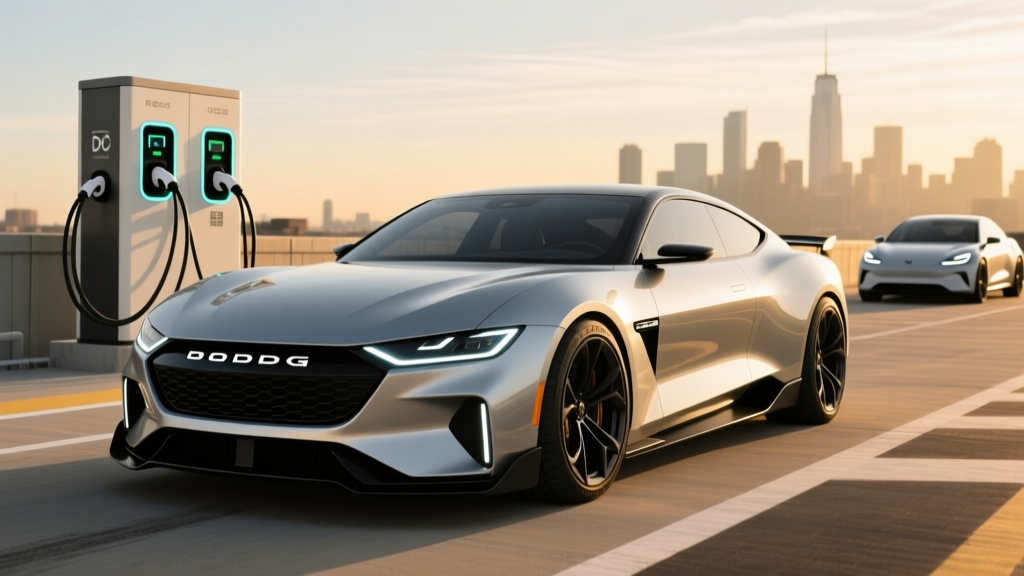
As of the 2026 model year, Dodge sells one battery-electric vehicle: the Charger Daytona, offered as the R/T ($51,990) and the Scat Pack ($59,990), plus the four-door Charger Daytona sedan variant starting around $53,990. Both ride on Stellantis' STLA Large platform with a 100.5 kWh (gross) NMC battery pack. EPA range is 317 miles for the R/T and 260 miles for the Scat Pack. DC fast charging peaks at roughly 175 kW, with a 10–80% session taking about 27 minutes. The Charger Daytona qualifies for a reduced $3,750 federal tax credit under current §30D rules because it meets only the critical-minerals requirement, not the battery-component requirement — and only if you fall under the IRS income caps and the vehicle's MSRP stays under the $55,000 sedan cap.
If you've been searching "dodge ev cars" expecting a full lineup of electric Challengers, Durangos, and Hornets, here's the reality: the Charger Daytona is the only production Dodge BEV on sale today. The Hornet is a plug-in hybrid (PHEV), not a BEV, and the Durango remains gas-only. This guide breaks down what buying and owning the Charger Daytona actually costs, how it compares to the gas V8 Chargers it replaces, and who should — and shouldn't — make the switch.
Charger Daytona Specs: R/T vs Scat Pack at a Glance
| Spec | 2026 Charger Daytona R/T | 2026 Charger Daytona Scat Pack |
|---|---|---|
| Base MSRP | $51,990 | $59,990 |
| Drivetrain | Dual-motor AWD | Dual-motor AWD |
| Horsepower | 496 hp (with Direct Connection Stage 1) | 670 hp (with Direct Connection Stage 2) |
| 0–60 mph | 4.7 sec | 3.3 sec |
| Battery (gross / usable) | 100.5 kWh / ~92 kWh (NMC) | 100.5 kWh / ~92 kWh (NMC) |
| EPA Range | 317 mi | 260 mi |
| Real-World Highway Range* | ~255–275 mi | ~210–230 mi |
| Efficiency (combined) | ~2.9 kWh/mi (115 MPGe) | ~3.5 kWh/mi (96 MPGe) |
| Peak DC Fast Charge | ~175 kW | ~175 kW |
| 10–80% DCFC Time | ~27 min | ~27 min |
| Level 2 Charge Rate | 11 kW onboard | 11 kW onboard |
| Level 2 0–100% Time | ~9 hours | ~9 hours |
| Connector | CCS1 (NACS adapter available) | CCS1 (NACS adapter available) |
| Battery Warranty | 8 yr / 100,000 mi | 8 yr / 100,000 mi |
| Federal Tax Credit (§30D) | $3,750 (income + MSRP dependent) | Not eligible (MSRP exceeds $55K sedan cap) |
*Real-world highway range assumes 70–75 mph sustained driving in moderate temperatures. Cold weather (below 32°F) can reduce range by an additional 15–25% due to cabin heating and battery resistance. Data synthesized from EPA figures at fueleconomy.gov and third-party EV testing.
Dodge EV Cars vs Gas Chargers: Cost and Performance Compared
The Charger Daytona replaces the Hemi V8 Charger lineup discontinued after 2023. Here's how the EV stacks up against the gas cars buyers are cross-shopping it against — and against competing electric muscle.
| Metric | Charger Daytona R/T (EV) | 2023 Charger R/T (5.7L Hemi V8) | 2023 Charger Scat Pack (6.4L Hemi) |
|---|---|---|---|
| MSRP (base) | $51,990 | ~$44,500 (final MSRP) | ~$50,000 (final MSRP) |
| 0–60 mph | 4.7 sec | 5.2 sec | 4.3 sec |
| Horsepower | 496 hp | 370 hp | 485 hp |
| Fuel/Energy Cost per Mile | ~$0.045 (home) / $0.14 (DCFC) | ~$0.16 (20 MPG, $3.20/gal) | ~$0.18 (18 MPG, $3.20/gal) |
| Annual Fuel/Energy (12K mi) | $540 (home) / $1,680 (DCFC) | $1,920 | $2,160 |
| EPA Range / Tank Range | 317 mi | ~370 mi (18.5 gal) | ~340 mi (18.5 gal) |
| "Refuel" Time | ~27 min (10–80% DCFC) | ~5 min | ~5 min |
| Federal Tax Credit | Up to $3,750 | $0 | $0 |
The EV Charger R/T is quicker to 60 than the old Hemi R/T and delivers 126 more horsepower. The Scat Pack EV is faster than the old 6.4L Scat Pack in a straight line (3.3 vs 4.3 seconds) but trades 57 miles of range for it. The critical tradeoff is refueling convenience: a gas fill-up takes 5 minutes, while a DC fast charge to 80% takes roughly 27 minutes — and that's at a functioning 150+ kW station, which public reliability surveys still show is not guaranteed on every network.
Real Ownership Costs: 5-Year Breakdown
Sticker price is only the starting point. Here's a five-year total cost of ownership (TCO) estimate for the Charger Daytona R/T, assuming 12,000 miles per year, 80% home charging at $0.14/kWh national average, and 20% DC fast charging at $0.40/kWh.
| Cost Category (5 Years) | Charger Daytona R/T | Comparable Gas Muscle Sedan |
|---|---|---|
| Purchase Price (after credit) | $48,240 ($51,990 − $3,750) | $45,000 (est. used/new equivalent) |
| Fuel / Electricity | $4,680 | $10,200 |
| Maintenance (oil, brakes, fluids) | $1,200 | $3,800 |
| Insurance (avg. annual premium) | $12,500 ($2,500/yr est.) | $9,500 ($1,900/yr est.) |
| Depreciation (est. 5-yr) | $22,000 | $16,000 |
| Home Charger Install (one-time) | $1,200–$2,000 | $0 |
| 5-Year Total | ~$89,820–$90,620 | ~$84,500 |
The EV saves roughly $5,500 in fuel and $2,600 in maintenance over five years — regenerative braking dramatically reduces brake pad wear, and there are no oil changes, spark plugs, or transmission fluid services. However, higher insurance premiums (typically 20–35% more for EVs due to repair costs and battery replacement risk) and steeper depreciation (EVs have depreciated faster than gas equivalents in recent years) eat most of those savings. The five-year TCO is roughly comparable, with the EV pulling slightly ahead if you can charge primarily at home on cheap electricity.
Key variable: your electricity rate. At $0.10/kWh (cheap utility or solar), your 5-year energy cost drops to ~$3,350. At $0.22/kWh (expensive coastal utility), it climbs to ~$7,400. If you rely entirely on DC fast charging at $0.40–$0.50/kWh, your 5-year energy cost can exceed $10,000 — more than the gas car. Home charging access is the single biggest financial variable in EV ownership.
Federal Tax Credit: What You Actually Qualify For
The §30D federal tax credit for new EVs is not a flat $7,500 for everyone. Current IRS rules split the credit into two $3,750 halves based on battery-component sourcing and critical-mineral sourcing. The Charger Daytona currently qualifies for only the critical-minerals half ($3,750) because its battery components do not yet meet the North American manufacturing threshold.
- MSRP cap: Sedans must be under $55,000. The R/T at $51,990 qualifies. The Scat Pack at $59,990 does NOT qualify.
- Buyer income cap: AGI must not exceed $150,000 (single), $225,000 (head of household), or $300,000 (joint).
- Point-of-sale transfer: You can apply the credit as a down-payment reduction at the dealer instead of waiting for a tax refund.
- Final assembly: Must occur in North America — the Charger Daytona is assembled in Brampton, Ontario, which qualifies.
- Sourcing requirements: Battery components and critical minerals must meet escalating annual thresholds. Verify current-year compliance on the IRS qualified-vehicles list before purchasing.
Warning: These rules change annually as sourcing thresholds tighten. A model that qualifies in early 2026 may lose eligibility mid-year. Always confirm on the official fueleconomy.gov tax credit page before signing a purchase agreement.
Charging at Home and on the Road: What to Expect
The Charger Daytona uses a CCS1 connector natively, with a NACS adapter available for Tesla Supercharger access. Here's what charging looks like across all three levels:
| Level | Power (kW) | Miles Added per Hour | Typical Use Case |
|---|---|---|---|
| Level 1 (120V household) | ~1.4 kW | ~4 mi/hr | Emergency / overnight trickle |
| Level 2 (240V home) | 11 kW | ~32 mi/hr | Daily home charging — full charge in ~9 hrs |
| DC Fast Charge | Up to 175 kW (peak) | ~180 mi/hr (at peak) | Road trips — 10–80% in ~27 min |
The charging curve matters. The 175 kW peak rate holds only between roughly 10–35% state of charge. From 35–60%, expect ~130 kW. From 60–80%, it tapers to ~80–90 kW. Above 80%, charging slows dramatically to protect the NMC cells — expect 20+ additional minutes to go from 80–100%. This is standard behavior for NMC chemistry and why road-trip strategy centers on 10–80% sessions.
Home charging installation: A Level 2 home charger requires a 240V circuit (typically 48A for a 60A breaker). Installation costs range from $800–$1,500 if your electrical panel has capacity, to $2,500–$4,500 if you need a panel upgrade from 100A to 200A service. Always get a quote from a licensed electrician before purchasing the car — panel upgrades are the most common surprise cost for first-time EV buyers.
Common Misconceptions About Dodge EV Cars
| Myth | Fact |
|---|---|
| "Dodge has a full EV lineup now" | The Charger Daytona is the only Dodge BEV. The Hornet is a PHEV, not a BEV. The Durango has no electrified variant. |
| "The Scat Pack gets the $7,500 tax credit" | It qualifies for $0. Its $59,990 MSRP exceeds the $55,000 sedan cap under §30D. |
| "317 miles means I can drive 317 miles before charging" | EPA range assumes mixed driving. Sustained highway speeds at 75 mph yield ~255–275 miles. In freezing weather, expect ~220–240 miles. |
| "It charges as fast as a Tesla" | At 175 kW peak, the Charger Daytona is slower than a Tesla Model S (250 kW) or Hyundai Ioniq 5 (240 kW). The 10–80% time of ~27 min is adequate but not class-leading. |
| "The Fratzonic exhaust sound is real" | It's a synthesized sound played through external and cabin speakers. You can turn it off, but it's not a physical exhaust system. |
| "EVs need no maintenance at all" | Tires wear 20–30% faster on heavy EVs. Cabin air filters, brake fluid, coolant, and windshield washer fluid still require service. Budget ~$200–$300/year. |
Decision Framework: Should You Buy the Charger Daytona?
Buy the Charger Daytona R/T if:
- You have Level 2 home charging (or can install it)
- Your daily driving is under 120 miles round-trip
- You want muscle-car performance with lower running costs
- You qualify for the $3,750 credit (income under $150K single / $300K joint, sedan MSRP under $55K)
- You're okay with CCS1 and an adapter for Supercharger access
Buy the Charger Daytona Scat Pack if:
- You prioritize 3.3-second 0–60 performance over range and tax credits
- You understand the $59,990 price makes it ineligible for §30D
- You accept 210–230 real-world highway miles between charges
Look elsewhere if:
- You live in an apartment without charging access and your area has sparse DCFC infrastructure
- You regularly drive 300+ miles in winter conditions (consider a PHEV or a longer-range EV like the Lucid Air or Tesla Model S)
- You need a family SUV — Dodge has no electric SUV; look at the Hyundai Ioniq 5, Kia EV6, or Tesla Model Y
- Budget is tight and you need the full $7,500 credit — competitors like the Chevy Equinox EV and Hyundai Ioniq 5 may qualify for more
Frequently Asked Questions
Is there a Dodge electric SUV or truck?
Not yet. As of 2026, Dodge sells only the Charger Daytona as a BEV. Stellantis has announced plans for broader electrification across its brands, but no Dodge electric SUV or truck has a confirmed on-sale date. The Ram 1500 REV (electric truck) is under the Ram brand, not Dodge.
Is the Dodge Hornet an electric car?
No. The Dodge Hornet R/T is a plug-in hybrid (PHEV) with roughly 30 miles of electric-only range and a combined EPA rating of 29 mpg in hybrid mode. It has a 15.5 kWh battery and a 1.3L turbocharged three-cylinder engine. It's a good bridge option if you want some electric driving without full BEV commitment.
How long will the Charger Daytona battery last?
Stellantis warranties the battery for 8 years / 100,000 miles against defects and capacity loss below 70% of original capacity. NMC batteries in similar EVs have shown degradation of roughly 10–15% over 100,000 miles in fleet data. A full battery replacement outside of warranty would likely cost $12,000–$18,000 based on current NMC pack pricing — though this is expected to decline as battery costs fall.
Can I use Tesla Superchargers with the Charger Daytona?
Yes, with a NACS adapter. Dodge offers an official adapter that allows CCS1-equipped Charger Daytonas to access Tesla's Supercharger network (V3 and V4 stalls). This significantly expands your road-trip charging options, though you'll be limited to the Supercharger's CCS-compatible stalls — not all older V2 stalls support non-Tesla vehicles.
What does the Charger Daytona cost to insure?
Insurance premiums for the Charger Daytona run 20–35% higher than equivalent gas muscle cars, based on early market data. Expect annual premiums of $2,200–$2,800 for the R/T and $2,600–$3,200 for the Scat Pack, depending on your age, location, driving record, and coverage level. Get quotes from at least three insurers before purchasing — EV insurance varies widely by carrier.
Is the Charger Daytona actually a good daily driver?
For most daily-driver use cases — commuting, errands, weekend drives — yes, provided you can charge at home. The 317-mile R/T range covers a week of typical commuting without a mid-week charge. The ride quality is firm but compliant, cabin noise is low (the synthetic exhaust sound is optional), and the 11 kW Level 2 charger replenishes the pack fully overnight. The main compromises are rear-seat space (it's a coupe), visibility, and the fact that public DCFC reliability still lags behind the gas-station experience on long road trips.