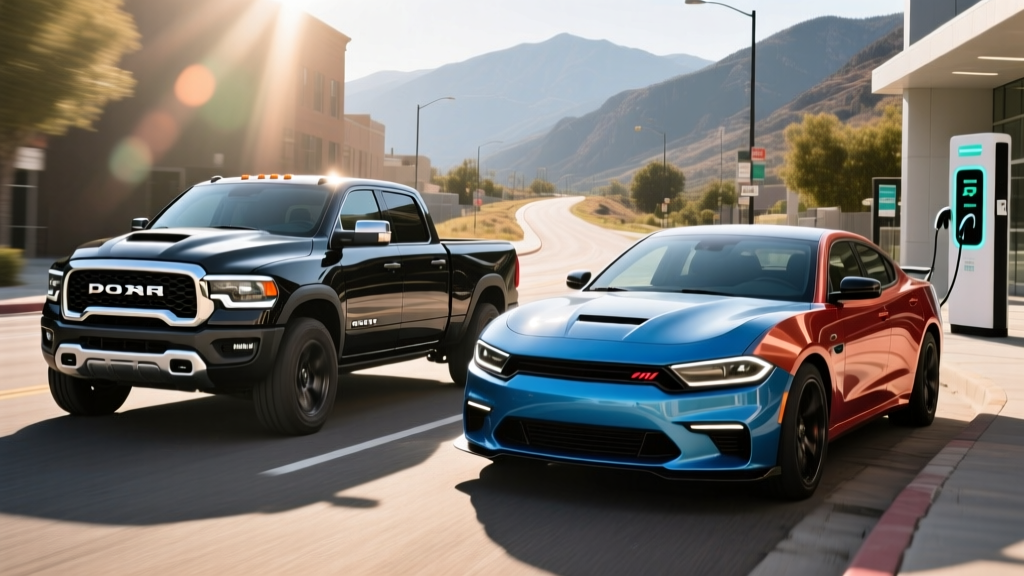
If you're searching for Dodge electric trucks, here's the direct answer: Stellantis (Dodge's parent company) does not currently sell a battery-electric truck under the Dodge badge. What it does offer is the 2026 Ram 1500 REV, a full-size battery-electric pickup under the Ram brand, plus the upcoming Ram 1500 Ramcharger, an extended-range electric vehicle (EREV) with a gas generator. The Dodge Charger Daytona is the brand's electric offering — but it's a muscle car, not a truck. If you want an electrified truck from the Stellantis family, Ram is where you'll find it.
Quick Answer: Dodge Electric Trucks in 2026
Available now: 2026 Ram 1500 REV (BEV) — up to 350 miles EPA range, starting ~$58,095
Coming soon: Ram 1500 Ramcharger (EREV) — 145 miles electric + gas generator, expected late 2026
Not a truck: Dodge Charger Daytona EV — electric muscle car, not a pickup
Federal tax credit: Up to $7,500 under IRS §30D, subject to income caps, MSRP limits, and battery-sourcing rules
The Ram 1500 REV: Stellantis's Answer to Electric Truck Buyers
The 2026 Ram 1500 REV is the closest thing to a "Dodge electric truck" that exists. Built on the new STLA Frame platform, it competes directly with the Ford F-150 Lightning, Chevrolet Silverado EV, and Rivian R1T. Ram took a different approach than Ford — instead of adapting an existing truck, they built the REV from the ground up as an EV, which allowed for a flat floor, front trunk (frunk), and a larger battery option.
| Spec | Standard Range (165 kWh) | Max Range (229 kWh) |
|---|---|---|
| EPA Range | ~270 miles | ~350 miles |
| Battery Capacity | 165 kWh usable (NMC) | 229 kWh usable (NMC) |
| Peak DC Fast Charge | Up to 350 kW (800V) | Up to 350 kW (800V) |
| 10–80% Charge Time | ~22 minutes (at 350 kW charger) | ~30 minutes (at 350 kW charger) |
| Horsepower | 654 hp (dual motor AWD) | 654 hp (dual motor AWD) |
| 0–60 mph | ~4.4 seconds | ~4.4 seconds |
| Max Towing | Up to 14,000 lbs | Up to 14,000 lbs |
| Max Payload | ~2,700 lbs | ~2,600 lbs |
| Starting MSRP | ~$58,095 (Tradesman) | ~$73,095 (Laramie w/ Max Range) |
| Battery Warranty | 8 years / 100,000 miles | 8 years / 100,000 miles |
Real-World Range vs. EPA Sticker
The 350-mile EPA figure for the Max Range model is impressive on paper, but real-world conditions change the math. Expect:
- Highway driving (75 mph): ~280–300 miles — aerodynamic drag hits full-size trucks hard at speed
- Cold weather (below 30°F): ~230–270 miles — NMC chemistry loses 15–25% range in freezing temps without preconditioning
- Towing (5,000+ lb trailer): ~150–180 miles — towing can cut range by 40–50%, and DC fast charging with a trailer attached is still awkward at most stations
- City/mixed driving (mild weather): 320–350 miles — regenerative braking recovers energy in stop-and-go traffic
The Ram 1500 REV's 800-volt architecture means it can accept peak charging rates up to 350 kW, but sustained rates taper above 80% State of Charge. At a 350 kW Electrify America or Tesla Supercharger (with NACS adapter), the 165 kWh pack adds roughly 100 miles in 10 minutes under ideal conditions. The 229 kWh pack charges more slowly in absolute time because there's simply more energy to fill.
Ramcharger EREV: The Bridge for Truck Buyers Not Ready for Full EV
The Ram 1500 Ramcharger is a fundamentally different vehicle. It's an extended-range electric vehicle (EREV): the wheels are always driven by electric motors, but a 3.6-liter V6 engine acts solely as a generator to recharge the battery on the go. Think of it as a series hybrid — the gas engine never touches the wheels.
This matters for truck buyers who need long range for towing or rural driving but still want electric torque and the ability to drive on electricity alone for daily commuting. The Ramcharger targets 145 miles of electric-only range from its ~92 kWh battery pack, with the generator extending total range to approximately 690 miles.
Who the Ramcharger is for: Truck owners in areas with sparse DC fast-charging infrastructure, those who regularly tow long distances, or anyone who can't risk being stranded with a depleted battery on a job site. The trade-off is complexity — you're maintaining both an electric powertrain and an internal combustion engine, which means oil changes and spark plugs return to your maintenance schedule.
Cost Breakdown: Ram 1500 REV vs. Gas Ram 1500
Upfront price is the biggest hurdle for electric trucks. But total cost of ownership tells a different story over five years, especially if you can charge at home.
| Cost Category | 2026 Ram 1500 REV (Laramie, $68,095) | 2026 Ram 1500 Gas (Laramie 4x4, $57,095) |
|---|---|---|
| Purchase Price (MSRP) | $68,095 | $57,095 |
| Federal Tax Credit (§30D) | Up to –$7,500* | $0 |
| Effective Purchase Price | ~$60,595 | $57,095 |
| Fuel/Energy (5 yrs, 60k mi) | ~$5,400 (home L2, $0.15/kWh) | ~$10,800 ($3.60/gal, 20 MPG) |
| Maintenance (5 yrs) | ~$1,800 | ~$4,200 |
| Insurance (5 yrs, avg.) | ~$12,000 | ~$9,600 |
| 5-Year Total (excl. depreciation) | ~$80,795 | ~$81,695 |
*§30D credit eligibility requires buyer income ≤$150K single / $300K joint, vehicle MSRP ≤$80K for trucks, and compliance with battery-sourcing and critical-mineral rules. Credit can be transferred to the dealer at point of sale for an instant discount. Verify current rules at IRS.gov. Tax advice: consult a qualified professional.
The numbers show near-parity over five years when the tax credit applies, with the REV pulling further ahead as fuel prices rise. However, insurance costs are 15–25% higher for the electric Ram, and depreciation remains uncertain for full-size electric trucks as a category. If you rely exclusively on public DC fast charging at $0.40–$0.60/kWh, the energy cost advantage narrows significantly.
Home Charging: The Make-or-Break Factor for Electric Truck Owners
Owning a Ram 1500 REV without home charging is possible but impractical. A full-size truck with a 165–229 kWh battery is expensive to fill at public DC fast chargers, and relying on them daily erodes both your wallet and your time. Here's what home charging actually requires:
| Item | Cost Range | Notes |
|---|---|---|
| Level 2 Charger (48A, hardwired) | $400–$750 | ChargePoint Home Flex, Wallbox Pulsar Plus, Emporia Level 2 |
| 240V / 60A Circuit (electrician) | $800–$2,500 | Depends on panel proximity, conduit run length |
| Electrical Panel Upgrade (if needed) | $1,500–$4,000 | Required if existing panel is 100A or near capacity |
| Permit & Inspection | $50–$300 | Varies by municipality |
| Total (no panel upgrade) | $1,250–$3,550 | Most homes with 200A panels |
| Total (with panel upgrade) | $2,750–$7,550 | Older homes, 100A service |
At 48 amps / 11.5 kW, a Level 2 charger adds roughly 25–30 miles of range per hour to the Ram 1500 REV. Fully replenishing the 165 kWh pack from 10% takes about 14–15 hours — fine for overnight charging if your daily driving is under 100 miles. The 229 kWh Max Range pack needs closer to 20 hours for a full charge at this rate, which means you'll rarely charge from empty to full at home; instead, you'll top up nightly.
Condo/apartment dwellers: If you lack dedicated parking with electrical access, the Ramcharger EREV becomes significantly more practical. You can drive on electric for your commute and rely on the gas generator for longer trips, without depending on any charging infrastructure at all.
Common Misconceptions About Dodge/Ram Electric Trucks
| Myth | Fact |
|---|---|
| "Dodge makes an electric truck" | The electric truck is branded Ram, not Dodge. Dodge's EV is the Charger Daytona muscle car. |
| "Electric trucks can't tow" | The Ram 1500 REV tows up to 14,000 lbs — competitive with gas half-tons. The issue isn't capability, it's range: towing cuts effective range by 40–50%. |
| "The battery will need replacing in 5 years" | Ram warranties the battery for 8 years/100,000 miles against degradation below 70% capacity. Real-world NMC data from other manufacturers shows 10–15% degradation over 150,000+ miles. |
| "Everyone gets the $7,500 tax credit" | The §30D credit has income caps ($150K single / $300K joint), MSRP caps ($80K for trucks/pickups), and battery-sourcing requirements that change annually. Not every buyer or trim qualifies. |
| "Charging takes too long for a truck battery" | At a 350 kW charger, the 165 kWh pack goes 10–80% in ~22 minutes. But 350 kW chargers are still uncommon, and the charge curve tapers sharply above 80%. Plan for 30–40 minute stops on road trips. |
| "EREVs are just complicated hybrids" | The Ramcharger's engine never drives the wheels — it's a generator only. This means you get full electric torque and one-pedal driving, with the gas engine as a range-extending backup. It's fundamentally different from a parallel hybrid like the F-150 PowerBoost. |
Decision Framework: Should You Buy the REV, Wait for the Ramcharger, or Stick with Gas?
Choose the Ram 1500 REV (BEV) if:
- You have reliable Level 2 home charging (garage, driveway with 240V access)
- Your daily driving is under 150 miles round-trip
- You want maximum performance (654 hp, 4.4s 0–60) and lowest running costs
- You qualify for the §30D federal tax credit (check income and sourcing rules)
- You rarely tow long distances away from charging corridors
Choose the Ram 1500 Ramcharger (EREV) if:
- You lack reliable home or workplace charging
- You regularly tow trailers 200+ miles from home
- You live in a region with extreme cold or sparse charging infrastructure
- You want electric daily driving but refuse to plan trips around chargers
- You're willing to accept higher maintenance (gas engine + electric powertrain)
Stick with a gas Ram 1500 if:
- Your budget is under $50,000 and you need a crew cab 4x4 now
- You drive in remote areas with zero charging access and no timeline for improvement
- You tow heavy loads daily for work and can't afford range/route planning
- You plan to keep the truck 10+ years and want proven long-term reliability data
What First-Time EV Truck Buyers Need to Know
Buying your first electric truck involves adjustments that go beyond the dealership:
1. Preconditioning matters for fast charging. The Ram 1500 REV can precondition its battery when you navigate to a DC fast charger, warming the cells to optimal temperature for maximum charge acceptance. Skip this step in cold weather and your peak charge rate could drop from 350 kW to under 100 kW, doubling your wait time.
2. The charge curve is not linear. A "350 kW peak" rate only applies at low State of Charge (typically 10–40%). Above 80%, charging slows dramatically to protect the battery. Plan road-trip stops to charge from 10–80%, then drive on — don't sit at a charger waiting for 100%.
3. NACS vs. CCS connectors. The Ram 1500 REV ships with a CCS1 port. Tesla Superchargers use NACS. Ram has indicated NACS adapter compatibility, but confirm adapter availability and Supercharger access before relying on Tesla's network for road trips. Electrify America and EVgo use CCS natively.
4. Insurance costs more. Electric trucks carry 15–25% higher insurance premiums on average due to higher repair costs, specialized parts, and battery replacement risk. Get quotes before purchasing — the difference can be $400–$800/year depending on your state and driving record.
5. The frunk changes your workflow. The REV's front trunk (estimated ~15 cu ft) is lockable, weatherproof, and ideal for charging cables, tools, or groceries. Combined with the bed, the REV offers more secure storage than a gas truck with its engine bay.
Frequently Asked Questions
Does Dodge make an electric truck?
No. Dodge's electric vehicle is the Charger Daytona, a muscle car. Electric trucks in the Stellantis family are sold under the Ram brand — specifically the Ram 1500 REV (battery-electric) and the upcoming Ram 1500 Ramcharger (extended-range electric).
How much does the 2026 Ram 1500 REV cost after the tax credit?
The Tradesman trim starts around $58,095. If you qualify for the full $7,500 §30D federal credit (income ≤$150K single / $300K joint, truck MSRP ≤$80K, battery sourcing compliance), the effective price drops to approximately $50,595. Higher trims like the Laramie Max Range at ~$73,095 may still qualify, but the Limited and top trims could exceed the $80K MSRP cap for trucks. Always verify eligibility at IRS.gov or with a tax professional.
Can the Ram 1500 REV tow as much as a gas Ram 1500?
The REV's max towing rating of 14,000 lbs matches or exceeds many gas half-ton configurations. The limitation is range: towing a 7,000-lb trailer at highway speed can reduce range from 350 miles to roughly 150–180 miles. If you tow frequently on long routes, the Ramcharger EREV or a gas truck may be more practical until DC fast-charging infrastructure for trucks matures.
What's the difference between the REV and the Ramcharger?
The REV is a battery-electric vehicle (BEV) — it runs exclusively on electricity stored in a 165 or 229 kWh battery. The Ramcharger is an extended-range electric vehicle (EREV) — it has a smaller battery (~92 kWh, ~145 miles electric range) plus a 3.6L V6 gas engine that acts as a generator to extend total range to ~690 miles. The engine never drives the wheels directly.
Will the Ram 1500 REV battery need replacement?
Ram warranties the battery for 8 years or 100,000 miles against degradation below 70% of original capacity. Industry data from similar NMC packs shows typical degradation of 10–15% over 150,000 miles. A full battery replacement, if ever needed out of warranty, would likely cost $15,000–$25,000+ based on current NMC pricing — though costs continue to decline. Most EV batteries outlast the vehicle's useful life.
How do I charge a Ram 1500 REV at home?
You'll need a 240V Level 2 charger on a dedicated 60-amp circuit, installed by a licensed electrician. Expect to pay $1,250–$3,550 if your electrical panel has capacity, or $2,750–$7,550 if you need a panel upgrade. At 11.5 kW, the charger adds ~25–30 miles of range per hour — enough to replenish a day's driving overnight. Consult a licensed electrician for your specific home's requirements.
Sources: Ram Trucks Official – 1500 REV, EPA Fuel Economy, IRS §30D Clean Vehicle Credits. Specifications based on manufacturer-published data for the 2026 model year; verify with your dealer before purchase.