Quick Answer: Is the Dodge Daytona Electric Worth Buying?
The 2026 Dodge Charger Daytona electric muscle car delivers 496 hp (up to 670 hp in Scat Pack) with an EPA-estimated 318 miles of range from its 81.2 kWh usable battery. Pricing starts at $49,995 for the Daytona R/T and climbs to $71,995 for the Scat Pack. Real-world highway range drops to approximately 240–270 miles; cold-weather driving can cut that by another 15–25%. DC fast charging peaks at 100 kW, adding 10–80% in roughly 27 minutes. It qualifies for the $7,500 federal §30D tax credit only if battery sourcing, MSRP, and buyer income requirements are met. If you want a fast, distinctive electric coupe and can charge at home, the Daytona fills a niche no other EV occupies — but it is not a budget-friendly efficiency play.
Range, Battery, and Efficiency: Beyond the EPA Sticker
The Daytona electric runs on an 81.2 kWh usable lithium-ion NMC (nickel manganese cobalt) battery pack — part of Stellantis' STLA Large platform. The EPA rates the 2026 Charger Daytona R/T at 318 miles of combined range, with the higher-output Scat Pack rated at approximately 260 miles due to its 670 hp, all-wheel-drive, and stickier tires demanding more energy.
Real-World Range Expectations
| Scenario | R/T (EPA 318 mi) | Scat Pack (EPA 260 mi) |
|---|---|---|
| Mild weather, mixed driving | ~285–305 mi | ~235–250 mi |
| Sustained 75 mph highway | ~250–270 mi | ~200–220 mi |
| Cold weather (below 30°F) | ~220–255 mi | ~175–200 mi |
| Aggressive driving / track use | ~180–210 mi | ~140–170 mi |
These figures reflect typical EV energy consumption physics: higher speeds increase aerodynamic drag (which scales with the square of velocity), cold temperatures slow electrochemical reactions and activate battery heaters, and aggressive throttle inputs spike watt-hour consumption per mile.
Efficiency for the R/T is rated at approximately 101 MPGe combined (roughly 33 kWh/100 miles). That is competitive for a 5,000+ lb performance coupe but trails lighter EVs like the Hyundai Ioniq 6 (140 MPGe). You can verify official figures at fueleconomy.gov.
Charging Speed: 100 kW Peak, Not Class-Leading
The Daytona's 800-volt architecture was expected to deliver blazing charge speeds, but the production setup peaks at 100 kW on DC fast chargers — noticeably slower than rivals like the Hyundai Ioniq 5 (240 kW peak) or Porsche Taycan (270 kW peak). Here is what charging actually looks like:
| Charging Level | Power | Speed | Notes |
|---|---|---|---|
| Level 1 (120V outlet) | ~1.4 kW | ~4 miles/hour | Full charge in ~58 hours — emergency use only |
| Level 2 (240V home/public) | ~11 kW | ~35 miles/hour | Full charge in ~8 hours — ideal overnight |
| DC Fast Charge | 100 kW peak | 10–80% in ~27 min | Tapers significantly above 80% SoC |
A critical nuance: the 10–80% charge takes approximately 27 minutes under ideal conditions (preconditioned battery, compatible 150+ kW station). However, the charge curve tapers sharply after 80%, so an 80–100% top-off can add another 20+ minutes. For road trips, plan stops around the 10–80% window and skip topping off unless needed.
The Daytona uses the CCS1 connector for DC fast charging and the J1772 inlet for Level 2 AC. Stellantis has confirmed NACS (Tesla Supercharger) compatibility via adapter, though native NACS port availability depends on the production date and trim. Always confirm with your dealer before relying on Supercharger access.
Performance and Powertrain
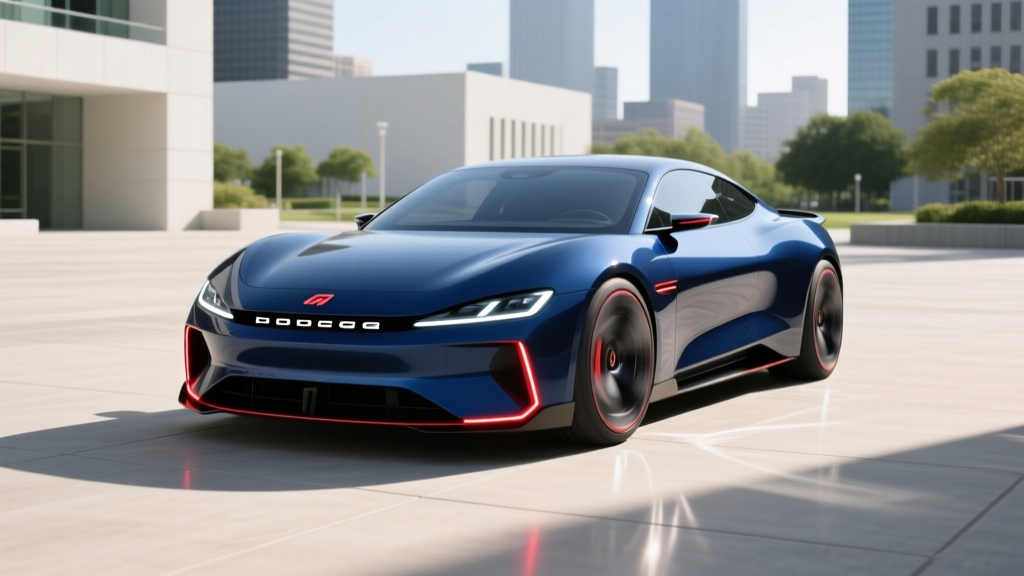
The Charger Daytona electric is a two-door, four-seat performance coupe — the first true electric muscle car from a legacy American brand. Key performance figures:
| Spec | Daytona R/T | Daytona Scat Pack |
|---|---|---|
| Drivetrain | AWD (dual motor) | AWD (dual motor) |
| Horsepower | 496 hp | 670 hp |
| 0–60 mph | 4.7 seconds | 3.3 seconds |
| Top Speed | ~135 mph | ~135 mph |
| Battery (usable) | 81.2 kWh NMC | 81.2 kWh NMC |
| EPA Range | 318 mi | 260 mi |
| Peak DC Charge | 100 kW | 100 kW |
| Curb Weight | ~5,838 lbs | ~5,838 lbs |
Dodge includes its "Fratzog" exhaust simulation system — artificial engine sounds pumped through interior and exterior speakers. It is polarizing: some enthusiasts appreciate the auditory feedback during aggressive driving, while others find it gimmicky. You can disable it entirely.
The Scat Pack's 3.3-second 0–60 time places it firmly in supercar territory, rivaling the Porsche Taycan 4S and Tesla Model S Plaid on acceleration. However, at 5,838 lbs, handling dynamics favor straight-line sprints over canyon carving. This is a muscle car, not a sports car.
Pricing, Trims, and Federal Tax Credit
| Trim | Base MSRP (2026) | Key Features |
|---|---|---|
| Daytona R/T | $49,995 | 496 hp, 318 mi range, 12.3" cluster + 12.3" infotainment, heated seats |
| Daytona Scat Pack | $71,995 | 670 hp, 260 mi range, Track mode, launch control, upgraded brakes |
Both trims qualify for the $7,500 federal §30D EV tax credit only if several conditions are met. This is not automatic. Under current IRS rules, you must satisfy:
- MSRP cap: Vehicle base price must not exceed $55,000 for sedans/coupes. The R/T qualifies; the Scat Pack at $71,995 does not.
- Buyer income cap: Modified AGI must not exceed $150,000 (single), $225,000 (head of household), or $300,000 (married filing jointly).
- Battery sourcing: Critical minerals and battery components must meet escalating domestic/free-trade-partner thresholds. Stellantis has indicated partial compliance, but final eligibility depends on the specific VIN and production batch.
- Point-of-sale transfer: You can elect to transfer the credit to the dealer at purchase, reducing your out-of-pocket cost directly — subject to dealer participation.
Bottom line: The R/T at $49,995 can drop to approximately $42,495 after the full credit if you meet all requirements. The Scat Pack does not qualify for the federal credit due to its MSRP. Always confirm eligibility with the IRS §30D guidelines and a qualified tax professional before purchase.
Daytona Electric vs. Gas Muscle: Real Cost of Ownership
How does the electric Daytona stack up against the last-generation gas Charger Scat Pack (6.4L V8, 485 hp)? Here is a 5-year comparison assuming 12,000 miles/year, home charging at $0.14/kWh, and gas at $3.50/gallon:
| Cost Category | Daytona Electric R/T | Gas Charger Scat Pack (6.4L V8) |
|---|---|---|
| Purchase price (after credit) | ~$42,495 | ~$52,000 |
| Fuel/energy (5 years) | ~$2,800 | ~$12,600 |
| Maintenance (5 years) | ~$1,200 | ~$3,500 |
| Insurance (5 years, avg) | ~$12,500 | ~$10,000 |
| Estimated depreciation | ~$21,000 | ~$20,000 |
| 5-year total cost | ~$79,995 | ~$98,100 |
The electric Daytona saves roughly $18,000 over five years, primarily from dramatically lower fuel costs ($2,800 vs. $12,600) and reduced maintenance (no oil changes, fewer brake replacements due to regenerative braking). However, EV insurance premiums run 15–25% higher on average due to repair costs and battery replacement risk. Depreciation for the electric Daytona is projected to be slightly steeper than its gas predecessor, reflecting the broader EV resale market's current softness.
The gas V8 Charger is discontinued after the 2023 model year, so this comparison is against used inventory. If you are cross-shopping new vehicles only, the Daytona's closest gas rival is the Ford Mustang GT (~$45,000, 17 MPG combined, ~$14,000 fuel cost over 5 years).
Home Charging, Climate, and Real Ownership Considerations
The Daytona's ownership experience depends heavily on your charging situation and driving environment:
Home Charging Access
With an 81.2 kWh battery, Level 1 (standard 120V) charging is impractical for daily use — it would take nearly 60 hours for a full charge. A Level 2 home charger (240V, 48-amp circuit) is strongly recommended. Expect to spend $800–$2,000 on equipment and electrician labor for a home Level 2 installation, plus $200–$1,000 if your electrical panel needs a 200-amp upgrade.
With Level 2 at 11 kW, you will add roughly 35 miles of range per hour — enough to fully recharge overnight from any realistic daily driving distance. Home charging at $0.14/kWh costs approximately $11.37 for a full charge, translating to about 3.6 cents per mile.
Climate Considerations
The Daytona's NMC battery chemistry is energy-dense but cold-sensitive. In sustained sub-freezing temperatures, expect 15–25% range loss due to battery heating demands and slower electrochemistry. Dodge includes a heat pump for cabin climate control, which mitigates some cold-weather energy draw, but preconditioning the battery (via the Dodge app while plugged in) is essential for preserving range and enabling faster DC charging in winter.
If you live in a region with harsh winters and no garage, the effective range loss combined with slower charging speeds may make the Daytona less practical for long winter road trips. In mild climates (California, Southeast, Southwest), real-world range aligns much more closely with EPA estimates.
Public Charging Reliability
The Daytona charges via CCS1, meaning access to Electrify America, EVgo, and ChargePoint networks. Public DC charging reliability remains inconsistent — a 2025 J.D. Power study found roughly 20% of public charging sessions encounter some failure. For road trips, plan routes using apps like A Better Routeplanner and always have a backup charging location within 15–20 miles.
Common Misconceptions: Myth vs. Fact
| Myth | Fact |
|---|---|
| "The Daytona gets 318 miles no matter how you drive." | EPA is a combined-cycle estimate. Sustained highway driving at 75+ mph typically yields 250–270 miles; cold weather reduces this further. |
| "100 kW charging is fast." | 100 kW is moderate by 2026 standards. The Hyundai Ioniq 5 charges at 240 kW; the Porsche Taycan at 270 kW. The Daytona's 27-minute 10–80% time is adequate but not class-leading. |
| "The $7,500 tax credit applies to all trims." | Only the R/T ($49,995) falls under the $55,000 MSRP cap. The Scat Pack ($71,995) does not qualify for the federal credit. |
| "Electric means zero maintenance." | You still need tire rotations, cabin air filter replacement, brake fluid checks, coolant top-offs, and software updates. Budget ~$200–300/year. |
| "The artificial engine sound is mandatory." | The Fratzog exhaust simulation can be fully disabled in the vehicle settings menu. |
Decision Framework: Should You Buy the Dodge Daytona Electric?
Choose the Daytona Electric if:
- You want a distinctive, fast American electric coupe and value brand heritage over maximum efficiency.
- You can install a Level 2 home charger and primarily drive within 200 miles of home.
- You are cross-shopping the R/T trim and qualify for the full $7,500 federal tax credit.
- You prioritize straight-line acceleration (4.7s or 3.3s 0–60) over corner-carving track performance.
- You accept that public charging infrastructure may be inconsistent on road trips and plan accordingly.
Look elsewhere if:
- You need maximum range and charging speed for frequent 400+ mile road trips (consider the Hyundai Ioniq 6 or Tesla Model 3).
- You want the Scat Pack trim but expected the federal tax credit — it does not qualify at $71,995 MSRP.
- You live in an apartment or condo without reliable Level 2 charging access.
- You prioritize cargo space and practicality — the Daytona is a two-door coupe with limited rear-seat and trunk room.
- You want a proven long-term reliability track record — the Daytona is a first-year model on a new platform.
Battery Warranty and Long-Term Outlook
Stellantis covers the Daytona's battery and electric powertrain with a 8-year/100,000-mile warranty, guaranteeing the battery will retain at least 70% of its original capacity. This is standard for the segment and consistent with federal emissions warranty requirements. If the battery degrades below 70% state of health within the warranty period, Stellantis will repair or replace it at no cost.
Based on NMC chemistry degradation data from similar Stellantis/Hyundai/Kia packs, expect approximately 10–15% capacity loss over 100,000 miles under normal use. Keeping daily charge between 20–80% and avoiding repeated DC fast charging from very low states of charge will help maximize battery longevity. A full out-of-warranty battery replacement for an 81.2 kWh pack currently runs $15,000–$22,000 including labor — a cost worth factoring into a 10+ year ownership plan.
Frequently Asked Questions
Does the Dodge Daytona Electric qualify for the $7,500 federal tax credit?
The R/T trim at $49,995 MSRP may qualify if you meet IRS income caps ($150K single / $300K married), and the battery meets critical-mineral and component sourcing thresholds. The Scat Pack at $71,995 exceeds the $55,000 MSRP cap for sedans/coupes and does not qualify. Always verify with the IRS §30D page and your tax professional.
What is the real-world range of the Dodge Daytona Electric?
EPA rates the R/T at 318 miles combined. Expect 250–270 miles on sustained highway drives in mild weather, and 220–255 miles in cold conditions. The Scat Pack's 260-mile EPA rating drops to roughly 200–220 miles highway.
How long does it take to charge the Daytona at home?
On a Level 2 (240V, 11 kW) home charger, a full charge from empty takes approximately 8 hours. Most owners will plug in nightly and wake to a full battery. Level 1 (120V) is impractical for regular use at ~58 hours for a full charge.
Is the Dodge Daytona Electric all-wheel drive?
Yes. Both the R/T and Scat Pack use a dual-motor all-wheel-drive configuration. There is no rear-wheel-drive variant of the electric Daytona.
Can I use Tesla Superchargers with the Dodge Daytona?
Stellantis has confirmed NACS adapter compatibility for Tesla Supercharger access, but the native port on the Daytona is CCS1/J1772. Confirm adapter availability and Supercharger network access with your dealer before purchase, as rollout details continue to evolve.
How does the Daytona compare to the Tesla Model S?
The Model S Long Range starts around $74,990 with 405 miles of EPA range and 250 kW peak charging — both significantly better than the Daytona. However, the Model S is a four-door sedan, not a two-door muscle coupe. The Daytona's value proposition is design, brand heritage, and the muscle-car experience — not efficiency or range leadership.
What should a first-time EV buyer know before purchasing the Daytona?
Confirm you have reliable Level 2 charging access at home or work. Understand that real-world range is 15–20% below EPA in highway driving. Budget for a home charger installation ($800–$2,000). Know that EV insurance costs 15–25% more on average. And plan road trips around DC fast charger locations — the 100 kW peak charge rate means longer stops than some rivals.