The Dodge Electric Car: 2026 Charger Daytona at a Glance
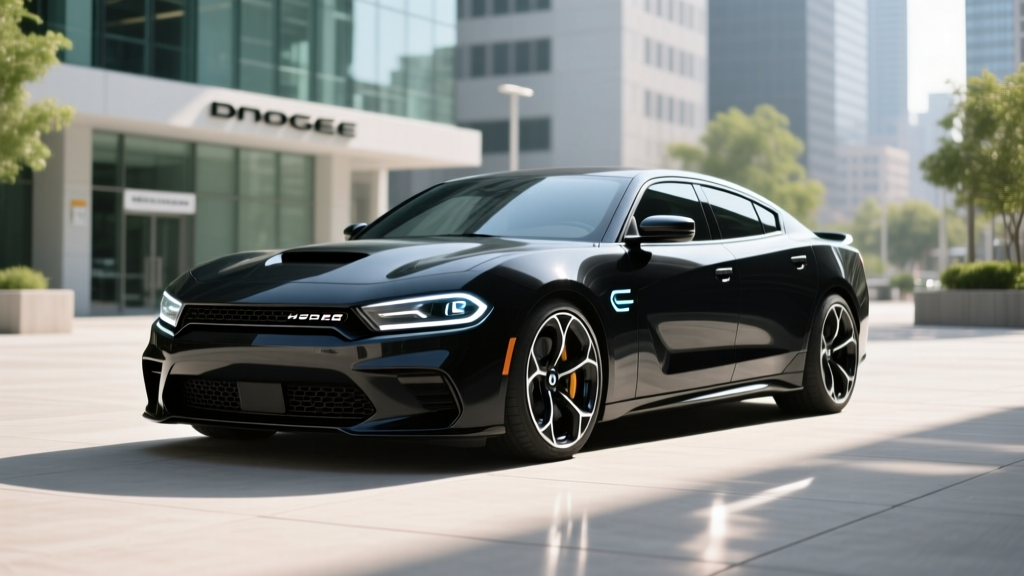
The Dodge electric car lineup currently centers on the 2026 Dodge Charger Daytona, a fully electric muscle car built on Stellantis's STLA Large platform. The R/T trim starts at $49,995 with a 100.5 kWh battery, 317 miles of EPA range, and 496 horsepower. The Scat Pack variant pushes to 670 hp and 260 miles of range, starting at $59,995. DC fast charging peaks at roughly 200 kW on an 800-volt architecture, achieving a 10-80% charge in approximately 27 minutes. Federal §30D tax credit eligibility depends on battery sourcing and buyer income — do not assume the full $7,500 applies without checking current IRS rules.
For decades, Dodge built its identity on supercharged V8s and tire-shredding burnouts. The Charger Daytona EV represents a fundamental pivot — an all-electric muscle car that promises Hellcat-rivaling acceleration without a drop of gasoline. But does the math work for buyers coming from a gas Charger or Challenger? This guide breaks down the real numbers: range, charging costs, ownership economics, and the practical considerations that spec sheets don't highlight.
Range, Battery, and Charging: The Real Numbers
The 2026 Charger Daytona uses a 100.5 kWh usable battery with NMC (nickel-manganese-cobalt) chemistry, mounted low in the STLA Large skateboard chassis. Here is what the EPA says versus what you should expect in practice:
EPA Range vs. Real-World Expectations
| Trim | EPA Range | Highway (75 mph) | Cold Weather (20°F) |
|---|---|---|---|
| R/T (496 hp) | 317 miles | ~260-275 miles | ~220-240 miles |
| Scat Pack (670 hp) | 260 miles | ~210-225 miles | ~175-195 miles |
Highway and cold-weather figures are estimates based on typical EV efficiency losses of 15-20% at sustained speed and 25-30% in freezing temps. Actual results vary with driving style, terrain, and climate-control usage. Source: fueleconomy.gov for EPA figures.
The 800-volt architecture enables DC fast charging at up to approximately 200 kW peak. However, as with all EVs, that peak rate is not sustained across the full session. Expect the charge curve to taper significantly above 80% State of Charge (SoC). A 10-80% session takes roughly 27 minutes at a capable DC fast charger ( Electrify America or similar 350 kW-rated stations). Charging from 80-100% can add another 20+ minutes — plan road-trip stops around the 80% mark to minimize downtime.
For home charging, the Charger Daytona accepts up to 11 kW on Level 2 (240V). That translates to roughly 30-35 miles of range per hour of charging, or a full overnight replenishment from near-empty in about 10 hours. Level 1 (120V) trickle charging adds approximately 3-4 miles per hour — adequate only for plug-in hybrids or emergency top-offs, not practical for daily use on a 100+ kWh battery.
| Charging Level | Power (kW) | Miles Added/Hour | Full Charge Time |
|---|---|---|---|
| Level 1 (120V) | ~1.4 kW | 3-4 mi | ~70+ hours |
| Level 2 (240V, 48A) | ~11 kW | 30-35 mi | ~10 hours |
| DC Fast Charge | Up to ~200 kW | N/A (session-based) | 10-80% in ~27 min |
Performance: Electric Muscle Car Credentials
Dodge engineered the Charger Daytona to deliver the kind of straight-line performance that made the brand famous — just without the exhaust note (though an artificial "Fratzonic" exhaust system attempts to replicate the sound through external speakers).
| Specification | R/T | Scat Pack |
|---|---|---|
| Horsepower | 496 hp | 670 hp |
| 0-60 mph | 4.7 seconds | 3.3 seconds |
| Drivetrain | AWD (dual motor) | AWD (dual motor) |
| Battery Capacity | 100.5 kWh (NMC) | 100.5 kWh (NMC) |
| EPA Range | 317 miles | 260 miles |
| DC Fast Charge Peak | ~200 kW | ~200 kW |
| Base MSRP | $49,995 | $59,995 |
The Scat Pack's 3.3-second 0-60 time puts it in the territory of a Dodge Challenger SRT Hellcat Redeye (3.4 seconds), while the R/T's 4.7-second run is closer to the outgoing 5.7L HEMI V8 Charger. Both trims come standard with all-wheel drive via dual electric motors — a departure from the rear-wheel-drive tradition of gas Chargers, but one that improves launch traction and all-weather capability.
Cost of Ownership: Charger Daytona EV vs. Gas Charger
The sticker price tells only part of the story. Here is how a 5-year ownership comparison breaks down between the electric Charger Daytona R/T and a comparably equipped gas Charger (using the final 2023 5.7L HEMI R/T as a baseline, since the gas Charger ended production after 2023).
| Cost Factor (5 Years / 75,000 mi) | Charger Daytona R/T (EV) | Gas Charger R/T (5.7L HEMI) |
|---|---|---|
| Purchase Price (MSRP) | $49,995 | ~$44,000 (est. final MSRP) |
| Est. Federal Tax Credit (§30D) | $0-$7,500 (see below) | $0 |
| Fuel/Energy Cost | ~$3,800-$5,200* | ~$9,400-$11,000** |
| Maintenance (est.) | ~$1,500-$2,000 | ~$3,500-$4,500 |
| Insurance (est. avg) | ~$12,000-$15,000 | ~$10,000-$13,000 |
| Estimated 5-Year Total | ~$60,000-$72,000 | ~$67,000-$72,500 |
*EV energy cost assumes $0.14/kWh home charging and $0.40/kWh DC fast charging mix. **Gas cost assumes 19 MPG combined and $3.40/gallon. Actual costs vary significantly by local electricity rates, gas prices, and driving patterns. Sources: fueleconomy.gov, IRS §30D.
The key takeaway: the Charger Daytona EV can break even or save money over five years compared to the gas Charger it replaces, primarily through dramatically lower fuel and maintenance costs. However, those savings depend heavily on your access to affordable home charging. If you rely exclusively on DC fast charging at $0.40-$0.50/kWh, the energy cost advantage narrows considerably.
Federal Tax Credit: §30D Eligibility Is Not Guaranteed
§30D Clean Vehicle Credit Requirements (2026)
- MSRP cap: Vehicle must be under $55,000 (sedans) — the R/T qualifies at $49,995; the Scat Pack at $59,995 likely exceeds the cap
- Buyer income cap: AGI must not exceed $150,000 (single) / $300,000 (joint)
- Battery sourcing: Critical minerals and battery components must meet phased-in domestic/free-trade-partner thresholds — Stellantis has not confirmed full compliance for the Charger Daytona
- Point-of-sale transfer: Eligible buyers can apply the credit as a down-payment reduction at the dealer
- Final assembly: Must occur in North America (Charger Daytona is assembled in Brampton, Ontario — qualifying)
Always verify current eligibility at IRS.gov or consult a tax professional before relying on the credit in your purchase decision. Rules change annually.
Real-World Ownership: What First-Time EV Buyers Must Know
Buying a Dodge electric car is not the same as buying a gas Charger. Here are the practical realities that will define your ownership experience:
Home Charging Is Almost Mandatory
With a 100.5 kWh battery, relying on public charging alone is expensive and time-consuming. Budget $500-$2,000 for a quality Level 2 home charger (e.g., ChargePoint Home Flex, Emporia Vue) and $800-$2,500 for professional installation by a licensed electrician. If your home has a 200-amp electrical panel with spare capacity, installation is straightforward. Older homes with 100-amp panels may require a $2,000-$4,000 panel upgrade — factor this into your total purchase budget.
Charging Deserts Still Exist
If you regularly drive rural routes in the Mountain West, Great Plains, or parts of the rural South, DC fast-charging infrastructure may be sparse. The Charger Daytona's CCS/NACS charging compatibility (Stellantis has committed to NACS adoption) helps, but plan routes carefully using apps like PlugShare or A Better Routeplanner. For cross-country road trips, expect 2-3 charging stops on a 600-mile drive, adding roughly 60-90 minutes of total stop time.
Cold Weather Hits Range Hard
NMC batteries lose efficiency in freezing temperatures. Expect 25-30% range reduction in sustained sub-30°F driving. The Charger Daytona includes a heat pump for cabin heating (more efficient than resistive heating), but battery preconditioning for fast charging still consumes energy. If you live in Minnesota, Montana, or New England, the 317-mile R/T may realistically deliver 220-240 miles in January. Garage parking and preconditioning while plugged in mitigate this loss.
Insurance Costs More
EV insurance premiums typically run 15-25% higher than comparable gas vehicles due to higher repair costs, specialized parts, and elevated MSRP. Get quotes from your insurer before purchasing — the Charger Daytona's performance credentials (especially the 670-hp Scat Pack) will push premiums further.
Common Misconceptions About the Dodge Electric Car
| Myth | Fact |
|---|---|
| "It gets the full $7,500 tax credit automatically" | Eligibility depends on MSRP caps, buyer income, and battery sourcing rules that change yearly. The Scat Pack likely exceeds the $55,000 sedan cap. Always verify at IRS.gov. |
| "317 miles means I'll always get 317 miles" | EPA range is a laboratory estimate. Highway driving at 75+ mph, cold weather, and aggressive acceleration reduce real-world range by 15-30%. |
| "It charges at 200 kW the whole time" | Peak charge rate applies only at low SoC with a warm battery. Expect tapering above 50-60% SoC, with significant slowdown past 80%. Average session speed is lower than peak. |
| "EVs have no maintenance costs" | No oil changes or spark plugs, but tires wear faster (heavy vehicle + instant torque), cabin air filters need replacement, brake fluid and coolant still require service, and the 12V auxiliary battery still dies every 3-5 years. |
| "The battery will need replacing in 5 years" | Modern NMC batteries are warrantied for 8 years/100,000 miles (minimum 70% capacity retention). Industry data shows most EV batteries retain 85-90% capacity at 100,000 miles. Full replacement, if needed outside warranty, runs $12,000-$18,000. |
Decision Framework: Is the Dodge Charger Daytona EV Right for You?
Choose the Charger Daytona R/T if:
- You have Level 2 home charging access (or can install it)
- Your daily commute is under 100 miles round-trip
- You want muscle-car acceleration with $5-7/day "fuel" costs at home
- You live in a moderate climate, or have garage parking for winter
- You value AWD traction and don't mind trading V8 sound for electric torque
Choose the Scat Pack if:
- You prioritize 3.3-second 0-60 performance above all else
- You accept the 260-mile range trade-off and higher MSRP
- You understand the $59,995 price likely disqualifies it from the §30D sedan cap
Look elsewhere (PHEV or gas) if:
- You cannot install home charging and lack reliable workplace charging
- You regularly drive 400+ mile rural routes with limited DC fast-charging infrastructure
- You live in an extreme cold climate and need consistent 300+ mile range year-round
- Your budget is strictly under $40,000 — the used-EV market or a PHEV like the Chrysler Pacifica Hybrid may serve you better
Frequently Asked Questions
What is the real-world range of the Dodge Charger Daytona EV?
The EPA rates the R/T at 317 miles and the Scat Pack at 260 miles. In real-world highway driving at 70-75 mph, expect roughly 260-275 miles (R/T) and 210-225 miles (Scat Pack). In freezing weather, subtract another 25-30%. These figures assume moderate climate-control use and no aggressive launch-control starts.
How long does it take to charge the Dodge electric car at home?
On a Level 2 home charger (240V, 48 amps, ~11 kW), a full charge from near-empty takes approximately 10 hours. Most owners charge overnight and wake up to a full battery every morning. Level 1 (120V standard outlet) adds only 3-4 miles per hour and is not practical for daily use with this battery size.
Does the Dodge Charger Daytona qualify for the $7,500 federal tax credit?
It depends. The R/T at $49,995 falls under the $55,000 MSRP cap for sedans, but full credit eligibility also requires the buyer's AGI to be within limits ($150K single / $300K joint) and the battery to meet critical-mineral and component sourcing thresholds. The Scat Pack at $59,995 likely exceeds the sedan MSRP cap. Verify current eligibility at IRS.gov before relying on the credit.
How does the Charger Daytona compare to a Tesla Model S or Ford Mustang Mach-E?
The Charger Daytona occupies a unique niche as a two-door electric muscle car. The Tesla Model S offers more range (402 miles EPA) and access to the Supercharger network but starts higher and has a different design ethos. The Mustang Mach-E GT is a crossover (more practical cargo space) with 312 miles of range and a lower starting price. The Charger Daytona's appeal is brand heritage, styling, and the muscle-car experience — not efficiency leadership or cargo volume.
What is the battery warranty on the Dodge Charger Daytona?
Stellantis provides an 8-year / 100,000-mile battery warranty, guaranteeing minimum 70% capacity retention. The basic vehicle warranty is 3 years / 36,000 miles, and the powertrain warranty (covering motors and power electronics) is 5 years / 60,000 miles. These are in line with industry standards.
Can I tow with the Dodge Charger Daytona EV?
Dodge has not published a towing rating for the Charger Daytona at launch. As a performance coupe, it is not designed as a tow vehicle. If towing capacity is a priority, look at electric trucks (Ford F-150 Lightning, Rivian R1T) or SUVs (Kia EV9, Tesla Model X).