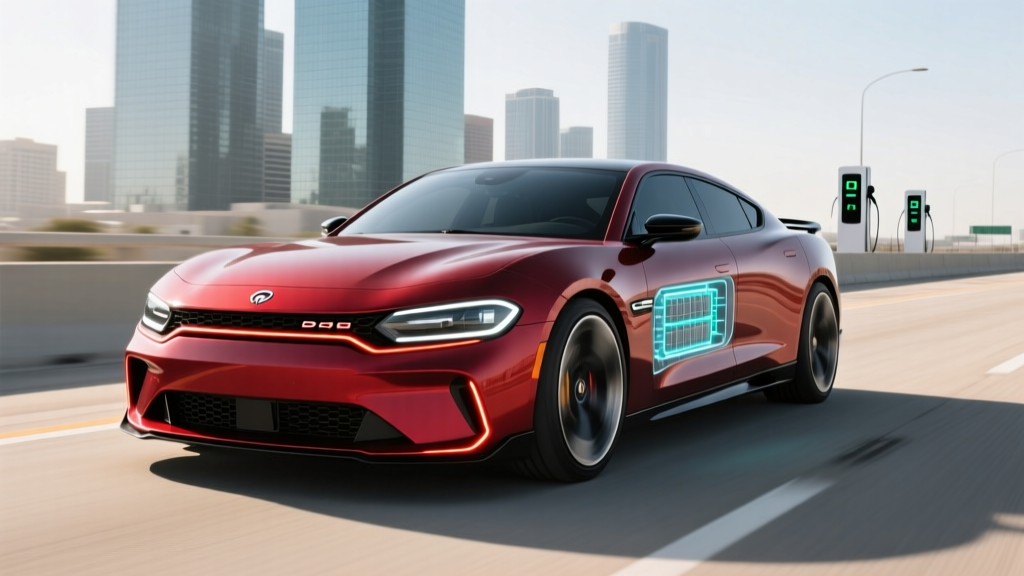
The short answer: Dodge's first electric vehicle, the 2026 Charger Daytona, is a two-door coupe (with a four-door variant arriving later) built on Stellantis' STLA Large platform. The R/T trim targets approximately 317 miles of EPA range with a 92 kWh usable battery, while the Scat Pack pushes 670 horsepower at the cost of range (~260 miles EPA). Base pricing starts around $51,990 for the R/T, placing it in performance-EV territory alongside the Ford Mustang Mach-E GT and Tesla Model 3 Performance. Federal §30D tax credit eligibility is uncertain due to North American battery sourcing requirements — verify current-year IRS rules before purchase.
What Is the Dodge Electric Vehicle Lineup in 2026?
After retiring the gas-powered Challenger and Charger after the 2023 model year, Dodge pivoted to electrification with the Charger Daytona. This is not a compliance car — it's a deliberate muscle-car-to-EV transition aimed at buyers who want straight-line performance, aggressive styling, and the brand's signature exhaust note (simulated here via Dodge's "Fratzonic" chambered exhaust system).
The 2026 lineup includes two primary trims:
- Charger Daytona R/T: 496 horsepower, all-wheel drive, ~317 miles EPA range, 0-60 mph in approximately 4.7 seconds.
- Charger Daytona Scat Pack: 670 horsepower, AWD, ~260 miles EPA range, 0-60 mph in approximately 3.3 seconds.
A four-door sedan variant is expected to follow, broadening the appeal beyond coupe buyers. Both trims use an 800-volt architecture enabling DC fast charging at up to 175 kW peak.
| Spec | R/T | Scat Pack |
|---|---|---|
| Battery (usable) | ~92 kWh (NMC) | ~92 kWh (NMC) |
| EPA Range | ~317 mi | ~260 mi |
| Horsepower | 496 hp | 670 hp |
| 0-60 mph | ~4.7 sec | ~3.3 sec |
| Drivetrain | AWD (dual motor) | AWD (dual motor) |
| DC Fast Charge Peak | 175 kW | 175 kW |
| 10-80% DC Charge | ~27 min | ~27 min |
| Level 2 Charge Rate | 11 kW | 11 kW |
| Starting MSRP | ~$51,990 | ~$61,990 |
| Battery Warranty | 8 yr / 100,000 mi | 8 yr / 100,000 mi |
Real-world range reality: The EPA sticker says ~317 miles for the R/T, but expect 250-270 miles in sustained highway driving at 70+ mph, and potentially 200-230 miles in freezing temperatures with cabin heat active. The Scat Pack's wider tires and higher output reduce efficiency further — plan for ~210 miles real-world highway. These are typical EV physics, not Dodge-specific shortcomings.
Charging Speed and Infrastructure: What Charger Daytona Owners Need
The 800-volt architecture is a genuine technical advantage — it allows the Charger Daytona to accept higher charge rates with less heat buildup compared to 400-volt systems. However, the 175 kW peak is modest compared to rivals like the Hyundai Ioniq 5 (240 kW peak) or the Lucid Air (300+ kW). Here's what charging looks like in practice:
| Level | Power | Miles Added per Hour | Use Case |
|---|---|---|---|
| Level 1 (120V) | ~1.4 kW | ~3-4 mi/hr | Emergency / overnight trickle |
| Level 2 (240V, 48A) | 11 kW | ~28-32 mi/hr | Home daily charging (~9 hrs 10-100%) |
| DC Fast Charge | 175 kW peak | ~300+ mi/hr (peak) | Road trips; 10-80% in ~27 min |
Charging curve reality: The 175 kW peak only holds between roughly 10-40% state of charge. Above 60%, the rate tapers significantly — expect ~80 kW from 60-80%, and ~30 kW from 80-100%. This is standard lithium-ion battery management to prevent degradation, but it means a 10-90% stop takes closer to 40 minutes, not 27.
Home charging setup: A Level 2 home charger is practically mandatory for daily convenience. Budget $500-$1,200 for a quality 48-amp ChargePoint or Wallbox unit, plus $800-$2,500 for electrician installation (potentially more if your panel needs a 200-amp upgrade). Consult a licensed electrician for a site-specific quote.
Dodge Charger Daytona EV vs. Gas Charger: Cost and Performance Comparison
The natural cross-shop for most buyers is the last-generation gas Charger (2023 Scat Pack, 6.4L HEMI V8, 485 hp) or the newly reintroduced gas-powered Charger SIXPACK (Hurricane inline-six). Here's how the numbers stack up:
| Metric | Charger Daytona R/T (EV) | 2023 Charger Scat Pack (Gas) |
|---|---|---|
| MSRP (base) | ~$51,990 | ~$48,000 (discontinued, used market varies) |
| Horsepower | 496 hp | 485 hp |
| 0-60 mph | ~4.7 sec | ~4.2 sec |
| Energy/Fuel Cost (15,000 mi/yr) | ~$600-$900/yr (home charging at $0.14/kWh) | ~$2,400/yr (20 MPG combined, $3.20/gal) |
| Annual Maintenance | ~$200-$400 | ~$600-$1,000 |
| 5-Year Fuel/Energy | ~$3,000-$4,500 | ~$12,000 |
| 5-Year Maintenance | ~$1,000-$2,000 | ~$3,000-$5,000 |
| EPA Efficiency | ~95 MPGe combined | ~19 MPG combined |
The EV's advantage is overwhelmingly in operating costs. Over five years and 75,000 miles, the Daytona R/T saves an estimated $7,500-$12,000 in fuel and maintenance alone. However, insurance premiums for the EV variant run 15-25% higher than the gas Charger in most states, partially offsetting those savings.
Federal Tax Credit and Incentive Eligibility
Under current IRS §30D rules, the Charger Daytona's eligibility for the full $7,500 federal tax credit is not guaranteed. The credit has three gates that must all be passed:
- MSRP cap: Sedans must be under $55,000; SUVs/trucks under $80,000. The Charger Daytona is classified as a sedan — the R/T at ~$51,990 clears this, but the Scat Pack at ~$61,990 does not.
- Buyer income cap: Modified AGI must not exceed $150,000 (single), $225,000 (head of household), or $300,000 (joint).
- Battery sourcing: Increasing percentages of critical minerals and battery components must be sourced from the US or FTA partners. Stellantis has not confirmed full compliance for the Charger Daytona's battery pack — this requirement tightens annually.
The point-of-sale transfer option allows eligible buyers to apply the credit as an immediate price reduction at the dealer, rather than waiting for a tax refund. Always verify current eligibility on IRS.gov and consult a tax professional before purchasing.
Common Dodge EV Misconceptions
| Myth | Fact |
|---|---|
| "It's not a real muscle car without a V8." | The Scat Pack's 670 hp and 3.3-second 0-60 beat every gas Charger ever made. Torque delivery is instant — no powerband to wait for. |
| "The battery will need replacing in a few years." | Stellantis warranties the battery for 8 years/100,000 miles with a 70% capacity retention floor. Industry data shows NMC packs typically degrade 10-15% over 150,000 miles with normal use. |
| "I can charge it on any public charger." | The Charger Daytona uses the CCS1 connector (or NACS on newer builds — confirm with your dealer). Most Electrify America and EVgo stations support CCS. Tesla Supercharger access requires a NACS port or approved adapter. |
| "I'll save $7,500 no matter what." | Federal credit eligibility depends on MSRP caps, buyer income, and battery sourcing rules. The Scat Pack exceeds the $55K sedan cap. Always verify on IRS.gov. |
Real-World Ownership: Who Should (and Shouldn't) Buy the Charger Daytona EV
Not every buyer is well-served by a performance EV coupe. Here's the honest decision framework:
Buy the Charger Daytona R/T if:
- You have Level 2 home charging (or can install it) and drive under 60 miles round-trip daily.
- You want muscle-car styling with sub-5-second 0-60 performance and don't need back-seat practicality.
- You live in a region with reliable DC fast charging (Electrify America, EVgo, or Tesla Superchargers with adapter) for road trips.
- You value low operating costs and can absorb a higher upfront price and insurance premium.
Consider the Scat Pack if:
- You prioritize 3-second acceleration over range and are willing to charge more frequently.
- You understand the Scat Pack likely exceeds the §30D sedan MSRP cap, meaning no federal credit.
Look elsewhere if:
- You lack home charging access and rely solely on public infrastructure — a coupe with ~260 miles of real-world range and 27-minute charge stops isn't ideal for apartment dwellers.
- You need four doors and usable rear seats (wait for the sedan variant, or cross-shop the Tesla Model S, BMW i5, or Hyundai Ioniq 6).
- You regularly drive in extreme cold (below 10°F) where range loss of 25-35% is typical for all EVs.
- Your budget is under $50,000 — consider the Chevrolet Equinox EV, Tesla Model 3 RWD, or a used EV instead.
Insurance, Depreciation, and Total Cost of Ownership
EV insurance premiums remain elevated compared to gas equivalents. For the Charger Daytona R/T, expect annual premiums of $2,200-$3,200 depending on state, driving record, and coverage level (data from industry averages for performance EVs). The Scat Pack will likely push higher given its 670 hp output.
Depreciation is the wildcard. Performance EVs have historically depreciated faster than their gas counterparts in the first three years — the Tesla Model S and Porsche Taycan both shed 40-50% of value in 36 months. The Charger Daytona's iconic brand name could help retention, but the EV market is volatile. Budget-conscious buyers should consider leasing to transfer depreciation risk to the lessor.
| Category | Estimated Cost |
|---|---|
| Purchase Price (MSRP) | $51,990 |
| Federal Tax Credit (if eligible) | -$7,500 |
| Effective Purchase | ~$44,490 |
| Home Charger Install | $1,500-$3,000 |
| 5-Year Energy (15K mi/yr, home charging) | $3,000-$4,500 |
| 5-Year Insurance | $11,000-$16,000 |
| 5-Year Maintenance | $1,000-$2,000 |
| Estimated Depreciation (5 yr) | $18,000-$24,000 |
| Approx. 5-Year Net Cost | $34,000-$47,000 |
For context, a comparably equipped gas performance coupe (BMW M440i, Ford Mustang GT Premium) might show a 5-year net cost of $38,000-$52,000, primarily due to higher fuel and maintenance expenses. The EV wins on operating costs but loses on depreciation risk and insurance.
What First-Time EV Buyers Should Know Before Ordering
If the Charger Daytona is your first electric vehicle, prepare for these ownership realities:
- Preconditioning matters. Use the Dodge app to precondition the battery before DC fast charging. A cold battery charges far slower — preconditioning warms it to optimal temperature, enabling the full 175 kW peak rate.
- Don't baby the battery. NMC chemistry (used in the Daytona) is happiest between 20-80% state of charge for daily use. Charge to 100% only before road trips. Avoid leaving the car at 100% or below 10% for extended periods.
- Regen braking replaces brake pads. One-pedal driving mode uses the motors to decelerate, recovering energy and dramatically reducing brake wear. Many EV owners report original brake pads lasting 100,000+ miles.
- Tires wear faster. The instant torque and heavier curb weight (~5,500+ lbs) accelerate tire wear. Budget for replacement every 25,000-35,000 miles — and choose EV-optimized tires (like Michelin Pilot Sport EV) for lower rolling resistance and noise.
- Plan road trips around chargers. Use AFDC's station locator or apps like PlugShare to map DC fast chargers along your route. The ~27-minute 10-80% charge time means planning 2-3 stops on a 600-mile drive.
Frequently Asked Questions
Does the Dodge Charger Daytona qualify for the $7,500 federal tax credit?
The R/T trim at ~$51,990 falls under the $55,000 sedan MSRP cap, but eligibility also depends on buyer income limits and battery component/critical mineral sourcing rules that tighten each year. The Scat Pack at ~$61,990 exceeds the sedan cap and is ineligible regardless of sourcing. Verify current-year rules at IRS.gov before purchasing.
What connector does the Charger Daytona use?
Early production models ship with CCS1. Stellantis has indicated a transition to NACS (Tesla-style) for future builds. Confirm the connector type on your specific VIN with the dealer, as it determines Supercharger access without an adapter.
How does cold weather affect the Charger Daytona's range?
In sustained temperatures below 32°F, expect 20-30% range reduction. Below 10°F, losses can reach 35%. This is universal across all EVs due to battery chemistry and cabin heating demands. The Daytona's heat pump (if equipped) mitigates this somewhat compared to resistive heating systems.
Can I tow with the Charger Daytona?
Dodge has not published an official towing rating for the Daytona coupe. Performance EVs in this class typically offer limited towing (1,000-2,000 lbs at most). If towing is a priority, consider an EV truck or SUV.
Is the Fratzonic exhaust system just a gimmick?
It's subjective. The system produces a synthetic exhaust note through a chambered speaker system that responds to throttle input and RPM. Some testers find it adds engagement; others prefer the silence of a typical EV. You can turn it off entirely.
How does the Charger Daytona compare to the Tesla Model 3 Performance?
The Model 3 Performance offers similar 0-60 times (~3.1 sec), lower pricing (~$52,990), better real-world charging infrastructure access (Supercharger network), and more interior space. The Daytona wins on styling, brand heritage, and coupe exclusivity. It's an emotional vs. rational choice.