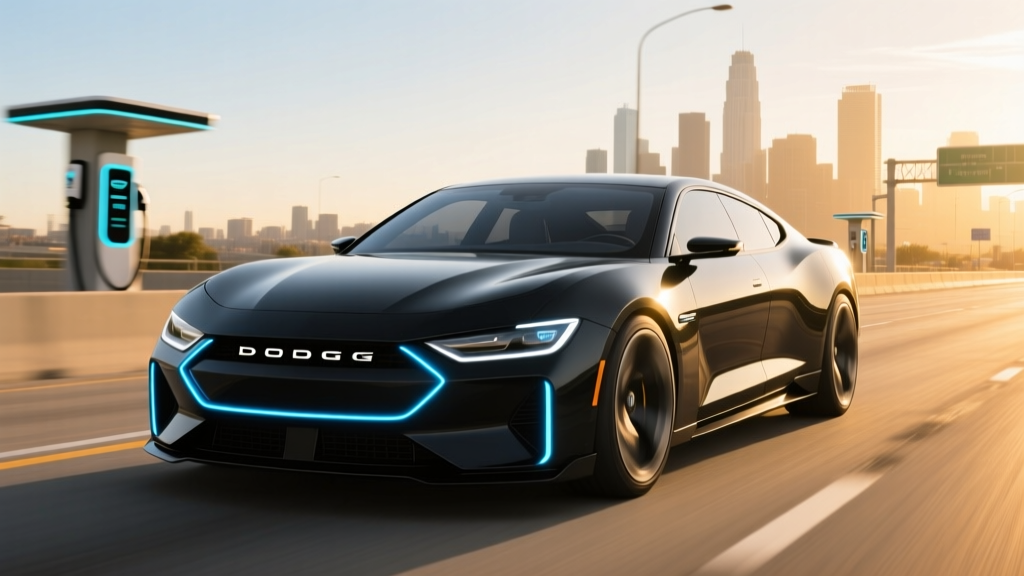
After years of teasing and concept reveals, Dodge's electric era is here — and it wears a Charger badge. The 2026 Dodge Charger Daytona is the brand's first production battery-electric vehicle, arriving as a two-door coupe (with a four-door sedan and hatchback variant also in the lineup) built on Stellantis' STLA Large platform. If you're searching for Dodge electric cars, the Charger Daytona is currently the only production model you can buy, offered in R/T and Scat Pack trims with up to 670 horsepower and an EPA-estimated 317 miles of range.
Quick Answer: Dodge Electric Cars in 2026
What's available now: The 2026 Dodge Charger Daytona (R/T and Scat Pack trims). A four-door sedan and hatchback variant join the two-door coupe.
Starting price: ~$51,990 (R/T) before incentives.
Max EPA range: 317 miles (R/T with standard battery).
Federal tax credit: Eligibility depends on battery sourcing, buyer income, and MSRP caps under IRS §30D — check current-year rules before purchasing.
Charger Daytona Lineup: Trims, Range, and Performance Specs
Dodge launched the Charger Daytona in two primary performance tiers. Both use a 100.6 kWh (gross) battery pack with NMC (nickel-manganese-cobalt) chemistry, and both feature dual-motor all-wheel drive as standard. Here's how they stack up:
| Spec | Charger Daytona R/T | Charger Daytona Scat Pack |
|---|---|---|
| Base MSRP | ~$51,990 | ~$59,990 |
| Drivetrain | Dual-motor AWD | Dual-motor AWD |
| Horsepower | 496 hp (with Direct Connection stage) | 670 hp (with Direct Connection stage) |
| 0–60 mph | 4.7 seconds | 3.3 seconds |
| Battery (gross) | 100.6 kWh NMC | 100.6 kWh NMC |
| EPA Range | 317 miles | 260 miles |
| MPGe (combined) | ~92 MPGe | ~78 MPGe |
| Peak DC Fast Charge | ~175 kW | ~175 kW |
| 10–80% DC Charge | ~27 minutes | ~27 minutes |
| Level 2 Charging (AC) | 11 kW onboard | 11 kW onboard |
| Battery Warranty | 8 yr / 100,000 mi | 8 yr / 100,000 mi |
Real-World Range vs. EPA Sticker
EPA estimate: 317 miles (R/T) / 260 miles (Scat Pack).
Expect in reality: Highway driving at 75+ mph will net roughly 250–275 miles in the R/T and 210–230 in the Scat Pack. In cold weather (below 30°F), plan for 15–25% range reduction — that 317-mile R/T could deliver closer to 240–260 miles on a frigid winter road trip. The Scat Pack's wider, stickier tires and more aggressive performance tuning are the main reason its range drops by 57 miles despite sharing the same battery.
Charging the Charger Daytona: Home and Public Networks
The Charger Daytona uses the CCS1 connector for DC fast charging (Stellantis has signaled future adoption of NACS for Tesla Supercharger access, but as of the 2026 model year, CCS remains the standard). Here's what charging looks like at each level:
| Level | Power | Speed (Approx.) | Best For |
|---|---|---|---|
| Level 1 (120V) | ~1.4 kW | ~3–4 miles/hour | Emergency top-ups only |
| Level 2 (240V) | Up to 11 kW | ~25–30 miles/hour | Daily home charging |
| DC Fast Charge | Peak ~175 kW | 10–80% in ~27 min | Road trips |
Important charging-curve reality: The 175 kW peak rate applies only in the mid-range state of charge (roughly 20–50%). Above 80%, charging speed tapers significantly to protect the NMC battery. If you're road-tripping, plan your stops around 10–80% charges rather than trying to fill to 100% — that last 20% can take as long as the first 70%.
Home charging setup: A full Level 2 home install (240V, 48-amp hardwired charger) typically costs $800–$2,200 including equipment, electrician labor, and permits, depending on whether your electrical panel needs an upgrade. A 100.6 kWh battery charging from empty to full at 11 kW takes roughly 9–10 hours — easily done overnight.
Dodge Charger Daytona EV vs. Gas Charger vs. Competing EVs
Dodge loyalists are asking the obvious question: how does the electric Charger stack up against the gas V8 Charger it replaces, and against rival EVs? Let's look at the numbers.
| Metric | Charger Daytona Scat Pack (EV) | 2023 Charger Scat Pack (6.4L V8) | Tesla Model S Plaid |
|---|---|---|---|
| Starting Price | ~$59,990 | ~$53,000 (discontinued) | ~$89,990 |
| 0–60 mph | 3.3 sec | 4.2 sec | 1.99 sec |
| HP | 670 | 485 | 1,020 |
| EPA Range | 260 mi | ~370 mi (tank) | 396 mi |
| Fuel/Energy Cost per Mile | ~$0.04–0.06 (home) | ~$0.18–0.22 (gas) | ~$0.04–0.06 |
| Annual Maintenance | ~$300–500 | ~$800–1,200 | ~$300–500 |
The performance verdict: The electric Scat Pack hits 60 mph nearly a full second quicker than the old 6.4L V8 Scat Pack — and does it with instant torque, no gear shifts, and a fraction of the per-mile energy cost. Where the gas Charger still "wins" is total highway range (370+ miles on a tank vs. 260 EV miles) and refueling speed (5 minutes at a gas station vs. 27 minutes at a DC fast charger).
Against the Tesla Model S Plaid: The Charger Daytona Scat Pack is roughly $30,000 cheaper and carries a distinctly American muscle identity. The Model S Plaid, however, offers far more range (396 vs. 260 miles), access to the Supercharger network, and blistering 1.99-second 0–60 times. If track-day bragging rights and price matter most, the Dodge wins. If range and charging convenience dominate your decision, Tesla still leads.
Total Cost of Ownership: 5-Year Breakdown
Sticker price is only part of the equation. Here's a realistic 5-year / 75,000-mile cost comparison for the Charger Daytona R/T versus the closest gas-powered equivalent:
| Category | Charger Daytona R/T (EV) | Comparable Gas Muscle Coupe |
|---|---|---|
| Purchase Price (MSRP) | $51,990 | $48,000 |
| Estimated Federal Tax Credit | Up to $7,500 (if eligible) | $0 |
| Effective Purchase Price | ~$44,490 | $48,000 |
| Fuel / Electricity (75k mi) | ~$3,000–$4,500 | ~$13,500–$16,500 |
| Maintenance (5 yr) | ~$1,500–$2,500 | ~$4,000–$6,000 |
| Insurance (5 yr est.) | ~$12,000–$15,000 | ~$10,000–$13,000 |
| Estimated Depreciation | ~$18,000–$22,000 | ~$16,000–$20,000 |
| 5-Year Total (approx.) | ~$61,000–$74,500 | ~$75,500–$87,500 |
Key takeaways: The Charger Daytona's higher MSRP is offset by the potential federal tax credit under IRS §30D, dramatically lower energy costs (especially with home charging), and reduced maintenance (no oil changes, fewer brake replacements thanks to regenerative braking). Insurance tends to run 15–25% higher on EVs due to repair costs and battery replacement risk — get quotes before buying. Depreciation on EVs has been volatile; Dodge's muscle-brand cachet may help the Charger hold value better than some EV competitors, but long-term data doesn't exist yet.
Tax credit caveats: The §30D credit of up to $7,500 has strict requirements — buyer income caps ($150K single / $300K joint), MSRP limits ($55K for sedans, $80K for SUVs/trucks), and battery critical-mineral and component sourcing rules that change annually. The Charger Daytona R/T at ~$51,990 falls under the sedan MSRP cap, but the Scat Pack at ~$59,990 may face classification questions. Always verify current-year eligibility on irs.gov and consult a tax professional.
Common Misconceptions About Dodge Electric Cars
| Myth | Fact |
|---|---|
| "The electric Charger isn't a real muscle car." | The Scat Pack does 0–60 in 3.3 seconds with 670 hp — faster than any production V8 Charger ever sold. Instant electric torque delivers the acceleration punch muscle buyers want. |
| "EV batteries need replacing every few years." | Stellantis warranties the Charger Daytona battery for 8 years / 100,000 miles against capacity loss below 70%. Industry data shows NMC batteries typically retain 85–90% capacity at 100,000 miles with normal use. |
| "You can't road-trip in an EV." | With 260–317 miles of range and 175 kW DC fast charging, the Charger Daytona can cover 500+ mile days with two 25–30 minute charge stops. The CCS network (Electrify America, EVgo, ChargePoint) covers major US highway corridors, though rural gaps remain. |
| "Charging an EV costs as much as gas." | At the US average residential rate of ~$0.16/kWh, fully charging the 100.6 kWh battery costs ~$16 — good for 260–317 miles. That's equivalent to $1.20–$1.50 per gallon of gasoline. Public DC fast charging is more expensive (~$0.35–$0.48/kWh) but still undercuts premium fuel in most states. |
| "The Charger Daytona has no sound or personality." | Dodge engineered the Fratzonic Chambered Exhaust system — a synthetic exhaust note piped through external speakers that mimics a V8 rumble. It's divisive, but it's a deliberate effort to retain muscle-car character. |
Real-World Ownership: What First-Time EV Buyers Need to Know
If the Charger Daytona is your first EV, here's what the ownership experience actually looks like day-to-day:
Home Charging Is Non-Negotiable for Convenience
Roughly 80–90% of EV charging happens at home. Without Level 2 home charging, you'll rely on public infrastructure for daily needs — which is more expensive, less predictable, and time-consuming. Before ordering, confirm you can install a 240V / 48-amp circuit in your garage or driveway. If you live in an apartment or condo without charging access, an EV may not be practical yet.
Cold Weather Cuts Range — Plan for It
NMC batteries lose efficiency in cold temperatures. In sub-freezing climates, expect 15–25% range loss. The Charger Daytona includes a heat pump for cabin heating (more efficient than resistive heating), but battery preconditioning and cabin heating still draw from the pack. If you live in Minnesota or Maine, treat the 317-mile R/T as a ~250-mile car in January.
Tire Costs Are Higher
The Charger Daytona Scat Pack runs wide, sticky performance tires that wear faster under the car's 5,800+ pound curb weight and instant torque. Budget $1,200–$2,000 for a set of replacement tires every 25,000–35,000 miles — a cost that surprises some first-time EV owners.
Regenerative Braking Saves Your Brake Pads
One-pedal driving and aggressive regen mean you'll use the friction brakes far less than in a gas car. Many EV owners report original brake pads lasting 80,000+ miles. This is a genuine long-term savings often overlooked in cost comparisons.
Decision Framework: Is the Dodge Charger Daytona Right for You?
Choose the Charger Daytona R/T if:
- You want a 300+ mile EV with muscle-car styling and a sub-$55K price point
- Daily driving is under 100 miles and you can charge at home
- You want practical AWD traction with 496 hp for occasional fun
- You qualify for the §30D federal tax credit, bringing the effective price below $45K
Choose the Charger Daytona Scat Pack if:
- Sub-3.5-second 0–60 times and 670 hp are your top priorities
- You accept 260 miles of range as a tradeoff for performance
- You plan to use the car primarily for weekend drives and shorter commutes
- You value the Dodge muscle heritage over maximum efficiency
Look elsewhere if:
- You need 350+ miles of range for frequent long-distance travel → consider the Tesla Model S or Lucid Air
- You can't install home charging → a PHEV like the Chrysler Pacifica Hybrid may be more practical
- You need a family-friendly four-door with maximum cargo space → the Charger coupe's rear seat and trunk are limited (the sedan variant offers more practicality)
- You live in a region with sparse CCS charging infrastructure and plan regular road trips
Frequently Asked Questions
Will Dodge make more electric cars beyond the Charger Daytona?
Stellantis has confirmed the STLA Large platform will underpin multiple vehicles across its brands. A Dodge-branded electric SUV is widely expected later this decade, but nothing has been officially announced with a production timeline beyond the Charger Daytona lineup. The four-door sedan and hatchback Charger variants expand the lineup for the current model year.
Does the Charger Daytona qualify for the $7,500 federal tax credit?
Eligibility depends on several factors that shift year to year: the vehicle's battery sourcing (critical minerals and component manufacturing requirements), your adjusted gross income (capped at $150K single / $300K joint filers), and MSRP limits. The R/T at ~$51,990 is under the $55K sedan cap. Always verify on irs.gov and with your tax advisor before counting on the credit.
Can I charge the Charger Daytona at a Tesla Supercharger?
As of the 2026 model year, the Charger Daytona ships with a CCS1 port. Tesla has opened some Superchargers to non-Tesla EVs with CCS connectors via the built-in adapter or through Tesla's Magic Dock at select stations, but full network access depends on ongoing Stellantis-Tesla agreements. Check the Tesla app or fueleconomy.gov for the latest compatibility maps.
How much does it cost to charge the Charger Daytona at home?
At the national average residential electricity rate of ~$0.16/kWh, a full charge of the 100.6 kWh battery costs roughly $16. For a typical daily commute of 40 miles (consuming ~12–14 kWh), you're spending about $2/day on electricity — compared to $6–$8/day in a gas muscle car getting 18–20 MPG on premium fuel.
What happens if the battery degrades?
Stellantis covers the battery for 8 years or 100,000 miles against capacity loss below 70%. Real-world data from similar NMC packs in other Stellantis EVs suggests 85–92% capacity retention at 100,000 miles under normal charging habits. Out-of-warranty battery replacement for a pack this size currently runs $12,000–$18,000, though prices are expected to decline as battery manufacturing scales.
Is the Fratzonic exhaust sound mandatory?
No. The Fratzonic Chambered Exhaust system can be turned off or adjusted through drive mode settings. In stealth mode, the Charger Daytona is as quiet as any other EV. In performance modes, it generates a synthetic rumble calibrated to mimic a Hemi V8. Reactions are mixed — some owners love the character, others prefer the silence.