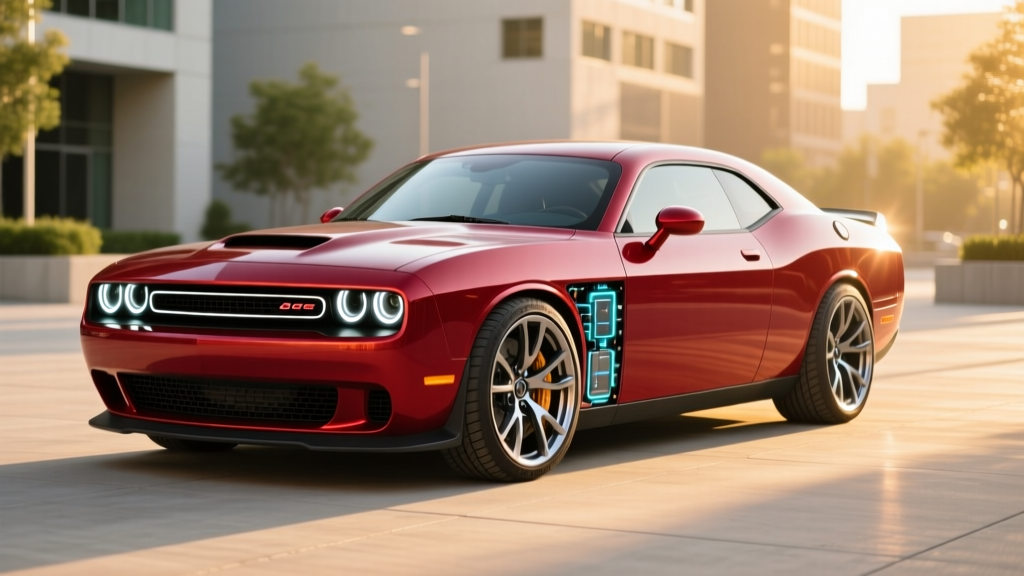
Quick Answer: As of 2026, Dodge has not released a production Challenger EV. Stellantis confirmed an electric successor to the Challenger is in development, previewed by the Dodge Charger Daytona SRT concept and subsequent production announcements. The gas-powered Challenger ended production in December 2023. If you're searching for a "Challenger EV" to buy today, none exists yet — but here's everything confirmed so far, plus realistic ownership projections based on the Charger Daytona EV platform that will underpin it.
The End of an Era and the Electric Muscle Car Pivot
The Dodge Challenger — along with its Charger sedan sibling — rolled off the Brampton, Ontario assembly line for the final time in late 2023, closing the chapter on Dodge's HEMI V8 muscle car era. Stellantis, Dodge's parent company, committed to an electrified successor lineup built on the new STLA Large platform, a flexible architecture supporting both battery-electric and internal combustion powertrains.
The production Dodge Charger Daytona EV (the two-door coupe variant) was announced with preliminary specifications, and a four-door Charger sedan EV variant followed. A Challenger-branded EV — whether as a distinct nameplate or folded into the Charger coupe lineup — is widely expected to share this platform, battery options, and powertrain hardware. Until Dodge issues a formal Challenger EV press release with specs and pricing, everything below should be treated as announced/estimated based on the confirmed Charger Daytona EV platform.
Projected Challenger EV Specs: Platform, Battery, and Performance
The STLA Large platform is engineered for high-performance applications. Based on Stellantis disclosures and the Charger Daytona EV production specs, here are the projected figures for a Challenger-badged EV variant:
| Specification | Estimated (R/T Trim) | Estimated (Scat Pack / SRT Trim) |
|---|---|---|
| Platform | STLA Large (BEV) | |
| Battery Chemistry | NMC (nickel manganese cobalt) | |
| Battery Capacity (usable) | ~92 kWh | ~100 kWh |
| EPA Range (est.) | ~300–320 miles | ~260–280 miles |
| Horsepower | ~496 hp | ~670 hp |
| 0–60 mph (est.) | ~4.5 sec | ~3.3 sec |
| Drivetrain | RWD (single motor) | AWD (dual motor) |
| Peak DC Fast Charge | ~350 kW (800V architecture) | |
| 10–80% DC Charge Time (est.) | ~23–27 minutes | |
| Level 2 AC Charge Rate | ~11.5 kW ( onboard charger) | |
| Connector | NACS (Tesla Supercharger compatible) | |
Real-World Range Reality: A 310-mile EPA estimate would likely translate to roughly 240–260 miles in sustained highway driving at 70–80 mph, and potentially 190–220 miles in sub-freezing winter conditions. Muscle car EVs tend to prioritize acceleration over efficiency — expect consumption around 35–40 kWh/100mi in spirited driving, which erodes range quickly. These are projections; final EPA certification numbers will come closer to launch.
How an Electric Challenger Compares to the Gas Car It Replaces
For buyers cross-shopping a used 2023 Challenger against a future Challenger EV, or weighing the EV against a gas sports coupe, the differences are significant. Here's a data-driven comparison using the final-model-year 2023 Challenger R/T (5.7L HEMI V8) as the gas baseline:
| Metric | 2023 Challenger R/T (Gas) | Challenger EV (Projected R/T) |
|---|---|---|
| Horsepower | 375 hp | ~496 hp |
| 0–60 mph | ~5.0 sec | ~4.5 sec |
| Fuel/Energy Cost per Mile | ~$0.19/mi (20 MPG combined, $3.80/gal) | ~$0.05–0.07/mi (home L2 at $0.14/kWh) |
| Annual Fuel/Energy (12,000 mi) | ~$2,280 | ~$600–$840 |
| Annual Maintenance | ~$600–$900 (oil, filters, brakes) | ~$200–$350 (tires, cabin filter, wipers) |
| EPA Range / Tank Range | ~340 miles (18.5 gal tank) | ~300–320 miles (est.) |
| "Refuel" Time | ~5 minutes | ~25 min (10–80% DC fast charge) |
| Emissions (tailpipe) | ~400 g CO₂/mile | 0 g (grid-dependent upstream) |
The EV variant delivers substantially more horsepower and dramatically lower per-mile operating costs. The trade-offs are longer refueling times on road trips, higher upfront purchase price (projected), and the need for reliable home or workplace charging access to capture the full cost advantage.
Real Ownership Costs: What a Challenger EV Buyer Should Budget
Understanding the total cost of ownership (TCO) is critical for a performance EV. Here's a projected 5-year breakdown assuming a $55,000 purchase price (estimated mid-range trim), 12,000 miles/year, and home Level 2 charging as the primary source:
| Cost Category (5 Years) | Challenger EV (Projected) | 2023 Challenger R/T (Gas Baseline) |
|---|---|---|
| Purchase Price (MSRP est.) | $55,000 | $43,000 (2023 MSRP) |
| Federal Tax Credit (§30D) | $0–$7,500 (see eligibility below) | $0 |
| Energy / Fuel | $3,500 (home + some DCFC) | $11,400 |
| Maintenance | $1,500 | $4,000 |
| Insurance (est.) | $12,000–$15,000 | $8,500–$11,000 |
| Home Charger Install (L2) | $800–$2,000 (one-time) | $0 |
| Tires (performance compound) | $3,000–$4,000 | $2,500–$3,500 |
| Estimated 5-Year Total | $68,300–$75,000 | $69,400–$72,900 |
Key takeaways: The EV's lower fuel and maintenance costs partially offset a higher purchase price and notably higher insurance premiums. Performance EVs routinely carry 20–40% higher insurance rates than gas equivalents due to repair costs and parts pricing. If you qualify for the full $7,500 federal tax credit, the 5-year totals become very competitive.
Federal Tax Credit Eligibility: §30D Rules for 2026
The IRS §30D Clean Vehicle Credit offers up to $7,500, but eligibility hinges on several requirements that change annually. For 2026, the key rules include:
- MSRP Cap: The vehicle must have an MSRP at or below $55,000 for sedans/coupes (SUVs and trucks have a higher $80,000 cap — classification matters and is determined by the IRS).
- Buyer Income Limits: Adjusted gross income must not exceed $150,000 (single), $225,000 (head of household), or $300,000 (joint filing).
- Battery Component Sourcing: A percentage of battery components must be manufactured or assembled in North America (thresholds increase yearly).
- Critical Minerals: A percentage of critical minerals must be sourced from the U.S. or free-trade-agreement partners.
- Point-of-Sale Transfer: Eligible buyers can transfer the credit to the dealer at purchase, reducing the sale price directly rather than waiting for a tax refund.
- FEOC Restriction: Vehicles with battery components from a "foreign entity of concern" (primarily Chinese manufacturers) are disqualified.
Given Stellantis's North American manufacturing footprint, a U.S.-built Challenger EV has a reasonable path to partial or full credit eligibility — but the final battery sourcing and MSRP will determine the actual amount. Consult a tax professional and check the latest fueleconomy.gov credit listings when the vehicle launches.
Charging at Home and on the Road: What Muscle Car EV Owners Need
Performance EVs with large battery packs demand thoughtful charging planning. Here's what to expect:
Home Level 2 Charging: With an 11.5 kW onboard charger and a ~100 kWh battery, a full charge from 10% to 100% takes roughly 8.5–9 hours — ideal for overnight replenishment. A 48-amp Level 2 home charger (requiring a 60-amp circuit) costs approximately $500–$800 for the unit plus $500–$1,500 for professional installation by a licensed electrician. If your home electrical panel is older or at capacity, a panel upgrade can add $1,500–$3,000.
DC Fast Charging (Road Trips): The 800V architecture and ~350 kW peak charge rate mean the battery can recover roughly 150–180 miles of range in 15 minutes at a compatible high-power station. However, sustained charge rates taper significantly above 80% State of Charge (SoC) — the charge curve is not linear. Real-world 10–80% sessions will average closer to 200–250 kW, not the 350 kW peak.
NACS Connector: Stellantis has committed to the NACS (North American Charging Standard) connector for its EVs, granting access to Tesla Supercharger stations — the most reliable and widespread DC fast-charging network in the U.S. This is a significant practical advantage over vehicles still using CCS1 that rely on Electrify America or EVgo.
Common Challenger EV Misconceptions
| Myth | Fact |
|---|---|
| "An EV muscle car won't feel fast." | Electric motors deliver instant torque with no turbo lag or transmission shift delay. A 670-hp dual-motor EV hits 0–60 in ~3.3 seconds — faster than a 2023 Challenger Hellcat Redeye off the line. |
| "The battery will need replacing in 5 years." | Modern NMC batteries with active thermal management typically retain 85–90% capacity after 100,000 miles. Stellantis is expected to offer an 8-year/100,000-mile battery warranty (the federal minimum for EVs). |
| "I can't take it on road trips." | With ~300 miles of range and 15-minute fast-charge stops every 200–220 miles, a 600-mile trip adds roughly 30–45 minutes of total charging time compared to gas stops. |
| "It will sound like a golf cart." | Dodge has developed a "Fratzonic" exhaust sound system that uses a tuned amplifier and chamber to project aggressive exhaust-like notes. Whether you love or hate it, it's far from silent. |
| "I'll save a fortune on fuel." | Home charging at $0.14/kWh delivers roughly $0.05/mile — yes, a major savings. But frequent DC fast charging at $0.35–$0.50/kWh brings cost per mile to $0.12–$0.18, narrowing the gap with gas significantly. |
Should You Wait for the Challenger EV? A Decision Framework
Wait for the Challenger EV if:
- You have reliable home Level 2 charging access (garage or driveway with a 240V circuit).
- Your daily driving is under 100 miles and you take road trips fewer than 6 times per year.
- You want muscle-car performance with dramatically lower per-mile operating costs.
- You're not in a rush — production timing is still uncertain, and early model-year vehicles often carry premium pricing and limited trim availability.
- You qualify for the §30D tax credit based on income and can benefit from point-of-sale transfer.
Consider alternatives now if:
- You rely exclusively on apartment/condo living with no charging access — public-only charging erodes cost savings and adds inconvenience.
- You live in a region with extreme cold (sustained temps below 15°F) and regularly drive over 200 miles — cold-weather range loss of 25–35% is real and compounds on long trips.
- You need a vehicle within 3–6 months — the Challenger EV timeline is unconfirmed.
- Budget is the top priority — a used 2023 Challenger R/T at $30,000–$38,000 will be significantly cheaper upfront, even with higher fuel costs.
If you want electric performance today and can't wait, consider the Tesla Model S Plaid (396-mile EPA range, 1,020 hp, ~$89,990), the BMW i4 M50 (270-mile range, 536 hp, ~$69,700), or the Ford Mustang Mach-E GT (280-mile range, 480 hp, ~$59,990) as available electric performance alternatives. None carry the Challenger nameplate, but all deliver serious acceleration with real-world usability.
Frequently Asked Questions
Is there a Dodge Challenger EV I can buy in 2026?
No. As of 2026, Dodge has not released a production Challenger EV for sale. The gas-powered Challenger ended production in December 2023. An electric successor is in development on the STLA Large platform, sharing architecture with the Dodge Charger Daytona EV, but no official on-sale date or final specifications have been published for a Challenger-branded variant.
How much will the Challenger EV cost?
Dodge has not announced pricing. Based on the Charger Daytona EV's positioning and the outgoing Challenger's price range ($36,000–$90,000+ depending on trim), industry estimates place a base Challenger EV R/T around $50,000–$55,000, with high-performance SRT variants potentially exceeding $70,000. Final MSRP will determine §30D tax credit eligibility (the coupe/sedan cap is $55,000).
Will the Challenger EV have a V8 sound?
Not a real V8, no. Dodge's "Fratzonic" chambered exhaust system uses an amplifier and tuned acoustic chamber to generate aggressive sound profiles, including idle rumble, acceleration crescendo, and deceleration pops. It's synthetic, but Dodge has invested heavily in making it emotionally compelling for muscle car loyalists. Early reviews of the system in the Charger Daytona EV suggest it's polarizing but undeniably attention-grabbing.
Can the Challenger EV do a burnout or drag strip runs?
Dodge has historically prioritized drag-strip capability in its SRT models. The Charger Daytona EV Scat Pack has been advertised with launch control and line-lock features (front brake lock for burnouts). Expect a Challenger EV variant to include similar performance modes, though sustained track use will generate significant battery heat and trigger thermal management interventions that limit repeated full-power launches.
What charger do I need at home for a Challenger EV?
A 48-amp Level 2 home charger on a dedicated 60-amp, 240V circuit is recommended. This delivers ~11.5 kW to the vehicle, fully replenishing a ~100 kWh battery overnight in roughly 8–9 hours. Budget $1,000–$2,500 total for equipment and professional installation by a licensed electrician. Homes with older 100-amp electrical panels may need a panel upgrade ($1,500–$3,000 additional).
Will it qualify for the $7,500 federal EV tax credit?
Possibly, but it depends on the final MSRP and battery sourcing. The §30D credit requires the vehicle MSRP to be at or below $55,000 (for coupes/sedans), the buyer's income to be under IRS thresholds, and battery components and critical minerals to meet North American sourcing requirements. Stellantis's U.S. manufacturing base is favorable, but final eligibility won't be confirmed until the vehicle's battery supply chain is certified. Check IRS.gov and fueleconomy.gov at launch for the definitive answer.