Quick Answer: Do You Have to Pay to Charge Your Electric Car?
Yes, in most cases you do pay to charge an electric car — but how much depends entirely on where and how you charge. Home Level 2 charging on a residential electricity plan averages $0.13–$0.17 per kWh nationally in 2026, which translates to roughly $3.50–$5.50 for a full charge on a typical 60–80 kWh battery. Public DC fast charging costs significantly more — often $0.35–$0.55 per kWh — while a shrinking number of workplaces, hotels, and municipal lots still offer free Level 2 charging. The bottom line: an EV driver who charges primarily at home spends about $500–$700 per year on electricity for 12,000 miles of driving, compared to $1,400–$1,800 in gasoline for an equivalent 27 MPG gas car.
Where You Charge Determines What You Pay
Not all electrons cost the same. The single biggest variable in EV charging cost is location. Here is how the three main charging environments break down for a typical EV owner in 2026.
Home Charging (Level 1 and Level 2)
Home charging is where 70–80% of all EV charging happens, and it is by far the cheapest option. You are paying your utility's residential electricity rate, which the U.S. Energy Information Administration (EIA) reports averages around $0.16 per kWh nationally as of early 2026 — though rates range from under $0.10/kWh in states like Louisiana and Idaho to over $0.30/kWh in Hawaii and parts of California.
Level 1 (120V standard outlet) delivers about 1.4 kW and adds roughly 3–5 miles of range per hour. It costs nothing extra beyond your existing electricity — no special equipment needed beyond the mobile cord that ships with most EVs.
Level 2 (240V, like a dryer outlet or hardwired wall charger) delivers 7–11.5 kW and adds 25–44 miles of range per hour. The electricity cost per kWh is identical to Level 1; you are simply charging faster. The hardware and installation are the added expense (more on that below).
Public DC Fast Charging
DC fast chargers — Tesla Superchargers, Electrify America, EVgo, ChargePoint — are the most expensive way to charge. Pricing models vary: some networks charge per kWh, others per minute, and some use a hybrid. In 2026, expect to pay:
- Tesla Supercharger (V3/V4): $0.28–$0.42/kWh depending on location and time of day
- Electrify America: $0.43–$0.56/kWh (guest rate); $0.36–$0.48/kWh with a Pass+ subscription ($4/month)
- EVgo: $0.38–$0.52/kWh depending on market
- Non-Tesla NACS/CCS chargers: $0.35–$0.55/kWh typical
At $0.45/kWh, fully charging an 82 kWh battery (like a Tesla Model Y Long Range) from 10% to 100% costs roughly $33–$37. That is comparable to filling a gas tank — which is precisely why frequent DC fast charging erodes the EV cost advantage.
Free and Subsidized Charging
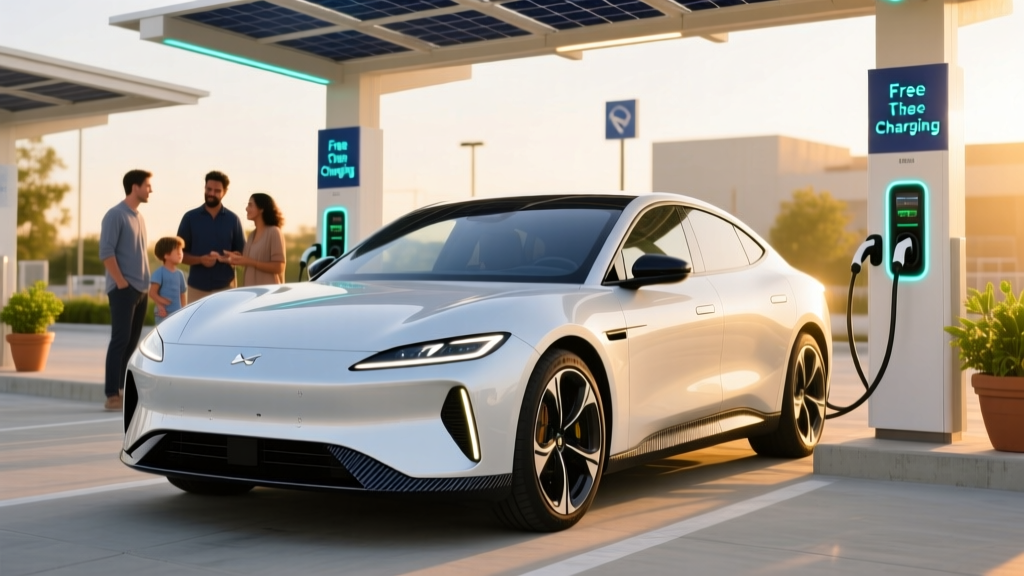
Free public charging still exists but is becoming less common as networks monetize their infrastructure. You can find it at:
- Some workplace parking garages (employer-subsidized)
- Select hotels and resorts (guest amenity, usually Level 2)
- Municipal lots in cities promoting EV adoption
- Auto manufacturer promotional programs — for example, some 2026 Hyundai and Kia EVs include complimentary Electrify America charging for a limited period
Do not build your ownership plan around free charging. Treat it as a bonus when available.
EV Charging Cost vs. Gasoline: The Real Numbers
The most common question from prospective EV buyers is whether charging is actually cheaper than buying gas. Let us compare a popular EV against a comparable gas vehicle using real 2026 data.
| Metric | 2026 Tesla Model Y Long Range (AWD) | 2026 Toyota RAV4 (AWD, Gas) |
|---|---|---|
| EPA Efficiency | 122 MPGe combined (28 kWh/100 mi) | 30 MPG combined |
| Energy/Fuel Needed for 12,000 mi | 3,360 kWh | 400 gallons |
| Home Charging Cost ($0.16/kWh) | $538/year | — |
| Public DCFC Cost ($0.45/kWh avg) | $1,512/year | — |
| Gasoline Cost ($3.45/gal avg) | — | $1,380/year |
| Annual Savings (Home Charging vs Gas) | EV saves ~$842/year | |
| Annual Savings (100% DCFC vs Gas) | EV costs ~$132 MORE/year | |
The data makes one thing clear: home charging is where the savings live. If you charge exclusively on public DC fast chargers at current rates, you may actually spend more than a gas car owner. The EV cost advantage depends on access to affordable home or workplace electricity.
Total Cost of Ownership: Beyond the Charger
Charging cost is just one line item. A serious purchase decision requires looking at the full five-year ownership picture. Here is a realistic breakdown comparing a mid-range EV against a comparable gas crossover, using data from fueleconomy.gov and current market pricing.
| Cost Category | 2026 EV (e.g., Hyundai Ioniq 5 SEL, ~$46,000 MSRP) | 2026 Gas Crossover (e.g., Toyota RAV4 XLE, ~$33,000 MSRP) |
|---|---|---|
| Purchase Price (after §30D credit) | $38,500 (if eligible for $7,500 point-of-sale credit) | $33,000 |
| Fuel/Energy (5 years, home charging) | $2,690 | $6,900 |
| Maintenance (5 years) | $1,200 (tire rotations, cabin filter, brake fluid) | $3,200 (oil changes, filters, brakes, spark plugs) |
| Insurance (5-year avg) | $9,500 (EV premiums ~15–20% higher) | $7,800 |
| Depreciation (est. 5-yr) | $18,000 | $14,000 |
| Total 5-Year Cost | ~$69,890 | ~$64,900 |
The EV still costs somewhat more over five years in this scenario, primarily due to higher depreciation and insurance. However, the gap narrows significantly if your state offers additional rebates, if you drive more than 12,000 miles per year (amplifying fuel savings), or if you keep the vehicle beyond five years (where EV maintenance savings compound). The IRS §30D clean vehicle credit can shift the purchase-price equation dramatically — but eligibility depends on MSRP caps ($55,000 for cars, $80,000 for SUVs/trucks), buyer income limits ($150K single / $300K joint), and battery critical-mineral sourcing requirements that change annually.
Home Charging Installation: The Upfront Cost Most Buyers Overlook
If you are asking "do you have to pay to charge your electric car," you also need to ask how much it costs to set up home charging. Level 1 (standard 120V outlet) is essentially free if you can park near an existing outlet. But for practical daily use, most EV owners install a Level 2 home charger.
Typical Level 2 Installation Costs
- Level 2 charger hardware (e.g., ChargePoint Home Flex, Wallbox Pulsar Plus, Tesla Wall Connector): $350–$700
- Electrician labor (240V circuit, 40–60 amp): $500–$2,000 depending on panel proximity and conduit run length
- Electrical panel upgrade (if needed, 100A → 200A): $1,500–$3,500
- Permits: $50–$200 depending on municipality
Best case (panel nearby, no upgrade): $850–$1,500 total. Worst case (panel upgrade required, long conduit run): $3,000–$5,500. Some utilities and state programs offer rebates of $250–$1,000 for home charger installation — check your local utility's EV programs page. Always hire a licensed electrician and pull the required permits; improper 240V wiring is a fire risk.
Common EV Charging Myths — Addressed with Facts
| Myth | Fact |
|---|---|
| "Charging an EV is free at public stations." | Free public chargers are increasingly rare. Most networks charge $0.35–$0.55/kWh for DC fast charging. Budget accordingly. |
| "EVs cost more to fuel than gas cars." | Only if you rely 100% on expensive public DC fast charging. Home-charged EVs cost roughly 60% less per mile than a 27 MPG gas car at 2026 electricity and gas prices. |
| "You need to install an expensive charger to own an EV." | Level 1 (120V) charging adds 3–5 miles per hour and costs nothing to set up. If you drive under 40 miles per day and can park near an outlet, Level 1 may suffice. Most owners do upgrade to Level 2 for convenience. |
| "Electricity rates are the same everywhere." | Residential rates range from ~$0.10/kWh (Louisiana, Idaho) to over $0.30/kWh (Hawaii, parts of California). Time-of-use plans can reduce EV charging costs to $0.05–$0.08/kWh during off-peak hours in some markets. |
| "Charging takes too long to be practical." | At home on Level 2, most EVs charge from 20% to 80% overnight in 4–6 hours. On a road trip, a modern EV with 200+ kW peak DC charging (like the Ioniq 5 or Model Y) adds 150–200 miles in 15–20 minutes at a compatible fast charger. |
Real-World Variables That Change Your Charging Bill
Published efficiency numbers assume ideal conditions. In practice, several factors shift your per-mile charging cost meaningfully.
Climate and Temperature
Cold weather increases energy consumption by 15–30% due to battery heating demands and cabin climate use. A Model Y rated at 28 kWh/100 mi in mild weather may consume 35–38 kWh/100 mi at 20°F. This means higher electricity costs in winter — and reduced regenerative braking efficiency, which further increases consumption.
Driving Patterns
Highway driving at 75+ mph is significantly less efficient than city driving for EVs (the opposite of gas cars, which benefit from steady highway speeds). An EV rated at 120 MPGe combined may achieve only 100 MPGe equivalent on sustained 80-mph highway runs, raising per-mile costs.
Time-of-Use Electricity Plans
Many utilities now offer time-of-use (TOU) rates that make overnight charging dramatically cheaper. In California, PG&E's EV rate plan offers off-peak rates as low as $0.10/kWh between midnight and 3 PM, compared to peak rates exceeding $0.45/kWh on summer evenings. Programming your EV or charger to charge only during off-peak hours can cut your home charging bill nearly in half.
Charging-Curve Taper on DC Fast Chargers
When using paid public DC fast chargers, understand that peak charge rates (e.g., 250 kW) are sustained only between roughly 10–50% state of charge. Above 80%, charging slows dramatically — sometimes to under 30 kW. If a network charges per minute (rather than per kWh), lingering above 80% SoC means you are paying for time while receiving very little energy. Best practice on a road trip: charge from 10% to 80% and move on.
Decision Framework: Is an EV Right for Your Budget?
Choose an EV if:
- You have access to home or workplace Level 2 charging (this is the single most important factor)
- Your daily commute is under 80 miles round-trip (most 2026 EVs handle this easily, even in cold weather)
- You qualify for the federal §30D tax credit or state incentives that narrow the purchase-price gap
- You plan to keep the vehicle 5+ years, where maintenance and fuel savings compound
- Your utility offers time-of-use rates that make overnight charging under $0.12/kWh
Consider a Hybrid (HEV/PHEV) Instead if:
- You live in an apartment or condo with no charging access and no realistic path to installing a charger
- You regularly drive 300+ miles between stops in areas with sparse charging infrastructure
- Your budget cannot absorb the higher upfront cost, even after tax credits
- You experience extreme cold (below 0°F) regularly, where EV range loss exceeds 30%
A Plug-in Hybrid (PHEV) May Be the Best Compromise if:
- You can install Level 2 at home and your daily commute is under 35 miles (covering most 2026 PHEVs' electric-only range)
- You want electric commuting without range anxiety on long road trips
- You are not ready to fully commit to a BEV but want to reduce gas consumption by 60–80%
Frequently Asked Questions
Can I charge my EV for free?
Sometimes, but do not count on it. Some workplaces, shopping centers, and hotels offer complimentary Level 2 charging. A few automakers include limited free DC fast charging with new EV purchases (e.g., 2 years / 1,000 kWh). However, free public chargers are disappearing as networks prioritize revenue. Plan your budget around paid charging and treat free sessions as a bonus.
How much does it cost to charge an EV at home per month?
For a driver covering 1,000 miles per month in an EV averaging 30 kWh/100 mi, at the national average rate of $0.16/kWh, the monthly home charging cost is approximately $48. With an off-peak TOU rate of $0.10/kWh, that drops to about $30/month. Compare that to $115–$150/month in gasoline for a 27 MPG car driving the same distance.
Is public DC fast charging worth the cost?
For road trips, absolutely — it is the only practical option for long-distance travel. For daily use, frequent DC fast charging is both expensive (often 3–4x the cost of home charging) and slightly harder on your battery long-term due to heat generation. Most EV owners use DC fast charging for 10–20% of their total charging and rely on home Level 2 for the rest.
Does charging an EV increase my electric bill significantly?
Yes, your electric bill will go up — but your gas bill disappears entirely. The net effect is almost always a savings. Adding 3,000–4,000 kWh of EV charging per year typically increases a household electric bill by $400–$640 at average rates, while eliminating $1,200–$1,800 in annual gasoline spending.
What happens if I can't charge at home?
Without home charging, EV ownership is more expensive and less convenient. You will rely on public Level 2 and DC fast chargers, which cost $0.20–$0.55/kWh. Some apartment dwellers manage using workplace charging combined with occasional DC fast charging sessions. However, if home charging is truly impossible, a hybrid (HEV) or plug-in hybrid (PHEV) is usually a more practical and cost-effective choice in 2026.
Do I pay to charge my electric car while it's plugged in but not actively charging?
Most modern EVs and smart chargers stop drawing current once the battery reaches its target state of charge. However, some public networks impose idle fees (e.g., Tesla charges $0.50–$1.00/minute if you remain plugged in after charging is complete and the station is busy). At home, the standby power draw is negligible — typically under 5 watts, or about $0.01/day.