The Short Answer: No, EVs Don't Need Oil Changes
Battery-electric vehicles (BEVs) have no internal combustion engine, which means there's no engine oil to drain, no oil filter to swap, and no scheduled oil change — ever. A typical gas car owner spends $150–$300 per year on oil changes alone (2–3 changes at $50–$100 each for conventional or synthetic). Over a 10-year ownership period, that's $1,500–$3,000 you'll never pay with an EV.
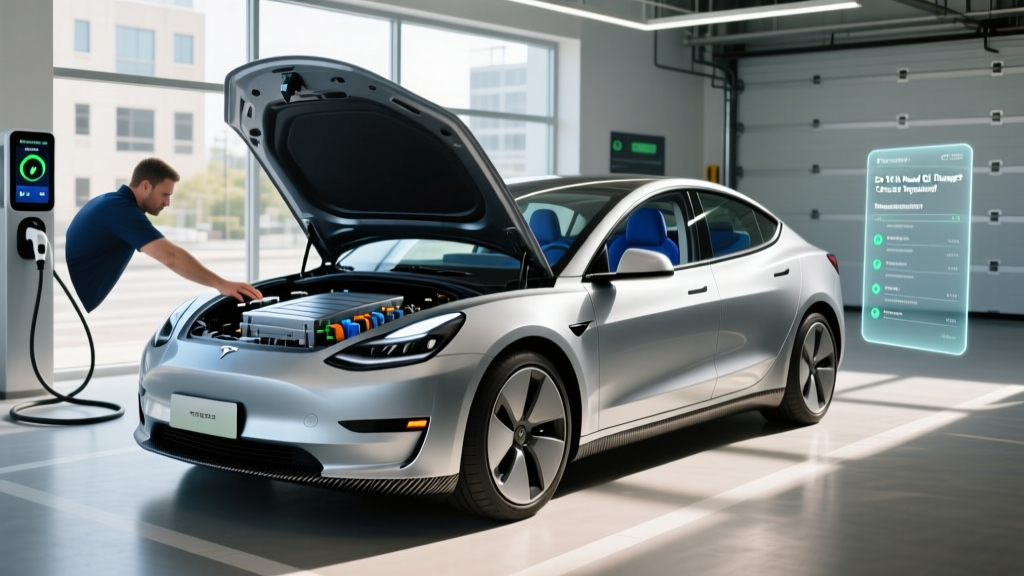
But "no oil changes" doesn't mean "no maintenance." EVs still require cabin air filters, brake fluid checks, coolant service, tire rotations, and windshield washer fluid. The difference is scale: the U.S. Department of Energy estimates EV maintenance costs at roughly $0.061 per mile compared to $0.101 per mile for gasoline vehicles — a savings of about $0.04 per mile, or $600 per year at 15,000 miles driven annually.
Why Electric Vehicles Skip the Oil Change Entirely
A gasoline engine contains hundreds of moving parts — pistons, valves, crankshafts, camshafts — all rubbing together at thousands of RPM. Engine oil lubricates those surfaces, absorbs heat, and captures metal particulates. Over time, oil breaks down and contaminates, requiring regular replacement.
An EV's electric motor has essentially one moving part: the rotor spinning inside the stator. There are no piston rings to wear, no valve trains to lubricate, and no combustion byproducts contaminating any fluid. The motor itself requires zero scheduled lubrication service under normal operation.
This fundamental mechanical difference is why manufacturers like Tesla, Hyundai, and Ford don't include oil changes in their EV maintenance schedules. The U.S. Department of Energy's fueleconomy.gov confirms that BEVs have significantly fewer maintenance requirements than their gasoline counterparts due to the elimination of the internal combustion engine and its associated fluids.
EV Maintenance: What You Actually Still Need
EVs aren't maintenance-free — they're maintenance-reduced. Here's what you'll still pay for, with typical intervals and costs based on current manufacturer schedules for popular models like the Tesla Model Y, Hyundai Ioniq 5, and Ford Mustang Mach-E:
| Service Item | Typical Interval | Average Cost | Notes |
|---|---|---|---|
| Tire rotation | Every 6,000–10,000 mi | $25–$60 | EVs are heavier and deliver instant torque — tires wear faster, especially on the drive axle |
| Cabin air filter | Every 15,000–20,000 mi | $30–$80 | HEPA filters (e.g., Tesla's Bioweapon Defense Mode) cost more but last longer |
| Brake fluid check/flush | Every 2–4 years | $80–$150 | Regenerative braking reduces pad wear dramatically, but fluid still absorbs moisture over time |
| Coolant service | Every 5–10 years (varies) | $100–$250 | Battery thermal management systems use dedicated coolant loops — check your owner's manual for intervals |
| Windshield washer fluid | As needed | $5–$15 | Same as any car |
| Wiper blades | Every 6–12 months | $20–$60 | Same as any car |
| 12V auxiliary battery | Every 3–5 years | $150–$300 | EVs still use a 12V battery for electronics — it can fail just like in a gas car |
| Brake pads (if needed) | 80,000–150,000+ mi | $200–$400/axle | Regen braking does most of the work; many EV owners report original pads at 100,000+ miles |
Estimated annual EV maintenance total: $200–$400, depending on your model and driving habits. Compare that to $800–$1,500+ annually for a comparable gas vehicle when you add oil changes, transmission fluid, spark plugs, air filters, and more frequent brake service.
EV vs Gas vs Hybrid: Full Maintenance Comparison
To put the oil-change question in context, here's how the three powertrain types compare on ongoing maintenance over a realistic 5-year/75,000-mile ownership window:
| Maintenance Item | Battery EV (BEV) | Plug-In Hybrid (PHEV) | Gas Vehicle (ICE) |
|---|---|---|---|
| Oil changes | $0 | $750–$1,500 | $750–$1,500 |
| Engine air filter | $0 (no engine) | $100–$200 | $100–$200 |
| Spark plugs | $0 | $200–$400 | $200–$400 |
| Transmission fluid | $0–$150 (single-speed reducer) | $150–$300 | $150–$300 |
| Brake pads | $0–$400 (regen saves pads) | $200–$500 | $400–$800 |
| Exhaust/emissions | $0 | $0–$300 | $0–$500 |
| Coolant | $100–$250 | $100–$250 | $100–$250 |
| Tires | $800–$1,400 (heavier vehicle) | $600–$1,200 | $600–$1,200 |
| Cabin filter, wipers, misc. | $300–$500 | $300–$500 | $300–$500 |
| 5-Year Estimated Total | $1,200–$2,700 | $2,350–$5,150 | $3,000–$5,950 |
The numbers are clear: a BEV saves roughly $1,500–$3,500 in maintenance over five years compared to a gas car. PHEVs fall in the middle — they still have an engine that needs oil changes, but the electric motor handles low-speed driving, reducing some engine wear and extending brake life through regen.
The Hidden Maintenance Question: Tires and the 12V Battery
Two maintenance items catch first-time EV owners off guard:
Tire Wear Is Real — and More Expensive
EVs are heavy. A Tesla Model Y Long Range weighs about 4,398 lbs; a Ford F-150 Lightning pushes past 6,000 lbs. Combined with instant torque delivery, that weight accelerates tire wear — particularly on the driven wheels. Many EV owners report needing new tires at 25,000–35,000 miles instead of the 40,000–60,000 miles typical for gas cars.
Budget for EV-specific tires (like the Michelin e.Primacy or Hankook iON evo) designed for low rolling resistance and noise reduction. Expect to pay $200–$350 per tire for a mid-size EV. Rotate every 6,000 miles to maximize lifespan.
The 12V Battery Can Still Die
Every EV still carries a conventional 12-volt lead-acid or lithium auxiliary battery that powers the electronics, door locks, and infotainment before the main traction battery engages. This battery can fail after 3–5 years, just like in a gas car. A dead 12V battery will prevent the car from starting even if the main battery is fully charged. Replacement runs $150–$300. Some newer models (including certain 2025+ Tesla and Hyundai vehicles) have moved to 12V lithium batteries with longer lifespans, but it's still an item to watch.
What About Hybrids? Do PHEVs Need Oil Changes?
Yes. Plug-in hybrids like the Toyota RAV4 Prime (42 miles EPA electric-only range, 94 MPGe combined) and the Jeep Wrangler 4xe (22 miles electric-only) still have gasoline engines that require regular oil changes. However, because the electric motor handles a significant portion of driving — especially city miles — the engine runs less often, and some owners can stretch intervals slightly.
Toyota recommends oil changes every 10,000 miles or 12 months for the RAV4 Prime using 0W-16 synthetic oil. That's fewer changes than a conventional RAV4 gas model driven the same distance, but the cost isn't zero. Expect to pay $60–$100 per change, or roughly $150–$250 per year for an average driver.
Standard hybrids (HEVs) like the Toyota Prius also require oil changes on the same schedule as their gas-only counterparts — the electric motor assists but doesn't replace the engine.
Total Ownership Cost: Where Maintenance Savings Actually Matter
Maintenance is one line item in the total cost of ownership (TCO). Here's how a popular EV stacks up against a comparable gas vehicle over 5 years at 15,000 miles/year, using representative 2026 pricing:
| Cost Category | 2026 Tesla Model Y Long Range (AWD) | 2026 Toyota RAV4 XLE (AWD Gas) |
|---|---|---|
| Base MSRP | $44,990 | $33,500 |
| Federal tax credit (§30D) | Up to $7,500 (subject to income, sourcing, MSRP caps — verify at IRS.gov) | $0 |
| Effective purchase price | ~$37,490 | $33,500 |
| Fuel/energy (5 yr) | ~$3,400 (at $0.14/kWh avg, 3.5 mi/kWh) | ~$9,400 (at $3.50/gal, 29 MPG combined) |
| Maintenance (5 yr) | ~$1,800 | ~$4,200 |
| Insurance (5 yr avg) | ~$11,500 | ~$8,500 |
| Depreciation (5 yr est.) | ~$18,000 | ~$14,000 |
| 5-Year Total Cost | ~$72,190 | ~$69,600 |
Even after eliminating oil changes and slashing maintenance and fuel costs, the Model Y's higher purchase price and insurance premiums keep its 5-year TCO slightly above the RAV4. The gap narrows significantly if you qualify for the full §30D credit, charge primarily at home on low electricity rates, or drive more than 15,000 miles/year. The maintenance savings alone — about $2,400 over five years — are meaningful but won't single-handedly close the upfront price gap.
Decision Framework: Is an EV Right for Your Maintenance Budget?
Choose a Battery EV (BEV) If:
- You want to eliminate oil changes, spark plugs, and engine-related maintenance entirely
- You have access to home Level 2 charging (a 240V outlet or installed charger) — this is critical for convenience and cost savings
- You drive 12,000+ miles/year, where fuel and maintenance savings compound fastest
- You qualify for the §30D federal tax credit (income caps: $150K single / $300K joint; vehicle MSRP caps: $55K cars / $80K SUVs and trucks)
- Your daily commute falls within the vehicle's real-world range (subtract 15–20% from EPA estimates for highway/cold-weather driving)
Choose a Plug-In Hybrid (PHEV) If:
- You want some electric driving (20–45 miles EPA electric-only) but still need gas-engine range for road trips
- You can charge at home but frequently drive beyond electric-only range
- You accept that oil changes and engine maintenance remain part of ownership
- You want lower upfront cost than most BEVs while still reducing fuel consumption
Stick With Gas (or Wait) If:
- You have no access to home or workplace charging and live in an area with sparse public DC fast-charging infrastructure
- You regularly drive in extreme cold (below 0°F) where EV range can drop 20–40%
- Your budget can't absorb the higher upfront cost, even with tax credits
- You drive fewer than 8,000 miles/year — the fuel and maintenance savings won't offset the price premium quickly enough
Common Maintenance Myths — Fact-Checked
| Myth | Fact |
|---|---|
| "EVs are completely maintenance-free." | False. Tires, cabin filters, brake fluid, coolant, wiper blades, and the 12V battery all require attention. Expect $200–$400/year in maintenance. |
| "EV brakes never need replacing." | Misleading. Regenerative braking dramatically extends pad life — often past 100,000 miles — but brake fluid still needs periodic flushing, and pads will eventually wear. Rust on rotors from disuse can also be an issue in humid climates. |
| "The EV battery will need replacing and cost a fortune." | Modern LFP and NMC batteries are designed to retain 70–80% capacity at 150,000–200,000 miles. Federal law mandates a minimum 8-year/100,000-mile battery warranty. Full replacement costs $5,000–$20,000 depending on the model, but most batteries outlast the vehicle. |
| "EV motors need oil or lubrication." | False. The electric motor has no user-serviceable lubrication. Some reduction-gear units contain gear oil that may need inspection at very high mileages (100,000+), but this is rarely a scheduled consumer expense. |
| "I'll save thousands per year on maintenance." | Partially true. Realistic savings are $400–$800/year for an average driver. Over 10 years, that adds up to $4,000–$8,000 — significant, but not transformative on its own. |
Frequently Asked Questions
Do Tesla vehicles need oil changes?
No. Tesla vehicles (Model 3, Model Y, Model S, Model X) are fully electric with no internal combustion engine. Tesla's maintenance schedule includes no oil changes. The drive unit contains lubricant sealed for the life of the vehicle under normal conditions. Owners should focus on tire rotations, cabin air filter replacement, brake fluid testing, and windshield washer fluid top-offs.
Do I still need to change any fluids in an EV?
Yes, but far fewer than a gas car. EVs use coolant for the battery thermal management system (service intervals vary from 5 years to "lifetime fill" depending on the manufacturer), brake fluid (check every 2 years, flush as needed), windshield washer fluid, and some have gear-reducer oil that may be inspected at high mileages. There is no engine oil, transmission fluid (in the traditional sense), or power steering fluid (EVs use electric power steering).
Why do EV tires wear out faster?
Two reasons: weight and torque. EVs are typically 500–1,000 lbs heavier than comparable gas vehicles due to the battery pack, increasing tire load. Electric motors also deliver maximum torque from zero RPM, which accelerates tread wear during acceleration. Rotating tires every 5,000–7,000 miles and choosing EV-optimized tires can help extend lifespan.
How much do I really save by not changing oil?
A gas car owner doing 15,000 miles/year typically needs 2–3 oil changes annually at $50–$100 each (synthetic), totaling $150–$300/year. Over 10 years, that's $1,500–$3,000 in oil changes alone. When you add the other engine-related maintenance items an EV eliminates (spark plugs, engine air filters, timing belts, exhaust system repairs), the total maintenance savings over a decade can reach $4,000–$8,000 according to fueleconomy.gov data.
Do hybrids need oil changes?
Yes. Both conventional hybrids (HEVs like the Toyota Prius) and plug-in hybrids (PHEVs like the RAV4 Prime) have gasoline engines that require regular oil changes. Intervals are typically every 10,000 miles or 12 months with synthetic oil. Because the electric motor shares the workload, the engine may run fewer hours, but oil still degrades over time and mileage. Don't skip it.
What's the most expensive maintenance an EV might need?
Outside of collision damage, the highest-cost maintenance event for an EV is traction battery replacement — typically $5,000–$20,000 depending on the model and battery size. However, this is rare within the first 150,000+ miles, and all EVs sold in the U.S. carry a minimum 8-year/100,000-mile battery capacity warranty. In practice, tire replacement ($800–$1,400 per set) and the eventual 12V battery swap ($150–$300) are the most common "surprise" costs for EV owners.