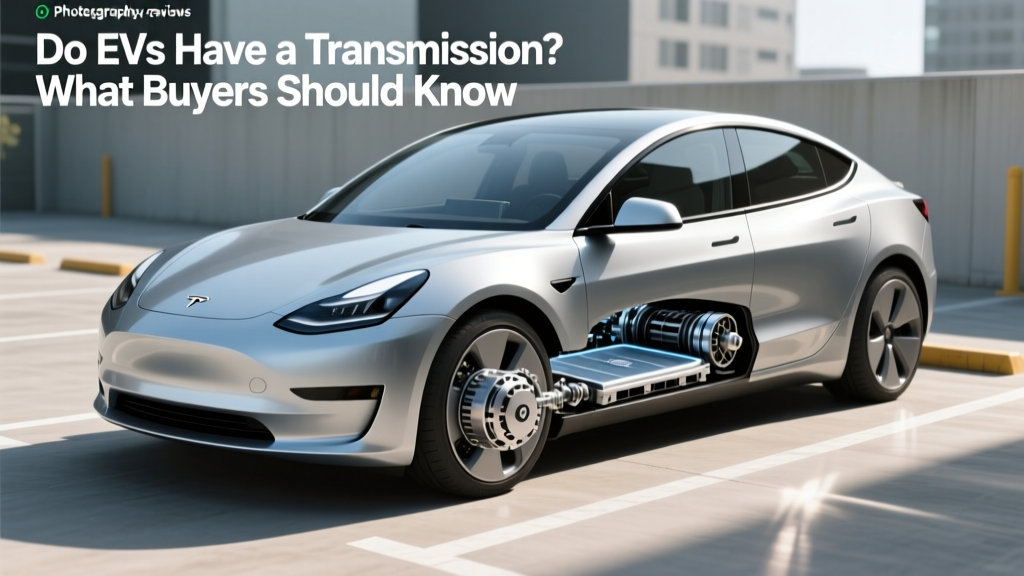
If you're shopping for an electric vehicle and wondering whether EVs have a transmission, the short answer is: most EVs use a single-speed reduction gear, not the multi-speed automatic or manual transmission found in gas cars. This single-gear setup delivers instant torque from 0 rpm, eliminates gear-shift lag, and removes dozens of moving parts that can wear out over time. A handful of performance EVs, like the original Porsche Taycan, use a two-speed gearbox on the rear axle for sharper launches and better high-speed efficiency, but the vast majority of EVs on the road in 2026 — from the Tesla Model 3 to the Hyundai Ioniq 5 to the Ford F-150 Lightning — rely on a single fixed-ratio reduction gear.
Quick Answer: Do EVs Have a Transmission?
Yes, but not the kind you're used to. Most EVs have a single-speed reduction gearbox (typically a 9:1 to 10:1 ratio) that transfers motor torque to the wheels. There are no gear shifts, no clutch, no torque converter, and no transmission fluid to change on a regular schedule. The electric motor's wide rpm range (often 0–15,000+ rpm) makes multiple gears unnecessary for everyday driving.
Why Electric Vehicles Don't Need Multi-Speed Transmissions
Internal combustion engines produce usable power in a narrow rpm band — typically between 1,500 and 5,000 rpm. A multi-speed transmission (6, 8, or even 10 gears) exists to keep the engine in that sweet spot as vehicle speed changes. Without it, a gas car would struggle to accelerate from a stop and couldn't reach highway speeds efficiently.
Electric motors operate fundamentally differently. A permanent-magnet or induction motor delivers peak torque from 0 rpm and maintains a broad power band up to 10,000–20,000 rpm. That means a single fixed gear ratio can handle everything from a stoplight launch to 80 mph highway cruising without ever leaving its efficient operating range.
This mechanical simplicity has direct ownership consequences. A conventional automatic transmission contains roughly 200–300 individual parts — planetary gear sets, clutch packs, valve bodies, torque converters. An EV's single-speed reduction gear typically contains fewer than 20 parts: a pair of helical gears, bearings, and a differential housed in a shared axle unit. Fewer parts means fewer failure points and less scheduled maintenance over the life of the vehicle.
Exceptions: EVs With Two-Speed Gearboxes
A small number of EVs use a two-speed transmission, usually to balance aggressive acceleration with high-speed efficiency:
- Porsche Taycan (2020–present): Uses a two-speed gearbox on the rear axle. First gear provides a short ratio for hard launches (0–60 mph in as little as 2.6 seconds in Turbo S trim); second gear engages around 50–60 mph for quieter, more efficient highway cruising.
- Audi e-tron GT: Shares the Taycan's J1 platform and uses the same rear-axle two-speed unit.
- Rimac Nevera: The hypercar uses a two-speed rear gearbox, though this is a low-volume, six-figure exception.
For mainstream buyers in 2026, every popular EV under $70,000 — the Tesla Model Y, Chevrolet Equinox EV, Hyundai Ioniq 5, Kia EV6, Ford Mustang Mach-E, Volkswagen ID.4, and Rivian R1S — uses a single-speed reduction gear. The two-speed design adds cost, weight, and complexity that most automakers have concluded isn't worth the marginal efficiency gain.
EV Drivetrain vs. Gas Car: Maintenance and Cost Comparison
The transmission difference is one of the biggest reasons EVs cost less to maintain. Here's how the drivetrain-related maintenance stacks up over a typical 5-year / 75,000-mile ownership period:
| Maintenance Item | Gas Car (Avg.) | EV (Avg.) |
|---|---|---|
| Transmission fluid change | $150–$300 (every 30k–60k mi) | $0 (sealed unit, no scheduled change) |
| Engine oil changes | $200–$500 (5–8 changes) | $0 (no engine oil) |
| Spark plugs | $100–$400 | $0 |
| Timing belt / chain | $500–$1,200 (if belt-driven) | $0 |
| Brake pad replacement | $200–$400 per axle | $0–$200 (regen braking reduces wear) |
| Clutch replacement (manual) | $1,000–$2,500 | $0 (no clutch) |
| Total estimated drivetrain maintenance | $2,150–$5,300 | $0–$200 |
The U.S. Department of Energy's fueleconomy.gov notes that EVs generally have lower maintenance costs than gasoline vehicles because they have fewer moving parts. Studies by Consumer Reports and Argonne National Laboratory estimate lifetime maintenance savings for EVs at $0.061 per mile, which translates to roughly $4,600 over 75,000 miles.
One important note: some EVs do specify a reduction-gear fluid inspection or replacement at high mileage intervals (typically 60,000–100,000 miles). The Hyundai Ioniq 5, for example, calls for a drive-unit fluid inspection at 60,000 miles. This is a $50–$120 service — far less than a traditional transmission fluid flush — but it's worth confirming in your owner's manual.
How the Single-Speed Gearbox Affects Real-World Driving
The single-speed design shapes the EV driving experience in ways that matter for daily ownership:
Acceleration feel
Because electric motors deliver maximum torque from 0 rpm with no gear shifts, acceleration is linear and uninterrupted. The Hyundai Ioniq 5 (Long Range AWD, 320 hp) hits 0–60 mph in approximately 5.1 seconds. A comparably priced gas crossover like the Toyota RAV4 (203 hp, 8-speed automatic) takes about 8.0 seconds. The EV doesn't feel faster just because of horsepower — it feels faster because there's no shift lag interrupting the pull.
Highway efficiency taper
The trade-off of a single gear is that EVs become less efficient at sustained high speeds compared to gas cars with tall overdrive gears. A gas car with an 8- or 10-speed transmission can drop engine rpm significantly at 75 mph, keeping fuel consumption moderate. An EV's motor simply spins faster, and aerodynamic drag (which scales with the square of velocity) compounds the energy demand. This is why EPA highway range estimates for EVs are typically 5–15% lower than city range — the opposite of most gas cars, which often achieve better highway MPG.
| Vehicle | City | Highway | Combined |
|---|---|---|---|
| 2025 Hyundai Ioniq 5 (LR RWD) | 134 MPGe | 105 MPGe | 120 MPGe |
| 2025 Toyota RAV4 (FWD, gas) | 27 MPG | 35 MPG | 30 MPG |
Source: fueleconomy.gov
Regenerative braking integration
The single-speed gearbox works in concert with regenerative braking. When you lift off the accelerator, the motor reverses its role and acts as a generator, sending energy back to the battery while slowing the car. This happens through the same reduction gear — no separate mechanism needed. Most EVs let you adjust regen intensity; in its strongest setting (often called "one-pedal driving"), the car can come to a near-stop without touching the brake pedal, which dramatically reduces brake pad wear.
What This Means for Total Cost of Ownership
The transmission simplicity contributes to EVs' lower total cost of ownership, but it's only one piece of the equation. Here's a realistic 5-year cost breakdown comparing a mainstream EV and a comparable gas car, based on 2026 pricing and average U.S. electricity/gas costs:
| Cost Category | 2025 Hyundai Ioniq 5 SEL (RWD, ~$45,500 MSRP) | 2025 Toyota RAV4 XLE (~$32,000 MSRP) |
|---|---|---|
| Purchase price (after $7,500 federal credit if eligible) | ~$38,000* | $32,000 |
| Fuel / electricity (75k mi) | $2,700–$4,200** | $7,500–$9,000 |
| Maintenance (drivetrain + general) | $800–$1,500 | $3,500–$5,500 |
| Insurance (5-year average) | $7,500–$9,500 | $6,000–$7,500 |
| Estimated depreciation | $15,000–$20,000 | $12,000–$15,000 |
| Approx. 5-year total | $64,000–$73,200 | $61,000–$69,000 |
*Federal §30D tax credit eligibility depends on income caps ($150k single / $300k joint), MSRP caps ($55k SUVs / $50k sedans), battery sourcing requirements, and point-of-sale transfer rules. Always verify current eligibility at irs.gov and consult a tax professional.
**Electricity cost assumes $0.14–$0.22/kWh depending on whether you charge at home (cheaper) or rely on public DC fast charging (more expensive). Gas assumes $3.40–$4.00/gallon at 30 MPG combined.
The EV's higher upfront cost and insurance premiums can offset the fuel and maintenance savings, particularly if you drive fewer than 10,000 miles per year or don't have access to affordable home charging. The transmission-related maintenance savings alone won't close the gap — but combined with fuel savings, they make the 5-year totals competitive.
Common EV Transmission Myths — Fact-Checked
| Myth | Fact |
|---|---|
| "EVs have no transmission at all." | Most EVs have a single-speed reduction gearbox. It's technically a transmission — just one with a single fixed ratio. |
| "EV transmissions need fluid changes every 30,000 miles like gas cars." | EV reduction gears are typically sealed units. If a fluid service is specified, it's usually at 60,000–100,000+ miles and costs $50–$120. |
| "Single-speed means EVs can't go fast." | Most EVs easily reach 100–155 mph (electronically limited). The Tesla Model S Plaid hits 200 mph with just two single-speed motors. |
| "Without a transmission, EVs can't tow." | The Ford F-150 Lightning (single-speed) tows up to 10,000 lbs. The Rivian R1T tows 11,000 lbs. Instant torque actually helps with towing. |
| "If the motor fails, you need a whole new transmission." | The motor and reduction gear are separate assemblies. Motor or inverter failures don't require gearbox replacement, and vice versa. |
Decision Framework: Does Transmission Type Matter for Your EV Purchase?
Use this framework to decide how much weight to give the drivetrain simplicity in your purchase decision:
Choose an EV (single-speed drivetrain) if:
- You want minimal scheduled maintenance — no transmission fluid, oil changes, or clutch service.
- You prioritize smooth, shift-free acceleration in stop-and-go commuting.
- You have access to home Level 2 charging (240V), where electricity costs $0.10–$0.18/kWh — making per-mile fuel cost roughly 3–5 cents versus 12–15 cents for gas.
- You plan to own the vehicle 7+ years and want to avoid the $2,000–$4,000 transmission rebuild risk that gas cars carry past 100,000 miles.
Consider a hybrid (which retains a conventional transmission or e-CVT) if:
- You regularly drive 400+ miles in a single trip through areas with sparse DC fast-charging infrastructure.
- You live in an apartment or lack access to home/workplace charging and can't install a Level 2 unit.
- You frequently tow heavy loads in cold climates, where EV range can drop 20–40% due to battery chemistry and cabin heating demands.
- Your budget is under $30,000 and you need the lowest possible purchase price — hybrids like the Toyota Prius ($28,500 MSRP) remain more affordable upfront.
First-Time EV Buyer Checklist: Beyond the Transmission
The single-speed drivetrain is one of the easiest parts of EV ownership. The harder questions for first-time buyers are:
- Can I charge at home? A Level 2 home charger (7.2–11.5 kW) adds roughly 25–44 miles of range per hour of charging. Installation typically costs $500–$2,000 depending on whether your electrical panel needs a 240V circuit added. If you can charge at home, daily EV ownership is nearly effortless — you wake up "full" every morning.
- What's the real-world range? EPA estimates are a starting point. Expect highway driving at 70+ mph to reduce range by 10–15%. In freezing temperatures (below 32°F), range can drop 20–35% due to battery chemistry limitations and cabin heating load. A 310-mile EPA rating might deliver 210–240 miles on a cold winter highway trip.
- How fast does it actually charge? Peak DC fast-charge rates (e.g., 240 kW) are sustained only between roughly 10–50% state of charge. Above 80%, the charge curve tapers sharply to protect battery health. A "10–80% in 18 minutes" spec assumes preconditioned battery and optimal charger conditions. Real-world 10–80% times are often 5–10 minutes longer.
- What's the battery warranty? Federal law requires EV battery warranties of at least 8 years / 100,000 miles. Most manufacturers guarantee the battery will retain 70–80% of its original capacity during that period. Replacement costs outside warranty range from $5,000 (smaller packs) to $20,000+ (100 kWh packs), though most modern NMC and LFP batteries are lasting well beyond 150,000 miles with manageable degradation.
Frequently Asked Questions
Do Teslas have a transmission?
All current Tesla models (Model 3, Model Y, Model S, Model X, Cybertruck) use single-speed reduction gears. The original 2008 Tesla Roadster initially shipped with a two-speed gearbox but switched to a single-speed unit within its first production year due to reliability issues. Tesla has never used a multi-speed transmission since.
Do EVs have a clutch?
No. A clutch exists to disconnect a running combustion engine from the transmission during gear changes. Since EV motors can spin from 0 rpm and don't stall, there's no need for a clutch. The motor is connected directly to the reduction gear at all times.
Can you shift gears in an EV?
Not in the traditional sense. Some EVs (like the Hyundai Ioniq 5 N and the Dodge Charger Daytona EV) simulate gear shifts through software — adjusting torque delivery and adding sound effects to mimic a multi-speed experience. This is purely cosmetic and doesn't involve any physical gear change.
Do EVs need transmission fluid?
Most EV reduction gears use a small amount of gear oil (typically 1–2 liters), but it's a sealed system with no dipstick and no scheduled change interval for many models. Some manufacturers specify an inspection or replacement at 60,000–100,000 miles. Check your specific owner's manual — this varies by model.
Why don't more EVs use multi-speed transmissions?
The added cost ($500–$1,500 per vehicle), weight (30–80 lbs), and mechanical complexity of a second gear don't justify the marginal 2–5% highway efficiency gain for most buyers. Porsche and Audi accept this trade-off for the performance benefits in their sports sedans, but mainstream automakers have determined that improving motor efficiency, battery energy density, and aerodynamics delivers better real-world results at lower cost.