The Short Answer
Most electric vehicles do not have a traditional multi-speed transmission. Instead, nearly every mainstream EV — from the Tesla Model Y to the Hyundai Ioniq 5 to the Ford F-150 Lightning — uses a single-speed reduction gear (typically a 9:1 to 11:1 ratio) that transfers torque from the electric motor directly to the wheels. Because electric motors produce maximum torque from 0 RPM and can safely rev to 15,000–20,000+ RPM, there's no need for multiple gear ratios. A handful of high-performance EVs, like the original Porsche Taycan, use a two-speed transmission on the rear axle to optimize both launch acceleration and top-end efficiency, but this is the exception, not the rule.
Why EVs Don't Need Multi-Speed Transmissions
To understand why an EV's drivetrain is so radically simpler than a gasoline car's, you need to look at the torque curve. A typical internal combustion engine (ICE) produces peak torque only within a narrow RPM band — say, 1,500 to 4,500 RPM — and redlines around 6,000–7,000 RPM. A multi-speed transmission (6, 8, 9, or even 10 gears) exists to keep that engine in its power band across varying vehicle speeds.
An electric motor is fundamentally different:
- Instant peak torque at 0 RPM: An EV motor delivers maximum twisting force the moment it starts spinning. This is why a 4,500-lb Hyundai Ioniq 5 N can hit 0–60 mph in 3.4 seconds without a single gear shift.
- Extremely wide RPM range: EV motors routinely spin to 15,000–20,000 RPM (some Tesla units exceed 22,000 RPM). That's three times the rev ceiling of a gas engine, allowing a single gear ratio to cover 0–120+ mph.
- No idle, no stall: Electric motors don't need a clutch or torque converter. They simply stop drawing current when stationary.
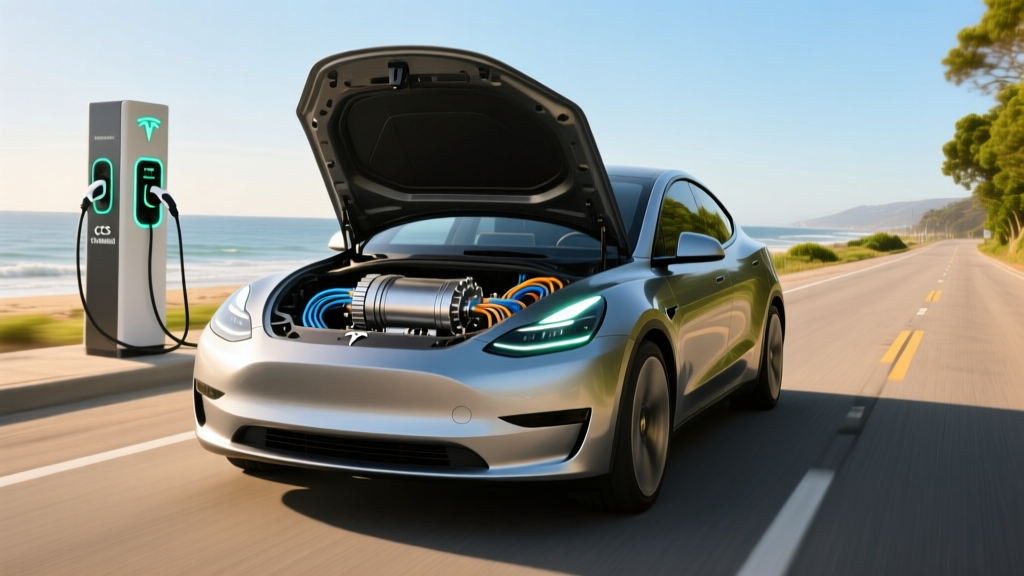
The result is a single-speed reduction gearbox — a compact, sealed unit containing one or two helical gear pairs that reduce the motor's high RPM to usable wheel speed. It requires no shifting, no clutch fluid, no band adjustments, and typically uses a lifetime fill of gear oil.
EV Single-Speed vs Gas Multi-Speed: By the Numbers
| Attribute | EV (Single-Speed Reduction Gear) | Gas Car (8–10 Speed Automatic) |
|---|---|---|
| Moving parts in transmission | ~5–10 (gear pairs, bearings) | 200+ (clutches, bands, valve body, torque converter) |
| Transmission fluid changes | None (lifetime fill, ~2–4 qt) | Every 30,000–60,000 mi ($150–$350 per service) |
| Typical drivetrain efficiency | 95–98% (motor + gear) | 70–85% (engine + torque converter + gears) |
| Shift interruptions | None — continuous torque | 50–200 ms per shift (torque interruption) |
| Weight (transmission unit) | 30–70 lbs | 150–250 lbs |
| Expected lifespan | 200,000+ mi (no wear items) | 120,000–180,000 mi before major service |
| Replacement cost (out of warranty) | $1,500–$3,500 | $4,000–$8,000+ |
According to fueleconomy.gov, EVs convert over 77% of electrical energy from the grid to power at the wheels, while gasoline vehicles convert only 12–30% of energy stored in fuel. The simplicity of the single-speed drivetrain is a significant contributor to that gap.
The Exceptions: When EVs Use Multi-Speed Gearboxes
A few production EVs have broken from the single-speed norm, and it's worth understanding why:
Porsche Taycan Two-Speed (Rear Axle)
The Taycan uses a two-speed automatic on its rear motor: first gear has a short ratio (~16:1) for explosive launches (0–60 in 2.6 seconds on the Turbo S), and second gear is a taller ratio (~8:1) for high-speed efficiency. The shift occurs around 50–60 mph and is nearly imperceptible.
Audi e-tron GT
Sharing the J1 platform with the Taycan, the e-tron GT also uses the two-speed rear axle for the same performance-versus-efficiency rationale.
Why Don't More EVs Do This?
Adding gears adds weight (30–50 lbs), complexity, cost ($800–$1,500 per unit), and a potential reliability liability. For 95% of EV buyers, the single-speed unit's instant torque and 0–120 mph coverage makes the trade-off unjustified. As motor technology improves — higher RPM limits, better field-weakening control — the case for multi-speed EV transmissions gets weaker, not stronger.
What This Means for Your Wallet: Real Ownership Costs
The transmission difference isn't just an engineering curiosity — it hits your bank account directly. Here's a realistic 5-year / 75,000-mile cost comparison between a 2026 Tesla Model Y Long Range AWD ($44,990 base MSRP) and a comparably equipped 2026 Toyota RAV4 XLE AWD gas SUV (~$34,500 MSRP):
| Cost Category (5 yr / 75k mi) | 2026 Tesla Model Y LR AWD | 2026 RAV4 XLE AWD (Gas) |
|---|---|---|
| Purchase price (MSRP) | $44,990 | $34,500 |
| Federal tax credit (§30D, if eligible) | −$3,750 to −$7,500* | $0 |
| Fuel/energy cost (15,000 mi/yr) | $3,375 (home L2, $0.15/kWh avg) | $7,500 (28 MPG combined, $2.80/gal) |
| Transmission fluid service | $0 | $450 (2 changes) |
| Oil changes | $0 | $625 (5 changes @ $125) |
| Brake pad replacement | $0–$250 (regen saves pads) | $600–$900 |
| Estimated insurance (avg) | $9,500 ($1,900/yr) | $7,000 ($1,400/yr) |
| 5-Year Total (before credit) | $57,865 | $50,575 |
| 5-Year Total (with max credit) | $50,365 | $50,575 |
*§30D credit eligibility depends on buyer income caps ($150k single / $300k joint), vehicle MSRP caps ($55k SUVs), battery critical-mineral and component sourcing, and point-of-sale transfer rules. Verify current-year rules at IRS.gov or consult a tax professional.
The maintenance savings are where the no-transmission advantage compounds. Over 150,000 miles, a gas vehicle may need a transmission fluid flush ($250), a valve-body or solenoid repair ($1,200–$2,500), or even a full rebuild ($4,000–$7,000). An EV's reduction gear? Drain and refill at most, and many manufacturers specify no interval at all.
Common EV Drivetrain Myths — Fact-Checked
| Myth | Fact |
|---|---|
| "EVs have no gears at all." | They have a single-speed reduction gear — usually 9:1 to 11:1 ratio. It's a gear, just not a shifting one. |
| "No transmission means no maintenance ever." | EVs still need cabin air filters, brake fluid checks, coolant flushes (battery thermal loop), wiper fluid, and tire rotations. Budget ~$300–$500/year. |
| "EV motors wear out like gas engines." | EV traction motors have essentially one moving part (the rotor) on two bearings. Failure before 200,000 miles is rare. The NHTSA and manufacturer data show motor replacement claims under 1% in the first 8 years. |
| "If the single-speed gear fails, the car is totaled." | Reduction gear replacement runs $1,500–$3,500 — far less than an EV battery ($8,000–$20,000) and less than a gas transmission rebuild. It's also covered under the federal-mandated 8-year/100,000-mile EV powertrain warranty on most models. |
| "AWD EVs have two transmissions." | Dual-motor AWD EVs have two reduction gears (one per axle), but they still don't shift. Each is a simple, sealed unit. |
First-Time EV Buyer: What to Know About the Drivetrain
Decision Framework: Does the EV Drivetrain Matter for You?
- Choose an EV if: You want near-zero drivetrain maintenance, instant torque for merging/highway on-ramps, and you drive under 300 miles/day (covers 95% of US drivers per fueleconomy.gov data).
- Consider a PHEV if: You lack reliable home charging, frequently drive 400+ miles in a day through charging deserts, or live in extreme cold (below 0°F) where EV range drops 20–40%. A PHEV like the Toyota RAV4 Prime gives you 42 miles electric-only plus a gas backup — and yes, it still has a conventional transmission on the gas side.
- Stay with gas if: You tow 8,000+ lbs regularly (EV range drops 40–50% under heavy towing), you live in an apartment with zero charging access and no public DC fast chargers within 15 miles, or your budget is strictly under $25,000 and you need a 3-row SUV.
What to Ask the Dealer
- "What's the reduction gear service interval?" Most say "lifetime" — but ask what "lifetime" means in the manual (often 150,000 mi). Some owners proactively change gear oil at 100,000 mi for $100–$200.
- "What does the powertrain warranty cover?" Federal law mandates 8 years/100,000 miles on the battery and drive motor for EVs sold in the US. The reduction gear is typically included, but confirm in writing.
- "Is it a single-motor or dual-motor?" Dual-motor AWD means two motors and two reduction gears — slightly more to maintain long-term, but massively better traction in snow and rain.
Frequently Asked Questions
Do Tesla vehicles have a transmission?
No Tesla currently in production uses a multi-speed transmission. The Model 3, Model Y, Model S, and Model X all use single-speed reduction gears. The original 2008 Tesla Roadster briefly had a two-speed gearbox (supplied by Magna), but Tesla abandoned it due to reliability issues and switched to a single-speed unit within the first year of production.
Do hybrids have transmissions?
Yes — and this is a key distinction. Traditional hybrids (Toyota Camry Hybrid, Honda CR-V Hybrid) use an eCVT (electronically controlled continuously variable transmission) or a conventional automatic with an integrated electric motor. Plug-in hybrids (PHEVs) also retain a multi-speed transmission for the gasoline engine. Only fully electric vehicles (BEVs) eliminate the multi-speed gearbox entirely.
Can an EV's single-speed gear handle towing?
Yes, within rated limits. The Ford F-150 Lightning (single-speed reduction gear on each axle) is rated to tow up to 10,000 lbs. The Rivian R1T tows 11,000 lbs. The reduction gear is engineered for the motor's peak torque output — no shifting under load means less stress on driveline components. The real towing penalty is range: expect a 40–50% reduction at highway speeds with a heavy trailer.
Will I ever need to replace the reduction gear?
Statistically, it's unlikely within typical ownership. The gear set itself is hardened steel with no friction surfaces — it doesn't "wear" the way clutch packs or brake bands do. Failure modes are usually bearing-related or from contamination (seal failure allowing moisture in). If it does fail out of warranty, expect $1,500–$3,500 for parts and labor — far less catastrophic than a gas transmission rebuild.
Does the single-speed design affect highway efficiency?
Slightly. At sustained 80+ mph speeds, an EV motor operates at very high RPM where efficiency drops marginally. This is why EVs tend to lose more range at highway speeds than gas cars do (gas cars shift into overdrive, dropping RPM). A two-speed gearbox could theoretically help here — but the 2–4% efficiency gain hasn't justified the cost and complexity for mainstream vehicles. Real-world impact: expect ~2.5–3.5 miles/kWh at 65 mph, dropping to ~2.2–3.0 at 80 mph.