The Short Answer: Most EVs Don't Have a Multi-Speed Transmission
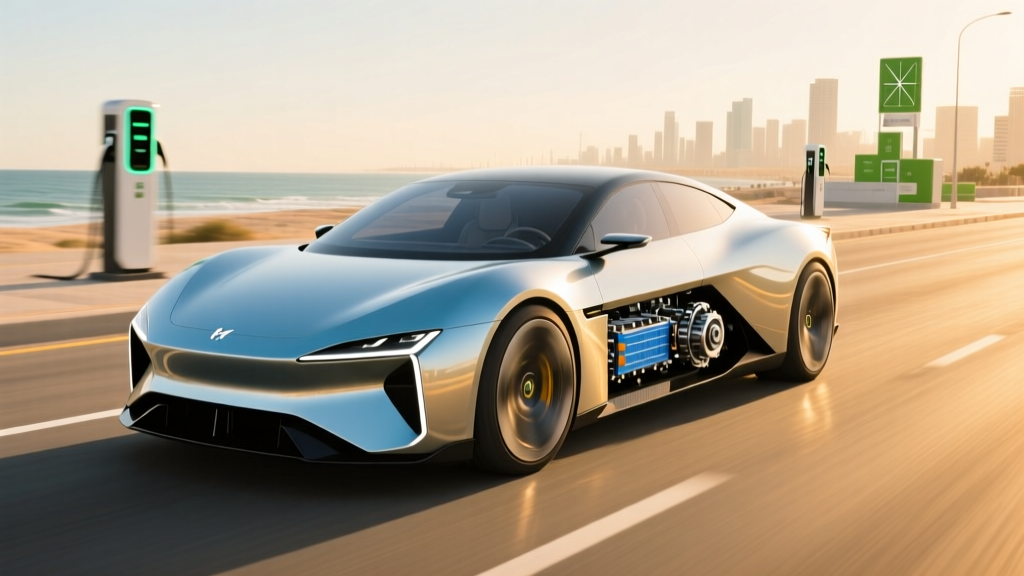
Quick Answer: No, the vast majority of electric cars do not need a traditional multi-speed transmission. Instead, they use a single-speed reduction gear (sometimes called a "fixed-ratio gearbox") that transfers torque from the electric motor to the wheels. Because electric motors produce maximum torque from 0 RPM and operate efficiently across a wide speed range — typically up to 10,000–20,000 RPM — there's no need for the 6, 8, or 10 gears found in internal combustion vehicles.
Exceptions: The Porsche Taycan uses a 2-speed rear axle gearbox for performance optimization, and some heavy-duty electric trucks use multi-speed setups. But for consumer EVs from Tesla, Hyundai, Ford, BMW, Rivian, and others, a single-speed unit is standard.
If you're shopping for your first EV in 2026, this is one of the biggest mechanical differences you'll encounter compared to a gas car. No transmission means fewer moving parts, lower maintenance costs, and a fundamentally different driving feel. But it also raises questions about efficiency at highway speeds, long-term durability, and what happens if something goes wrong. Let's break down the engineering, the economics, and what this means for your ownership experience.
Why Electric Motors Don't Need Multiple Gears
The reason EVs can skip the transmission comes down to the physics of electric motors versus internal combustion engines (ICE).
A gasoline engine produces usable torque only within a narrow RPM band — typically between 1,500 and 5,000 RPM. Below that range, it stalls. Above it, it hits a rev limiter. To keep the engine in its power band as vehicle speed changes, a transmission shifts through multiple gear ratios. A modern 8-speed automatic might have ratios spanning from 4.7:1 in first gear to 0.67:1 in eighth.
An electric motor, by contrast, delivers peak torque at 0 RPM and maintains strong power output across a massive RPM range. The motor in a Tesla Model 3 Rear-Wheel Drive, for example, spins up to roughly 16,000 RPM. The single-speed reduction gear (typically around a 9:1 to 11:1 ratio) multiplies that torque for acceleration while allowing the motor to spin fast enough for highway speeds up to 120+ mph.
This is why an EV accelerates so smoothly — there are no shift interruptions. The power delivery is linear and continuous, which is a big part of what makes EVs feel quicker than their 0-60 times might suggest.
Key Engineering Advantages of a Single-Speed Design
- Fewer moving parts: A typical automatic transmission contains hundreds of components — planetary gear sets, clutch packs, torque converters, valve bodies, solenoids. An EV reduction gear has a handful of gears and bearings.
- No transmission fluid changes: Most EV reduction gears are sealed and lubricated for life. There's no 30,000-mile fluid service interval like you'd find on a gas car.
- Lower weight: A single-speed unit weighs significantly less than a multi-speed automatic, contributing to overall vehicle efficiency.
- Higher reliability: With fewer wear components, there's simply less that can fail.
EV vs. Gas Car: Drivetrain Maintenance Compared
The absence of a multi-speed transmission is one of the biggest maintenance advantages EVs hold over gas vehicles. Here's how the drivetrain costs stack up over a typical ownership period.
| Maintenance Item | Gas Car (ICE) | Battery Electric Vehicle (BEV) |
|---|---|---|
| Transmission fluid service | $200–$400 (every 30k–60k mi) | $0 (sealed unit, lifetime fill) |
| Engine oil changes | $250–$500 (5–10 changes) | $0 (no engine) |
| Spark plugs / ignition | $200–$600 | $0 |
| Timing belt / chain | $500–$1,500 (if applicable) | $0 |
| Brake pad replacement | $300–$600 | $0–$200 (regen braking extends life) |
| Coolant flush | $100–$200 | $100–$200 (EV thermal management) |
| Total Estimated | $1,550–$3,800 | $100–$400 |
According to fueleconomy.gov, EVs have significantly fewer drivetrain components subject to wear. The U.S. Department of Energy estimates that EV maintenance costs run roughly $0.061 per mile compared to $0.101 per mile for gasoline vehicles — a savings of about $3,000 over 75,000 miles when you factor in all systems, not just the drivetrain.
The Porsche Taycan Exception: When 2 Speeds Make Sense
The Porsche Taycan is the most notable consumer EV with a multi-speed transmission — specifically, a 2-speed gearbox on the rear axle. First gear provides aggressive acceleration (the Taycan Turbo S hits 0-60 mph in 2.4 seconds), while second gear optimizes efficiency and top-end performance at highway speeds.
Why did Porsche add complexity that other automakers avoid? It comes down to the Taycan's performance targets. Porsche engineers wanted both brutal launch acceleration and a top speed of 161+ mph while maintaining efficiency at cruise. A single-speed gear forces a compromise between those goals. The 2-speed unit lets the Taycan have both — shifting into the taller gear around 60–70 mph.
For everyday EVs that prioritize range and value over Nürburgring lap times, the single-speed approach remains the engineering sweet spot. The Hyundai Ioniq 6, Tesla Model 3, Chevrolet Equinox EV, and BMW i4 all use single-speed reduction gears and deliver strong real-world performance without the added weight, cost, and complexity.
Common Misconceptions About EV Transmissions
| Myth | Fact |
|---|---|
| "EVs have no gears at all." | EVs use a single-speed reduction gear (typically 9:1 to 11:1 ratio). It's a gear set — just not a shifting transmission. |
| "Single-speed means EVs are slow at highway speeds." | Most EVs reach 110–155 mph top speed. Electric motors spin to 15,000+ RPM, so a single ratio covers 0 to highway speed easily. |
| "EV transmissions will need expensive replacement." | Reduction gears are extremely simple and durable. Failures are rare. The bigger cost concern is the traction battery, not the gear set. |
| "Regenerative braking wears out the transmission." | Regen braking works through the electric motor, not the reduction gear's friction surfaces. It actually reduces wear on brake pads and rotors. |
| "All hybrids have the same setup as EVs." | PHEVs and HEVs often use specialized transmissions (e.g., Toyota's e-CVT power-split device) that blend engine and motor power. These are more complex than a pure BEV reduction gear. |
Real-World Ownership: What This Means for You
The transmission question isn't just academic — it shapes your daily ownership experience in several practical ways.
Driving Feel
Without gear shifts, EV acceleration is seamless. There's no shift shock, no momentary power interruption, no hunting for the right gear on a hill climb. You press the accelerator and get immediate, linear torque. This makes city driving especially pleasant — stop-and-go traffic becomes a one-pedal experience with regenerative braking handling most deceleration.
Highway Efficiency Trade-Off
One legitimate engineering trade-off of a single-speed gear: electric motors are slightly less efficient at sustained high RPM (highway speeds of 75–85 mph). This is why EVs often see a noticeable efficiency drop at highway speeds compared to city driving. A Tesla Model 3 Long Range, rated at 132 MPGe combined by the EPA, might achieve 140+ MPGe in city driving but drop to 115–120 MPGe at 80 mph on the interstate.
In real-world terms, expect to see about 10–15% less range on a pure highway trip compared to the EPA combined estimate. Cold weather compounds this — a 35°F day at highway speeds can cut range by 25–30% due to battery chemistry limitations and cabin heating demands.
Long-Term Durability
The reduction gear itself is one of the most durable components in an EV. It's essentially a small set of helical or spur gears in an oil bath — technology that's been proven for over a century. The more common drivetrain concern in EVs is the traction battery, which carries an 8-year/100,000-mile federal warranty mandate (10 years/150,000 miles in CARB states like California). Battery degradation typically runs 1–2% per year for NMC chemistries and less for LFP packs, meaning most owners will see 85–92% state of health after 8 years.
Total Cost of Ownership: EV vs. Gas Over 5 Years
The transmission advantage is just one piece of the cost picture. Here's a realistic 5-year comparison using a 2026 Tesla Model 3 Rear-Wheel Drive (base MSRP ~$38,990) versus a comparably equipped Toyota Camry gas sedan (MSRP ~$28,990).
| Cost Category | 2026 Tesla Model 3 RWD (BEV) | 2026 Toyota Camry LE (Gas) |
|---|---|---|
| Purchase price (MSRP) | $38,990 | $28,990 |
| Federal §30D tax credit (if eligible) | -$7,500* | $0 |
| Effective purchase price | $31,490 | $28,990 |
| Fuel / charging (75k mi) | $2,625 (home charging at $0.14/kWh) | $7,500 (30 MPG avg, $3.00/gal) |
| Maintenance | $1,000 | $3,000 |
| Insurance (5-year avg) | $9,500 | $7,000 |
| Depreciation (est.) | $14,000 | $12,000 |
| Total 5-Year Cost | ~$58,615 | ~$58,490 |
*Federal §30D tax credit eligibility depends on buyer income limits ($150k single / $300k joint), vehicle MSRP caps ($55k sedans), battery sourcing requirements, and point-of-sale transfer rules. Check current IRS guidelines before purchasing. Credit rules are subject to change.
The numbers show near-parity over 5 years, with the EV's higher insurance and depreciation roughly offset by fuel and maintenance savings. The transmission-free drivetrain contributes directly to that $2,000 maintenance gap. Over 10 years, the EV's savings compound further as the gas car faces larger repairs — timing chain, water pump, exhaust system — that simply don't exist on an electric vehicle.
Decision Framework: What Should You Choose?
If you want the lowest maintenance burden and simplest drivetrain → A battery electric vehicle (BEV) with a single-speed reduction gear. No transmission fluid, no clutch packs, no shift solenoids. Just gears and bearings.
If you drive mostly in the city with home charging access → A BEV is ideal. Regenerative braking maximizes efficiency in stop-and-go traffic, and overnight Level 2 charging at home (adding ~30–44 miles of range per hour at 7.7–11.5 kW) means you start every day with a full battery.
If you regularly tow, drive high-mileage highway routes, or lack home charging → A plug-in hybrid (PHEV) may be more practical. PHEVs like the Toyota RAV4 Prime (42 miles electric-only, 38 MPG combined after depletion) use a more complex drivetrain but eliminate range anxiety and public-charging dependency.
If you want performance without compromise → The Porsche Taycan's 2-speed rear gearbox demonstrates that multi-speed EV transmissions exist for specific use cases. Expect higher complexity and cost in exchange for optimized launch and top-end performance.
Frequently Asked Questions
Do Teslas have transmissions?
Teslas use a single-speed reduction gear, not a multi-speed transmission. The Tesla Model 3, Model Y, Model S, and Model X all use fixed-ratio gearboxes. There are no gears to shift and no transmission fluid to change on a regular schedule.
Can an EV transmission fail, and what does replacement cost?
Reduction gear failures are extremely rare because the design is so simple. If one does fail — typically due to a bearing defect or manufacturing flaw — replacement costs range from $2,000 to $5,000 depending on the vehicle. However, this is far less common than automatic transmission failures in gas cars, which affect a meaningful percentage of ICE vehicles by 100,000 miles and cost $3,000–$7,000 to rebuild or replace.
Why don't more EVs use 2-speed transmissions like the Taycan?
The added cost, weight, and complexity of a second gear ratio isn't justified for most consumer EVs. A single-speed unit handles 0–120+ mph adequately for daily driving, and the efficiency gain at highway speeds is marginal — typically 2–4%. Automakers prioritize reducing cost and weight, which directly improves range and pricing.
Do hybrids have the same transmission setup as pure EVs?
No. Hybrids (HEVs) and plug-in hybrids (PHEVs) use more complex drivetrain systems because they need to blend power from both a gas engine and an electric motor. Toyota's hybrid system uses an e-CVT (planetary gear set) that's fundamentally different from both a conventional automatic and a BEV's single-speed gear. These systems are proven and reliable but have more moving parts than a pure EV drivetrain.
Does regenerative braking put extra stress on the EV's gears?
No. During regen braking, the electric motor acts as a generator, converting kinetic energy back into electrical energy. The torque flows backward through the reduction gear, but the gear teeth and bearings are designed to handle bidirectional loads. Regen braking actually reduces wear on the friction brakes, extending pad and rotor life significantly — many EV owners report original brake pads lasting 80,000+ miles.
What should a first-time EV buyer know about the drivetrain?
Focus less on the transmission (it's the simplest part of the car) and more on three factors: (1) battery capacity in kWh and chemistry (LFP for longevity, NMC for energy density), (2) charging speed in kW and whether the vehicle uses NACS or CCS connectors, and (3) your home charging situation. A Level 2 home charger installation typically costs $800–$2,500 including equipment and electrician labor, and it's the single biggest quality-of-life upgrade in EV ownership.