The Short Answer
Most electric cars do not have a traditional multi-speed transmission. Instead, they use a single-speed reduction gear (sometimes called a single-speed transmission) that transfers power from the electric motor to the wheels. Electric motors produce maximum torque from zero RPM and can rev to 15,000–20,000+ RPM, eliminating the need for multiple gears. A handful of EVs — notably the original Porsche Taycan and Audi e-tron GT — use a two-speed transmission on the rear axle to optimize both launch acceleration and high-speed efficiency. But for the vast majority of EVs on the road in 2026, there is no gear shifting, no transmission fluid to change, and far fewer moving parts than a gas car's drivetrain.
Why Most EVs Don't Need a Multi-Speed Transmission
Internal combustion engines have a narrow power band — they produce useful torque only between roughly 1,500 and 5,000 RPM and peak horsepower in a similarly tight window. A 6-, 8-, or 10-speed automatic transmission exists to keep the engine in that sweet spot as vehicle speed changes. Shift too early, and the engine lugs; shift too late, and you waste fuel and stress components.
Electric motors operate on entirely different physics. A permanent-magnet synchronous motor (the type in most modern EVs) delivers peak torque at 0 RPM and maintains a broad, flat torque curve through most of its rev range. That means a single fixed gear ratio — typically between 8:1 and 10:1 — can handle everything from a stoplight launch to 80 mph highway cruising without ever needing to shift.
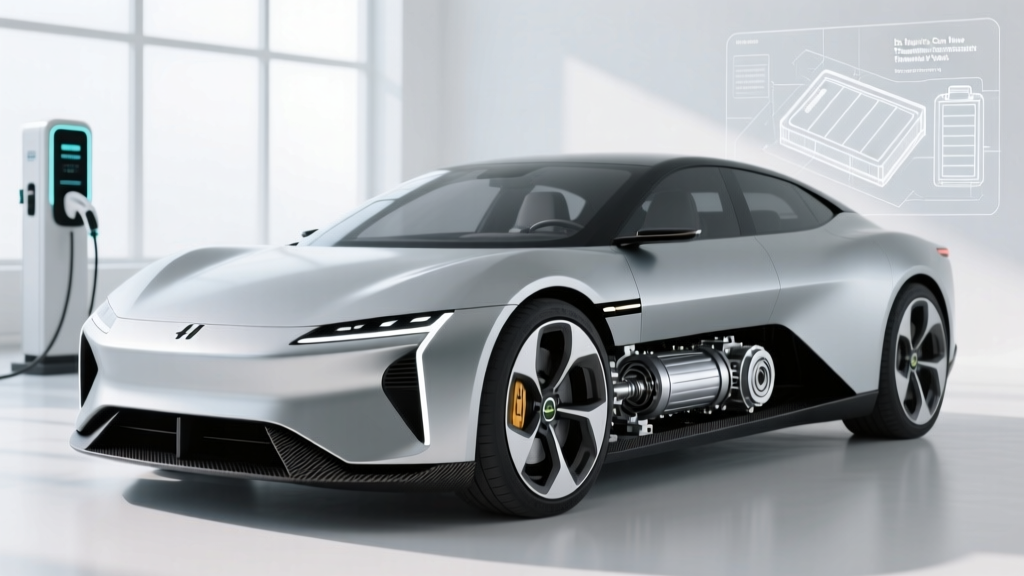
The reduction gear sits between the motor and the differential, reducing the motor's high RPM output to a usable wheel speed while multiplying torque. It's a simple, sealed unit with helical gears bathed in lubricant. There are no clutch packs, torque converters, valve bodies, or bands to wear out.
Exceptions: EVs That Do Use Multi-Speed Gearboxes
A few performance-oriented EVs have adopted two-speed transmissions, and understanding why reveals the engineering trade-offs:
Porsche Taycan and Audi e-tron GT
The Taycan's rear axle uses a ZF-developed two-speed gearbox. First gear has a short ratio (~16:1) for explosive launches — the Taycan Turbo S hits 0–60 mph in 2.4 seconds. Second gear (~8:1) engages around 50–60 mph for more relaxed, efficient highway cruising. The front axle uses a conventional single-speed unit. Porsche's engineering rationale: the two-speed setup recovers roughly 2–3% efficiency at sustained highway speeds while preserving supercar-level acceleration.
Why Most Automakers Skip It
The added cost, weight (~30–50 lbs), complexity, and packaging challenges of a multi-speed gearbox rarely justify the marginal efficiency gain for mainstream EVs. Tesla, Hyundai, Ford, GM, BMW, Rivian, and nearly every other manufacturer have concluded that motor and inverter improvements — plus larger battery packs — deliver better real-world results than adding gears. The single-speed reduction gear remains the industry standard for good reason: it's lighter, cheaper, more reliable, and 97–98% efficient at transferring power.
EV Single-Speed vs. Gas Multi-Speed: By the Numbers
| Attribute | Typical EV (Single-Speed) | Typical Gas Car (8-Speed Auto) |
|---|---|---|
| Gear ratios | 1 (fixed, ~9:1 reduction) | 8 forward + reverse |
| Moving parts in transmission | ~10–15 (gears, bearings) | ~200+ (clutches, bands, valves, solenoids) |
| Transmission fluid changes | None (sealed, lifetime fill) | Every 30,000–60,000 miles ($150–$300 each) |
| Typical replacement cost | Rarely needed; $1,500–$3,000 if so | $3,000–$7,000 (rebuilt or new) |
| Drivetrain efficiency | ~95–98% (motor + gear) | ~70–85% (engine + transmission losses) |
| Weight (transmission unit) | ~25–45 lbs | ~150–220 lbs |
| 0–60 mph torque delivery | Instant, no shift lag | 2–3 shift interruptions during run |
Sources: fueleconomy.gov, manufacturer service documentation.
What This Means for Maintenance Costs
The absence of a multi-speed transmission is one of the biggest long-term ownership advantages EVs hold over gas vehicles. Here's how the maintenance picture compares over a typical 5-year/75,000-mile ownership period:
| Maintenance Item | Gas Car (5 yr / 75k mi) | EV (5 yr / 75k mi) |
|---|---|---|
| Engine oil changes | $400–$750 (5–10 changes) | $0 |
| Transmission fluid service | $150–$600 (1–2 services) | $0 |
| Air/filter replacements | $200–$400 | $50–$100 (cabin filter only) |
| Spark plugs | $200–$500 | $0 |
| Brake pad replacement | $300–$600 (1–2 sets) | $0–$300 (regen braking extends life significantly) |
| Coolant service | $100–$200 | $100–$200 (battery thermal management) |
| Estimated total routine maintenance | $1,350–$3,050 | $150–$600 |
Figures based on national average service pricing. Your costs may vary by region and dealer vs. independent shop. EV battery coolant intervals vary by manufacturer — consult your owner's manual.
The transmission alone accounts for $150–$600 in scheduled fluid services over five years for a gas car, plus the risk of a catastrophic failure that could cost $3,000–$7,000. EV reduction gears are sealed units that virtually never require service under normal ownership.
How the EV Drivetrain Affects Real-World Driving
The single-speed design creates a driving experience fundamentally different from a gas car, and it's worth understanding before you buy:
Instant, Linear Acceleration
With no gear shifts, EVs deliver seamless, uninterrupted acceleration. A 2026 Hyundai Ioniq 5 (RWD, 168 hp) reaches 0–60 mph in about 7.2 seconds — not blistering, but the torque arrives instantly at any speed, making highway merging and city driving feel more responsive than the numbers suggest. The AWD Ioniq 5 (320 hp) cuts that to 4.5 seconds with the same linear delivery.
Regenerative Braking Replaces Downshifting
Gas cars downshift to use engine braking on descents or when slowing. EVs use regenerative braking — the motor reverses direction, converting kinetic energy back into electricity stored in the battery. Most EVs offer adjustable regen levels, and many (like Nissan Leaf, Chevrolet Equinox EV, and Tesla models) support one-pedal driving, where lifting off the accelerator slows the car substantially without touching the brake pedal. This is the functional equivalent of engine braking, but it also recaptures energy and extends brake pad life to 100,000+ miles in many cases.
High-Speed Efficiency Trade-Off
The single-speed gear is a compromise optimized for the broad middle of driving — city, suburban, and moderate highway speeds. At sustained speeds above 80 mph, the motor operates at higher RPM where efficiency drops slightly. This is one reason EVs tend to lose more range at highway speeds than their EPA estimates suggest. A 2026 Tesla Model Y Long Range (EPA 320 miles) may deliver 260–280 miles at a steady 75–80 mph on the highway, and considerably less in cold weather. The Porsche Taycan's two-speed gearbox partially addresses this, but the real-world gain is small enough that most buyers will never notice.
Common EV Transmission Myths — Busted
| Myth | Fact |
|---|---|
| "EVs have no transmission at all." | They have a single-speed reduction gear. It's technically a transmission — just one with a single ratio. |
| "EV transmissions need regular fluid changes." | Reduction gears in virtually all consumer EVs are sealed, lifetime-fill units requiring no scheduled fluid service. |
| "Without gears, EVs can't go fast." | The Tesla Model S Plaid (1,020 hp) hits 155 mph with a single-speed gear. The Lucid Air Sapphire reaches 205 mph. Electric motors rev to 20,000+ RPM — more than enough for any road-legal speed. |
| "EV drivetrains are fragile." | The reduction gear has roughly 10–15 moving parts versus 200+ in a conventional automatic. Fewer parts means fewer failure points. Tesla's drive units have demonstrated 300,000+ mile durability in fleet data. |
| "You'll need a costly transmission rebuild." | Reduction gear failures are extremely rare. If one does occur, replacement runs $1,500–$3,000 — far less than a gas transmission rebuild. |
EV vs. Gas vs. Hybrid: Drivetrain Complexity Compared
If you're weighing an EV against a hybrid or gas car, the drivetrain complexity gap is a major factor in long-term ownership cost and reliability:
| Vehicle Type | Drivetrain Components | Transmission Type | Maintenance Burden |
|---|---|---|---|
| BEV (Battery Electric) | Motor(s) + reduction gear + inverter + battery | Single-speed (usually) | Lowest |
| PHEV (Plug-in Hybrid) | Gas engine + electric motor + battery + transmission | Multi-speed auto or e-CVT | Highest (two full powertrains) |
| HEV (Conventional Hybrid) | Gas engine + motor-generator + battery + e-CVT | e-CVT (planetary gearset) | Moderate (still has engine maintenance) |
| Gas-only ICE | Engine + multi-speed transmission | 6–10 speed auto | High (oil, plugs, trans fluid, filters) |
Plug-in hybrids like the 2026 Toyota RAV4 Prime (42 miles electric-only range, 38 MPG combined after depletion) carry the maintenance burden of both a gas engine and an electric drivetrain. They offer flexibility for drivers without reliable home charging, but they have more components that can eventually require service. Pure BEVs strip the drivetrain down to its simplest form.
What First-Time EV Buyers Should Know About the Drivetrain
The transmission question often opens a broader set of ownership considerations. Here's a practical framework:
Decision Framework: Is a Single-Speed EV Right for You?
Choose a BEV (single-speed, no gas engine) if:
- You have access to Level 2 home charging (a 240V outlet or installed wallbox adding 25–40 miles of range per hour)
- Your daily driving is under 250 miles round-trip, which covers ~95% of American drivers
- You want the lowest long-term maintenance cost and simplest drivetrain
- You value instant torque and a smooth, shift-free driving experience
Choose a PHEV (has both a motor and a traditional transmission) if:
- You can't install home charging and public infrastructure in your area is sparse
- You frequently drive 300+ miles in a day and don't want to plan around DC fast chargers
- You want electric-only commuting (20–45 miles) with gas-engine range for road trips
Consider a two-speed EV (Taycan/e-tron GT class) if:
- You prioritize high-speed highway efficiency and supercar-level launch performance
- You're shopping in the $90,000+ performance EV segment
Home Charging Reality Check
The simplicity of an EV drivetrain means the biggest ownership variable isn't the car — it's your charging setup. A Level 2 home charger (7.2–11.5 kW) costs $500–$1,500 for equipment plus $500–$2,500 for professional installation, depending on whether your electrical panel needs an upgrade. If you live in an apartment or park on the street, you'll rely on public Level 2 and DC fast charging, which costs more per mile and requires more planning. The drivetrain is simple; the charging logistics require forethought.
Cold-Weather Considerations
The single-speed drivetrain itself is unaffected by cold, but battery chemistry isn't. In temperatures below 30°F, expect 15–30% range loss depending on severity, because the battery's internal resistance increases and energy is diverted to cabin and battery heating. A heat pump (standard on many 2026 models including the Hyundai Ioniq 5, Tesla Model Y, and BMW i4) reduces this penalty by 5–10 percentage points. The drivetrain won't let you down in winter — but plan for reduced range.
Federal Tax Credit and Pricing Context
The EV's simpler drivetrain contributes to a lower total cost of ownership, but the upfront price still matters. Under current IRS §30D rules, the federal clean vehicle credit offers up to $7,500 for qualifying new EVs, available as a point-of-sale rebate transferred to the dealer. However, eligibility depends on:
- MSRP caps: $80,000 for SUVs, pickups, and vans; $55,000 for sedans and other body styles
- Buyer income limits: $300,000 joint / $225,000 head of household / $150,000 single
- Battery sourcing: Critical minerals and battery components must meet phased-in domestic/free-trade-partner sourcing thresholds that tighten annually
Not every EV qualifies for the full credit — or any credit — depending on where its battery materials come from. Always verify current eligibility on the IRS website or with your tax professional before counting the credit into your budget. The credit can also be applied to qualifying used EVs (up to $4,000 or 30% of the sale price, whichever is less), making a simpler-drivetrain used EV an even more compelling value proposition.
Frequently Asked Questions
Do Tesla cars have transmissions?
Tesla vehicles use a single-speed reduction gear on each drive axle. The Model S, Model 3, Model X, and Model Y all use this design. Tesla's original Roadster (2008) initially shipped with a two-speed gearbox but switched to a single-speed unit due to reliability issues with the early two-speed design. Every Tesla since has used single-speed reduction gears.
Can an EV transmission break?
It's possible but extremely uncommon. The reduction gear is a simple set of helical gears on bearings — there are no clutches, bands, or hydraulic systems to fail. Most EV drivetrain warranties cover the motor and reduction gear assembly for 8 years/100,000 miles (federally mandated minimum for emissions-related components, which the EPA classifies EV battery and powertrain components under in many cases). If a reduction gear does fail, replacement typically costs $1,500–$3,000, far less than a conventional transmission rebuild.
Do hybrids have transmissions?
Yes. Conventional hybrids (HEVs) like the Toyota Prius use an e-CVT — a planetary gearset that blends engine and motor power without traditional gear shifts. Plug-in hybrids (PHEVs) like the Jeep Wrangler 4xe use a conventional multi-speed automatic (an 8-speed ZF in that case) alongside the electric motor. Both systems are more complex than a pure EV's single-speed setup.
Does the single-speed gear limit towing capacity?
Not in practice. The Ford F-150 Lightning (single-speed reduction gears on both axles) tows up to 10,000 lbs. The Rivian R1T tows 11,000 lbs. The instant torque from electric motors at 0 RPM is actually an advantage for towing, as there's no need to build RPM before torque arrives. The limitation with EV towing is range reduction (often 40–50% loss at max tow weight), not the drivetrain's capability.
Will more EVs adopt multi-speed transmissions in the future?
Unlikely for mainstream models. As motor efficiency improves and battery energy density increases, the marginal benefit of a second gear shrinks further. Multi-speed EV gearboxes will likely remain confined to the high-performance segment where launch optimization and top-speed efficiency justify the cost and weight. For the 2026 model year, the single-speed reduction gear remains the dominant, proven, and most cost-effective solution.