Quick Answer: Do Electric Cars Have Engines?
No, electric cars do not have engines. The word "engine" specifically refers to an internal combustion engine (ICE) — a machine that burns fuel (gasoline or diesel) to create mechanical motion. Battery-electric vehicles (BEVs) use one or more electric motors powered by a high-voltage lithium-ion battery pack instead. There is no combustion, no exhaust system, no spark plugs, and no multi-speed transmission. Hybrids (HEVs) and plug-in hybrids (PHEVs) do contain a gas engine alongside an electric motor, which is where much of the confusion comes from.
What Replaces the Engine in an Electric Car?
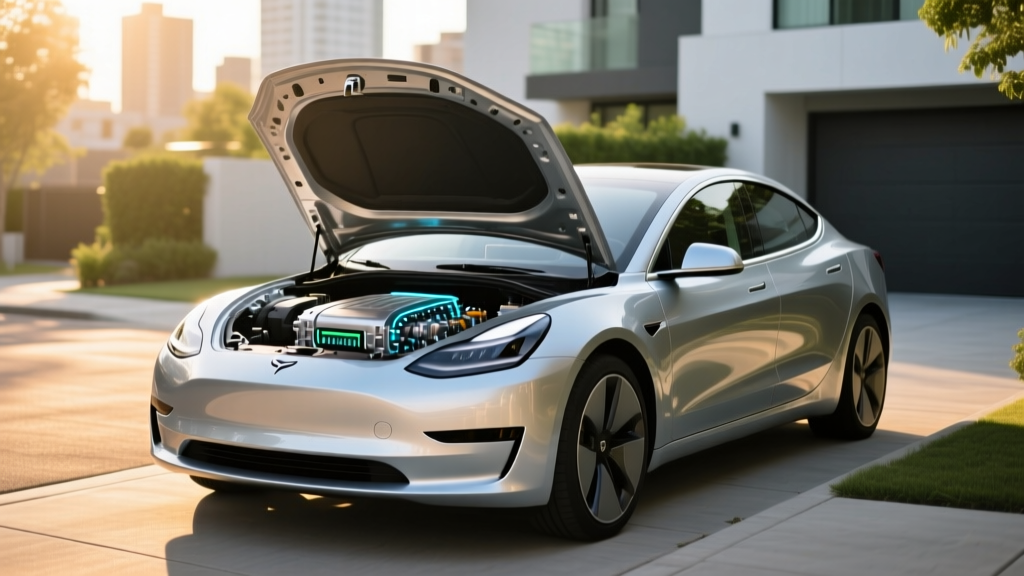
In a conventional gas vehicle, the internal combustion engine is the heart of the powertrain. It converts chemical energy in fuel into rotational force through thousands of controlled explosions per minute. This requires a complex system of pistons, valves, camshafts, a crankshaft, a fuel injection system, an exhaust system with catalytic converters, and typically a multi-gear transmission to keep the engine in its narrow efficient RPM band.
An electric vehicle replaces all of that with a radically simpler setup:
- Electric motor(s): Most EVs use a permanent-magnet synchronous motor (PMSM) or an AC induction motor. These convert electrical energy from the battery directly into rotational force with typical efficiencies of 85–95%, compared to roughly 20–35% thermal efficiency for a gas engine. A single motor can produce maximum torque from 0 RPM — no need to rev up.
- Traction battery pack: A high-voltage lithium-ion battery (typically 400V or 800V architecture) stores energy in kilowatt-hours (kWh). For context, the 2026 Tesla Model Y Long Range carries approximately 75 kWh of usable energy; the Hyundai Ioniq 5 carries about 77.4 kWh.
- Inverter: Converts the battery's DC (direct current) electricity into the AC (alternating current) that the motor requires, and controls motor speed and torque.
- Single-speed reduction gear: Most EVs use a single fixed-ratio gear reduction (roughly 9:1 to 10:1) rather than a multi-speed transmission, because electric motors operate efficiently across a very wide RPM range (often 0–15,000+ RPM).
- Onboard charger: Converts incoming AC power from a Level 1 or Level 2 charger into DC to replenish the battery.
- Thermal management system: Liquid cooling/heating loops keep the battery and motor within optimal temperature ranges for performance, charging speed, and longevity.
The net effect is a powertrain with roughly 20 moving parts in the drivetrain versus 2,000+ in a typical internal combustion powertrain. That simplicity is the primary reason EVs require far less routine maintenance.
EV vs. Gas Car vs. Hybrid: Powertrain Compared
Understanding what each vehicle type actually has under the hood clarifies why the terminology matters.
| Component | Battery EV (BEV) | Gas Car (ICE) | Hybrid (HEV) | Plug-in Hybrid (PHEV) |
|---|---|---|---|---|
| Gas engine | No | Yes | Yes | Yes |
| Electric traction motor | Yes (1–3) | No | Yes (1–2) | Yes (1–2) |
| High-voltage battery | Yes (50–120+ kWh) | No (12V only) | Yes (1–2 kWh) | Yes (10–25 kWh) |
| Fuel tank | No | Yes | Yes | Yes |
| Exhaust system | No | Yes | Yes | Yes |
| Multi-speed transmission | Rarely (single-speed) | Yes (6–10 spd) | Yes (eCVT) | Yes (eCVT/AT) |
| Can drive on electricity alone | Yes (always) | No | Briefly, low speed | Yes (20–45 mi) |
| Tailpipe emissions | None | Yes | Yes | Yes (when engine runs) |
Notice that hybrids and PHEVs do have gas engines — they're the vehicles that blur the line. When someone asks "does an electric car have an engine?" the accurate answer depends on whether they mean a pure BEV (no) or are loosely including hybrids (yes).
Real-World Performance and Efficiency Numbers
Because electric motors convert energy so much more efficiently than combustion engines, EVs deliver dramatically better miles-per-energy-unit figures. The EPA expresses this as MPGe (miles per gallon equivalent), where 33.7 kWh of electricity = 1 gallon of gasoline.
Representative 2026 model-year figures from fueleconomy.gov:
- 2026 Hyundai Ioniq 6 SE Long Range: EPA 361 miles range, 140 MPGe combined, 24 kWh/100 mi. Battery: 77.4 kWh NMC.
- 2026 Tesla Model 3 Long Range AWD: EPA 341 miles, 132 MPGe combined, ~25 kWh/100 mi. Battery: ~75 kWh NMC.
- 2026 Ford F-150 Lightning Extended Range: EPA 320 miles, 70 MPGe combined, ~48 kWh/100 mi. Battery: 131 kWh NMC.
- 2026 Toyota Camry (gas, 4-cyl): EPA 32 MPG combined — roughly equivalent to 32 MPGe for comparison.
That efficiency gap is why an EV can travel 3–4× farther on the same dollar of energy as a comparable gas car, even at 2026 national average electricity rates of ~$0.17/kWh versus ~$3.30/gallon for regular unleaded.
What EV Ownership Actually Costs (2026 Numbers)
The biggest objection to EVs is the higher sticker price. The real question is total cost of ownership (TCO). Here's a realistic 5-year/75,000-mile breakdown comparing a typical 2026 EV sedan (base MSRP ~$42,000, after potential §30D tax credit ~$34,500 net) against a comparable gas sedan (base ~$30,000).
| Category (5 yr / 75k mi) | BEV Sedan | Gas Sedan | Notes |
|---|---|---|---|
| Purchase (after incentives) | $34,500 | $30,000 | BEV assumes $7,500 §30D credit (subject to MSRP, income, battery-sourcing rules) |
| Energy/fuel | $2,650 | $8,250 | BEV: 25 kWh/100mi × $0.17/kWh home charging. Gas: 28 MPG × $3.30/gal |
| Maintenance | $1,200 | $3,800 | BEV: cabin filter, wipers, brake fluid, tire rotation. Gas adds oil, filters, spark plugs, transmission fluid, belts |
| Brake replacement | $0 | $600 | Regen braking preserves EV pads past 100k mi in most cases |
| Insurance (avg) | $9,500 | $7,800 | EV premiums run ~15–25% higher on average |
| Depreciation (est.) | $18,000 | $14,500 | EV resale has improved but still trails ICE in most segments |
| 5-year total cost | $65,850 | $64,950 |
The verdict: at 2026 prices, a similarly equipped EV and gas car are within ~$1,000 over five years when the full federal credit applies. Without the credit — or if you mostly drive short city trips where gas cars are least efficient — the EV pulls further ahead. If you drive very low annual miles (under 8,000/year), the gas car often wins on pure economics because the fuel savings don't offset the higher purchase price.
Charging cost reality check: Home Level 2 charging at $0.17/kWh is cheap. Public DC fast charging averages $0.40–$0.55/kWh in 2026, which erases much of the fuel-cost advantage. Owners who must rely on public charging should run their own numbers carefully.
What First-Time EV Buyers Must Know Before Switching
Moving from a gas car to a vehicle without an engine introduces new ownership rhythms. These are the non-negotiable considerations:
1. Home Charging Access Is the Make-or-Break Factor
Over 80% of EV charging happens at home. If you have a garage or dedicated parking spot with access to a 240V circuit, a Level 2 home charger (7–11.5 kW) will add 25–45 miles of range per hour — enough to fully replenish any EV overnight. Installation typically costs $600–$2,200 depending on panel capacity and run length; a panel upgrade to 200A can add $1,500–$3,500. Without reliable home or workplace charging, EV ownership becomes substantially less convenient.
2. Real-World Range ≠ EPA Sticker
EPA range is measured on a mixed cycle at moderate temperatures. Expect:
- Highway driving at 75 mph: 10–15% below EPA
- Cold weather (below 30°F): 15–30% below EPA, worst at short trips without preconditioning
- Mountain climbs / towing: 25–40% below EPA
A 320-mile EPA rating realistically becomes 250–270 miles on a 75-mph winter road trip. Plan accordingly.
3. DC Fast Charging Is Not Linear
Advertised "peak 250 kW" charge rates are only sustained between roughly 10–40% state of charge. The charge curve tapers sharply above 80%. A realistic 10–80% session on a modern 800V EV takes 18–25 minutes; on a 400V architecture, 25–35 minutes. Charging from 80–100% can take as long as 10–80%.
4. Battery Longevity Is Better Than Feared
Modern NMC and LFP battery packs are warrantied for 8 years/100,000 miles (10 years/150,000 miles in California Air Resources Board states) to retain at least 70% of original capacity. Real-world degradation data from Tesla's fleet reports and independent analyses show most packs retaining 85–92% capacity at 100,000 miles. Full battery replacement — rarely needed — runs $10,000–$20,000 depending on pack size.
Common Misconceptions, Addressed With Facts
| Myth | Fact |
|---|---|
| "EVs have hidden engines as backups" | Pure BEVs have no engine whatsoever. Only hybrids (HEV/PHEV) pair a motor with a gas engine. |
| "EVs are slower because they don't have engines" | Electric motors produce peak torque at 0 RPM. A 2026 Tesla Model 3 Performance does 0–60 mph in 2.9 seconds — faster than most V8 sports sedans. |
| "You need to change oil in an EV" | No oil, no oil changes, no oil filter. EVs use a small amount of gearbox fluid that rarely requires service. |
| "EV batteries need replacement every few years" | EV traction batteries are engineered for 15–20+ year service life. The 12V auxiliary battery may need replacement every 4–6 years, like any car. |
| "EVs are worse for the environment because of battery manufacturing" | Lifecycle analyses from Argonne National Lab and ICCT consistently show BEVs produce 50–70% fewer lifetime CO₂ emissions than comparable gas cars in the US grid mix, with payback typically within 1–2 years of driving. |
| "EVs can't handle cold weather" | Range drops in cold are real (15–30%), but preconditioning the battery while plugged in and using a heat pump (standard on many 2026 models) mitigate the loss substantially. Norway, with harsh winters, has the highest per-capita EV adoption in the world. |
Decision Framework: Should Your Next Car Have an Engine or Not?
Choose a pure BEV (no engine) if:
- You can install Level 2 charging at home or have reliable workplace charging
- Your typical daily driving is under 200 miles
- You want minimum maintenance and lowest per-mile energy cost
- You qualify for the §30D federal tax credit (income caps: $150k single / $300k joint; MSRP caps: $55k sedans / $80k SUVs and trucks; battery sourcing requirements apply)
- You live in a region with moderate winters or have garage parking
Choose a PHEV (has both engine + motor) if:
- You lack reliable home charging but want some electric-only driving
- You frequently take 400+ mile road trips and don't want to plan around chargers
- You want electric commuting (20–45 miles) with gas-engine range flexibility
Stick with a conventional gas car (has engine only) if:
- You drive fewer than 8,000 miles per year (fuel savings won't offset EV premium)
- You live in an apartment with no charging access and limited public infrastructure
- You regularly tow heavy loads long distances in cold weather
Frequently Asked Questions
Do Teslas have engines?
No. Every Tesla (Model 3, Model Y, Model S, Model X, Cybertruck) is a pure battery-electric vehicle with electric motors only. Tesla has never produced a vehicle with a gas engine.
Do electric cars have transmissions?
Most EVs use a single-speed reduction gear rather than a multi-speed transmission. The Porsche Taycan and Audi e-tron GT are rare exceptions with a 2-speed gearbox on the rear axle for optimized launch and top-speed efficiency.
Why do some people call the EV motor an "engine"?
Colloquial usage. In engineering, "engine" specifically means a machine that converts thermal or chemical energy into mechanical work through combustion. "Motor" converts electrical energy into mechanical work. The terms are often swapped informally, but technically an EV has a motor, not an engine.
Do hybrids have engines?
Yes. Both conventional hybrids (Toyota Prius, Honda Accord Hybrid) and plug-in hybrids (Toyota RAV4 Prime, Jeep Wrangler 4xe) pair a gas engine with one or more electric motors and a battery pack.
What happens if an EV battery dies completely?
If the traction battery reaches 0% state of charge, the car stops — just like a gas car running out of fuel. A tow to a charger is required. This is why manufacturers build in a buffer (typically 3–5 kWh) below the displayed 0% to protect battery health and give a small warning margin.
How long do electric motors last compared to engines?
Electric motors have fewer wear components and routinely outlast the vehicle itself — 300,000+ miles is common. Internal combustion engines typically require major service (timing chain, head gasket, etc.) between 150,000–250,000 miles.