The Quick Answer
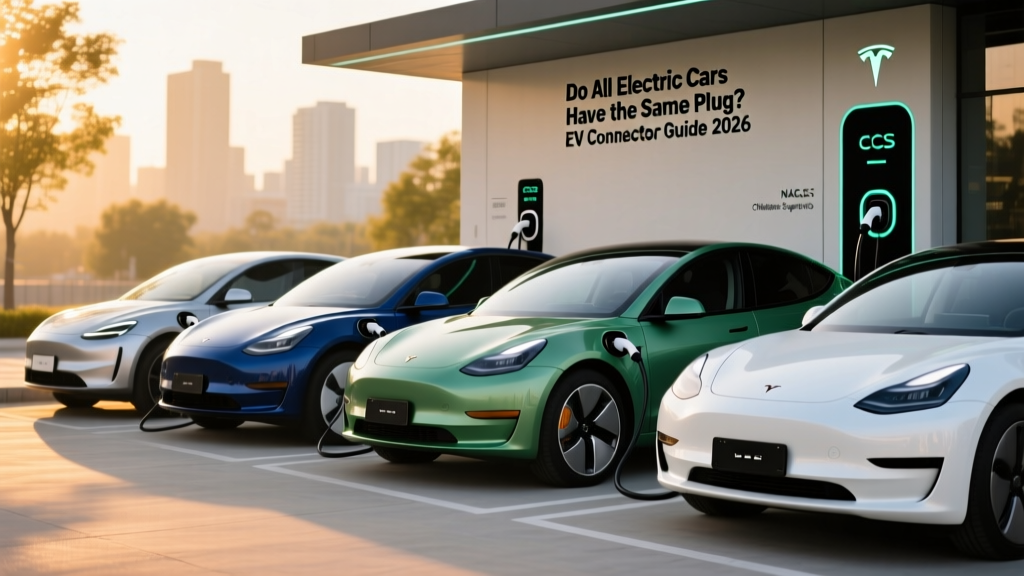
No, not all electric cars have the same plug. As of 2026, the North American EV market primarily uses three DC fast-charging connector standards: NACS (Tesla's North American Charging Standard, now adopted by most major automakers), CCS1 (Combined Charging System, used on older non-Tesla EVs), and the legacy CHAdeMO (found on the Nissan Leaf and Mitsubishi Outlander PHEV). For Level 2 AC charging, nearly all non-Tesla EVs use the J1772 connector, while Tesla uses its proprietary NACS connector for both AC and DC. However, adapters are widely available, and the industry is rapidly consolidating around NACS as the dominant standard.
Why EV Plugs Differ: A Brief History of Connector Fragmentation
Unlike gasoline vehicles, which standardized on a single fuel-filler neck decades ago, the EV industry developed multiple charging connectors in parallel. Tesla introduced its proprietary connector in 2012 alongside the Model S. The rest of the industry adopted CCS1 (backed by GM, Ford, Volkswagen, and others) and CHAdeMO (championed by Nissan and Mitsubishi). This fragmentation meant that a CCS-equipped Chevrolet Bolt couldn't plug into a Tesla Supercharger without an adapter, and a Nissan Leaf with CHAdeMO was locked out of both networks.
The turning point came in late 2022 when Ford and GM announced they would adopt Tesla's NACS connector for future vehicles. By 2024–2025, nearly every major automaker — including Hyundai, Kia, Rivian, BMW, Mercedes-Benz, and Volvo — committed to NACS. The result: NACS is now the de facto North American standard, though millions of CCS1-equipped EVs remain on the road.
The Three Main EV Connector Types Explained
| Connector | AC Level 2 Charging | DC Fast Charging | Peak DC Rate (Typical) | Vehicles Using It (2026) |
|---|---|---|---|---|
| NACS (J3400) | Yes (up to 19.2 kW) | Yes (up to 350 kW) | 250–350 kW | Tesla (all), Ford F-150 Lightning/Explorer EV, GM Ultium vehicles (Equinox EV, Blazer EV, Silverado EV, Cadillac Lyriq), Rivian R1T/R1S (2025+), Hyundai Ioniq 5/6 (2025+), Kia EV6/EV9 (2025+), BMW iX/i4 (2025+), Volvo EX30/EX90, Nissan Ariya (2026+) |
| CCS1 | Uses J1772 for AC | Yes (up to 350 kW) | 150–350 kW | Older non-Tesla EVs: Chevrolet Bolt EV/EUV, Hyundai Ioniq 5 (2022–2024), Kia EV6 (2022–2024), VW ID.4 (2021–2024), Ford Mustang Mach-E (2021–2024), BMW i4 (2022–2024), Audi e-tron/GT, Porsche Taycan |
| CHAdeMO | Uses J1772 for AC | Yes (up to 100 kW) | 50–100 kW | Nissan Leaf (all years), Mitsubishi Outlander PHEV (DC capable), older Kia Soul EV (2015–2019) |
NACS: The Winning Standard
Tesla opened its proprietary connector design in November 2022, renaming it the North American Charging Standard (NACS). SAE International subsequently formalized it as the J3400 standard. The NACS connector is significantly smaller and lighter than CCS1, uses the same pins for both AC and DC charging (eliminating the bulky lower DC pins on CCS), and supports charging speeds up to 350 kW on V4 Supercharger stalls. As of 2026, most new EVs from major automakers ship with a native NACS port.
CCS1: Still Everywhere, But Fading
If you bought a non-Tesla EV between 2018 and 2024, it almost certainly has a CCS1 port. The CCS1 connector combines a J1772 AC inlet on top with two large DC pins below. While CCS1 supports impressive peak rates (the Hyundai Ioniq 5 and Kia EV6 can peak at 240 kW on 800V architectures), the connector is physically larger and heavier than NACS. Automakers are phasing it out on new models, but the installed base of CCS1 vehicles ensures public CCS chargers will remain operational for years.
CHAdeMO: The Legacy Connector
CHAdeMO is a round, multi-pin DC connector used primarily by the Nissan Leaf. It maxes out at around 100 kW (most Leaf models peak at 50 kW), and no new vehicles sold in North America use it. CHAdeMO chargers are still found at many public stations, but new installations overwhelmingly favor NACS and CCS. If you're buying a used Nissan Leaf, CHAdeMO compatibility is worth understanding — you'll rely on Electrify America and other networks that still maintain CHAdeMO stalls.
Level 2 AC Charging: J1772 vs. NACS
For home and destination Level 2 AC charging, the picture is simpler but still split:
- J1772: The universal AC connector for all non-Tesla EVs in North America. Every public Level 2 station (ChargePoint, Blink, EVgo Level 2) has a J1772 plug. If your EV has a NACS port, you'll need a NACS-to-J1772 adapter (typically $50–$150) to use these stations.
- NACS (AC mode): Tesla vehicles and newer NACS-equipped EVs charge on AC using the same compact NACS connector. Tesla Wall Connectors and an increasing number of third-party Level 2 chargers (Emporia, Enel X Way) now ship with NACS plugs.
Common Misconceptions About EV Plugs
| Myth | Fact |
|---|---|
| "I can't charge a Ford at a Tesla Supercharger." | Since 2024, Ford EVs with CCS ports can use Tesla Superchargers with a Tesla-provided CCS adapter (free for Ford owners, ~$200 retail). 2025+ Fords ship with native NACS ports and need no adapter. |
| "Different plugs mean different charging speeds." | The connector is just the physical interface. Actual charging speed depends on the vehicle's onboard charger (for AC) and battery architecture (for DC). A CCS1 Hyundai Ioniq 5 charges at up to 240 kW DC — faster than many NACS vehicles. |
| "CHAdeMO is dead; I should avoid any car with it." | CHAdeMO chargers still exist at Electrify America and other networks. However, no new vehicles use it, and infrastructure investment has shifted to NACS/CCS. A used Leaf with CHAdeMO is fine for local driving but less ideal for road trips. |
| "I need a Tesla to use Superchargers." | Tesla has opened its Supercharger network to non-Tesla EVs. CCS-equipped vehicles can access select Supercharger stalls via the Tesla app and an adapter. NACS-equipped non-Tesla EVs (2025+ models) can access the full network natively. |
| "Adapters will damage my car's battery." | Properly certified adapters (UL-listed, from Tesla or reputable manufacturers) are electrically safe. They simply remap pins — no voltage conversion occurs. An adapter does not affect charging speed or battery health. |
Real-World Charging Access: What This Means for Ownership
The connector on your EV determines which public charging networks you can access natively — but adapters and network expansion have narrowed the gaps significantly. Here's what ownership actually looks like in 2026:
Home Charging (Where 80%+ of EV Charging Happens)
If you can install a Level 2 home charger (240V, 32–48 amps), your connector type matters far less. A hardwired Level 2 station with a J1772 cable will charge any non-Tesla EV directly, and any NACS EV with a simple adapter. Expect to add 25–44 miles of range per hour of Level 2 charging at 7.7–11.5 kW — more than enough to replenish a full day's driving overnight.
Home charging cost: At the US average residential electricity rate of ~$0.17/kWh (per the U.S. Energy Information Administration), fully charging a 77 kWh battery (Ford Mustang Mach-E Extended Range) costs roughly $13.09 — versus approximately $45–$55 to fill a comparable gas car's tank at $3.50/gallon.
Public DC Fast Charging (Road Trips and Quick Top-Ups)
Here, connector type directly impacts convenience:
- NACS vehicles (2025+): Access Tesla's Supercharger network (17,000+ stalls in North America, widely considered the most reliable) plus Electrify America, EVgo, and ChargePoint DC stations with a NACS-to-CCS adapter.
- CCS vehicles: Access Electrify America, EVgo, ChargePoint, and select Tesla Superchargers (via adapter and Tesla app). The CCS network is extensive but historically less reliable than Superchargers.
- CHAdeMO vehicles: Limited to Electrify America and scattered legacy chargers. Increasingly inconvenient for road trips.
Charging Cost Comparison: EV vs. Gas (2026)
| Scenario | EV (77 kWh Battery, 270 mi EPA Range) | Gas Car (30 MPG Combined, 15-Gallon Tank, 450 mi Range) |
|---|---|---|
| Home charging / fueling (full) | $13.09 (at $0.17/kWh) | $52.50 (at $3.50/gal) |
| Public DC fast charge (10–80%) | $15–$25 (at $0.35–$0.55/kWh) | N/A (full tank shown above) |
| Cost per mile (home) | $0.048/mile | $0.117/mile |
| Annual fuel/energy cost (12,000 mi/yr, home charging) | $581 | $1,400 |
| Annual savings (EV vs. gas) | ~$819/year in fuel savings | |
Sources: fueleconomy.gov, EIA average electricity rates. Actual costs vary by state, utility rate, and driving conditions.
Adapter Guide: Bridging the Connector Gap
If your EV's native plug doesn't match a charger, adapters solve the problem. Here's the 2026 adapter landscape:
| Adapter | Use Case | Approximate Cost | Notes |
|---|---|---|---|
| Tesla CCS-to-NACS adapter | CCS vehicles → Tesla Superchargers | Free (Ford/GM/Rivian owners); ~$200–$250 retail | Requires Tesla app activation; supports up to 250 kW on compatible stalls |
| NACS-to-CCS adapter | NACS vehicles → Electrify America, EVgo CCS chargers | $150–$300 | Lectron, A2Z, and Setec offer UL-listed options; supports up to 350 kW |
| NACS-to-J1772 adapter | NACS vehicles → public Level 2 (J1772) stations | $50–$150 | Essential for NACS owners using destination chargers, workplace chargers |
| J1772-to-NACS adapter | J1772 Level 2 cable → NACS vehicle | $50–$130 | Tesla Mobile Connector includes this; third-party options widely available |
| CHAdeMO-to-CCS adapter | CCS vehicles → legacy CHAdeMO stations | $200–$400 | Rare; limited availability. Not recommended for most buyers. |
EV vs. Gas: Beyond the Plug — Total Ownership Costs
Connector compatibility is one piece of the EV ownership puzzle. Here's how a typical mid-range EV stacks up against a comparable gas vehicle over five years, based on 12,000 miles driven annually:
| Cost Category (5 Years) | EV (e.g., 2026 Hyundai Ioniq 5 SEL, ~$45,000 MSRP) | Gas (e.g., 2026 Toyota RAV4 XLE, ~$33,000 MSRP) |
|---|---|---|
| Purchase price (MSRP) | $45,000 | $33,000 |
| Federal tax credit (§30D) | −$3,750 to $7,500 (varies by sourcing/income; see IRS guidelines) | $0 |
| Fuel / energy (5 years) | $2,905 (home charging at $0.17/kWh) | $7,000 (at $3.50/gal, 30 MPG) |
| Maintenance (5 years) | $1,200–$1,800 (no oil changes, fewer brake replacements due to regen) | $3,000–$4,500 (oil, filters, brake pads, spark plugs) |
| Insurance (5 years, avg.) | $9,000–$11,000 (EV premiums run 15–25% higher) | $7,500–$9,000 |
| Estimated 5-year total cost | $49,405–$57,255 (after credit) | $50,500–$53,500 |
Tax credit eligibility depends on MSRP caps ($55,000 for cars, $80,000 for SUVs/trucks), buyer income limits ($150K single / $300K joint), and battery critical-mineral sourcing requirements. Always verify current-year rules on irs.gov or consult a tax professional.
Decision Framework: Which EV Plug Situation Applies to You?
If X, Then Y: Choosing Based on Your Charging Reality
IF you have a garage/driveway and can install Level 2 home charging:
→ Connector type matters less for daily use. Buy the EV that best fits your needs (range, cargo, budget). Install a 48-amp hardwired Level 2 charger (~$500–$800 for the unit, $500–$2,000 for electrician labor depending on panel capacity). You'll wake up with a full "tank" every morning and rarely need public charging except on road trips.
IF you rely entirely on public charging (apartment, street parking):
→ Prioritize a NACS-equipped vehicle (2025+ Tesla, Ford, GM, Hyundai, Kia, Rivian). NACS gives you the broadest access to reliable public charging, especially Tesla Superchargers. Check your area for Electrify America, EVgo, and ChargePoint stations. Expect to pay $0.35–$0.55/kWh at public DC chargers — roughly $0.10–$0.16/mile, still cheaper than gas but less so than home charging.
IF you frequently road-trip (200+ miles one way, multiple times per year):
→ A NACS vehicle with access to the Tesla Supercharger network is the most convenient option. Superchargers offer the highest uptime (~97% per Tesla's reports) and the best geographic coverage. Plan routes using A Better Route Planner to identify charger locations and estimate charging stops.
IF you live in a cold climate (regularly below 25°F / −4°C):
→ All EVs lose 20–35% of their EPA range in extreme cold due to battery resistance and cabin heating demands. A vehicle with a heat pump (standard on most 2025+ EVs from Hyundai, Kia, Tesla, BMW) reduces this penalty to 15–25%. Choose an EV with at least 300 miles of EPA range to maintain a comfortable 200+ real-world winter range. Preconditioning the battery before DC fast charging (automatic when you navigate to a charger in most EVs) is essential — without it, charging speeds can drop by 50% or more in cold weather.
IF you're buying used and on a budget:
→ A CCS-equipped used EV (2022–2024 Hyundai Ioniq 5, Kia EV6, Ford Mustang Mach-E) offers excellent value, as depreciation has been steep. Budget $200 for a CCS-to-NACS adapter to unlock Tesla Supercharger access. A used Nissan Leaf with CHAdeMO is the cheapest EV option (under $15,000 for a 2019–2022 model with 150–226 miles of range) but limits your public charging flexibility — best as a commuter car with home charging.
What First-Time EV Buyers Should Know About Plugs and Charging
1. Your home charger is your "gas station." Over 80% of EV charging happens at home. If you can install a Level 2 charger, daily charging convenience surpasses any gas car — no detours, no pumps, no fumes. A typical 48-amp Level 2 charger adds ~30–40 miles of range per hour and costs $1,000–$2,500 installed (including the unit, electrical work, and permits). If your home has a 200-amp electrical panel with spare capacity, installation is straightforward. Older homes with 100-amp panels may need a $1,500–$3,000 panel upgrade — consult a licensed electrician.
2. DC fast charging is for road trips, not daily use. Frequent DC fast charging (above 150 kW) accelerates battery degradation slightly. For battery longevity, rely on Level 2 for daily charging and use DC fast chargers for trips. Most manufacturers warranty their batteries for 8 years / 100,000 miles with a minimum 70% capacity retention threshold.
3. Peak kW ≠ sustained kW. A vehicle rated for "350 kW peak DC charging" will only sustain that rate for a small portion of the charge session (typically 10–30% state of charge). The charging curve tapers significantly above 80% SoC to protect battery health. A more useful metric is 10–80% charge time: the Hyundai Ioniq 5 (84 kWh, NMC battery) achieves 10–80% in approximately 18 minutes on a 350 kW charger; the Ford F-150 Lightning (131 kWh extended range) takes roughly 41 minutes due to its larger battery.
4. The $7,500 federal tax credit isn't guaranteed. Under IRS §30D, eligibility depends on vehicle MSRP caps, buyer income limits, battery component manufacturing origin, and critical-mineral sourcing. Many popular EVs qualify for only $3,750 or $0 depending on the model year and sourcing updates. The credit can now be transferred to the dealer as a point-of-sale discount. Always verify on fueleconomy.gov before purchasing.
5. The industry is consolidating on NACS. If connector standardization matters to you, buying a 2025+ NACS-equipped vehicle future-proofs your access. CCS vehicles will remain supported for years, but new charging infrastructure investments heavily favor NACS.
Frequently Asked Questions
Can I charge a non-Tesla EV at a Tesla Supercharger?
Yes, with conditions. Vehicles with a native NACS port (2025+ Ford, GM, Hyundai, Kia, Rivian, BMW, Volvo models) can plug directly into any Supercharger. Older CCS-equipped vehicles need a Tesla-approved CCS-to-NACS adapter and must activate charging through the Tesla app. Not all Supercharger stalls are open to non-Tesla vehicles — check the Tesla app for compatible locations.
Will my CCS EV become obsolete?
No. CCS chargers will remain at Electrify America, EVgo, ChargePoint, and other networks for years. Adapters also let CCS vehicles access Tesla Superchargers. However, new charging infrastructure is increasingly NACS-first, and CCS-only chargers may become less common over the next 5–10 years.
Is CHAdeMO worth considering in 2026?
Only if you're buying a used Nissan Leaf as a budget commuter car with home charging. CHAdeMO limits your public fast-charging options, and no new vehicles use it. For road-trip-capable EVs, choose NACS or CCS.
Do adapters reduce charging speed?
High-quality, properly rated adapters (UL-listed, from Tesla, Lectron, or similar) do not meaningfully reduce charging speed. A CCS-to-NACS adapter supports up to 250 kW, which covers the vast majority of public DC charging scenarios. Your vehicle's battery architecture and state of charge determine actual charging speed, not the adapter.
How much does it cost to install a home Level 2 charger?
Expect $1,000–$2,500 total for a typical installation: $400–$800 for a quality 48-amp Level 2 charger (ChargePoint Home Flex, Emporia Vue, Tesla Wall Connector), $500–$1,500 for electrician labor (running a 240V/60A circuit from your panel to your garage), and $50–$200 for permits. If your electrical panel needs upgrading (100A to 200A), add $1,500–$3,000. Some utilities offer rebates of $250–$1,000 for Level 2 installations — check with your provider.
What's the difference between kW and kWh?
kW (kilowatts) measures power — the rate at which energy flows. A 150 kW DC charger delivers energy at that rate. kWh (kilowatt-hours) measures energy capacity — how much the battery holds. A 77 kWh battery stores 77 kilowatt-hours of energy. Think of kW as the "speed" of charging (like gallons per minute at a gas pump) and kWh as the "tank size."