Quick Answer: Is a DIY Electric Outboard Worth It?
A DIY electric outboard motor typically costs $1,500–$6,000 to build using repurposed EV batteries and a brushless DC motor, compared to $2,500–$8,000+ for a comparable commercial unit. However, electric outboards for marine use fall outside the scope of federal §30D EV tax credits, which apply only to qualified highway vehicles. DIY builds offer deep customization and potential cost savings but require electrical knowledge, waterproofing skills, and careful battery management. For most boaters, a DIY electric outboard makes sense only if you have access to shore power or solar charging, boat primarily on calm inland waters, and accept a range of 10–40 miles depending on battery capacity and hull speed.
As electric vehicles have reshaped road transportation, the same lithium-ion and motor technology is quietly migrating to the water. DIY electric outboard projects—converting or building electric marine propulsion from EV-sourced components—have grown from niche forums into a legitimate subculture of maker-boaters. This guide breaks down what it actually takes to build one, what it costs, and whether the electrification math holds up beyond the driveway.
What a DIY Electric Outboard Actually Involves
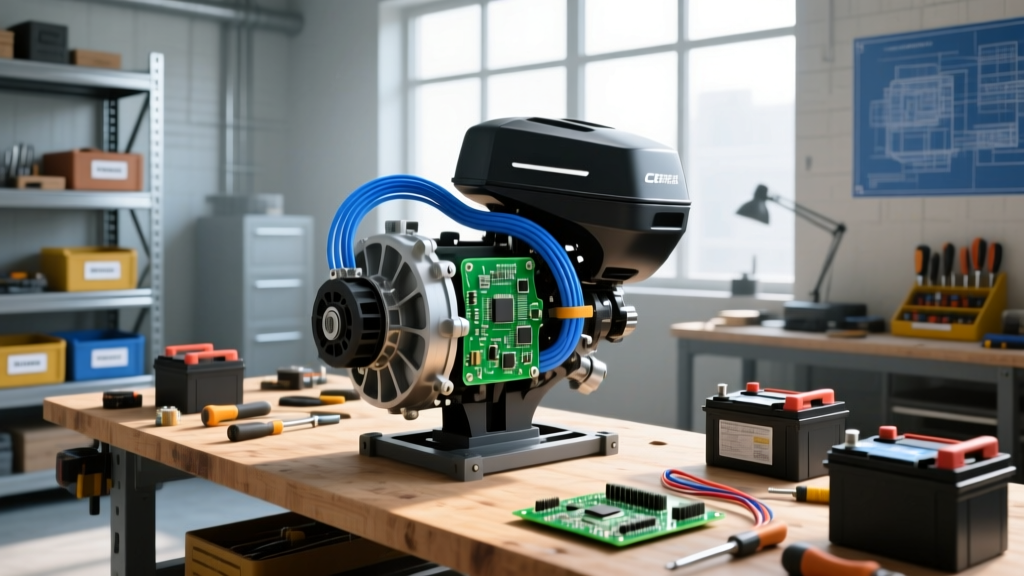
A DIY electric outboard replaces a gasoline-powered outboard engine with a system built from three core components:
- Electric motor: Typically a brushless DC (BLDC) motor rated between 1 kW and 10 kW (roughly 1.3–13.4 horsepower). Popular choices include repurposed e-bike hub motors, RC outrunner motors, or salvaged EV traction motors scaled down for marine use.
- Battery pack: Most builders use either salvaged EV modules (such as Nissan Leaf or Chevrolet Bolt battery modules) or purpose-built lithium iron phosphate (LiFePO4/LFP) packs. Capacity typically ranges from 2 kWh to 15 kWh.
- Motor controller and throttle: A marine-rated electronic speed controller (ESC) manages power delivery. Waterproof throttles and kill switches are mandatory for safe operation.
The build also demands a lower unit (the leg and propeller assembly), which many builders salvage from a retired gas outboard, and a waterproof housing for the electronics. Total build time for a first-time builder ranges from 40 to 120 hours, depending on fabrication complexity.
Cost Breakdown: DIY Electric Outboard vs. Gas vs. Commercial Electric
The financial case for a DIY electric outboard depends heavily on whether you can source used EV batteries and whether you already own fabrication tools. Here's how the numbers stack up for a typical 5 kW (≈6.7 HP) system:
| Category | DIY Electric Outboard | New Gas Outboard (6–8 HP) | Commercial Electric (e.g., ePropulsion, Torqeedo) |
|---|---|---|---|
| Upfront Cost | $1,500–$6,000 | $1,800–$3,200 | $2,500–$8,500 |
| Fuel/Energy Cost per Hour | $0.30–$0.90 (electricity) | $2.50–$5.00 (gasoline) | $0.30–$0.90 (electricity) |
| Annual Maintenance | $0–$50 (connections, prop) | $150–$400 (oil, impeller, carb) | $0–$100 (seals, prop) |
| Estimated Lifespan | 5–10 years (battery-dependent) | 10–20 years (with maintenance) | 8–15 years |
| Range (typical displacement hull) | 10–40 miles | 80–200+ miles | 10–35 miles |
| Noise Level | Near silent | 70–85 dB | Near silent |
The energy cost advantage is significant. At the U.S. average residential electricity rate of roughly $0.16/kWh (EIA, 2025 data), running a 5 kW motor at half throttle (2.5 kW draw) costs about $0.40 per hour. The same runtime on a 6 HP gas outboard burning roughly 0.6 gallons per hour at $4.00/gallon costs $2.40. Over 100 hours of annual use, that's a $200/year savings on energy alone—before factoring in eliminated oil changes, spark plug replacements, and winterization.
Battery Sizing and Range: The Hard Math
Range is where DIY electric outboard projects live or die. Unlike road EVs, which benefit from regenerative braking and relatively low rolling resistance, boats face constant hydrodynamic drag with no regen opportunity. Your range depends on three factors:
1. Battery capacity (kWh): A 5 kWh pack is the practical minimum for useful operation. A 10 kWh pack provides comfortable half-day cruising on a small displacement hull.
2. Hull type and speed: Displacement hulls (sailboats, pontoons, dinghies) are far more efficient than planing hulls. At 4–5 knots, a displacement hull might draw 1–2 kW. Pushing to hull speed can double or triple that draw.
3. Motor efficiency: BLDC motors typically operate at 85–92% efficiency at their optimal load point. Cheap controllers and mismatched propellers can drop system efficiency to 70% or below.
For a realistic example: a 10 kWh LFP battery pack powering a 3 kW motor on a 14-foot displacement dinghy at 4.5 knots yields roughly 15–18 miles of range (about 3.5 hours of runtime). Double the battery to 20 kWh and you approach 30–35 miles—but you're now carrying 300+ pounds of battery in a small boat, which affects stability and freeboard.
Real-world range reality: Manufacturer claims for commercial electric outboards often cite optimistic conditions. Independent testing by marine publications consistently shows 60–75% of claimed range at cruising speeds. Apply the same discount to your DIY calculations.
Battery Chemistry for Marine Use: LFP vs. NMC
If you're sourcing batteries from a salvaged EV, you'll encounter two main chemistries:
| Factor | LFP (Lithium Iron Phosphate) | NMC (Nickel Manganese Cobalt) |
|---|---|---|
| Energy Density | Lower (~140–170 Wh/kg) | Higher (~200–260 Wh/kg) |
| Cycle Life | 3,000–6,000 cycles | 1,000–2,500 cycles |
| Thermal Runaway Risk | Very low | Moderate (requires BMS protection) |
| Weight for 10 kWh | ~60–70 kg (132–154 lbs) | ~40–50 kg (88–110 lbs) |
| Best For | Safety-first builds, daily use | Weight-critical applications |
| Salvage Source Examples | Tesla Model 3 RWD, BYD packs | Chevy Bolt, Nissan Leaf, VW ID.4 |
For marine applications, LFP is the strongly preferred chemistry. The marine environment amplifies every safety concern: a thermal runaway event on the water is far more dangerous than in a driveway, where you can simply exit the vehicle. LFP's higher cycle life also matters—boat batteries often sit at partial charge for weeks between outings, and LFP handles calendar aging better than NMC.
If you do use salvaged NMC modules, invest in a quality battery management system (BMS) with cell-level voltage and temperature monitoring, and never charge above 80% state of charge for daily use.
DIY Electric Outboard vs. Gas: The Ownership Decision
Here's how the two options compare across the factors that actually matter on the water:
| Factor | DIY Electric Outboard | Gas Outboard |
|---|---|---|
| Instant Torque | Yes — full torque at 0 RPM | No — needs RPM buildup |
| Noise / Vibration | Near zero | Significant |
| Emissions on Water | Zero tailpipe | Unburned hydrocarbons in water |
| Range | 10–40 miles (battery-limited) | 80–200+ miles |
| Refueling/Recharging Time | 2–8 hours (shore power) | 2 minutes (gas can) |
| Cold Weather Performance | Reduced battery capacity (~15–25% loss below 40°F) | Harder starting, but runs fine once warm |
| Storage / Winterization | Minimal — no fuel stabilizer, no fogging | Fuel stabilizer, lower unit oil, fogging |
| Reliability (moving parts) | Very few — motor + controller | Many — carburetor, fuel pump, ignition |
Real-World Ownership Considerations
Charging access: Unlike EVs, which benefit from a growing DC fast-charging network, electric boats charge almost exclusively from shore power. You need access to a standard 120V outlet at your dock or a 240V outlet in your garage. A 10 kWh pack on a standard 120V/15A outlet (about 1.4 kW effective charging) takes 7–8 hours from empty. A 240V Level 2 setup cuts this to 2–3 hours.
Climate: If you boat in northern latitudes, expect 15–25% range loss in water temperatures below 50°F. Battery chemistry slows in cold, and you can't precondition a boat battery the way you can an EV cabin. Store batteries in a climate-controlled space when not in use.
Usage patterns: A DIY electric outboard is ideal for: lake fishing (slow trolling all day on minimal power), tender/dinghy duty from a moored sailboat, short river cruises, and no-wake-zone cruising. It is poorly suited for: offshore fishing, water skiing, long-distance passages, or any use case requiring sustained high-speed planing.
Insurance and registration: Most states require registration for any motorized vessel, including electric. Insurance for DIY marine systems is available but may require documentation of your build quality, BMS specs, and battery certifications. Expect premiums comparable to small gas outboards: $150–$400/year for a basic policy.
Tax Credits and Incentives: What Does and Doesn't Apply
A common misconception is that the federal §30D clean vehicle tax credit extends to electric marine motors. It does not. The §30D credit applies only to qualified plug-in electric vehicles designed for road use, meeting specific MSRP caps, buyer income limits, and battery sourcing requirements.
However, there are adjacent savings opportunities:
- Solar integration: If you charge your boat battery from a home solar system, you're effectively running on free energy after the solar payback period. The residential clean energy credit covers 30% of solar installation costs through 2032.
- State-level incentives: A handful of states and local air quality districts offer rebates for zero-emission marine equipment. California's CARB programs, for example, have periodically funded clean marine initiatives. Check your state's environmental agency for current programs.
- Used EV battery sourcing: Salvaged EV battery modules from totaled vehicles can cost 50–70% less than new cells, significantly reducing your build cost.
Common Misconceptions About DIY Electric Outboards
| Myth | Fact |
|---|---|
| "Electric outboards have no power." | A 5 kW BLDC motor delivers instant torque equivalent to a 6–8 HP gas outboard at low speeds. High-speed planing is the limitation, not low-speed thrust. |
| "Batteries will die in a year on the water." | Properly managed LFP batteries last 3,000–6,000 cycles. At 50 cycles per year, that's 60+ years of cycle life. Calendar aging is the real limit: expect 10–15 years with proper storage. |
| "You can't use EV batteries in a boat." | Salvaged EV modules are among the most popular battery sources for DIY marine builds. The key is a proper BMS, waterproof enclosure, and correct chemistry selection. |
| "It's cheaper to just buy gas." | At current fuel and electricity prices, electric operation costs $0.30–$0.90/hour vs. $2.50–$5.00/hour for gas. The savings compound quickly for frequent boaters. |
| "DIY builds aren't safe." | A well-engineered DIY build with proper fusing, BMS, waterproofing, and marine-grade connections can match or exceed commercial safety. A sloppy build, obviously, cannot. |
Decision Framework: Should You Build a DIY Electric Outboard?
Build a DIY electric outboard if:
- You boat primarily on calm inland waters (lakes, slow rivers, protected harbors)
- Your typical outing is under 20 miles round-trip
- You have reliable shore power access or solar charging
- You value silent operation (fishing, wildlife observation, conversation)
- You have basic electrical and fabrication skills, or willingness to learn
- You want to eliminate gas engine maintenance (carburetor cleaning, fuel stabilizer, lower unit oil changes)
Stick with gas (or wait for commercial electric) if:
- You need to plane a hull at high speed for water sports or offshore runs
- Your typical outing exceeds 30 miles
- You boat in remote areas with no shore power and no way to carry a generator
- You have no electrical experience and no interest in troubleshooting marine electronics
- You need a turnkey warranty and dealer support network
Frequently Asked Questions
How fast can a DIY electric outboard go?
On a displacement hull (dinghy, pontoon, sailboat), expect 4–6 knots cruising speed with a 3–5 kW motor. Planing speeds (15+ knots) require 15+ kW and a massive battery pack—impractical for most DIY builds. The physics of hull speed means electric outboards excel at efficient low-speed cruising, not high-speed runs.
Can I charge my electric outboard battery from my EV charger?
Potentially, yes. If your DIY battery pack is compatible with a standard J1772 or NACS connector and you have a compatible onboard charger, you could use your home Level 2 EV charger. Most DIY builders, however, use a simpler dedicated charger (such as a Victron or Mean Well unit) plugged into a standard 120V or 240V outlet, which avoids the complexity of EVSE communication protocols.
What happens if the battery runs out on the water?
Unlike a gas outboard where you can pour in fuel from a jerry can, a depleted electric outboard leaves you without propulsion. Responsible builders carry a backup: a small paddle, a sail, a secondary trolling motor on a separate battery, or plan routes within rowing distance of shore. Never rely on a single battery pack with no margin.
How do I waterproof the electronics?
Motor controllers and BMS units should be housed in IP67-rated enclosures with marine-grade cable glands. All connections should use heat-shrink butt connectors with adhesive lining. Battery compartments need ventilation (LFP batteries can off-gas minimally) while remaining splash-proof. Commercial marine potting compounds protect circuit boards from salt air corrosion.
Is a DIY electric outboard legal?
Yes, in most U.S. jurisdictions. Your motorized vessel must be registered with your state's boating agency, and you must carry required safety equipment (PFDs, fire extinguisher, navigation lights). There is no federal prohibition on electric propulsion. Some local waterways restrict motor type or horsepower—check your specific waterway regulations.
What's the single biggest mistake DIY builders make?
Undersizing the battery. Many builders spec a motor first, then try to fit the cheapest battery that will run it. The correct approach is to define your required range and speed, calculate the energy draw, then size the battery with a 20–30% reserve margin. A 5 kW motor on a 2 kWh pack will leave you stranded in under 30 minutes at moderate throttle.
Building a DIY electric outboard sits at the intersection of EV technology and marine tradition. The components—salvaged EV batteries, BLDC motors, lithium battery management—are the same ones reshaping road transportation, adapted for a harsher, wetter environment. The economics favor builders who boat frequently at low speeds, have shore power access, and value silence and zero maintenance over range and speed. For those use cases, the math works: lower operating costs, dramatically less maintenance, and a near-silent experience on the water that gas simply cannot match.