The Short Answer on How to Build an Electric Car
Building an electric car from a donor vehicle (an EV conversion) costs between $8,000 and $25,000+ in parts alone, requires 100–300+ hours of labor, and typically yields 60–120 miles of EPA-equivalent range depending on battery size. You'll need a donor car with a manual transmission, a DC motor or AC motor kit ($2,000–$6,000), a battery pack ($3,500–$12,000), a motor controller, charger, and extensive fabrication skill. For most buyers, purchasing a used EV like a 2023 Nissan Leaf ($14,000–$18,000) or Chevrolet Bolt ($16,000–$20,000) delivers better range, reliability, safety, and warranty for less money and zero fabrication risk.
The idea of building your own electric car is compelling: you pick the donor chassis, choose your battery chemistry, and end up with a custom EV that reflects your priorities. DIY EV conversions have a passionate community, and the technology has matured significantly since the early 2010s. But the gap between a YouTube highlight reel and a road-legal, daily-drivable electric car is enormous. This guide breaks down exactly what it takes, what it costs, and when a conversion makes financial sense versus simply buying a production EV.
What an EV Conversion Actually Requires
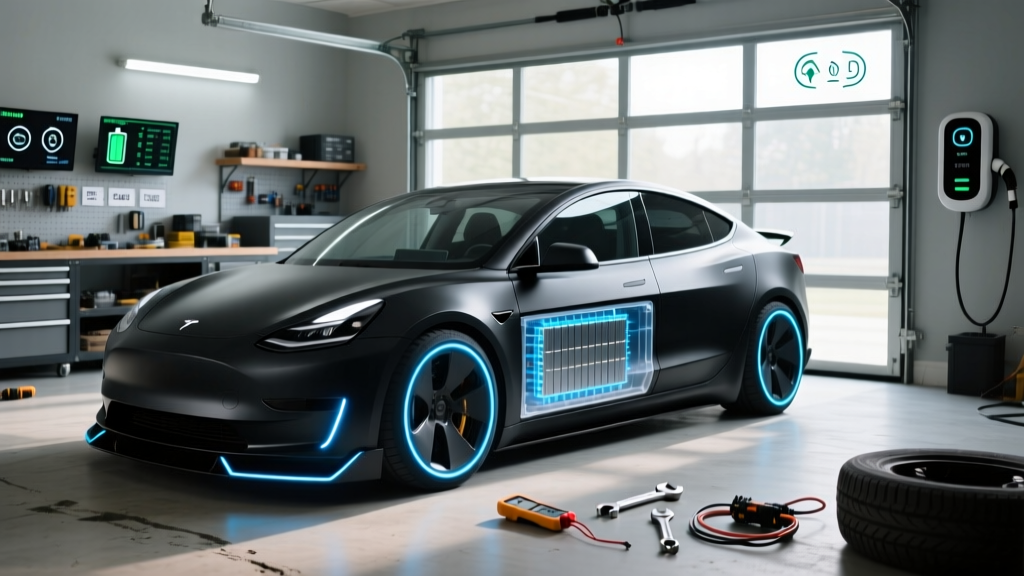
An EV conversion replaces a vehicle's internal combustion engine, fuel tank, exhaust, and associated systems with an electric motor, motor controller, battery pack, onboard charger, and high-voltage wiring. The donor vehicle's transmission is usually retained (locked in a single gear or used with a manual shifter), and the 12V auxiliary system is preserved to run lights, wipers, and electronics.
Core Components You'll Source
- Electric motor: DC series-wound motors ($1,500–$3,000) are simpler but less efficient; AC induction or permanent-magnet motors ($3,000–$6,000) offer regenerative braking and better efficiency. Popular choices include the NetGain Hyper9 (AC, ~120 HP peak) and salvaged Tesla drive units.
- Motor controller: Matches the motor type. A Kelly Controls or Sevcon controller runs $800–$2,500 and governs torque delivery, regen, and throttle mapping.
- Battery pack: The single largest expense. Salvaged Nissan Leaf modules (LMO chemistry, ~2 kWh each) run $100–$200 per module; you'll need 20–40 for a usable pack. Tesla modules (NMC, ~5.2 kWh each from a Model S) run $250–$400 each. A 30 kWh usable pack—the minimum for practical daily driving—costs $3,500–$7,000 in cells alone.
- Battery management system (BMS): Mandatory for lithium packs. Monitors cell voltage, temperature, and balancing. Orion BMS or SimpBMS units cost $400–$900.
- Onboard charger: A 3.3 kW or 6.6 kW Level 2 charger ($500–$1,200) for home charging. Some builders integrate salvaged Chevy Volt or Nissan Leaf OEM chargers.
- DC-DC converter: Steps down high-voltage pack to 12V for accessories ($150–$400).
- Throttle, contactors, fuses, high-voltage cable, connectors: $500–$1,500 in miscellaneous electrical components.
- Fabrication materials: Motor adapter plate, battery boxes, mounting brackets, cooling lines. Budget $500–$2,000 depending on complexity.
Skill and Tool Requirements
You need intermediate-to-advanced skills in welding, electrical wiring (both high-voltage DC and 12V), metal fabrication, and basic automotive mechanics. A MIG welder, angle grinder, drill press, multimeter, and crimping tools for Anderson connectors are baseline. If you've never worked with voltages above 100V DC, the learning curve is steep—and mistakes at 300–400V are lethal, not merely painful.
Full Cost Breakdown: Building vs. Buying an EV
The table below compares a typical DIY conversion against purchasing a comparable used or new production EV in 2026.
| Cost Category | DIY EV Conversion | Used 2023 Chevy Bolt EUV | New 2026 Hyundai Kona Electric |
|---|---|---|---|
| Vehicle / Donor | $2,000–$5,000 (used manual-trans car) | $16,000–$20,000 | $34,975 MSRP (SE trim) |
| Motor + Controller | $3,000–$6,000 | Included | Included |
| Battery Pack (30–65 kWh) | $3,500–$12,000 | Included (65 kWh NMC) | Included (65 kWh NMC) |
| BMS, Charger, DC-DC, Wiring | $1,500–$3,000 | Included | Included |
| Fabrication & Misc Parts | $1,000–$3,000 | N/A | N/A |
| Labor (Your Time) | 150–300+ hours | 0 hours | 0 hours |
| Total Cash Outlay | $11,000–$29,000 | $16,000–$20,000 | ~$27,475 after $7,500 §30D credit* |
| EPA Range | 60–120 mi (estimated) | 247 mi (EPA) | 261 mi (EPA) |
| DC Fast Charging | Rarely (most conversions lack it) | 55 kW peak (CCS) | 100+ kW peak (NACS/CCS) |
| Warranty | None | Remaining factory / battery 8yr/100k | 5yr/60k vehicle, 10yr/100k battery |
| Safety Ratings | Unrated | NHTSA 5-star | NHTSA/IIHS rated |
* §30D federal tax credit eligibility for 2026 requires meeting MSRP caps ($55,000 for cars), buyer income limits ($150k single / $300k joint), and battery critical-mineral and sourcing requirements per IRS.gov. Credit can be transferred to the dealer at point of sale. Consult a tax professional for your specific eligibility.
Range and Charging: The Conversion Reality Check
Most DIY conversions land between 30 kWh and 50 kWh of usable battery capacity, constrained by the physical space available in a donor car's engine bay, trunk, or underbody. A 1990s Mazda Miata conversion with 30 kWh might achieve 80–100 miles of range in mild weather at city speeds. A heavier donor like a 1980s Volkswagen Vanagon with 40 kWh might manage 60–80 miles.
Real-World Range Expectations for a 35 kWh DIY Conversion:
- Mild weather, city driving (30–40 mph): 90–110 miles
- Highway driving (65–70 mph): 60–75 miles (aerodynamic drag dominates)
- Cold weather (below 32°F), city: 65–80 miles (no heat pump in most conversions; cabin heater draws 2–4 kW)
- Cold weather, highway: 45–60 miles
DC fast charging is the biggest practical gap. Integrating CCS or NACS fast-charge capability requires a compatible charge port, high-voltage contactors rated for 500V+, communication with the vehicle's BMS via CAN bus protocols, and often a liquid-cooled battery pack. Most DIY builders rely exclusively on Level 2 home charging at 3.3 kW or 6.6 kW, meaning a full charge from empty takes 5–10 hours. This is fine for a commuter car with a predictable daily route but makes road trips impractical.
For comparison, a production 2026 Hyundai Kona Electric charges from 10–80% in roughly 43 minutes on a 100 kW DC fast charger, and a Tesla Model 3 Highland does it in about 15–18 minutes at a 250 kW Supercharger. That infrastructure gap matters enormously if you ever drive beyond your home charging radius.
EV Conversion vs. Gas Car vs. Hybrid: Operating Costs
| Metric | DIY EV Conversion (35 kWh) | 2026 Toyota Corolla (Gas) | 2026 Toyota Prius (HEV) |
|---|---|---|---|
| Fuel/Energy Cost per Mile | $0.04–$0.06 (home charging at $0.14/kWh) | $0.12–$0.15 (at $3.50/gal, 33 MPG) | $0.06–$0.08 (at $3.50/gal, 57 MPG) |
| Annual Fuel Cost (12,000 mi) | $480–$720 | $1,440–$1,800 | $720–$960 |
| Maintenance (Annual) | $100–$300 (no oil, minimal brakes with regen) | $600–$900 (oil, filters, brakes, belts) | $500–$700 (similar to gas, less brake wear) |
| Insurance (Annual, Est.) | $1,200–$2,000 (specialty/modified vehicle) | $1,000–$1,400 | $1,000–$1,400 |
| Registration | Varies by state; some states surcharge EVs $50–$225/yr | Standard | Standard (some states surcharge hybrids less) |
The per-mile energy cost strongly favors the EV, even a DIY one. But insurance is a wildcard: many mainstream insurers won't cover a modified vehicle, forcing you to specialty carriers like Hagerty or Grundy, which may charge higher premiums and require agreed-value appraisals. Registration fees in states like Ohio ($200 EV surcharge) or Georgia (repealed but historically $200) can partially offset fuel savings. Check your state's current rules.
Legal, Registration, and Safety Considerations
Every state has different requirements for registering a converted vehicle. Most require:
- A state safety inspection (brakes, lights, steering, structural integrity)
- A VIN verification or assigned VIN for "specially constructed" vehicles
- Proof of insurance before registration
- Emissions testing exemption paperwork (most states exempt EVs, but you must document the engine removal)
Crash safety is the unspoken risk. A production EV has been engineered and crash-tested with its battery pack as a structural element, with high-voltage disconnect systems that cut power in milliseconds during a collision. A DIY conversion does not. Your battery boxes are bolted in, your high-voltage cables are routed by hand, and there is no crash-test data. In a serious collision, the risk of battery puncture, thermal runaway, or electrical shock to first responders is real and unquantified. This is not a reason to dismiss conversions entirely, but it is a reason to be honest about the trade-off.
When Does Building Your Own EV Make Sense?
Build a conversion IF:
- You want a specific classic or vintage car electrified (e.g., a 1970s Porsche 914, a VW Bus, a 1980s Mercedes SL) and no production EV equivalent exists
- You have welding, electrical, and fabrication skills—or a trusted shop that does
- The car is a hobby/weekend vehicle, not your primary daily commuter
- You value the building process itself as a project, not just the end result
- You have access to a garage, tools, and 150+ hours of free time
Buy a production EV IF:
- You need reliable daily transportation with 200+ miles of range
- You want DC fast charging for road trips
- You need warranty coverage, safety ratings, and mainstream insurance
- You lack fabrication skills, tools, or garage space
- Your budget is under $20,000 (a used Bolt, Leaf, or Model 3 delivers more for less)
Common Misconceptions About DIY EV Conversions
| Myth | Fact |
|---|---|
| "Building an EV is cheaper than buying one." | For a daily-driver with 150+ miles of range and fast charging, a used production EV almost always costs less and delivers more. Conversions save money primarily on very short-range, low-speed builds. |
| "I can use any old car as a donor." | Lightweight cars with manual transmissions work best. Heavy vehicles (trucks, large SUVs) need enormous battery packs to achieve even modest range, driving cost past $30,000. |
| "I'll get 200 miles of range easily." | 200 miles requires roughly 60–70 kWh of usable battery in a typical car. That's $8,000–$15,000 in cells alone and significant packaging challenges. Most conversions achieve 60–120 miles. |
| "Electric cars don't need maintenance." | EVs need less maintenance (no oil changes, fewer brake replacements), but suspension components, tires, cabin filters, coolant, and 12V batteries still require attention. A conversion adds custom wiring and connections that need periodic inspection. |
| "I can charge it anywhere." | Without DC fast-charge capability, you're limited to Level 1 (120V, ~1 kW, adding ~3–4 miles per hour) and Level 2 (240V, 3.3–6.6 kW, adding ~12–25 miles per hour). Public charging networks like Electrify America and Tesla Superchargers are designed for CCS or NACS-equipped production vehicles. |
Practical First Steps If You Decide to Build
If the project appeals to you despite the cost and complexity trade-offs, here's a realistic path forward:
- Pick your donor car. Lightweight, simple, and well-supported by the conversion community. Popular donors include the VW Golf/Jetta (Mk2–Mk4), Mazda Miata (NA/NB), Porsche 944, Honda Civic (1990s), and Fiat 500 (pre-2012).
- Join the community. Forums like DIY Electric Car (diyelectriccar.com) and the OpenInverter community have documented hundreds of builds with wiring diagrams, parts lists, and lessons learned.
- Design your battery pack before buying anything. Measure the physical spaces available (engine bay, trunk, under rear seat), choose your module type, calculate total kWh, and design the BMS wiring scheme. This determines everything else.
- Budget 50% more than your initial estimate. Unexpected costs—custom adapter plates, upgraded brakes for the added weight, a better charger, replacement modules—always arise.
- Plan for inspection and registration early. Contact your state DMV before you start cutting metal. Understand what documentation you'll need.
Frequently Asked Questions
How long does it take to build an electric car from a donor vehicle?
A first-time builder working weekends should expect 6–12 months and 150–300 hours. Experienced builders with a well-documented donor platform can complete a conversion in 80–120 hours over 2–4 months.
Can I use a Tesla motor and battery in a DIY conversion?
Salvaged Tesla drive units (from wrecked Model S or Model 3 vehicles) are popular in the conversion community and available for $2,000–$5,000. However, they require CAN bus integration, a compatible inverter, and often liquid cooling. Battery modules from Tesla packs are also widely used but need careful BMS pairing and thermal management.
Is a DIY EV conversion street-legal in all 50 states?
Yes, but the registration process varies significantly. California, Oregon, and Washington have relatively straightforward processes for specially constructed vehicles. Some states require more extensive inspections. Contact your local DMV for specific requirements before beginning your build.
What's the cheapest EV conversion I can realistically build?
A minimal conversion using a lightweight donor (e.g., a 1990s Geo Metro or VW Beetle), a DC motor, and 15–20 kWh of salvaged Leaf modules can be done for $6,000–$9,000 in parts. Expect 35–50 miles of range, no fast charging, and a top speed around 70–80 mph. This works as a neighborhood commuter but not as a primary vehicle.
Do I need to worry about battery degradation in a conversion?
Yes. Salvaged modules from a 2013–2017 Nissan Leaf may already have 15–30% degradation. Always capacity-test modules before building your pack. New LFP (lithium iron phosphate) cells from suppliers like EVE or CATL offer longer cycle life (3,000+ cycles to 80% capacity) and better thermal stability, though at a higher per-kWh cost.
How does a conversion compare to buying a used Nissan Leaf or Chevy Bolt?
A used 2020–2023 Nissan Leaf (40 or 62 kWh) costs $12,000–$18,000 and delivers 149–226 miles of EPA range, CHAdeMO fast charging, full safety systems, and remaining factory warranty. A Chevy Bolt EUV offers 247 miles and CCS charging for $16,000–$20,000. For pure transportation value, production EVs are extremely difficult to beat unless you specifically want a classic car body or the building experience itself.
Building an electric car is a rewarding engineering project for the right person with the right goals. If you want a unique electrified classic, have the skills and tools, and understand the range and charging trade-offs, a conversion can be deeply satisfying. If you simply want affordable, reliable, efficient electric transportation, the used and new EV market in 2026 offers dramatically better value per dollar, per mile of range, and per hour of your time.