Quick Answer: Can You Build an Electric Car at Home?
Building a custom electric car from a donor vehicle is technically possible in 2026, but it is rarely practical for daily transportation. A competent DIY EV conversion using a kit like those from EV West or Zero EV typically costs $12,000–$30,000 in parts alone, requires 200–500 hours of labor, and yields a vehicle with 60–120 miles of real-world range using salvaged or aftermarket battery modules. By contrast, a new 2026 Chevrolet Equinox EV starts around $33,600 MSRP (potentially $26,100 after the §30D federal tax credit) with an EPA-estimated 315 miles of range, full safety certification, and an 8-year/100,000-mile battery warranty. Unless you are building for a hobby, education, or a specialty application, purchasing a production EV delivers dramatically better range, safety, and value.
Why People Search "How to Build Electric Cars"
The query "how to build electric cars" captures a wide audience: engineering students, weekend fabricators, classic-car restomodders, and budget-minded shoppers hoping to sidestep high new-EV prices. The intent splits into three realistic paths:
- Full scratch build: Designing a chassis and powertrain from raw materials — essentially a multi-year engineering project.
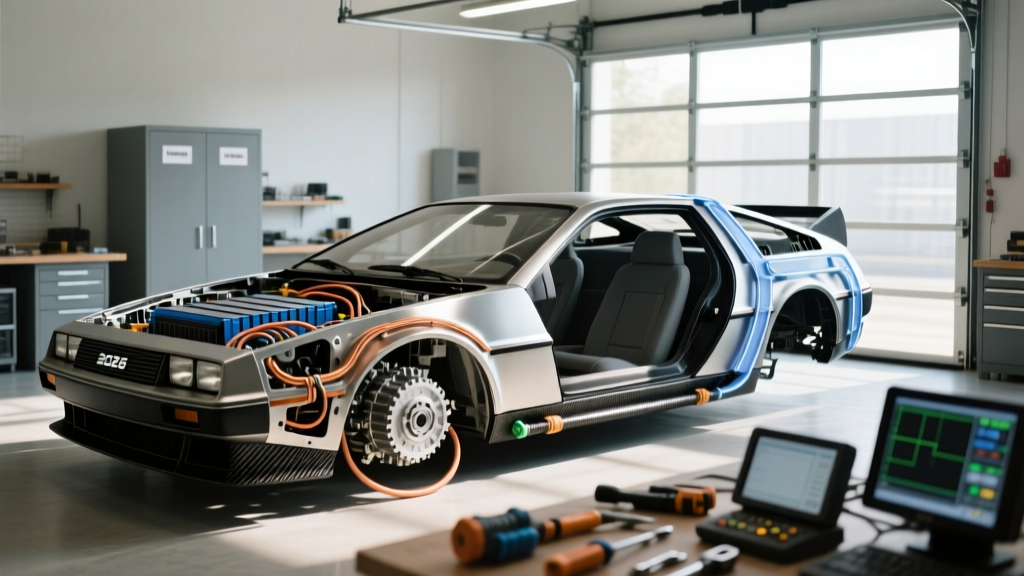
- Donor-vehicle conversion: Removing an internal combustion engine (ICE) from an existing car and installing an electric motor, controller, and battery pack. This is what most DIYers mean.
- Kit-car assembly: Purchasing a turnkey EV kit (motor, controller, BMS, wiring harness) and installing it into a lightweight donor like a VW Beetle, Porsche 914, or Mazda Miata.
Each path shares the same core challenge: the battery pack. In 2026, lithium-ion cells suitable for traction applications remain the single most expensive and technically demanding component, whether you source them new, salvaged, or refurbished.
What a DIY EV Conversion Actually Costs in 2026
Below is a realistic parts-and-labor breakdown for a typical donor-vehicle conversion using a 25–35 kWh battery pack (enough for roughly 70–100 miles of range in a lightweight car). Labor assumes you perform all work yourself; professional conversion shops charge $40,000–$80,000+ for a turnkey result.
| Component | Typical Cost Range | Notes |
|---|---|---|
| Donor vehicle (ICE car, stripped) | $2,000–$8,000 | Lighter is better; Miata, Beetle, early 911 popular |
| Electric motor (e.g., NetGain Hyper9, Tesla drive unit) | $2,500–$6,000 | 70–150 kW typical for DIY; AC induction or PMSM |
| Motor controller | $1,500–$4,000 | Must match motor voltage/current specs |
| Battery modules (25–35 kWh usable) | $4,000–$12,000 | Salvaged Tesla/Prius modules or new LFP packs |
| Battery management system (BMS) | $500–$1,500 | Critical for cell balancing and safety |
| Charger (Level 2 onboard, 3.3–7.2 kW) | $800–$2,000 | DC fast charging rarely feasible in conversions |
| DC-DC converter, wiring, contactors, fuses | $1,000–$2,500 | High-voltage safety components are non-negotiable |
| Throttle, gauges, instrumentation | $300–$800 | CAN bus integration can be complex |
| Fabrication (motor mounts, battery boxes) | $500–$3,000 | Welding and machining required |
| Total parts | $13,100–$39,800 | Median ~$22,000 for a functional build |
| Professional labor (if outsourced) | $15,000–$40,000+ | 200–500 hrs at shop rates |
What you get for ~$22,000 in parts: A lightweight conversion (e.g., a 2,200-lb Miata with a 30 kWh pack and a 100 kW motor) might deliver 0–60 mph in roughly 7–9 seconds, a top speed of 90–110 mph, and 70–100 miles of real-world range. Charging is limited to Level 2 (240V, 6.6–7.2 kW), meaning a full charge takes 5–6 hours. DC fast charging is almost never practical in a DIY build due to the cost and complexity of high-voltage architecture, liquid cooling, and CCS/NACS protocol compliance.
DIY Conversion vs. Buying a Production EV: The Numbers
The table below compares a representative DIY build against three popular 2026 production EVs that compete on price and efficiency. All production figures are from fueleconomy.gov and manufacturer specifications.
| Attribute | DIY Conversion (Miata, ~30 kWh) | 2026 Chevy Equinox EV 2LT | 2026 Hyundai Ioniq 5 SE | 2026 Tesla Model 3 RWD |
|---|---|---|---|---|
| Total cost (parts/MSRP) | ~$22,000 (DIY) / ~$45,000 (shop) | $33,600 | $42,600 | $38,990 |
| After §30D tax credit | $0 credit (not a new qualified vehicle) | ~$26,100 (up to $7,500) | ~$35,100 (up to $7,500) | ~$31,490 (up to $7,500) |
| EPA range | N/A (no EPA cert) | 315 mi | 318 mi | 363 mi |
| Real-world range (highway/cold) | 50–80 mi | ~250–270 mi | ~260–280 mi | ~290–310 mi |
| Battery capacity (usable) | ~28 kWh | 85 kWh (NMC) | 77.4 kWh (NMC) | ~60 kWh (LFP) |
| DC fast charge (peak kW) | None (Level 2 only) | 150 kW | 240 kW (10–80% in ~18 min) | 170 kW |
| Level 2 charge rate | 6.6 kW (~5 hrs full) | 11.5 kW | 10.9 kW | 11.5 kW |
| 0–60 mph | ~8 sec (est.) | 7.9 sec | 5.0 sec (RWD) | 5.8 sec |
| ADAS / safety | None (no airbags, ABS may be disabled) | Super Cruise available, full airbags | Highway Driving Assist 2, full suite | Autopilot (Level 2), full suite |
| Battery warranty | None | 8 yr / 100,000 mi | 10 yr / 100,000 mi | 8 yr / 120,000 mi |
| Registration / insurance | Difficult; specialty insurer required | Standard | Standard | Standard |
The gap is stark. A production EV delivers 3–5× the range, DC fast charging for road trips, certified crash safety, modern ADAS, a multi-year battery warranty, and — critically — eligibility for the federal §30D tax credit (up to $7,500 at point of sale, subject to MSRP caps, buyer income limits, and battery-sourcing requirements). A DIY conversion offers none of these advantages and may not even be insurable for daily driving in many states.
Real-World Ownership Considerations for a Home-Built EV
If you are seriously evaluating a conversion, these practical factors determine whether the project is viable for your situation:
Home Charging Access
Most conversions rely exclusively on Level 2 (240V) charging. You will need a dedicated 30–50 amp circuit installed by a licensed electrician — typically $800–$2,500 for the circuit and EVSE hardware, more if your electrical panel requires an upgrade to 200A. Without home charging, a conversion is effectively unusable: public chargers almost universally require CCS or NACS connectors and communication protocols that DIY systems cannot replicate.
Climate and Range Loss
Production EVs use liquid-cooled battery packs with active thermal management. Most DIY builds use air-cooled or passively cooled modules, meaning range degrades sharply in extreme heat or cold. In freezing temperatures (below 32°F), expect 30–50% range loss in an unheated conversion pack — a 90-mile summer range could drop to 45–60 miles in January. Cabin heat, if electric, further drains the pack.
Driving Patterns
A conversion with 70–100 miles of range can serve as a commuter car if your round trip is under 50 miles and you charge nightly. It cannot serve as a sole vehicle for road trips, errands in rural areas, or families with unpredictable schedules. Most conversion owners keep a second vehicle.
Registration, Inspection, and Insurance
State DMVs vary widely in how they handle EV conversions. Some states require a special "homemade vehicle" title, a state police inspection, or proof of a certified high-voltage system. Insurance companies like Hagerty or specialty EV insurers may cover conversions, but standard carriers often refuse. Budget $1,500–$3,000/year for specialty insurance — potentially more than a production EV.
Common Misconceptions About Building Your Own EV
| Myth | Fact |
|---|---|
| "I can build an EV for under $5,000." | Only with severely limited range (~20–30 mi), lead-acid batteries, or unsafe salvaged cells. A functional, safe lithium-ion conversion starts around $13,000 in parts. |
| "I'll save money vs. buying a new EV." | After the §30D tax credit, a 2026 Equinox EV costs ~$26,100 with 315 mi range, DC fast charging, and a warranty. A comparable conversion costs $22,000+ for 70–100 mi range and no warranty. |
| "I can use salvaged Tesla battery modules." | Possible but risky. Salvaged modules have unknown degradation, no warranty, and require careful cell-matching and BMS programming. Mismatched cells are a fire hazard. |
| "Conversions are exempt from emissions testing." | True in most states, but you still need registration, a title, and often a special inspection. Some states (notably California) require a BAR EV conversion certification. |
| "I can add DC fast charging to my conversion." | Technically possible but prohibitively expensive ($5,000–$10,000+ for the charger hardware alone) and requires a liquid-cooled, high-voltage (400V+) pack architecture that most DIY builds lack. |
| "A conversion is a good way to learn about EVs." | It teaches fabrication and high-voltage safety, but you will not learn about modern battery chemistry, thermal management, or SAE Level 2 ADAS — the technologies that define 2026 production EVs. |
When Building an EV Actually Makes Sense
A DIY conversion is the right choice only under specific conditions:
- Classic-car restomod: You own a vintage vehicle (Porsche 911, VW Bus, Ford Bronco) and want to preserve the body while eliminating the ICE. Specialty shops like Zelectric or EV West cater to this market. Budget $50,000–$100,000+ for a professional result.
- Engineering education: You are a student or hobbyist building for learning, not daily transportation. A lightweight kit build teaches motor control, BMS logic, and high-voltage safety.
- Off-road or specialty use: Electric conversions excel in rock crawlers, farm vehicles, or autocross cars where instant torque and simplicity outweigh range needs.
- Regulatory arbitrage in specific states: A handful of states offer registration or HOV-lane benefits for converted EVs, though these are increasingly rare.
Decision Framework: Should You Build or Buy?
If X, Then Y
- If you need a daily driver with 200+ miles of range, DC fast charging, and safety features → Buy a production EV (Equinox EV, Ioniq 5, Model 3).
- If your budget is under $30,000 after tax credit and you have home charging → Buy a 2026 Equinox EV or a used EV with a verified battery SoH report.
- If you own a classic car and want to preserve it while going electric → Build a conversion, but budget $50,000+ for a professional, safe result.
- If you are an engineering student or hobbyist building for education → Build a lightweight kit conversion, but do not rely on it as primary transportation.
- If you lack home charging and live in an apartment → Do not build a conversion. A production EV with public-charging compatibility (NACS/CCS) is your only practical EV option.
- If you live in a cold climate (sub-freezing winters) → Buy a production EV with a heat pump and liquid-cooled battery (standard on most 2026 models). A DIY conversion will lose 30–50% of its already limited range.
The Bottom Line on Building Electric Cars in 2026
The search for "how to build electric cars" often reflects sticker shock at new-EV prices or a desire for a hands-on project. The honest answer: production EVs in 2026 have crossed the threshold where they are cheaper, safer, longer-ranged, and more practical than anything a home builder can assemble. The §30D tax credit, when available, narrows the price gap further. A conversion remains a rewarding hobby for the right builder — but it is not a cost-effective alternative to buying.
Is it legal to build your own electric car?
Yes, but registration requirements vary by state. Most states require a "homemade vehicle" or "specially constructed vehicle" title, a safety inspection, and proof of insurance. Some states (e.g., California) require a Bureau of Automotive Repair (BAR) EV conversion certification. Check your state DMV before starting a build.
How far can a DIY electric car go on a charge?
A typical lightweight conversion (2,000–2,500 lbs) with a 30 kWh usable battery pack delivers 70–100 miles of real-world range in moderate weather. In freezing temperatures or at highway speeds, expect 50–70 miles. Production 2026 EVs deliver 250–360+ miles EPA-estimated.
Can I get a federal tax credit for building an EV?
No. The IRS §30D credit applies only to new, qualified clean vehicles purchased from a manufacturer. A DIY conversion does not qualify. The §30D credit in 2026 is up to $7,500, subject to MSRP caps ($55,000 for cars, $80,000 for SUVs/trucks), buyer income limits, and battery critical-mineral sourcing requirements. Always verify current rules at irs.gov or consult a tax professional.
How long does it take to build an electric car from a donor vehicle?
A first-time builder working weekends should expect 300–500 hours over 6–18 months. Professional conversion shops complete builds in 3–6 months but charge $40,000–$80,000+ in labor.
What battery chemistry is best for a DIY conversion?
LFP (lithium iron phosphate) cells are the safest choice for DIY builders: they are more thermally stable, tolerate 100% state of charge better, and offer 3,000+ cycle life. The trade-off is lower energy density (roughly 160 Wh/kg vs. 250 Wh/kg for NMC), meaning a heavier, bulkier pack for the same range. Most production 2026 EVs use NMC for long-range trims and LFP for standard-range trims (e.g., Tesla Model 3 RWD).
Can a DIY EV use regenerative braking?
Yes. Most modern motor controllers (e.g., Sevcon, Curtis, AEM) support regenerative braking, which recovers kinetic energy during deceleration and extends range by 5–15%. However, integrating regen with the donor car's existing brake system (ABS, proportioning valve) requires careful engineering to maintain safe braking performance.