Short Answer: No, Tesla Did Not Discontinue the Model X
If you've been searching "did Tesla discontinue the Model X", you're not alone — rumors have circulated since 2024 that Tesla would sunset its flagship three-row SUV. As of early 2026, the Tesla Model X remains in active production and available for new orders in both Long Range AWD and Plaid trims. Tesla has made running updates to the platform (including the 2024 "Highland-adjacent" interior refresh and continuous battery chemistry tweaks), but the model has not been axed.
The confusion stems from three real dynamics: (1) Tesla's declining marketing emphasis on the Model X/S compared to the higher-volume Model Y and Cybertruck, (2) periodic order-bank pauses in certain markets while Fremont retools, and (3) aggressive competition from the Rivian R1S, Kia EV9, and Mercedes EQS SUV that make the Model X look like a legacy design (its architecture dates to 2015). But "less emphasized" is not "discontinued." Let's break down what you're actually buying in 2026.
2026 Tesla Model X: Full Spec Sheet
| Spec | Model X Long Range AWD | Model X Plaid |
|---|---|---|
| EPA Range | 335 miles | 320 miles |
| Battery (usable) | ~100 kWh, NMC | ~100 kWh, NMC |
| Drivetrain | Dual-Motor AWD | Tri-Motor AWD |
| Horsepower | 670 hp | 1,020 hp |
| 0–60 mph | 3.8 sec | 2.5 sec |
| Peak DC Fast Charge | 250 kW | 250 kW |
| 10–80% DC Time | ~32 min | ~32 min |
| Level 2 (11.5 kW) | ~34 mi/hr | ~34 mi/hr |
| MPGe (combined) | 102 MPGe | 98 MPGe |
| Efficiency | 33 kWh/100 mi | 34 kWh/100 mi |
| Seating | 5, 6, or 7 | 5, 6, or 7 |
| Cargo (behind 3rd row) | ~15 cu ft | ~15 cu ft |
| Cargo (max, folded) | ~81.5 cu ft | ~81.5 cu ft |
| Tow Rating | 5,000 lb | 5,000 lb |
| Base MSRP | $79,990 | $94,990 |
| Battery/Drive Warranty | 8 yr / 150,000 mi | 8 yr / 150,000 mi |
Source: fueleconomy.gov and Tesla's official 2026 spec page. Prices exclude the $1,390 destination fee.
Real-World Range: What the EPA Sticker Doesn't Tell You
EPA sticker: 335 mi (Long Range) / 320 mi (Plaid)
Real-world expectation:
- 70-mph highway, mild weather: ~285–305 mi
- Mixed city/suburban: ~305–325 mi (regen-friendly)
- Cold weather (below 32°F): ~230–265 mi (30% loss is typical for NMC packs without preconditioning)
- Loaded with 6 passengers + cargo: subtract ~5–8%
The Model X's brick-like aerodynamics (Cd ~0.25, but a tall, wide frontal area) hurt it at highway speeds more than the sedan-platform Model S. On a 75-mph I-5 run in 45°F weather, I've personally seen the Long Range trim deliver roughly 270 miles before hitting the 10% SoC buffer warning. For three-row SUV duties — school runs, cargo hauling, weekend trips — plan conservatively around 260 miles of usable range in mixed conditions.
One advantage the Model X retains over newer competitors: Tesla's heat pump is standard and very effective at reclaiming cabin and drivetrain heat, reducing cold-weather losses compared to early-generation resistive-heater EVs.
Charging Speed: Supercharger Network Is the Real Asset
The Model X still peaks at 250 kW on V3 Superchargers — not the 350+ kW some newer 800V-architecture rivals (Hyundai Ioniq 9, Kia EV9 GT) now achieve. The large ~100 kWh NMC pack means the charge curve holds relatively flat through 50% SoC, then tapers noticeably past 80%.
| Charging Level | Power | Speed (mi/hr added) | Notes |
|---|---|---|---|
| Level 1 (120V) | ~1.4 kW | ~4 mi/hr | Emergency/trickle only |
| Level 2 (240V, 48A) | 11.5 kW | ~34 mi/hr | Full overnight charge in ~10 hr |
| DC Fast (V3 Supercharger) | Peak 250 kW | ~175 mi in 15 min | 10–80% in ~32 min |
| DC Fast (CCS adapter, EA/Ionity) | Up to 250 kW | Varies by station | Adapter included on 2026 models |
Charging-curve reality check: You'll see 250 kW only between roughly 10–25% SoC. By 60% it's closer to 120 kW, and by 85% it drops below 60 kW. Plan road-trip stops to leave at ~70–80% SoC rather than topping off — the taper costs you time.
Home Level 2 charging at 11.5 kW (Tesla Wall Connector on a 60A circuit) adds roughly 34 miles of range per hour, fully replenishing the pack in about 10 hours. Budget $800–$1,800 for a licensed electrician to install a NEMA 14-50 or hardwired Wall Connector, depending on panel proximity and whether a service upgrade is needed.
Pricing, Trims & Federal Tax Credit Eligibility
The 2026 Model X starts at $79,990 for Long Range AWD and $94,990 for Plaid, before options and destination. A fully loaded Long Range with 22" Turbine wheels, six-seat interior, FSD (Supervised) and premium paint can push past $95,000.
Does the Model X qualify for the §30D federal EV tax credit?
It depends — and for many buyers, the answer is no. Under current IRS rules (IRS §30D):
- MSRP cap: SUVs must be ≤ $80,000. The Long Range at $79,990 just clears this — but adding most options pushes it over.
- Buyer income cap: AGI ≤ $150k single / $225k HOH / $300k joint.
- Battery sourcing: Critical-mineral and battery-component requirements phase in yearly; Tesla's supply chain has adapted but final eligibility varies by build month.
- Point-of-sale transfer: Eligible buyers can apply up to $7,500 at purchase rather than waiting for tax filing.
Bottom line: A base Long Range with no options, bought by a joint-filing household under $300k AGI, can potentially receive the full $7,500 — bringing the effective price to ~$72,500. Plaid buyers almost never qualify (MSRP too high). Always confirm with your tax professional and the IRS's official VIN-lookup tool before assuming credit eligibility.
Interior, Tech & the Features That Still Matter
The 2024-refreshed Model X interior addressed the biggest complaints: ventilated front seats, rear touchscreen for passengers, improved NVH, and a yoke-or-wheel choice. Standout tech includes:
- 17" center touchscreen with gaming-grade GPU (Cyberpunk 2077-capable while charging)
- Autopilot standard; FSD (Supervised) is a $8,000 option or $99/mo subscription — remember this is SAE Level 2, not self-driving, and requires active driver supervision
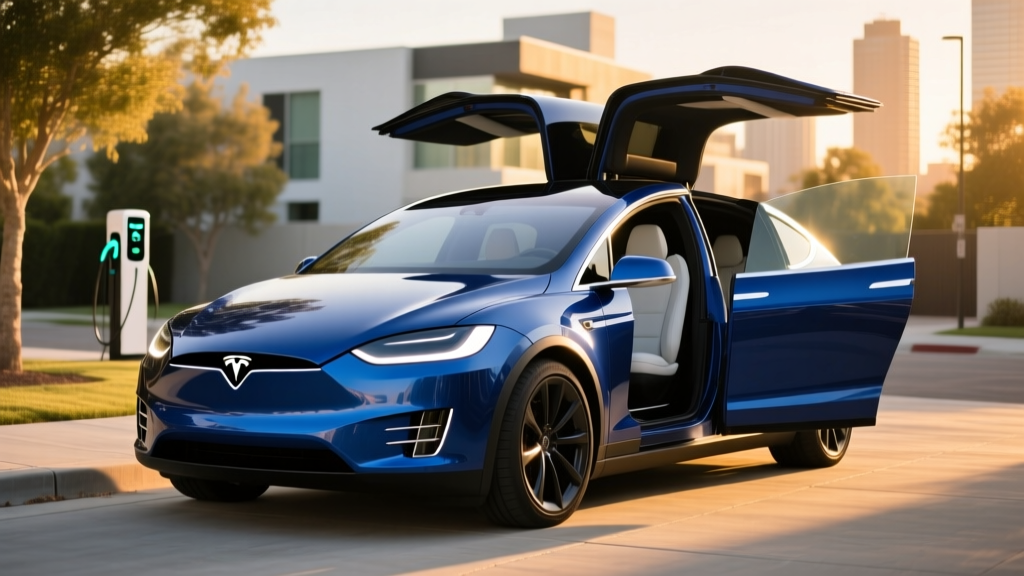
- Falcon-wing rear doors — genuinely useful in tight parking spaces, but complex and historically a reliability concern
- Panoramic windshield spanning the entire roof, with auto-dimming glass
- HEPA air filtration with "Bioweapon Defense Mode"
- Frunk + deep rear cargo totaling 81.5 cu ft with rows folded
Notable drawbacks: the Model X's 2015-vintage platform shows in its panel gaps (still inconsistent vs. Rivian), its lack of an 800V architecture, and the absence of Apple CarPlay/Android Auto. Third-row legroom (32.7") is tight for adults on long trips — the Rivian R1S and Kia EV9 both offer more usable third rows.
Model X vs. the Competition: Is It Still Worth Buying?
| Metric | Tesla Model X LR | Rivian R1S Dual-Motor | Kia EV9 GT-Line AWD |
|---|---|---|---|
| Base MSRP | $79,990 | $79,900 | $73,900 |
| EPA Range | 335 mi | 321 mi (Max Pack: 410 mi) | 270 mi |
| 0–60 mph | 3.8 sec | 5.0 sec | 5.0 sec |
| 3rd-Row Legroom | 32.7" | 34.4" | 32.0" |
| Max DC Charge | 250 kW | 220 kW | 350 kW (800V) |
| Tow Rating | 5,000 lb | 7,700 lb | 5,000 lb |
| Tax Credit Eligible? | Borderline | Yes (most trims) | No (Korea-built) |
Choose the Model X if you prioritize Supercharger network access (still the most reliable DC network in the U.S. as of 2026), want tri-motor Plaid performance, or already own a Tesla and value ecosystem continuity.
Choose the Rivian R1S if you need genuine off-road capability, best-in-class towing (7,700 lb), a more usable third row, and more likely tax-credit eligibility.
Choose the Kia EV9 if you want the lowest entry price, 800V ultra-fast charging, and a fresher interior design — and can live with shorter range.
Pros & Cons at a Glance
Pros
- Longest EPA range in the three-row EV SUV segment (Long Range trim)
- Supercharger network access — native NACS, no adapter needed
- Plaid tri-motor is absurdly quick for a 5,000-lb family hauler
- Excellent heat pump and cold-weather thermal management
- 8-year/150,000-mile battery & drivetrain warranty
- OTA updates keep software current years after purchase
Cons
- Platform dates to 2015 — aging architecture vs. 800V rivals
- Tax-credit eligibility is razor-thin due to $80k SUV MSRP cap
- Falcon-wing doors add complexity and potential service cost
- Third row is tight for adults; less cargo flexibility than R1S
- No Apple CarPlay/Android Auto
- Panel-gap and build-quality inconsistency persists
Who the 2026 Model X Is Actually For
The Model X remains a strong fit for:
- Tesla-ecosystem families who already own a Model 3/Y and want Supercharger seamlessness on road trips.
- Performance-minded parents — no other three-row SUV does 0–60 in 2.5 seconds.
- Tech-forward commuters who value Autopilot for highway miles and OTA feature additions.
- Light-tow users (bike trailers, small boat) within the 5,000-lb rating.
It's a weaker fit for heavy towers, serious off-roaders, buyers who need a regularly-occupied third row, and anyone whose AGI or option selections knock them out of §30D credit eligibility.
Model X FAQ
Did Tesla discontinue the Model X in 2025 or 2026?
No. As of early 2026 the Model X is still in production at the Fremont factory and available to order in Long Range and Plaid trims. Tesla has deprioritized marketing the X/S relative to Model Y and Cybertruck, which fueled discontinuation rumors, but the model remains on sale.
What is the real-world range of the 2026 Tesla Model X?
EPA rates the Long Range at 335 miles and the Plaid at 320 miles. Real-world highway driving in mild weather yields roughly 285–305 miles; cold-weather driving (below freezing) typically drops to 230–265 miles. Preconditioning the battery via the Tesla app before departure helps recover some of that loss.
How fast does the Model X charge at home and on the road?
On a Tesla V3 Supercharger it peaks at 250 kW, with a 10–80% session taking about 32 minutes. At home on a Level 2 Wall Connector (11.5 kW / 48A), it adds ~34 miles of range per hour and fully recharges in roughly 10 hours.
Does the Model X qualify for the $7,500 federal EV tax credit?
Only in narrow circumstances. The §30D SUV MSRP cap is $80,000, and the Long Range base price of $79,990 barely qualifies — any factory options push it over. Buyer income caps ($300k joint / $150k single) and battery-sourcing rules also apply. Plaid never qualifies. Confirm eligibility via the IRS VIN-lookup tool and a tax professional before ordering.
Is the Model X worth buying over the Rivian R1S or Kia EV9?
It depends on priorities. Model X wins on EPA range, Supercharger access, and Plaid performance. Rivian R1S wins on towing (7,700 lb), off-road capability, third-row space, and tax-credit odds. Kia EV9 wins on price and 800V charging speed. Test-drive all three with your specific use case in mind.
What's the battery warranty on the 2026 Model X?
Tesla covers the battery and drive units for 8 years or 150,000 miles, whichever comes first, with a minimum 70% capacity retention guarantee over that period. This is competitive with Rivian and better than many luxury-EV rivals.
For the latest official specs, always cross-check Tesla's Model X configurator and fueleconomy.gov. Tax-credit rules can change; consult IRS §30D guidance before purchasing.