The Short Answer: No, Rivian Is Still in Business
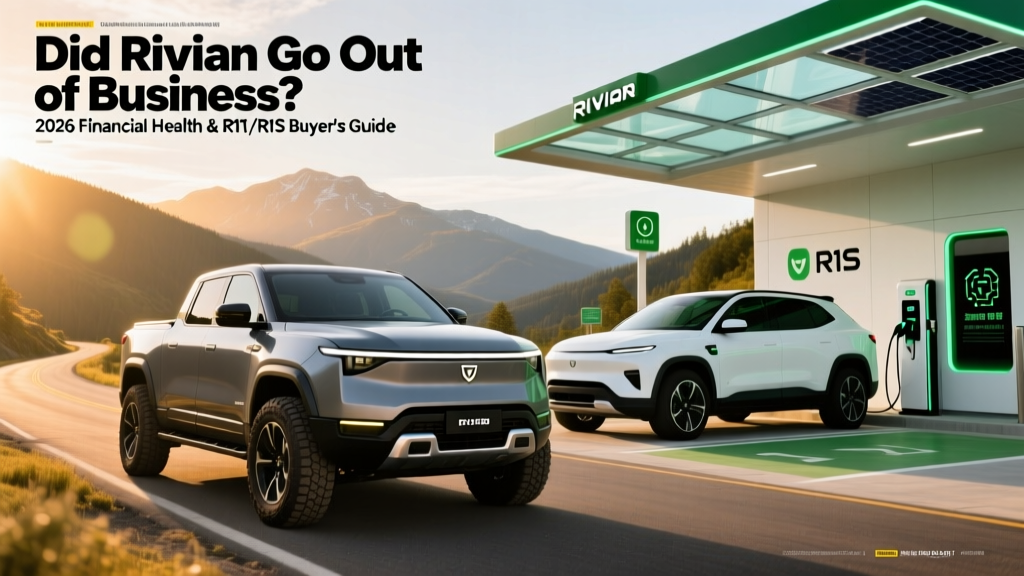
If you've seen the headline and wondered, "did Rivian go out of business?" — the answer as of early 2026 is a definitive no. Rivian Automotive continues manufacturing the R1T pickup and R1S SUV at its Normal, Illinois facility, has delivered over 150,000 vehicles cumulatively, and is actively ramping production of its more affordable R2 platform at a new Georgia factory. The company remains publicly traded on NASDAQ (ticker: RIVN) and continues to honor all vehicle warranties and software updates.
That said, the question isn't baseless. Rivian has burned through billions in cash, faced production bottlenecks, dealt with multiple recalls, and watched its stock price fall dramatically from its 2021 IPO highs. For a buyer considering a $75,000+ electric truck or SUV, the company's long-term viability is a legitimate factor in the purchase decision. This guide breaks down exactly where Rivian stands financially in 2026, then dives deep into what the current R1T and R1S actually deliver in range, charging, and daily usability — so you can decide if the risk-reward equation works for you.
Rivian's Financial Position in 2026: What the Numbers Show
Rivian ended 2025 with approximately $6.1 billion in cash and equivalents, bolstered by the $5.8 billion Volkswagen Group joint-venture investment announced in mid-2024. That VW deal funds the co-development of a shared EV software and electrical architecture and provides ongoing capital infusions tied to milestones. The company's cash runway, combined with revenue from vehicle sales and its commercial delivery van contract with Amazon, extends well into 2028 by most analyst estimates — even if R2 production ramp encounters delays.
Key financial realities to understand:
- Still unprofitable: Rivian has not yet posted an annual net profit. Gross margin per vehicle turned positive in late 2024, but operating losses continue as the company funds R2 factory construction and R&D.
- Production scale-up: The Normal, Illinois plant produces roughly 60,000–80,000 R1 vehicles annually. The Georgia R2 plant is targeted for first production in 2026–2027.
- Recall history: Rivian has issued several recalls (airbag deployment, seat belt fasteners, drive-mode software), all addressed via over-the-air updates or dealer service. This is not unusual for a startup but is a factor for used buyers.
- Service network: Still thinner than legacy brands — approximately 45 service centers and 20+ mobile service vans nationwide as of 2026. Rural owners may face longer tow distances for major repairs.
Bottom line: Rivian is not going out of business in the near term. But it is not yet a financially mature company the way Toyota or Ford is. Buyers should factor in service-network proximity and the company's evolving financial trajectory.
2026 Rivian R1T & R1S: Core Specs at a Glance
Rivian offers both the R1T (crew-cab pickup) and R1S (three-row SUV) on the same skateboard platform with shared powertrain options. For 2026, both are available in Dual-Motor AWD and Quad-Motor AWD configurations, with Standard, Large, and Max battery packs. Here's the consolidated spec sheet for the R1T Dual-Motor with the Large Pack — the most popular configuration:
| Specification | Value |
|---|---|
| EPA Range | 352 miles |
| Real-World Highway Range | ~280–310 miles (70 mph, moderate weather) |
| Real-World Cold-Weather Range | ~230–260 miles (below 30°F, cabin heat) |
| Battery Capacity (usable) | ~128.9 kWh (NMC lithium-ion, 2170 cylindrical cells) |
| MPGe (combined) | 73 MPGe |
| Efficiency | 46 kWh/100 mi |
| Peak DC Fast Charge | 220 kW (NACS connector, native) |
| 10–80% DC Charge Time | ~27 minutes |
| Level 2 Home Charge Rate | 11.5 kW (~25 miles/hr) |
| Horsepower (Dual-Motor) | 533 hp |
| Torque | 610 lb-ft |
| 0–60 mph | 4.5 seconds |
| Drivetrain | Dual-Motor AWD |
| Max Towing Capacity | 11,000 lbs |
| Bed Length (R1T) | 54 inches (4.5 ft) |
| Cargo Volume — Gear Tunnel (R1T) | 11 cu ft |
| Front Trunk (Frunk) | 11 cu ft |
| Rear Legroom | 38.2 inches |
| Base MSRP (Adventure trim) | $79,900 (before destination) |
| Federal Tax Credit (§30D) | Not eligible — exceeds $80,000 MSRP cap for trucks |
| Battery/Powertrain Warranty | 8 years / 175,000 miles (70% capacity retention) |
| Bumper-to-Bumper Warranty | 5 years / 60,000 miles |
Charging Speed and Infrastructure: What Owners Actually Experience
Charging speed is a top concern for any EV buyer, and the R1T/R1S delivers competitive but not class-leading DC fast charging. Here's what the numbers mean in practice:
| Charging Level | Max Power | Speed (Miles Added) | Notes |
|---|---|---|---|
| Level 1 (120V household) | ~1.4 kW | ~3 miles/hr | Emergency/trickle only |
| Level 2 (240V home, 48A) | 11.5 kW | ~25 miles/hr | Full charge overnight in ~13 hrs |
| DC Fast Charge (NACS) | 220 kW peak | ~140 miles in 20 min | 10–80% in ~27 min; tapers above 80% |
Charging curve reality: The R1 platform peaks at 220 kW but only sustains that rate briefly between roughly 15–35% State of Charge. The curve tapers progressively, dropping to ~100 kW by 60% and ~50 kW past 80%. This is normal for NMC chemistry with a large pack, but it means a "10–80%" session takes about 27 minutes, while an 80–100% top-off adds another 40+ minutes. On road trips, plan to charge from 10% to 70% and move on — don't wait for a full fill.
Connector: All 2026 Rivians ship with the NACS (Tesla-style) charge port natively, meaning direct access to the Tesla Supercharger network (20,000+ stalls) without an adapter. This is a significant advantage over CCS-only vehicles now that the Supercharger network has opened to NACS-equipped non-Tesla EVs. Rivian's own Adventure Network chargers remain limited in deployment.
Home charging: Rivian sells a Wall Charger rated at 11.5 kW (48 amps on a 60-amp circuit). Expect a full 0–100% charge in roughly 13 hours — sufficient for overnight replenishment of daily driving. Installation typically costs $800–$2,000 depending on panel capacity and conduit run. If your home has a 200-amp panel with spare capacity, installation is straightforward. Older 100-amp panels may require a $2,000–$4,000 upgrade. Always get a quote from a licensed electrician before purchasing.
Pricing, Tax Credits, and True Cost to Buy
Rivian positions the R1T and R1S as premium adventure vehicles, and the pricing reflects that. Here's the current trim and pricing structure:
| Configuration | MSRP (before destination) | §30D Tax Credit | Effective Price (if eligible) |
|---|---|---|---|
| Dual-Motor / Standard Pack (est. 270 mi) | $69,900 | Eligible — up to $7,500* | ~$62,400 |
| Dual-Motor / Large Pack (352 mi) | $79,900 | Not eligible — exceeds $80,000 truck cap | $79,900 |
| Dual-Motor / Max Pack (est. 420 mi) | $89,900 | Not eligible | $89,900 |
| Quad-Motor / Large Pack (328 mi) | $87,900 | Not eligible | $87,900 |
| Quad-Motor / Max Pack (est. 400 mi) | $97,900 | Not eligible | $97,900 |
*Critical tax credit caveat: Under IRS §30D rules, pickup trucks must have an MSRP at or below $80,000 to qualify for the federal clean vehicle credit. Only the R1T Dual-Motor Standard Pack clears this threshold. The Large Pack and all Quad-Motor trims exceed the cap and are ineligible. Additionally, the buyer must meet income limits ($150,000 single / $300,000 joint AGI), and the vehicle must satisfy critical-mineral and battery-component sourcing requirements that shift annually. Always verify current-year eligibility on fueleconomy.gov before relying on the credit. Point-of-sale transfer is available for eligible purchases, reducing your dealer cost directly.
The R1S (SUV variant) falls under the $80,000 SUV/VAN MSRP cap, meaning more R1S trims qualify for the credit — but the Large Pack R1S starts at $84,900, which also exceeds the SUV cap. Only the R1S Standard Pack at ~$74,900 qualifies.
Performance, Tech, and Daily Livability
Performance: The Dual-Motor R1T delivers 533 hp and a 4.5-second 0–60 mph time — genuinely quick for a 7,100-lb truck. The Quad-Motor variant pushes 1,025 hp and a 3.0-second 0–60, which is supercar territory in a pickup. Rivian's torque-vectoring AWD system provides excellent traction in snow, mud, and sand, with dedicated drive modes for each. The air suspension offers up to 14.4 inches of ground clearance in Off-Road mode and drops for highway efficiency.
Tech and infotainment: Rivian runs a proprietary software stack on a 15.6-inch center display with a clean, responsive interface. Wireless Apple CarPlay and Android Auto are not supported — Rivian uses its own navigation and media apps, which are well-designed but a dealbreaker for some buyers. The digital driver display and head-up display are clear. Over-the-air updates are frequent and substantive, adding features like improved regen profiles and camp-mode enhancements.
Driver assistance: Rivian's Driver+ system is a SAE Level 2 hands-on-wheel highway assist combining adaptive cruise and lane centering. It works well on divided highways but requires constant driver supervision — it is not autonomous. Rivian has been testing a hands-free highway assist feature, but as of early 2026, the production system still requires hands on the wheel. There is no "Full Self-Driving" equivalent.
Cargo and space: The R1T's 4.5-foot bed is shorter than a full-size truck's, limiting plywood or lumber hauling. However, the 11-cu-ft gear tunnel (a lockable pass-through behind the rear seats) and 11-cu-ft frunk add substantial enclosed storage. The R1S seats up to seven with a usable third row (30.4 inches of legroom) and offers up to 104 cu ft of cargo volume with both rear rows folded. Rear-seat passengers in the R1T get 38.2 inches of legroom — comfortable for adults on long trips.
Warranty Coverage and Long-Term Ownership Considerations
Rivian provides competitive warranty coverage for the EV segment:
- Battery & Drive Unit: 8 years / 175,000 miles, whichever comes first. Coverage triggers if the battery degrades below 70% of original capacity. This is more generous than the industry-standard 100,000-mile threshold used by most competitors.
- Vehicle (Bumper-to-Bumper): 5 years / 60,000 miles.
- Corrosion: 5 years / unlimited miles.
Battery chemistry note: Rivian uses NMC (nickel-manganese-cobalt) lithium-ion cells in a 2170 cylindrical format (similar to Tesla's earlier packs). NMC offers high energy density — critical for fitting 128+ kWh into a truck platform — but is more sensitive to sustained high-State-of-Charge storage than LFP chemistry. Best practice: charge to 80% for daily use and only charge to 100% before long road trips. Avoid leaving the vehicle parked at 100% for extended periods.
Service and parts availability: This is where Rivian's startup status matters most. While the company has expanded its service footprint, wait times for collision parts and some drivetrain components can stretch to weeks in less-served regions. Rivian's mobile service vans handle many software-related and minor hardware repairs at your home, but structural or high-voltage work requires a service center. Check Rivian's service map for coverage in your area before buying.
R1T and R1S vs. Key Competitors: Is It Worth Buying?
| Attribute | Rivian R1T (Dual-Motor Large) | Ford F-150 Lightning (Ext. Range) | Tesla Cybertruck (AWD) | Chevrolet Silverado EV (4WT) |
|---|---|---|---|---|
| EPA Range | 352 mi | 320 mi | 340 mi | 440 mi |
| Starting MSRP | $79,900 | $76,995 | $79,990 | $72,900 |
| Peak DC Charge | 220 kW | 150 kW | 250 kW | 200 kW |
| 10–80% Time | ~27 min | ~41 min | ~20 min | ~30 min |
| 0–60 mph | 4.5 sec | 5.0 sec | 4.1 sec | 5.5 sec |
| Max Tow | 11,000 lbs | 10,000 lbs | 11,000 lbs | 10,000 lbs |
| NACS Native | Yes | No (CCS, adapter avail.) | Yes | No (CCS, adapter avail.) |
| §30D Eligible | Standard Pack only | Yes (select trims) | Yes (select trims) | Yes (select trims) |
Decision Framework: Who Should Buy a Rivian?
Choose the R1T if: You want a premium adventure-oriented electric pickup with best-in-class off-road capability, a usable gear tunnel, NACS Supercharger access, and don't need a full 6.5-foot bed. You're comfortable with a startup's service network and can absorb the premium price.
Choose the R1S if: You need a three-row electric SUV with genuine off-road chops and don't want to default to the Tesla Model X. You value build quality and design over the lowest price per mile of range.
Look elsewhere if: Budget is your top priority (the F-150 Lightning and Silverado EV offer more range per dollar), you need a full-size truck bed for work, you live far from a Rivian service center, or you require Apple CarPlay/Android Auto.
Pros and Cons: The Honest Summary
Pros
- Class-leading off-road capability with air suspension and tank turns (Quad-Motor)
- NACS native — full Supercharger network access without an adapter
- Gear tunnel and frunk provide versatile enclosed storage
- 352-mile EPA range (Large Pack) is among the best for electric trucks
- 8-year/175,000-mile battery warranty exceeds industry standard
- Frequent, substantive OTA updates improve the vehicle over time
- Premium build quality and interior materials
Cons
- Most trims exceed the $80,000 MSRP cap — no federal tax credit
- Service network still limited; parts delays possible in rural areas
- No Apple CarPlay or Android Auto support
- Short 4.5-foot bed limits utility-hauling vs. full-size trucks
- Heavy vehicle = high tire wear and above-average insurance premiums
- Company financials still uncertain long-term (unprofitable)
- Driver+ is competent but not class-leading vs. GM Super Cruise or Ford BlueCruise
Frequently Asked Questions
Did Rivian go out of business in 2025 or 2026?
No. As of early 2026, Rivian is actively manufacturing vehicles, delivering to customers, and building its R2 factory in Georgia. The company holds approximately $6.1 billion in cash reserves, supported by its Volkswagen joint venture. It is not profitable, but it is operational and has no announced plans to cease production.
What is the real-world range of the Rivian R1T?
The EPA rates the R1T Dual-Motor Large Pack at 352 miles. In real-world highway driving at 70–75 mph, expect 280–310 miles. In cold weather (below 30°F), expect 230–260 miles. The Standard Pack delivers roughly 270 miles EPA, with real-world highway range around 215–240 miles.
How fast does the Rivian R1T charge?
On a DC fast charger, the R1T peaks at 220 kW and charges from 10–80% in approximately 27 minutes. At home on a Level 2 (240V, 48A) charger, it adds about 25 miles of range per hour, with a full charge taking roughly 13 hours. The NACS connector provides native access to Tesla Superchargers.
Does the Rivian R1T qualify for the $7,500 federal tax credit?
Only the R1T Dual-Motor Standard Pack (MSRP $69,900) qualifies, as it falls below the $80,000 MSRP cap for trucks. All Large Pack and Max Pack trims exceed the cap and are ineligible. Buyer income must also fall under IRS thresholds ($150K single / $300K joint), and the vehicle must meet critical-mineral sourcing requirements. Verify current eligibility on IRS.gov.
Is it safe to buy a Rivian given the company's financial situation?
Rivian's cash reserves and VW partnership provide a credible runway through at least 2028. The 8-year/175,000-mile battery warranty is backed by the company, and parts availability has improved. However, the service network remains thinner than legacy brands. If you live near a Rivian service center and value the R1's unique capabilities, the risk is manageable. If you're in a rural area far from service, consider a competitor with broader dealer coverage.
How does the Rivian R1T compare to the Ford F-150 Lightning?
The R1T offers more range (352 vs. 320 miles), faster DC charging (220 vs. 150 kW), native NACS, and superior off-road capability. The F-150 Lightning has a larger 5.5-foot bed, a wider service network through Ford dealers, more trims eligible for the federal tax credit, and a lower starting price for comparable configurations. The Lightning is the pragmatic work-truck choice; the R1T is the premium adventure choice.
What is Rivian's battery warranty?
Rivian covers the battery and drive unit for 8 years or 175,000 miles, whichever comes first. If the battery degrades below 70% of its original capacity within that period, Rivian will repair or replace it. The bumper-to-bumper warranty covers 5 years or 60,000 miles.