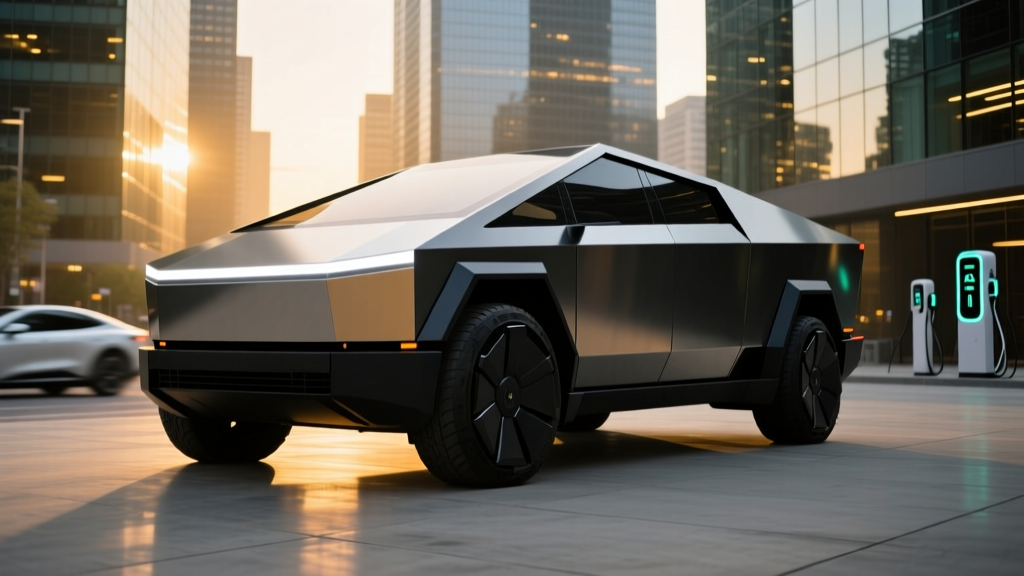
The Tesla Cybertruck was already polarizing when it launched, but a niche aftermarket segment has emerged that takes its stainless-steel exoskeleton to the extreme: the so-called Diamond Cybertruck. This isn't a Tesla factory trim—it's a third-party armored and luxury upfit applied to the Cybertruck platform by specialty outfitters like AddArmor, Rezvani, and a handful of boutique coachbuilders. The result is a vehicle that blends EV torque with ballistic-rated glass, reinforced body panels, and bespoke interiors that push the price well past $200,000.
For 2026, interest in the Diamond Cybertruck concept has grown among buyers who want the Cybertruck's 845-horsepower tri-motor powertrain but demand higher levels of physical security, off-road survivability, or show-car exclusivity. This review examines what these upfits actually include, how added weight impacts real-world range, what charging looks like with a heavier rig, and whether the math works after federal tax credits.
What Exactly Is a Diamond Cybertruck?
The term "Diamond Cybertruck" has been used loosely across forums, YouTube channels, and upfitter marketing to describe Cybertrucks that receive a comprehensive armor and luxury package. There is no single "Diamond" trim from Tesla. Instead, the name typically refers to builds that combine:
- Ballistic-rated glass — B4 to B6 level, capable of stopping handgun and some rifle rounds, replacing the factory laminated "armor glass."
- Reinforced body cladding — additional steel or composite plating over the cold-rolled stainless skin, sometimes with a diamond-plate texture (the likely origin of the "Diamond" moniker).
- Underbody armor — skid plates rated for IED-blast or heavy rock-strike protection, replacing or supplementing Tesla's factory titanium-plated undercarriage.
- Run-flat tire systems — Hutchinson-style run-flat inserts that allow driving 30–50 miles on a deflated tire.
- Bespoke interior — diamond-quilted leather, alcantara headliners, executive rear seating, and upgraded audio.
These packages are typically applied to the Cyberbeast (tri-motor AWD) variant, though some outfitters work with the dual-motor AWD trim. The base vehicle must be purchased separately, then delivered to the upfitter.
Base Platform Specs: 2026 Tesla Cybertruck (Pre-Upfit)
Before any armor is added, here's what the 2026 Cyberbeast brings to the table, per EPA data on fueleconomy.gov and Tesla's published specifications:
| Spec | Value |
|---|---|
| EPA Range | 320 miles (with range extender) |
| Battery Capacity | ~123 kWh usable (NMC chemistry) |
| Drivetrain | Tri-motor AWD |
| Horsepower | 845 hp |
| 0–60 mph | 2.6 seconds |
| Peak DC Fast Charge | ~250 kW (V4 Supercharger) |
| 10–80% Charge Time | ~15 minutes (stock weight) |
| Level 2 Home Charge | 11.5 kW (~37 mi/hr) |
| MPGe (combined) | 69 MPGe |
| Efficiency | 48 kWh/100 mi |
| Base MSRP (Cyberbeast) | $99,990 |
| Battery Warranty | 8 years / 120,000 miles |
How Armor Upfits Change Range, Weight, and Efficiency
A full B6-level Diamond Cybertruck upfit adds an estimated 800–1,500 lbs of armor, glass, and reinforcement. That pushes curb weight from ~6,800 lbs to 7,600–8,300 lbs.
Stock EPA range: 320 miles
Estimated armored real-world range: 220–260 miles (mixed driving)
Highway at 75 mph: ~190–220 miles
Cold weather (below 32°F): ~160–190 miles
Efficiency drops from 48 kWh/100 mi to an estimated 58–65 kWh/100 mi depending on upfit weight and aerodynamic changes from added cladding.
The physics are straightforward: more mass requires more energy to accelerate and sustain speed. The tri-motor Cyberbeast's regenerative braking recovers some energy in stop-and-go driving, but highway efficiency suffers most because the vehicle must overcome rolling resistance and the added frontal area of roof-mounted armor or light bars.
Upfitters rarely publish official efficiency data because every build is custom. Buyers should expect to charge more frequently on road trips and plan routes around Supercharger stops every 180–200 miles for a comfortable buffer.
Charging an Armored Cybertruck: What Changes
| Charge Type | Stock Cyberbeast | Armored (Est.) |
|---|---|---|
| DC Fast Charge (peak) | ~250 kW | ~250 kW (same hardware) |
| 10–80% Time | ~15 min | ~18–22 min (heavier pack draw) |
| Level 2 (240V / 48A) | 11.5 kW / ~37 mi/hr | 11.5 kW / ~25–28 mi/hr* |
| Level 1 (120V) | ~1.4 kW / ~4 mi/hr | ~1.4 kW / ~2.5–3 mi/hr* |
*Miles-per-hour rates drop because each mile now requires more energy to propel the heavier vehicle.
The Cybertruck's 800V architecture and NACS connector remain unchanged after upfitting. The battery pack and charge controller are untouched, so peak kW capability stays at ~250 kW on a V4 Supercharger. However, the charge curve may taper slightly earlier because the thermal management system works harder under heavier loads.
For home charging, a Wall Connector at 48 amps (11.5 kW) remains the practical standard. Expect an overnight charge from 20% to 80% to take roughly 6.5–7.5 hours instead of the stock ~5.5 hours, simply because the usable range per kWh is lower. If your daily drive is under 60 miles, this is a non-issue — you'll wake up with a full buffer every morning.
Pricing: Base Truck + Upfit + Total Cost
| Component | Cost Range |
|---|---|
| Cyberbeast AWD (base MSRP) | $99,990 |
| B4 Armor Package (glass + body) | $45,000 – $75,000 |
| B6 Armor Package (rifle-rated) | $85,000 – $140,000 |
| Underbody Blast Protection | $15,000 – $35,000 |
| Run-Flat Tire System | $8,000 – $15,000 |
| Bespoke Interior Upgrade | $20,000 – $50,000 |
| Smoke/Evasion Package (lights, comms) | $10,000 – $25,000 |
| Total Build Range | $185,000 – $370,000+ |
For context, a B4-level "executive protection" build typically lands around $200,000–$250,000 all-in. A full B6 military-spec build with underbody blast protection and evasion systems can exceed $350,000.
Federal Tax Credit Eligibility (§30D)
The base Cybertruck Cyberbeast at $99,990 sits below the $80,000 MSRP cap for trucks... actually, it does not. The IRS §30D cap for trucks, vans, and SUVs is $80,000 MSRP, and the Cyberbeast at $99,990 exceeds that threshold. This means the Cyberbeast does not qualify for the $7,500 federal tax credit regardless of the buyer's income or battery sourcing.
The dual-motor AWD Cybertruck, if available at or below $80,000 MSRP, could qualify — but most Diamond upfits are applied to the Cyberbeast for its 845 hp and towing capacity. Buyers should consult IRS §30D guidelines and a tax professional for their specific situation. The upfit cost itself is not part of the vehicle MSRP for credit purposes.
Performance After Upfitting: Does It Still Pull?
The tri-motor Cyberbeast produces 845 hp and an estimated 740+ lb-ft of torque. Electric motors deliver instant torque regardless of added weight, so off-the-line acceleration remains impressive even with 1,000+ lbs of armor:
- Stock 0–60 mph: 2.6 seconds
- Armored 0–60 mph (est.): 3.2–3.8 seconds
- Towing capacity: 11,000 lbs (stock); reduced to ~9,000–9,500 lbs with heavy armor due to payload limits
- Top speed: Electronically limited to 130 mph (stock); similar with armor
Braking distances increase with weight. Upfitters typically upgrade brake pads and rotors, but the regenerative braking system bears more load, which can increase battery temperatures during aggressive driving. Tesla's thermal management system handles this, but sustained mountain descents with a fully loaded armored truck will stress the system more than stock.
Interior, Tech, and Standout Features
The stock Cybertruck interior is minimalist: an 18.5-inch center touchscreen, a rear 9.4-inch display, and a yoke-style steering wheel. Diamond-level upfits transform the cabin:
- Diamond-quilted Nappa leather with contrast stitching across seats, door panels, and dash
- Executive rear seating with fold-out tables, wireless charging pads, and individual climate controls
- Upgraded audio — some outfitters install 20+ speaker systems replacing Tesla's 15-speaker setup
- Starlight headliner or alcantara-wrapped ceiling
- Secure communications — encrypted satellite phones, GPS jammers (where legal), and panic buttons wired to the vehicle's electrical system
On the tech side, the Cybertruck's native systems carry over: Autopilot (SAE Level 2 driver assist) and optional FSD (Supervised). These remain Level 2 systems — the driver must remain fully engaged and hands must be detected on the yoke. Tesla's vision-only approach means no lidar redundancy, which is a consideration for security-focused buyers who may prefer the sensor fusion approach used in Level 4 robotaxis like Waymo.
Tesla Autopilot and FSD (Supervised) are SAE Level 2 driver-assistance systems. They do not make the vehicle self-driving. The driver must monitor the road, maintain hands on the steering yoke, and be prepared to take over at any moment. Armoring the vehicle does not change or enhance these systems.
Cargo, Bed, and Passenger Space
The Cybertruck's dimensions are unchanged by armoring (interior space is preserved; armor is applied externally and to the glass):
- Bed length: 6 feet (72 inches)
- Bed volume: 67 cu ft (with tonneau closed)
- Front trunk (frunk): ~7 cu ft — note: some underbody armor packages reduce frunk access or eliminate it
- Front legroom: 41.2 inches
- Rear legroom: 38.4 inches (tight for a full-size truck; armored builds may reduce this with thicker floor plating)
- Seating: 5 passengers (3-across rear bench)
One trade-off buyers should know: underbody blast plating often adds 1–2 inches of floor height, which can reduce rear-seat headroom and legroom slightly. Upfitters compensate by modifying seat mounting points, but the Cybertruck's already snug rear seat becomes tighter.
Who Should Consider a Diamond Cybertruck?
- High-net-worth individuals requiring executive protection in daily driving
- Diplomats, executives, or public figures operating in high-risk environments
- Overlanding enthusiasts who want maximum underbody and rock-strike protection
- Collectors and enthusiasts who want a one-of-one show vehicle
- Buyers prioritizing maximum range — expect 220–260 real-world miles, not 320
- Those on a budget — total build cost starts around $185,000
- Commuters who don't need ballistic protection — the stock Cybertruck is already heavy and large
- Buyers counting on the $7,500 federal tax credit — the Cyberbeast MSRP exceeds the §30D cap
Diamond Cybertruck vs. Armored Competitors
| Feature | Diamond Cybertruck (Cyberbeast) | Rezvani Hercules 6x6 | Mercedes G-Wagon (Brabus armored) |
|---|---|---|---|
| Powertrain | Tri-motor EV, 845 hp | V8 gas, ~500 hp | V8 gas, ~577 hp |
| Est. Range / Tank | 220–260 mi (electric) | ~300 mi (gas) | ~250 mi (gas) |
| 0–60 mph | ~3.5 sec (armored) | ~6.0 sec | ~5.5 sec |
| Armor Level | B4–B6 (custom) | B4–B6 (factory option) | B4–B6 (aftermarket) |
| Est. Total Cost | $185K–$370K | $300K–$500K | $250K–$450K |
| Tax Credit Eligible? | No (MSRP cap) | No (gas vehicle) | No (gas vehicle) |
The Diamond Cybertruck's primary advantage is electric instant torque and lower per-mile energy cost compared to gas-powered armored trucks. Charging at home at $0.14/kWh costs roughly $0.09 per mile (at 62 kWh/100 mi armored), versus $0.30+ per mile for a gas armored truck getting 8–10 mpg. Over 15,000 annual miles, that's a $3,000+ fuel savings.
Warranty Considerations
Tesla's factory warranty on the Cybertruck includes:
- Basic Vehicle: 4 years / 50,000 miles
- Battery & Drive Unit: 8 years / 120,000 miles (minimum 70% capacity retention)
However, significant aftermarket modifications can void portions of Tesla's warranty. Adding 1,000+ lbs of armor stresses suspension components, half-shafts, and wheel bearings beyond their designed load. If a drive unit fails and Tesla's diagnostics show sustained overload, the claim may be denied. Buyers should:
- Get written warranty terms from the upfitter covering all added components
- Ask the upfitter whether they have a Tesla-authorized service relationship
- Consider third-party extended warranty coverage that explicitly includes modified EVs
Frequently Asked Questions
What is the real-world range of a Diamond Cybertruck?
With a B4–B6 armor package adding 800–1,500 lbs, expect 220–260 miles in mixed driving, 190–220 miles on the highway at 75 mph, and 160–190 miles in cold weather below freezing. The stock EPA rating is 320 miles, but weight and aerodynamic penalties reduce that significantly.
How fast does an armored Cybertruck charge?
Peak DC fast charging remains ~250 kW via NACS on Tesla V4 Superchargers. Expect 10–80% in 18–22 minutes (vs. ~15 min stock) due to the heavier vehicle drawing more energy during the charge session. Home Level 2 charging at 11.5 kW adds roughly 25–28 miles per hour of charging.
How much does a Diamond Cybertruck cost after tax credits?
Total build costs range from $185,000 to $370,000+ depending on armor level and interior customization. The Cyberbeast's $99,990 MSRP exceeds the IRS §30D truck cap of $80,000, so no federal tax credit applies. Some states may offer separate incentives, but these vary by jurisdiction.
Does the Diamond Cybertruck qualify for the federal EV tax credit?
No. The IRS §30D credit caps truck MSRP at $80,000. The Cyberbeast starts at $99,990, and the upfit cost is separate. Even the dual-motor AWD Cybertruck may exceed the cap depending on options. Always verify current rules with a tax professional.
Is it worth buying vs. other armored vehicles?
If you specifically want an electric armored vehicle with instant torque, low running costs, and the Cybertruck's angular design, there is no direct competitor at this price point. Gas-powered armored options like the Rezvani Hercules or Brabus G-Wagon offer longer range and established service networks but cost significantly more per mile to operate and lack EV torque delivery.
What are the biggest pros and cons?
- 845 hp tri-motor EV with instant torque even under armor load
- B4–B6 ballistic protection in a modern EV platform
- Low per-mile energy cost vs. gas armored trucks
- Highly customizable interior and security systems
- NACS access to Tesla Supercharger network
- Real-world range drops to ~220–260 mi (from 320 EPA)
- Total cost: $185K–$370K+ with no federal tax credit
- Warranty risk from aftermarket weight and modifications
- Rear seat space compromised by floor armor
- Long upfit lead times (3–6 months typical)
Can I daily-drive a Diamond Cybertruck?
Yes, if your commute fits within the reduced range and you have reliable home charging. The Cybertruck's size (231.7 inches long, 82.7 inches wide with mirrors) makes it challenging in tight urban garages. Plan for a dedicated Level 2 home charger — Level 1 (120V) charging adds only ~2.5 miles per hour on an armored build, which is impractical for daily use.
Sources: fueleconomy.gov, IRS §30D Clean Vehicle Credit, Tesla Cybertruck specifications (tesla.com/cybertruck).