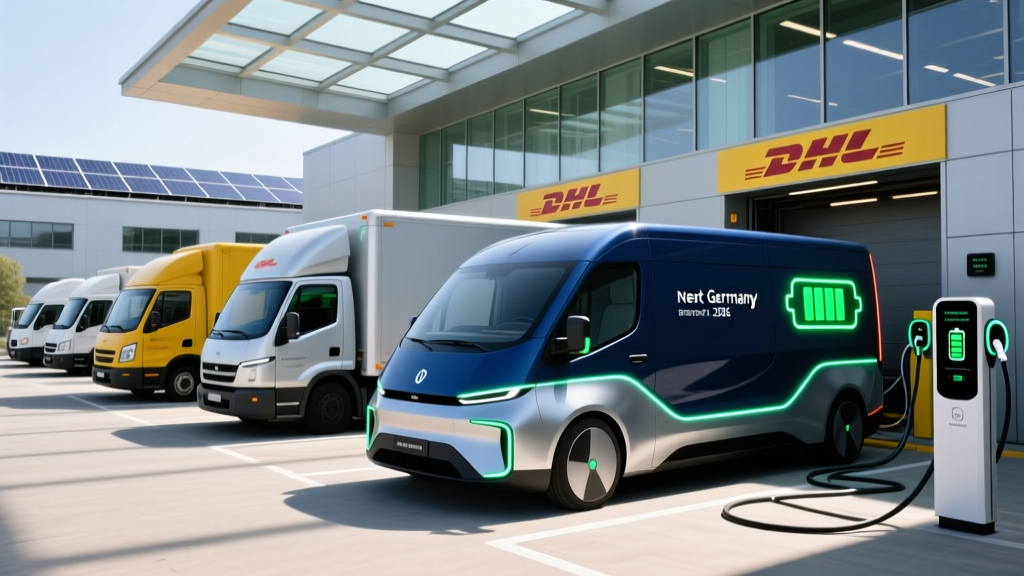
When you think about the electric-vehicle transition, passenger sedans and SUVs usually dominate the conversation. But the real volume play in fleet electrification is happening in commercial delivery — and DHL Germany's fleet electrification targets are among the most aggressive in global logistics. With over 60% of its German last-mile fleet already running on electric power as of early 2026, DHL's parent company Deutsche Post DHL Group (DPDHL) is reshaping what a zero-emission delivery network looks like at scale.
This isn't a concept. It's a rolling deployment of thousands of electric vans, medium-duty trucks, and cargo bikes supported by one of the largest private charging networks in Europe. Here's a detailed look at the vehicles, the specs, the infrastructure, and what DHL's electrification roadmap means for the broader EV industry.
DHL's Electrification Goals: What the Targets Actually Say
DHL's electrification strategy is nested inside DPDHL's broader GoGreen Plus sustainability program. The key targets relevant to the German fleet include:
- 60% electric last-mile delivery in Germany by end of 2026 (up from ~45% in 2024)
- 100% electric last-mile in Germany by 2030
- 30% of regional line-haul routes electrified by 2028
- Net-zero logistics emissions group-wide by 2050, with a 2030 interim target of 42% reduction in Scope 1 and 2 emissions versus 2019 baseline
For context, DHL Express and DHL Parcel operate a combined fleet of roughly 22,000 delivery vehicles in Germany alone, making this one of the largest single-country fleet electrification efforts in the world. The scale matters because it drives vehicle procurement decisions, depot charging infrastructure, and grid-capacity planning years in advance.
The EV Fleet: Vehicles Powering DHL Germany in 2026
DHL's German fleet is a multi-brand, multi-class operation. Here's a breakdown of the primary electric vehicles in service, with the specs that matter for fleet operators evaluating similar deployments.
| Vehicle | Class | Battery (kWh) | WLTP Range | Real-World Range | Max DC Charge | 10–80% Time | Payload |
|---|---|---|---|---|---|---|---|
| Streetscooter WORK | Last-mile van | 40–60 kWh (NMC) | ~125 mi (200 km) | ~80–100 mi (urban, loaded) | 50 kW | ~50 min | ~1,760 lb |
| Ford E-Transit | Last-mile / mid-route van | 68 kWh (NMC) | ~196 mi (315 km) | ~130–150 mi (mixed, loaded) | 115 kW | ~34 min | ~3,880 lb |
| Mercedes eSprinter | Last-mile / regional van | 113 kWh (NMC) | ~273 mi (440 km) | ~180–210 mi (mixed route) | 115 kW | ~42 min | ~2,645 lb |
| Volvo FH Electric | Regional heavy truck | 360–540 kWh (NMC) | ~186 mi (300 km) | ~140–170 mi (loaded, regional) | 250 kW | ~40 min (to 80%) | Up to ~44,000 lb GCW |
| MAN eTGE / eTGM | Urban van / medium truck | 36–64 kWh (NMC) | ~87–125 mi | ~60–90 mi (urban, loaded) | 50–80 kW | ~45 min | Varies by config |
Charging Infrastructure: The Backbone of Fleet Electrification
Vehicles are only half the equation. DHL Germany has invested heavily in depot-based charging infrastructure, and the scale is staggering. As of 2026, DPDHL operates over 12,000 charge points across German facilities, with the majority being Level 2 AC chargers (11–22 kW) for overnight depot charging, supplemented by DC fast chargers (50–150 kW) at high-throughput hubs.
| Charging Level | Power (kW) | Use Case | Typical Session | Miles Added/Hr |
|---|---|---|---|---|
| Level 2 (AC depot) | 11–22 kW | Overnight fleet top-up | 6–10 hours | ~30–60 mi/hr (van-dependent) |
| DC Fast (depot hub) | 50–150 kW | Mid-day top-up, shift change | 30–60 minutes | ~120–250 mi/hr |
| Public DC Fast | 150–350 kW | Regional truck en-route charging | 30–45 minutes | ~250–400 mi/hr (truck) |
The depot charging model is critical for fleet economics. Overnight Level 2 charging at industrial electricity rates (roughly €0.12–0.18/kWh in Germany for commercial contracts) is dramatically cheaper than public fast charging or diesel fuel. A Streetscooter WORK consuming 20 kWh/100 km charged overnight costs approximately €2.40–3.60 per 100 km in electricity — versus €12–15 for an equivalent diesel van at current German fuel prices.
DHL has also partnered with EnBW and other German energy providers to secure grid capacity at large distribution centers. Some mega-hubs now feature on-site battery storage systems (2–5 MWh) to buffer peak demand and avoid costly grid-upgrade fees — a strategy that any large fleet operator should study.
Battery Chemistry and Longevity in Fleet Service
Nearly all vehicles in DHL's current German fleet use NMC (nickel-manganese-cobalt) lithium-ion batteries, which offer higher energy density than LFP (lithium iron phosphate) — a critical factor for cargo vans where battery weight directly reduces payload capacity.
However, fleet duty cycles introduce unique degradation pressures:
- Daily depth of discharge: Last-mile vans typically use 60–80% of battery capacity per shift, recharged nightly — roughly 300+ full equivalent cycles per year
- DC fast-charging frequency: Vehicles on double-shift routes may DC fast-charge once or twice daily, which accelerates degradation compared to slow AC charging
- Thermal management: Modern fleet EVs like the eSprinter and E-Transit feature active liquid cooling, which significantly extends battery life versus passive air cooling
DPDHL reports that Streetscooter units deployed since 2018 are retaining approximately 85–90% of original battery capacity after 5+ years of daily commercial use — a strong real-world data point for NMC longevity in fleet applications. Most OEM battery warranties for commercial EVs cover 8 years or 100,000 miles (160,000 km) with a guaranteed 70% capacity retention threshold.
The Economics: Total Cost of Ownership for Fleet EVs
DHL's electrification targets aren't driven by environmental idealism alone — the economics increasingly favor electric delivery vehicles over diesel in last-mile applications. Here's why:
- Fuel cost savings: Electricity at commercial rates costs roughly 70–80% less per mile than diesel in Germany
- Maintenance reduction: EVs eliminate oil changes, particulate filter replacements, AdBlue refills, and most transmission service — DHL estimates 30–40% lower maintenance costs per vehicle
- Urban access advantages: Zero-emission vehicles face no restrictions in German low-emission zones (Umweltzonen), while older diesel vans increasingly face access bans
- Government incentives: Germany's Umweltbonus and commercial fleet subsidies offset 15–25% of vehicle acquisition cost, though these programs have been scaled back since 2023
The primary cost disadvantage remains higher upfront vehicle price: an electric delivery van typically costs 1.5–2x its diesel equivalent before subsidies. However, DHL's scale (22,000+ vehicles) gives it negotiating leverage with OEMs, and the 5–7 year total cost of ownership now breaks even or favors electric on most urban routes.
What DHL's Targets Mean for the Broader EV Market
DHL Germany's fleet electrification targets are a bellwether for the commercial EV sector. Several industry implications stand out:
Vehicle supply signals: DHL's procurement volumes give OEMs like Ford, Mercedes-Benz, Volvo, and MAN the demand certainty needed to scale production lines. When a single fleet operator commits to 10,000+ electric vans over three years, it justifies factory tooling investments.
Charging standards: DHL Germany's fleet exclusively uses CCS2 (Combined Charging System Type 2) connectors — the European standard. This reinforces CCS2 dominance in commercial applications and influences charging-station deployment decisions by networks like Ionity, EnBW, and Shell Recharge.
Grid infrastructure: Large depot electrification projects require utility coordination years in advance. DHL's experience with grid-capacity negotiations, transformer upgrades, and on-site storage provides a blueprint for other fleet operators in the US and Europe.
Second-life batteries: As DHL's early Streetscooter fleet ages out, retired battery packs (still retaining 70–80% capacity) are being repurposed for stationary storage at DHL facilities — creating a circular-economy model that reduces total battery lifecycle cost.
Challenges and Limitations DHL Still Faces
Despite the progress, DHL's fleet electrification targets face real obstacles:
- Regional and long-haul gaps: Battery-electric trucks for routes over 200 miles remain limited in availability and payload capacity. Hydrogen fuel-cell and overhead catenary (eHighway) pilots continue, but neither is deployed at scale.
- Depot grid constraints: Some older urban distribution centers lack the electrical service capacity for full-fleet overnight charging, requiring costly multi-million-euro grid upgrades.
- Winter range loss: In northern German states, winter temperatures reduce van range by 25–35%, requiring route-planning adjustments and mid-day charging for longer routes.
- Vehicle availability: OEM production backlogs for electric vans and trucks remain an issue. Delivery lead times for the Mercedes eSprinter and Volvo FH Electric can extend 6–12 months for large orders.
- Driver training: Transitioning thousands of drivers from diesel to electric requires structured training on regenerative braking, range management, and charging protocols.
Frequently Asked Questions
What percentage of DHL's German fleet is electric in 2026?
As of early 2026, approximately 60% of DHL's last-mile delivery vehicles in Germany are fully electric. The target is 100% by 2030. This covers DHL Express and DHL Parcel operations across urban and suburban routes.
Which electric vans does DHL use in Germany?
The primary vehicles include the Streetscooter WORK (a purpose-built delivery van originally developed by a DPDHL subsidiary), the Ford E-Transit, the Mercedes-Benz eSprinter, and the MAN eTGE. For regional heavy routes, DHL is deploying Volvo FH Electric and MAN eTGM trucks.
How does DHL charge its electric fleet?
The majority of charging happens overnight at depot-based Level 2 AC chargers (11–22 kW), which fully replenish most vans during an 8–10 hour off-peak window. High-throughput hubs also have DC fast chargers (50–150 kW) for mid-day top-ups and double-shift operations. Regional trucks use public DC fast-charging networks along highways.
What is the real-world range of DHL's electric delivery vans?
Real-world range depends heavily on payload, route type, and weather. The Streetscooter WORK delivers roughly 80–100 miles on a loaded urban route. The Ford E-Transit manages 130–150 miles in mixed driving, and the Mercedes eSprinter achieves 180–210 miles on suburban routes. In winter conditions (below 32°F / 0°C), subtract 25–35% from these figures.
Is DHL's fleet electrification model replicable in the US?
Yes, with caveats. DHL's model depends on high depot density (short routes returning to a central hub nightly), predictable urban routes, and commercial electricity rates that make overnight charging economical. US operators like Amazon, UPS, and FedEx are pursuing similar strategies, but US routes often involve longer suburban/rural distances and less reliable public charging infrastructure — making the transition more complex outside dense metro areas.
What battery chemistry do DHL's electric vans use?
Current fleet vehicles primarily use NMC (nickel-manganese-cobalt) lithium-ion batteries, chosen for their higher energy density — critical for maximizing cargo payload. DHL reports ~85–90% capacity retention after 5+ years of daily commercial use in Streetscooter units, supported by active liquid thermal management systems.
Sources: Deutsche Post DHL Group GoGreen Plus, U.S. DOE fueleconomy.gov (for comparative EV efficiency data), DHL GoGreen.