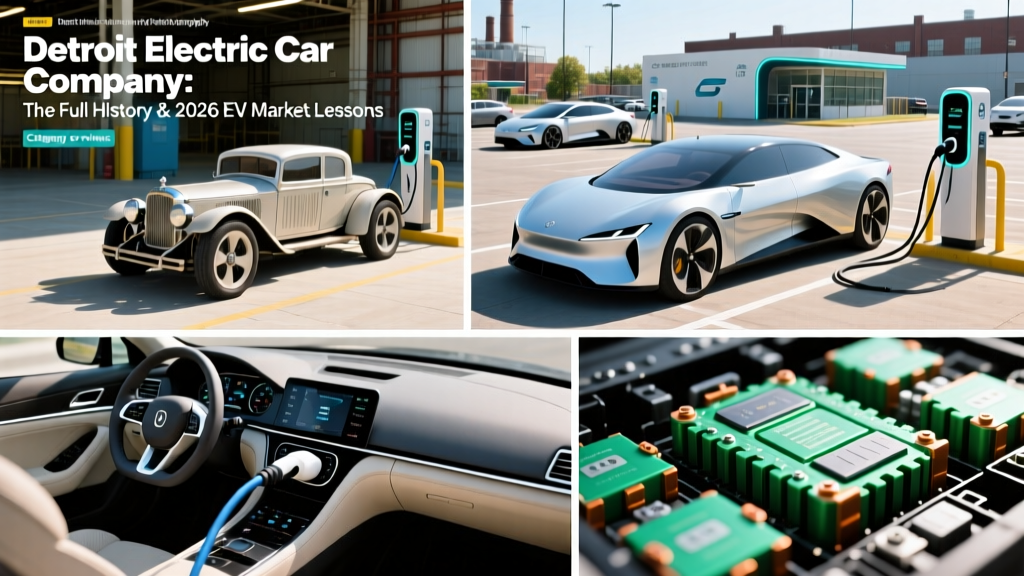
Quick Answer: What Is the Detroit Electric Car Company?
The original Detroit Electric was an American automaker that produced battery-electric vehicles from 1907 to 1939 — one of the most successful early EV brands, building over 35,000 cars. The name was revived in 2008 by Detroit Electric SP:TECH (later Detroit Electric EV Limited), which announced the SP:01 electric sports car but never reached meaningful production volume. As of 2026, no current-production vehicle carries the Detroit Electric badge. For today's buyers, the company's story is a useful lens for understanding how EV technology, charging infrastructure, and ownership economics have evolved — and what to actually look for when buying a modern electric vehicle.
The Original Detroit Electric (1907–1939): What It Actually Built
Detroit Electric, manufactured by the Anderson Electric Car Company in Detroit, Michigan, was one of the most prominent electric car brands of the early 20th century. Between 1907 and 1939, the company produced approximately 35,000 vehicles — a remarkable figure for the era.
The cars were powered by lead-acid batteries (and later, Edison nickel-iron batteries as an option). They offered a top speed of roughly 20 mph and a range of about 80 miles on a full charge under ideal conditions. The vehicles were marketed primarily to women and physicians who valued quiet, clean operation and the absence of a hand crank to start the engine.
Key historical figures drove Detroit Electrics: Thomas Edison owned one, as did Henry Ford's wife, Clara Ford, who reportedly preferred her Detroit Electric to the gasoline-powered Model T her husband built. John D. Rockefeller Jr. also owned two.
Why the Original Detroit Electric Failed
The decline followed a pattern that echoes in modern EV discussions:
- Range limitation: 80 miles on heavy lead-acid batteries could not compete with the expanding range of gasoline cars as road networks grew.
- Cost: A Detroit Electric cost $1,750–$2,500 (roughly equivalent to $55,000–$80,000 today), while a Model T sold for under $300 by the 1920s.
- Infrastructure: The electric starter (invented 1912) eliminated gasoline cars' biggest usability disadvantage, and rural electrification lagged behind gasoline station expansion.
- Battery weight: Lead-acid chemistry offered poor energy density — a fundamental physics problem that modern lithium-ion batteries have largely solved.
The Modern Revival: Detroit Electric SP:01 and Beyond
In 2008, the Detroit Electric brand was revived under Detroit Electric SP:TECH, led by Albert Lam, a former Lotus Engineering executive. The company announced the SP:01, an electric sports car based on the Lotus Exige platform.
SP:01 Announced Specifications (Never Reached Production)
| Attribute | Announced Spec |
|---|---|
| Motor Output | 201 hp / 166 lb-ft torque |
| 0–60 mph | 3.7 seconds (claimed) |
| Top Speed | 155 mph |
| Battery | 37 kWh lithium-polymer |
| Range (claimed) | ~180 miles (NEDC cycle) |
| Charge Time (Level 2) | ~4.3 hours (claimed) |
| Price (announced) | $135,000+ |
| Production Status | Never reached volume production |
The SP:01 was unveiled in 2013 with plans to build 999 units. By 2015, the company had relocated operations and restructured. As of 2026, Detroit Electric EV Limited remains a registered entity but has not delivered a production vehicle to the consumer market. The SP:01 joins a long list of announced-but-undelivered EV startups — a cautionary tale for buyers evaluating any pre-production EV company.
What the Detroit Electric Story Teaches 2026 EV Buyers
The century-long arc from the original Detroit Electric to today's EV market surfaces practical lessons for anyone shopping for an electric vehicle right now.
Lesson 1: Battery Chemistry Dictates Everything
The original Detroit Electric's 80-mile range on heavy lead-acid batteries failed because the energy density was too low. Today's buyers face a similar chemistry decision, just with modern options:
| Chemistry | Energy Density | Cost | Cycle Life | Best For |
|---|---|---|---|---|
| NMC (Nickel Manganese Cobalt) | High (~250 Wh/kg cell-level) | Higher | ~1,000–1,500 cycles | Long-range, performance models |
| LFP (Lithium Iron Phosphate) | Lower (~160 Wh/kg cell-level) | Lower | ~3,000+ cycles | Daily commuting, budget models |
LFP batteries, now used in base-trim Tesla Model 3 and Model Y vehicles, standard-range Ford Mustang Mach-E models, and many Chinese-market EVs, trade some range for dramatically longer lifespan and lower cost. NMC remains the choice for long-range variants. Understanding which chemistry is in the vehicle you're buying matters more than the brand badge on the hood.
Lesson 2: Infrastructure Access Determines Practicality
The original Detroit Electric died partly because gasoline stations proliferated while home electricity access remained limited. In 2026, the equivalent question is: Can you charge at home?
Home Level 2 charging (240V, typically 7.2–11.5 kW) adds roughly 25–44 miles of range per hour of charging. A full overnight charge covers the needs of 95%+ of American drivers, whose median daily commute is under 40 miles according to EPA data.
If you cannot install a home charger — apartment dwellers, street-parkers — your EV ownership experience will depend heavily on public DC fast charging reliability. Networks like Tesla Supercharger, Electrify America, and EVgo vary dramatically by region. Before buying, map the chargers within 5 miles of your home and workplace using PlugShare or the network's app.
Lesson 3: Upfront Cost vs. Total Cost of Ownership
Detroit Electrics in 1915 cost 6–8x more than a Model T, despite lower operating costs. This same dynamic persists in 2026, though the gap has narrowed significantly. Here's a realistic comparison for a mid-range EV versus a comparable gasoline sedan over 5 years and 75,000 miles:
| Cost Category | 2026 EV (e.g., Hyundai Ioniq 6 SE, ~$38,000 MSRP) | Gas Sedan (e.g., Toyota Camry LE, ~$29,000 MSRP) |
|---|---|---|
| Purchase Price (after §30D credit) | ~$30,500 (if eligible) | $29,000 |
| Fuel/Energy (75,000 mi) | ~$3,750 (home charging at $0.15/kWh) | ~$9,375 (30 MPG avg, $3.75/gal) |
| Maintenance (5 yr) | ~$1,800 | ~$3,500 |
| Insurance (5 yr avg) | ~$9,500 | ~$7,500 |
| Estimated Depreciation | ~$14,000 | ~$12,000 |
| 5-Year Total | ~$59,550 | ~$61,375 |
The EV saves roughly $1,800 over five years in this scenario — but only if you qualify for the federal §30D tax credit (up to $7,500, subject to MSRP caps, buyer income limits, and battery sourcing requirements that change annually). Without the credit, the EV costs approximately $5,700 more over the same period. Run the numbers for your specific electricity rate, annual mileage, and tax situation before deciding.
EV vs. Gas vs. Hybrid: A 2026 Decision Framework
The original Detroit Electric competed against gasoline and steam cars. Today's buyer faces a three-way choice. Here's a data-driven framework:
| Factor | BEV (Battery Electric) | PHEV (Plug-in Hybrid) | Gas/HEV (Hybrid) |
|---|---|---|---|
| EPA Range | 220–400+ mi | 25–44 mi electric, then 350–500 mi gas | 400–600 mi |
| Home Charging Required? | Strongly recommended | Recommended for EV-mode savings | No |
| Maintenance Cost | Lowest (no oil, fewer moving parts) | Moderate (two powertrains) | Moderate to high |
| Cold-Weather Range Loss | 20–35% at 20°F | 15–25% electric range, gas unaffected | Minimal |
| Best For | Home charging + daily commute under range | Short EV commute + long road trips | No charging access or towing-heavy use |
| Federal Tax Credit | Up to $7,500 (§30D) | Up to $7,500 (§30D, if battery ≥7 kWh) | None (gas); HEV none |
Decision Framework: Which Powertrain Is Right for You?
- Choose a BEV if: You have home or workplace Level 2 charging, your daily round-trip commute is under 80% of the vehicle's real-world range, and you want the lowest operating cost and maintenance burden.
- Choose a PHEV if: Your daily commute is under 30 miles (covering most on electric), you take regular road trips exceeding 200 miles, or you lack reliable DC fast charging on your common routes.
- Choose a gas/HEV if: You cannot charge at home or work, you live in an area with limited public charging infrastructure, you tow frequently (towing cuts EV range by 40–60%), or your budget is strictly under $25,000.
Real-World Ownership: What the Sticker Doesn't Tell You
Whether you're evaluating a Tesla Model Y, a Ford F-150 Lightning, a Hyundai Ioniq 5, or any other 2026 EV, these are the ownership realities that spec sheets omit:
Real-World Range vs. EPA Sticker
EPA range estimates are generated under controlled conditions. In practice:
- Highway driving at 75+ mph: Expect 85–90% of EPA range due to aerodynamic drag scaling with the square of velocity.
- Cold weather (below 32°F): Expect 65–80% of EPA range. Battery chemistry slows, cabin heating draws 2–5 kW continuously (versus waste heat in an ICE vehicle).
- Combined highway + cold: Plan for 60–70% of EPA range. A vehicle rated at 310 miles EPA may deliver 190–220 miles in a 20°F highway drive.
Charging Speed Reality: Peak kW ≠ Sustained kW
Automakers advertise peak DC fast-charge rates (e.g., "up to 250 kW"). In reality, charging follows a curve. A vehicle that peaks at 250 kW may sustain that rate only between 10–30% state of charge, tapering to 150 kW by 50% and below 50 kW past 80%. The meaningful metric is 10–80% charge time, which accounts for the taper. For example, a Hyundai Ioniq 5 with its 800V architecture charges from 10–80% in approximately 18 minutes at a 350 kW charger, while a vehicle peaking at 150 kW might take 30–35 minutes for the same session.
Insurance Costs Are Higher
EV insurance premiums run 15–25% higher than equivalent gasoline vehicles, driven by higher repair costs (specialized labor, battery replacement risk, aluminum body panels). Budget an extra $300–$600/year and get quotes before purchasing.
Battery Degradation Is Real but Manageable
Modern lithium-ion EV batteries typically lose 5–10% of capacity over the first 100,000 miles, then degrade more slowly. All major manufacturers warranty batteries for at least 8 years/100,000 miles with a capacity retention threshold of 60–70%. IRS §30D credit rules and manufacturer warranties are updated periodically — verify current terms before purchase.
Common EV Misconceptions — Addressed With Data
| Myth | Fact |
|---|---|
| "EV batteries need replacing every 5 years" | Modern EV batteries are warrantied for 8 yr/100,000 mi minimum. Real-world data from fleet operators shows most retain 85–90% capacity at 150,000 miles. |
| "The grid can't support mass EV adoption" | Most charging occurs overnight during off-peak hours. The U.S. DOE estimates that off-peak grid capacity could support millions more EVs without major upgrades. |
| "EVs are worse for the environment" | Even on coal-heavy grids, EVs produce fewer lifecycle emissions than gasoline cars per EPA lifecycle analysis. On cleaner grids, the advantage widens dramatically. |
| "You can't road-trip in an EV" | With 200+ mile range and DC fast charging adding 150–250 miles in 20–30 minutes, road trips are practical — but require route planning in charging-desert regions (rural Great Plains, parts of the Mountain West). |
| "All EVs qualify for the $7,500 tax credit" | The §30D credit has MSRP caps ($55,000 sedans, $80,000 SUVs/trucks/vans), buyer income caps ($150K single/$300K joint), and battery critical-mineral sourcing requirements. Many popular EVs qualify for partial or no credit in 2026. Always verify on the IRS website or with a tax professional. |
What a First-Time EV Buyer Should Know Before Signing
- Test your electrical panel. A Level 2 home charger typically requires a 240V/40–60A circuit. If your panel is 100A or near capacity, a panel upgrade ($1,500–$3,000) may be needed. Get an electrician's quote before buying the car.
- Buy for your worst-case range day, not your average. If your longest regular drive is 180 miles in winter, you need a vehicle with at least 270–300 miles EPA range to maintain a comfortable buffer.
- Precondition your battery. Most modern EVs allow you to precondition (warm) the battery before fast charging or departure. This preserves range in cold weather and enables faster DC charging speeds.
- Verify tax credit eligibility independently. Dealer point-of-sale transfers of the §30D credit are available, but you remain responsible for meeting income and sourcing requirements. If you don't qualify, you owe the credit back at tax time.
- Factor in charging time on road trips. A 400-mile drive in a gasoline car takes roughly 6 hours non-stop. In an EV requiring one 25-minute fast-charge stop, plan for 6 hours 25 minutes minimum — plus buffer for charger availability and occupancy.
Frequently Asked Questions
Is the Detroit Electric car company still making cars in 2026?
No. The original Detroit Electric ceased production in 1939. The modern revival (Detroit Electric SP:TECH/EV Limited) announced the SP:01 sports car but never reached volume production. No Detroit Electric vehicle is currently available for purchase new in 2026.
What happened to the Detroit Electric SP:01?
The SP:01 was announced in 2013 as a limited-production electric sports car at $135,000+. The company faced financial restructuring, production delays, and ultimately did not deliver meaningful volume. It serves as a cautionary example of the challenges EV startups face in reaching production — a pattern seen with multiple brands.
How much would a vintage Detroit Electric car cost today?
Surviving original Detroit Electric vehicles (1907–1939) are collector items. Auction prices typically range from $30,000 to over $100,000 depending on model, condition, and provenance. These are not practical daily drivers — they are museum and show pieces.
What's the most affordable new EV I can buy in 2026?
As of early 2026, the most affordable new EVs include the Nissan Leaf S (~$28,140 MSRP, 149 miles EPA range) and the Chevrolet Equinox EV 2LT (~$33,000, 319 miles EPA). After a potential $7,500 §30D credit (if eligible), effective prices can drop significantly. Always confirm current pricing and credit eligibility before purchasing.
Should I wait for solid-state batteries before buying an EV?
Solid-state batteries promise higher energy density and faster charging, but commercial availability in affordable consumer vehicles remains years away — likely 2028–2030 at the earliest for limited models, with mass-market availability further out. Current lithium-ion technology is mature, well-warrantied, and sufficient for most buyers' needs. Waiting for future battery technology means forgoing years of fuel savings and driving electric today.