Why Tesla Demand Bends (or Doesn't) When Prices Shift
When Tesla cuts prices, headlines follow. When they raise them, forums erupt. But beneath the noise lies a genuine economic question that every prospective EV buyer should understand: what are the determinants of price elasticity of demand for Tesla, and how do they translate into real purchase decisions in 2026?
Price elasticity of demand measures how sensitive buyers are to price changes. A highly elastic product sees demand swing wildly with small price shifts; an inelastic one holds steady. Tesla occupies an unusual middle ground — its demand is shaped by charging infrastructure lock-in, brand identity, competitor saturation, tax-credit cliffs, and the raw math of total cost of ownership. Understanding these forces isn't an academic exercise. It's the framework you need to decide whether today's Tesla pricing represents value or whether a rival deserves your deposit.
This analysis anchors each elasticity determinant in hard vehicle data — EPA range, charging curves, battery chemistry, and out-the-door pricing — because no demand model matters if the underlying product doesn't deliver.
The 2026 Tesla Lineup: Spec-Driven Snapshot
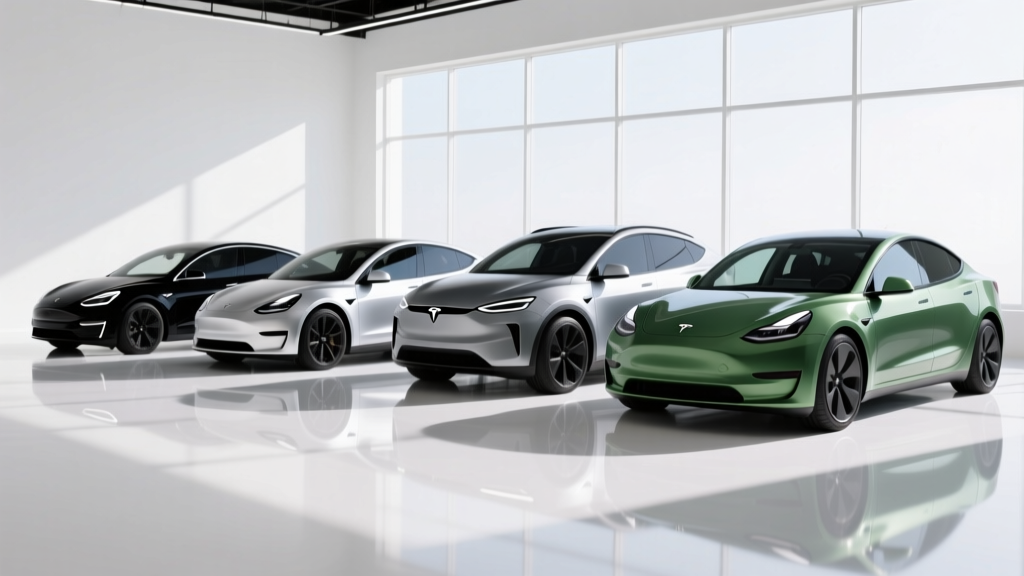
Before analyzing demand drivers, we need the numbers. Tesla's 2026 U.S. lineup spans four core models, each competing in a segment that has grown dramatically more crowded since the Model Y first launched.
| Spec | Model 3 LR AWD | Model Y LR AWD | Model S LR | Cybertruck AWD |
|---|---|---|---|---|
| EPA Range | 341 mi | 320 mi | 402 mi | 340 mi |
| Battery (usable, chemistry) | ~75 kWh, NMC | ~75 kWh, NMC | ~95 kWh, NMC | ~123 kWh, NMC |
| Peak DC Fast Charge | 250 kW | 250 kW | 250 kW | 250 kW |
| 10–80% DCFC Time | ~25 min | ~25 min | ~30 min | ~35 min |
| Level 2 Home Rate | 11.5 kW (~44 mi/hr) | 11.5 kW (~44 mi/hr) | 11.5 kW (~44 mi/hr) | 11.5 kW (~44 mi/hr) |
| 0–60 mph | 4.2 sec | 4.8 sec | 3.1 sec | 3.9 sec |
| Horsepower | 346 hp | 384 hp | 670 hp | 600 hp |
| Drivetrain | Dual-motor AWD | Dual-motor AWD | Dual-motor AWD | Dual-motor AWD |
| MPGe (combined) | 134 MPGe | 123 MPGe | 124 MPGe | 79 MPGe |
| Efficiency (kWh/100 mi) | 25 | 27 | 27 | 43 |
| Cargo Volume | 23 cu ft (trunk+frunk) | 76 cu ft (max) | 28 cu ft | ~70 cu ft (bed+frunk) |
| Base MSRP | $47,740 | $48,630 | $79,990 | $79,990 |
| Battery Warranty | 8 yr / 120,000 mi | 8 yr / 120,000 mi | 8 yr / 120,000 mi | 8 yr / 100,000 mi |
Sources: fueleconomy.gov, Tesla official specifications. MSRP figures reflect 2026 model-year pricing before destination fees and incentives.
Real-World Range: Where EPA Meets the Interstate
- EPA sticker: 320 miles
- Real-world highway (70–75 mph, moderate temps): ~265–285 miles
- Real-world cold weather (below 32°F, mixed driving): ~225–255 miles
- City/regenerative-heavy driving: ~290–310 miles
Tesla's NMC packs deliver strong energy density but lose roughly 15–25% range in sustained sub-freezing conditions, depending on whether you precondition. The Model 3's slightly lower frontal area and weight give it a small real-world edge over the Model Y at highway speeds.
Range elasticity matters here: a buyer comparing the Model Y's 320-mile sticker to a Hyundai Ioniq 5's 318-mile EPA figure might view them as equivalent. But Tesla's Supercharger network — over 6,000 U.S. stalls as of early 2026 — reduces the effective range anxiety that suppresses demand for competitors on long trips. This infrastructure moat is a primary determinant making Tesla demand more inelastic than rivals: buyers pay a premium because the charging ecosystem substitutes for raw battery capacity.
Charging Speed and the Supercharger Lock-In Effect
Charging speed is arguably the single most misunderstood spec in EV shopping. Peak kW tells you the maximum rate; the charge curve tells you what actually happens during a session.
| Charging Level | Power / Rate | Practical Speed |
|---|---|---|
| Level 1 (120V household) | ~1.4 kW | ~4–5 miles per hour |
| Level 2 (240V home, 48A) | 11.5 kW | ~44 miles per hour; full charge in ~7–8 hours |
| DC Fast Charge (V3 Supercharger) | Peak 250 kW | 10–80% in ~25 min (Model 3/Y); tapers sharply above 80% |
| DC Fast Charge (V4 Supercharger) | Peak 250–350 kW* | Newer stalls support higher rates; Model 3 Highland+ capable of sustained higher C-rate |
*V4 Supercharger availability varies by location. Tesla vehicles currently cap intake at approximately 250 kW even at V4 stalls due to onboard architecture limits.
One elasticity determinant this reveals: Tesla's demand is partially insulated from price sensitivity because Supercharger reliability remains measurably higher than third-party CCS networks. A 2025 J.D. Power study ranked Tesla's proprietary network highest in uptime and satisfaction. For road-trip-heavy buyers, this reliability commands a price premium that makes demand less elastic — you're not just buying a car, you're buying access to the most dependable DC fast-charging infrastructure in North America.
That said, with NACS adoption now standard across Ford, GM, Rivian, Hyundai, and others, the Supercharger exclusivity moat is narrowing. By late 2026, virtually every new EV sold in the U.S. will access Superchargers via native NACS port or adapter. This is a structural shift pushing Tesla demand toward greater elasticity: when the charging advantage becomes universal, price competition intensifies on vehicle merits alone.
Pricing, Tax Credits, and the Elasticity Cliff
Perhaps no determinant of price elasticity is more immediate than the federal tax credit. Under IRS §30D rules, the credit can slash effective price by up to $7,500 — but only if the vehicle, the buyer, and the battery sourcing all qualify. This creates sharp elasticity cliffs where a $500 price change can swing effective cost by thousands.
| Model / Trim | Base MSRP | MSRP Cap (§30D) | Max Credit | Effective Price (max credit) |
|---|---|---|---|---|
| Model 3 LR AWD | $47,740 | $55,000 (sedans) | $7,500* | ~$40,240 |
| Model 3 Performance | $54,990 | $55,000 (sedans) | $7,500* | ~$47,490 |
| Model Y LR AWD | $48,630 | $80,000 (SUVs) | $7,500* | ~$41,130 |
| Model S LR | $79,990 | $55,000 (sedans) | $0 (over cap) | $79,990 |
| Cybertruck AWD | $79,990 | $80,000 (trucks) | $7,500* | ~$72,490 |
*Credit eligibility depends on buyer income limits (AGI ≤ $150K single / $300K joint), critical-mineral sourcing, and battery-component manufacturing requirements per IRS §30D rules. Point-of-sale transfer is available at participating dealers. Always verify current-year eligibility with a tax professional.
Here's the elasticity insight: the Model 3 and Model Y sit precisely in the credit-eligible sweet spot, making their effective price dramatically lower than MSRP suggests. This compresses the price gap against competitors like the Hyundai Ioniq 6 ($42,715 base, also credit-eligible) and Chevrolet Equinox EV (~$33,000 base). When Tesla adjusts pricing by even $1,000–2,000 on these models, demand responds sharply because buyers are cross-shopping within a tight effective-price band. That's high elasticity in action.
The Model S, by contrast, has no credit buffer. Its demand is driven by performance prestige and is far more inelastic — buyers at $80,000+ are less cross-shopping against a Chevrolet and more comparing against a BMW i5 or Mercedes EQE, where brand loyalty and feature preferences dominate over price.
- Vehicle MSRP must not exceed $55,000 (sedans) or $80,000 (SUVs, vans, trucks)
- Buyer modified AGI must not exceed $150,000 (single) / $225,000 (head of household) / $300,000 (joint)
- Battery critical minerals must meet escalating U.S.-or-FTA-sourced thresholds
- Battery components must meet escalating North American manufacturing thresholds
- Credit is transferable at point of sale as an instant rebate at participating dealers
- Final assembly must occur in North America
Competition, Substitutes, and Cross-Shopping Elasticity
The number and quality of available substitutes is a textbook determinant of price elasticity, and in 2026, Tesla faces more credible alternatives than at any point in its history.
Model 3 competitors: Hyundai Ioniq 6 (318 mi EPA, 800V charging at up to 350 kW), BMW i4 (307 mi, premium interior), Chevrolet Equinox EV (319 mi, lower base price).
Model Y competitors: Hyundai Ioniq 5 (318 mi, 10–80% in ~18 min), Ford Mustang Mach-E (320 mi extended range), Kia EV6 (310 mi, 800V architecture), Rivian R2 (announced, ~330 mi estimated).
The availability of these substitutes increases Tesla's demand elasticity. A 2024–2025 Tesla buyer who waited 12+ months for delivery had few comparable options. A 2026 buyer can walk into a Hyundai dealer and drive home an Ioniq 5 with faster peak charging and competitive range. When substitutes are plentiful and immediately available, price sensitivity rises.
However, Tesla retains two inelasticity anchors:
- Software and OTA updates: Tesla's over-the-air improvement track record — adding features to existing vehicles years after purchase — has no direct parallel among legacy automakers at the same scale.
- Supercharger access (for now): Even as NACS opens the network, Tesla owners still enjoy seamless plug-and-charge integration, stall availability prioritization in some regions, and the most mature navigation-to-charger preconditioning in the industry.
Tech, Autopilot, and the Feature-Value Calculation
Tesla's tech stack is simultaneously its strongest demand driver and its most polarizing feature — a combination that creates bifurcated elasticity across buyer segments.
Standard features across the 2026 lineup:
- 15.4-inch central touchscreen (Model 3/Y refreshed interior)
- Autopilot basic (SAE Level 2 driver-assist: adaptive cruise + lane centering)
- Over-the-air software updates
- Sentry Mode dashcam surveillance
- Heat pump HVAC (significant cold-weather efficiency gain)
- Phone-as-key with Bluetooth proximity
Optional/upgraded tech:
- FSD (Supervised) — $8,000 one-time or $99/month: expanded lane changes, intersection handling, parking. Remains SAE Level 2; driver must monitor at all times.
- Accelerated Performance package (Model 3 Performance): track mode, adaptive dampers
The elasticity implication: tech-forward buyers who value Tesla's software ecosystem exhibit lower price sensitivity — they're buying into a platform, not just a vehicle. Conversely, buyers who view a car primarily as transportation and find Tesla's minimalist interior lacking (no physical buttons, no Apple CarPlay/Android Auto, no instrument cluster) show higher elasticity, readily switching to a Hyundai or BMW that offers more traditional luxury cues.
Pros, Cons, and the Demand Verdict
- Supercharger network reliability remains the industry benchmark
- Class-leading efficiency: Model 3 achieves 134 MPGe combined, stretching each kWh further than most rivals
- OTA updates continuously add features post-purchase
- Strong resale value relative to most EV competitors
- Heat pump standard across lineup reduces cold-weather range loss
- Model Y cargo versatility (76 cu ft max) suits families
- 250 kW peak DC charging is outpaced by Hyundai/Kia 800V platforms (350 kW peak, 10–80% in ~18 min)
- No Apple CarPlay or Android Auto — a dealbreaker for some
- Minimalist interior lacks physical controls for climate, mirrors, and glovebox
- FSD (Supervised) remains Level 2 despite the "Full Self-Driving" name
- Model S and Cybertruck pricing exceeds §30D credit caps, raising effective cost
- Ride quality on Model 3/Y can be firm compared to comfort-tuned rivals
Synthesizing the Elasticity Determinants: A Decision Framework
- Choose Tesla if: You prioritize charging infrastructure reliability, value software-driven features and OTA improvements, drive in regions with dense Supercharger coverage, and your target model falls within §30D MSRP caps (Model 3, Model Y, Cybertruck base).
- Choose a competitor if: You need faster peak DC charging (Hyundai/Kia 800V), prefer physical controls and Apple CarPlay, want a luxury interior (BMW i4/iX, Mercedes EQE), or your budget targets the sub-$35,000 credit-eligible segment (Chevrolet Equinox EV).
- Wait if: You're eyeing the Rivian R2 or next-gen Tesla platforms — announced vehicles with potentially different pricing dynamics, but not yet available for purchase.
The determinants of price elasticity of demand for Tesla in 2026 ultimately converge on one reality: Tesla's demand is more elastic at the volume end (Model 3/Y, where competitors and tax-credit math compress effective pricing) and more inelastic at the premium end (Model S, Cybertruck, where substitutes are fewer and buyers prioritize performance or identity over value). For the individual buyer, this means the best purchase timing depends on your segment. Model 3/Y shoppers should aggressively cross-shop and leverage price competition. Premium Tesla buyers face less competitive pressure and can buy with more confidence that alternatives won't dramatically undercut the experience.
Frequently Asked Questions
What is the real-world range of the 2026 Tesla Model Y?
The Model Y Long Range AWD carries an EPA rating of 320 miles. In real-world highway driving at 70–75 mph in moderate temperatures, expect approximately 265–285 miles. In cold weather below freezing, range drops to roughly 225–255 miles depending on preconditioning and cabin heat usage. City driving with heavy regenerative braking can approach or slightly exceed the EPA figure.
How fast does a Tesla charge at home and on the road?
At home on a 240V Level 2 charger (48A circuit), all 2026 Tesla models charge at up to 11.5 kW, adding roughly 44 miles of range per hour — a full overnight charge. On DC fast chargers (V3 Superchargers), peak rate is 250 kW with a 10–80% session taking approximately 25 minutes for Model 3/Y and 30–35 minutes for Model S and Cybertruck. Note that charging slows significantly above 80% state of charge to protect battery health.
How much does a Tesla cost after the federal tax credit?
The 2026 Model 3 Long Range starts at $47,740 MSRP and may qualify for the full $7,500 §30D credit, bringing effective price to approximately $40,240. The Model Y Long Range starts at $48,630 and similarly qualifies, landing near $41,130. However, eligibility depends on buyer income (AGI ≤ $300K joint), battery sourcing requirements, and MSRP caps. The Model S at $79,990 exceeds the $55,000 sedan cap and does not qualify. Always verify eligibility via IRS §30D guidelines and consult a tax professional.
Is a Tesla worth buying versus competitors in 2026?
For buyers who road-trip frequently and value Supercharger reliability, the Model Y and Model 3 remain compelling — especially with tax-credit-adjusted pricing. However, the Hyundai Ioniq 5 and Kia EV6 now offer faster DC charging (800V architecture, 10–80% in ~18 min), and the Chevrolet Equinox EV undercuts on price. Tesla's advantages center on software, OTA updates, and charging-network maturity; its disadvantages include the lack of Apple CarPlay, a minimalist interior that polarizes, and 250 kW peak charging that trails Korean rivals.
Does the Tesla Model 3 qualify for the federal EV tax credit?
The 2026 Model 3 qualifies for up to $7,500 under §30D, provided the buyer meets income limits ($150K single / $300K joint AGI), the vehicle's battery sourcing meets current-year critical-mineral and component thresholds, and final assembly occurred in North America. The credit can be transferred at point of sale as an instant discount at participating dealers. Because sourcing rules tighten annually, confirm current-year eligibility on the IRS website before purchasing.
What are the biggest pros and cons of owning a Tesla in 2026?
Top pros: Supercharger network access, class-leading efficiency (134 MPGe Model 3), continuous OTA improvements, strong resale value, and heat-pump-equipped thermal management. Top cons: 250 kW peak charging trails 800V competitors, no smartphone integration (CarPlay/Android Auto), minimalist controls require touchscreen reliance, and FSD remains a Level 2 system despite its name.