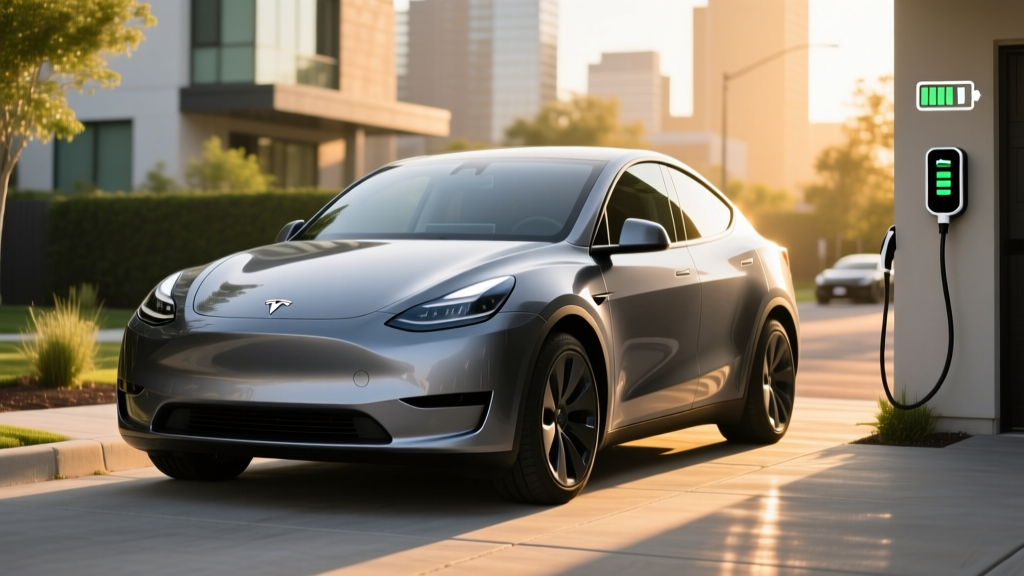
Tesla's Model Y remains the best-selling electric vehicle in the United States, but buyers in 2026 are asking a sharper question than range or performance: how much value will this car lose? The depreciation of Tesla vehicles — and the Model Y in particular — has shifted dramatically since the price wars of 2023-2024 reshaped the used-EV market. This review pairs a full spec-and-drive profile of the 2026 Tesla Model Y (the refreshed "Juniper" generation) with a hard look at what ownership actually costs when resale value enters the equation.
If you're cross-shopping the Model Y against the Hyundai Ioniq 5, Ford Mustang Mach-E, or the growing field of mid-size electric crossovers, you need more than EPA stickers. You need real-world range honesty, charging-curve reality, tax-credit precision, and a clear-eyed depreciation forecast. That's what follows.
2026 Tesla Model Y: Quick Verdict
The refreshed Model Y (internally called "Juniper") carries over the core formula — industry-leading efficiency, access to the Supercharger network (now universally NACS), and strong performance — while adding a quieter cabin, ventilated seats, a rear touchscreen, and ambient lighting that the pre-2025 models lacked. Starting at $44,990 for the Long Range AWD (the RWD base trim was discontinued for the Juniper generation in the US), it competes squarely with the Ioniq 5 Limited ($52,000) and Mach-E Premium ($48,995) on price, while undercutting the BMW iX and Mercedes EQB on luxury.
The depreciation story in 2026 is more favorable than in 2023-2024, when aggressive Tesla price cuts cratered used values. With pricing now stabilized and the Juniper refresh resetting the product cycle, 5-year depreciation projections sit closer to industry norms — though still steeper than a Toyota RAV4 Hybrid.
Range, Battery, and Real-World Efficiency
| Spec | Value |
|---|---|
| EPA Range | 320 miles |
| Battery Capacity (usable) | ~78 kWh (NMC) |
| Battery Chemistry | Nickel Manganese Cobalt (NMC) |
| EPA Efficiency | 122 MPGe combined / 28 kWh/100mi |
| Drivetrain | Dual-Motor AWD |
| Horsepower | 384 hp |
| 0-60 mph | 4.8 seconds |
| Cargo Volume (rear seats up / folded) | 30.2 / 72.1 cu ft |
| Rear Legroom | 41.6 in |
| Battery & Drive Unit Warranty | 8 years / 120,000 miles |
| Base MSRP | $44,990 |
EPA vs. Real-World Range
EPA sticker: 320 miles. In real-world highway driving at 70-75 mph in moderate temperatures (60-75°F), expect ~270-290 miles before needing to charge. In winter conditions (below 30°F), range drops to approximately 230-260 miles due to battery heating demands and cabin climate load. The Model Y's heat pump helps mitigate cold-weather loss compared to older EVs without one, but physics still applies. City driving with heavy regenerative braking can exceed the EPA figure, occasionally reaching 330+ miles in stop-and-go traffic at moderate speeds.
Source: fueleconomy.gov EPA estimates; real-world figures from independent EV testing and owner data aggregation.
The Juniper Model Y uses an NMC (nickel manganese cobalt) battery pack, which offers higher energy density than LFP (lithium iron phosphate) chemistry. This means more range in a lighter package, but NMC cells are more sensitive to sustained high states of charge. Tesla recommends daily charging to 80-90% for NMC packs and 100% only for longer trips — a nuance that matters for depreciation, since battery health directly influences resale value.
Charging Speed: DC Fast, Level 2, and the Supercharger Advantage
| Charging Level | Power / Rate | Miles Added per Hour | Notes |
|---|---|---|---|
| Level 1 (120V household) | ~1.4 kW | ~4-5 mi/hr | Emergency/trickle only |
| Level 2 (240V home, 48A) | 11.5 kW | ~44 mi/hr | Full charge in ~7-8 hours |
| DC Fast Charge (peak) | 250 kW (V3 Supercharger) | ~1,000 mi/hr (peak) | 10-80% in ~25 minutes |
| DC Fast Charge (V4 Supercharger) | Up to 250 kW (Model Y limited) | Similar to V3 | V4 architecture; Model Y doesn't reach 350 kW |
The Model Y Long Range AWD peaks at 250 kW on a V3 or V4 Supercharger, adding roughly 200 miles in 15 minutes under ideal conditions. However, the charging curve tapers significantly above 50% state of charge — a 10-80% session takes approximately 25 minutes, but pushing from 80-100% adds another 20+ minutes. This taper is standard for NMC chemistry and is managed by the vehicle's thermal system.
At home on a Level 2 Tesla Wall Connector (48 amps / 11.5 kW), the Model Y adds about 44 miles of range per hour of charging. A full overnight charge from 20% to 90% takes roughly 5-6 hours, which suits most commuters perfectly. Home charging installation typically costs $800-$2,000 for a standard 60-amp circuit, though older homes may need a panel upgrade adding $1,500-$3,000.
The Supercharger network remains Tesla's strongest ownership advantage. With over 6,000 V3/V4 stalls in the US and increasingly reliable uptime, road-trip charging is measurably less stressful than relying on third-party CCS networks — though Electrify America and others have improved substantially since 2024.
Depreciation of Tesla Model Y: 5-Year Ownership Cost Breakdown
Depreciation is the single largest cost of vehicle ownership, and EVs have historically depreciated faster than comparable gas vehicles due to rapid tech iteration, price volatility, and battery-health concerns. Here's where the Model Y stands in 2026:
| Year | Estimated Value | Annual Depreciation | Cumulative Loss |
|---|---|---|---|
| Year 0 (purchase) | $44,990 | — | — |
| Year 1 | ~$37,340 | ~$7,650 (17%) | $7,650 (17%) |
| Year 2 | ~$31,490 | ~$5,850 (13%) | $13,500 (30%) |
| Year 3 | ~$26,090 | ~$5,400 (12%) | $18,900 (42%) |
| Year 4 | ~$21,590 | ~$4,500 (10%) | $23,400 (52%) |
| Year 5 | ~$18,440 | ~$3,150 (7%) | $26,550 (59%) |
Key depreciation context:
- Pre-2024 vs. post-2024: Model Y vehicles purchased in 2022-2023 at inflated prices ($55,000-$65,000) saw catastrophic depreciation — some losing 40%+ in a single year after Tesla's price cuts. The 2026 Juniper at $44,990 starts from a more realistic baseline, reducing the risk of a similar collapse.
- Compared to competitors: The Hyundai Ioniq 5 and Ford Mach-E show similar 5-year depreciation curves (55-65% loss). The Toyota RAV4 Hybrid, by contrast, retains roughly 55-60% of its value after 5 years — a significant advantage for buyers prioritizing resale.
- Battery health factor: Tesla's NMC packs typically retain 85-90% capacity after 100,000 miles based on fleet data. A Model Y with documented battery health (visible in the Tesla app's degradation graph) commands a premium on the used market.
- Tech obsolescence risk: The Juniper refresh resets the clock — a 2026 model won't look outdated next to a 2027 the way a 2023 pre-refresh Model Y did next to the Juniper. This helps stabilize near-term depreciation.
Pricing, Trims, and Federal Tax Credit Eligibility
The 2026 Tesla Model Y is available in two primary trims in the US market:
- Long Range AWD: $44,990 — 320 miles EPA, dual-motor, 384 hp
- Performance AWD: $48,990 — 293 miles EPA, dual-motor, 510 hp, 0-60 in 3.5 seconds, track mode
Both trims fall under the $55,000 MSRP cap for SUVs under the IRS §30D federal tax credit. However, eligibility depends on several factors that change annually:
- Buyer income caps: Modified AGI must not exceed $150,000 (single), $225,000 (head of household), or $300,000 (joint filers)
- Battery sourcing requirements: As of 2026, 100% of critical minerals and 100% of battery components must meet North American sourcing or free-trade-agreement requirements to qualify for the full $7,500. Tesla has worked to localize its supply chain, but trim-level eligibility can shift mid-year.
- Point-of-sale transfer: The credit can now be applied at purchase as a down-payment reduction, rather than waiting for a tax refund — a significant cash-flow advantage.
Always verify current eligibility at IRS.gov §30D before purchasing, as battery-sourcing compliance is updated periodically by the Treasury Department.
If eligible, the effective price of the Long Range AWD drops to approximately $37,490 — a figure that dramatically improves the depreciation equation, since your cost basis is lower from day one.
Interior, Technology, and Driver Assistance
The Juniper refresh addressed the Model Y's most common complaints: cabin noise, ride harshness, and the austerity of the minimalist interior. The 2026 model features:
- 15.4-inch front touchscreen with faster processor, improved navigation, and Netflix/YouTube streaming while parked
- 8-inch rear touchscreen for rear-seat climate and entertainment control (new for Juniper)
- Ventilated front seats (previously absent and widely criticized)
- Ambient lighting across the dashboard and door panels
- Acoustic glass on all windows, reducing highway noise by roughly 4-6 dB vs. pre-2025 models
- Power-folding second row (60/40 split) with improved cargo access
On the driver-assistance front, every Model Y includes Tesla Autopilot (SAE Level 2) as standard — adaptive cruise control, lane centering, and automatic emergency braking. The optional Full Self-Driving (Supervised) package ($8,000 one-time or $99/month) adds automated lane changes, traffic-light recognition, and city-street navigation. It is critical to understand: FSD Supervised is not autonomous driving. It is a Level 2 system that requires continuous driver attention and hands-on-wheel confirmation. Tesla's naming is aspirational; the SAE Level 2 designation means the driver is always responsible.
Driver Assistance Limitations
Tesla Autopilot and FSD (Supervised) are SAE Level 2 driver-assistance systems. They do not make the vehicle self-driving. You must remain alert, keep your hands on the wheel, and be prepared to take over at any moment. Performance degrades in heavy rain, construction zones, faded lane markings, and unmapped roads. Never use these systems while fatigued or distracted.
Pros, Cons, and Who the Model Y Suits Best
Pros
- Class-leading efficiency (122 MPGe combined) means lower charging costs per mile than any competitor
- Supercharger network access provides the most reliable road-trip charging experience available
- Over-the-air updates continuously add features — the car improves after purchase
- Strong performance (4.8s 0-60) in a practical family crossover package
- Spacious cargo area (72.1 cu ft with seats folded) and usable frunk
- Juniper refresh fixes cabin noise, seat comfort, and rear-seat tech complaints
- 8-year/120,000-mile battery warranty provides long-term peace of mind
Cons
- Depreciation remains steeper than a Toyota RAV4 Hybrid or Honda CR-V Hybrid
- No physical buttons for climate, wipers, or glovebox — everything routes through the touchscreen
- 250 kW peak DC charging is slower than the Hyundai Ioniq 5's 800V architecture (350 kW capable)
- NMC battery requires 80-90% daily charge limit; not ideal for owners who want to charge to 100% daily (LFP is better for that)
- FSD (Supervised) is expensive ($8,000) and still requires full driver engagement
- Insurance premiums run 15-25% higher than comparable gas crossovers in most states
- Minimal dealer/service-center footprint compared to legacy automakers
Who Should Buy the 2026 Model Y?
The Model Y is best suited for: tech-forward families and commuters who have access to home Level 2 charging, drive 20-60 miles daily with occasional 200+ mile road trips, and value efficiency and software features over traditional luxury materials. It's also a strong pick for current Tesla owners upgrading from a Model 3 who need more cargo space.
It's less ideal for: buyers in extreme cold climates (below 0°F regularly), those without home charging access who would rely entirely on public infrastructure, or anyone who prioritizes maximum resale value retention above all else.
Depreciation of Tesla vs. Key Competitors
When evaluating the depreciation of Tesla against its direct competitors, the picture in 2026 is more competitive than in prior years:
- 2026 Hyundai Ioniq 5 (Long Range AWD): MSRP ~$52,000, 5-year depreciation ~58-63%. Higher starting price means more absolute dollars lost, though percentage is similar.
- 2026 Ford Mustang Mach-E (Premium AWD): MSRP ~$48,995, 5-year depreciation ~60-65%. Ford's EV division has struggled with demand consistency, pressuring used values.
- 2026 Toyota RAV4 Hybrid (XLE AWD): MSRP ~$36,500, 5-year depreciation ~40-45%. The gold standard for value retention, though it's a hybrid — not a BEV.
- 2026 BMW iX (xDrive50): MSRP ~$87,000, 5-year depreciation ~60-65%. Luxury EVs depreciate heavily in percentage terms, but the buyer demographic is less sensitive to this.
The Model Y's depreciation advantage over the Ioniq 5 and Mach-E comes from Tesla's brand recognition in the used-EV market, the Supercharger ecosystem, and OTA update longevity. Its disadvantage versus the RAV4 Hybrid comes from the inherent tech-obsolescence risk of any battery-electric vehicle in a rapidly evolving market.
Frequently Asked Questions
What is the real-world range of the 2026 Tesla Model Y?
The EPA rates the Long Range AWD at 320 miles. In real-world highway driving at 70+ mph, expect 270-290 miles. In winter (below 30°F), plan for 230-260 miles. City driving with regenerative braking can exceed the EPA figure.
How fast does the Model Y charge at home and on DC fast chargers?
On a home Level 2 charger (11.5 kW / 48A), it adds ~44 miles per hour, fully charging overnight. On a V3 Supercharger at 250 kW peak, 10-80% takes approximately 25 minutes. The charge curve tapers above 50% SoC, so the last 20% takes significantly longer.
How much does the Model Y cost after the federal tax credit?
The Long Range AWD starts at $44,990. If you qualify for the full $7,500 §30D credit (meeting income caps, MSRP limits, and battery-sourcing requirements), the effective price drops to ~$37,490. Verify eligibility at IRS.gov before purchase, as sourcing rules update periodically.
Does the 2026 Tesla Model Y qualify for the $7,500 federal EV tax credit?
It can, but eligibility depends on your income (≤$150K single / ≤$300K joint), the vehicle's MSRP (under $55K for SUVs — both trims qualify), and current battery-sourcing compliance. Tesla's North American battery sourcing has improved, but always confirm at the point of sale. The credit can be transferred at purchase as a down-payment reduction.
Is the Model Y worth buying vs. the Ioniq 5 or Mach-E in 2026?
If you prioritize charging network reliability, efficiency, and software features, the Model Y wins. If you prefer physical buttons, 800V ultra-fast charging (Ioniq 5), or a more traditional dealership service experience, the competitors have merit. On depreciation specifically, all three BEVs lose 55-65% over 5 years — the differentiator is the lower effective purchase price after tax credits and Tesla's stronger used-market brand recognition.
What are the biggest factors affecting Tesla depreciation?
The four main factors are: (1) Tesla's pricing stability — sudden price cuts destroy used values, as seen in 2023; (2) battery health documentation — well-maintained packs retain value; (3) product-cycle timing — buying right after a refresh (like the Juniper) reduces near-term obsolescence risk; (4) the broader EV adoption curve — as EVs become mainstream, depreciation normalizes toward gas-car levels.
How long will the Model Y battery last?
Tesla warranties the battery for 8 years or 120,000 miles (whichever comes first) against degradation below 70% capacity. Fleet data suggests NMC packs in Tesla vehicles typically retain 85-90% capacity at 100,000 miles with proper charging habits (avoiding frequent 100% charges and deep discharges). Replacement cost, if needed out of warranty, ranges from $12,000-$16,000 depending on pack configuration.
Sources: fueleconomy.gov (EPA range and efficiency data), Tesla.com (manufacturer specifications), IRS.gov (§30D tax credit rules). Depreciation projections based on aggregated used-market data and historical trends; individual results vary by condition, mileage, market conditions, and regional demand.