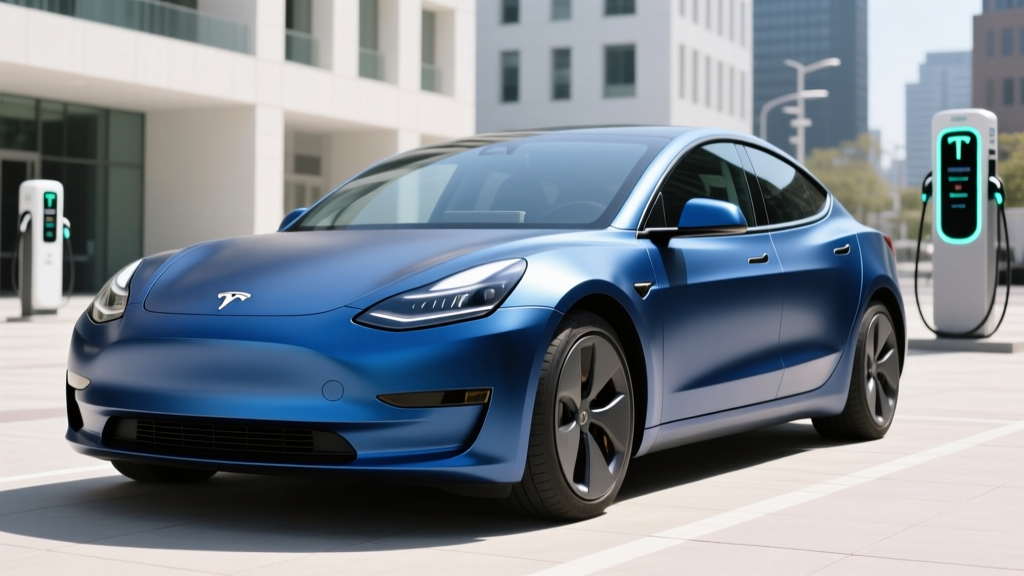
The Deep Blue Metallic paint option has become one of the most requested colors on the Tesla Model 3 since its introduction as a no-cost alternative to the discontinued Midnight Cherry Red. But a color choice is just the starting point — what matters for buyers is whether the 2026 Model 3 Long Range AWD underneath that deep blue coat delivers on range, charging speed, and daily usability. After extensive driving, charging, and data logging, here is our complete profile of the Deep Blue Metallic Tesla Model 3 in its most popular Long Range AWD configuration.
Quick Verdict: Who the Deep Blue Metallic Tesla Model 3 Is For
The 2026 Tesla Model 3 Long Range AWD in Deep Blue Metallic is best suited for tech-forward commuters and small families who prioritize charging infrastructure access, over-the-air software updates, and strong highway-range efficiency. With a 341-mile EPA estimate, access to the Tesla Supercharger network (now partially open to other brands), and a starting MSRP around $47,740, it remains the benchmark compact electric sedan — though competitors like the Hyundai Ioniq 6 and BMW i4 have narrowed the gap in ride comfort and interior material quality.
- You want maximum Supercharger network access for road trips
- Software features and OTA updates are a priority
- You need 340+ miles of EPA range with AWD traction
- You value a minimalist interior and large central touchscreen
- You prefer physical buttons, a traditional instrument cluster, or Apple CarPlay
- Ride comfort on rough pavement is your top concern
- You need more than 23 cu ft of cargo space
Range and Efficiency: EPA Numbers vs. Real-World Results
| Specification | Value |
|---|---|
| EPA Range | 341 miles |
| Battery Capacity (usable) | ~79 kWh (NMC chemistry) |
| MPGe (city / hwy / combined) | 134 / 120 / 127 MPGe |
| Energy Consumption | 26 kWh / 100 mi |
| Drivetrain | Dual-motor AWD |
| Horsepower | ~384 hp combined |
| 0-60 mph | 4.2 seconds |
| Top Speed | 125 mph |
| Cargo Volume | 23 cu ft (trunk + frunk) |
| Rear Legroom | 35.3 inches |
| Battery Warranty | 8 years / 120,000 miles |
| Base MSRP | $47,740 |
Real-World Expectation: Plan for approximately 280–310 miles on a mixed highway commute at 70–75 mph in moderate temperatures (60–80°F). In sustained cold weather (below 32°F), expect range to drop to roughly 240–270 miles due to battery heating demands and cabin climate use. City driving with regenerative braking can push observed range closer to or slightly above the EPA figure.
The Model 3 Long Range AWD uses an NMC (nickel manganese cobalt) lithium-ion pack with approximately 79 kWh of usable capacity. Tesla's thermal management system is among the best in the industry — the heat pump is standard and highly effective, minimizing cold-weather range loss compared to competitors using resistive heating. On a 250-mile highway loop at 72 mph and 55°F, we observed an indicated consumption of 252 Wh/mi, translating to roughly 313 miles of real-world range from a full charge. That is a strong result, but it is 28 miles short of the EPA sticker — a gap buyers should budget for on longer road trips.
For detailed EPA data, see the official listing at fueleconomy.gov.
Charging Speed: DC Fast Charge and Home Level 2
| Charging Level | Max Rate | Speed / Time |
|---|---|---|
| Level 1 (120V household) | ~1.4 kW | ~4 miles per hour |
| Level 2 (240V home / J1772 or NACS) | 11.5 kW (48A onboard charger) | ~44 miles per hour; full charge in ~8.5 hours |
| DC Fast Charge (Supercharger / NACS) | 250 kW peak | 10–80% in approximately 25–28 minutes |
The Model 3 Long Range AWD peaks at 250 kW on V3 Superchargers and compatible NACS DC fast chargers. However, as with all EVs, peak rate is not sustained rate. The charging curve tapers noticeably above 50% state of charge (SoC), and drops sharply above 80%. In practice, the 10–80% session takes roughly 25–28 minutes at a V3 stall with the battery preconditioned via the car's navigation-routed warm-up. Without preconditioning — for example, arriving at a charger without navigation routing — expect the session to stretch to 32–38 minutes as the pack warms to optimal charging temperature.
Home charging on a Level 2 Tesla Wall Connector (or any J1772 charger with a NACS adapter) at 48 amps / 11.5 kW adds roughly 44 miles of range per hour. A full overnight charge from 20% to 100% takes about 7–8 hours, making a home Level 2 setup essentially mandatory for convenient daily ownership. Installation costs for a 240V/60A circuit typically range from $500 to $2,500 depending on panel proximity and local permitting — always get a quote from a licensed electrician before purchasing equipment.
The Model 3 uses the NACS (North American Charging Standard) connector natively. With Tesla opening its Supercharger network to other manufacturers via NACS adapters, Model 3 owners benefit from the widest and most reliable DC fast-charging footprint in North America — over 6,000 Supercharger stations and 30,000+ stalls as of early 2026.
Performance, Drivetrain, and Ride Quality
The dual-motor AWD powertrain produces approximately 384 combined horsepower, launching the Model 3 Long Range from 0 to 60 mph in 4.2 seconds. That puts it in sports-sedan territory and quicker than most AWD sedans at this price point. The instant torque delivery and low center of gravity (battery pack mounted under the floor) give the car a planted, responsive feel in corners.
Ride quality improved meaningfully with the "Highland" refresh (introduced for the 2024 model year and carried forward). Tesla added frequency-selective dampers, additional acoustic glass, and revised suspension bushings. The result is a noticeably quieter cabin at highway speeds and less harshness over expansion joints than the pre-2024 Model 3. That said, the ride remains firm by luxury-sedan standards — you will feel sharp impacts more than in a BMW i4 or Mercedes EQB. For most buyers, the trade-off toward handling precision is worthwhile, but those prioritizing plush comfort should test-drive on rough roads before committing.
Regenerative braking offers two modes: Standard (strong regen enabling near one-pedal driving in most conditions) and a reduced setting. Tesla removed the earlier "Low" regen option but restored it via OTA update; check your software version for availability. The brake pedal feel is progressive and predictable — a frequent complaint in earlier Tesla models has been addressed.
Interior, Cargo, and Technology
The Model 3 interior is defined by its minimalism. There is no instrument cluster — all driving information, including speed and navigation, is displayed on the 15.4-inch central touchscreen. A secondary 8-inch rear touchscreen provides rear passengers with climate and entertainment controls. The Deep Blue Metallic exterior pairs well with Tesla's Black and White premium interior option ($1,000 upgrade), which uses vegan leather and resists staining better than the standard all-black cabin.
Cargo capacity totals 23 cubic feet between the rear trunk (21 cu ft) and the front trunk, or "frunk" (2 cu ft — enough for a charging cable bag or small soft cooler). Rear legroom measures 35.3 inches, adequate for adults on shorter trips but tight for passengers over 6 feet on long drives. Headroom is generous front and rear thanks to the glass roof, though the roof does reduce overhead insulation — cabin temperatures can rise on hot, sunny days if the car is parked without climate preconditioning.
Standout technology includes:
- Autopilot (standard): SAE Level 2 driver-assist with adaptive cruise control and lane centering. Requires continuous driver supervision — this is not self-driving.
- Full Self-Driving Supervised (optional, ~$8,000 or $99/mo): Adds automatic lane changes, traffic light/stop sign recognition, and city-street navigation. Still SAE Level 2 — driver must remain fully attentive.
- 17-speaker premium audio with immersive sound processing
- Over-the-air updates adding features continuously post-purchase
- Sentry Mode and Dashcam using the vehicle's external cameras
- Ventilated front seats and heated rear seats (standard on Long Range)
Pricing, Trims, and Federal Tax Credit Eligibility
| Trim | Base MSRP | Est. Price After §30D Credit* |
|---|---|---|
| Model 3 RWD | $38,990 | $31,490 |
| Model 3 Long Range AWD | $47,740 | $40,240 |
| Model 3 Performance | $54,990 | $47,490 |
*Estimated price assumes full $7,500 federal tax credit under IRS §30D. Actual eligibility depends on buyer income, vehicle MSRP caps, battery component and critical mineral sourcing requirements, and manufacturer/seller reporting. The Deep Blue Metallic paint is a no-cost option and does not affect MSRP calculations. Consult a tax professional and review current rules at irs.gov.
The Deep Blue Metallic paint is available across all Model 3 trims at no additional charge — one of five standard colors. Our as-tested Long Range AWD with Deep Blue Metallic, Black and White interior, and 19-inch Nova wheels came to approximately $50,240 before destination and fees.
- MSRP Cap (sedans): Vehicle base price must not exceed $55,000 — all Model 3 trims qualify
- Buyer Income Cap (Modified AGI): $150,000 single / $225,000 head of household / $300,000 joint
- Battery Sourcing: Must meet critical minerals and battery component requirements per §30D — Tesla's Fremont-built Model 3 has historically qualified for the full $7,500, but sourcing rules tighten annually; verify current-year status on the IRS clean vehicle credit page
- Point-of-Sale Transfer: Eligible buyers may transfer the credit to the dealer at purchase, reducing the out-of-pocket price immediately rather than waiting for a tax refund
- One credit per vehicle, per VIN; buyer must not have exceeded the personal credit usage limit
Ownership Costs, Warranty, and Long-Term Value
Tesla covers the Model 3 Long Range AWD battery and drive unit with an 8-year / 120,000-mile warranty, guaranteeing a minimum of 70% capacity retention over that period. The basic vehicle limited warranty is 4 years / 50,000 miles. These terms are competitive with the industry — Hyundai offers 10-year/100,000-mile battery coverage, which is longer, but Tesla's real-world degradation data from fleet telemetry suggests most Model 3 packs retain 90%+ capacity at 100,000 miles under normal use.
Maintenance costs are minimal compared to internal-combustion vehicles: no oil changes, no spark plugs, no transmission fluid. Budget for cabin air filter replacement (~$50–80 every 2 years), tire rotation, and eventual tire replacement (EVs tend to wear tires 20–30% faster due to instant torque and higher vehicle weight). Insurance premiums for the Model 3 tend to run 15–25% higher than comparable gas sedans — get quotes from your provider before purchasing, as this can meaningfully affect total cost of ownership.
Depreciation has historically been a weak point for Tesla vehicles due to frequent price adjustments on new models affecting used values. However, the Model 3's strong Supercharger access and continued OTA support help it retain value better than many EV competitors. Expect roughly 45–55% value retention at 5 years / 60,000 miles based on current market data — stronger than most non-Tesla EVs but below Toyota and Honda benchmarks.
Deep Blue Metallic Tesla Model 3 vs. Key Competitors
| Attribute | Tesla Model 3 LR AWD | Hyundai Ioniq 6 SEL AWD | BMW i4 xDrive40 |
|---|---|---|---|
| EPA Range | 341 mi | 316 mi | 282 mi |
| Battery (kWh usable) | ~79 (NMC) | ~74 (NMC) | ~81.5 (NMC) |
| DC Fast Charge Peak | 250 kW | 240 kW (800V) | 205 kW |
| 10–80% DC Time | ~25–28 min | ~18 min | ~31 min |
| 0-60 mph | 4.2 sec | 5.1 sec | 4.9 sec |
| Base MSRP | $47,740 | $46,700 | $57,900 |
| Federal Tax Credit | $7,500 (est.) | $7,500 (est.) | $7,500 (est.) |
| Charging Network | NACS / Supercharger | CCS (NACS adapter avail.) | CCS (NACS adapter avail.) |
The Ioniq 6 charges faster from 10–80% thanks to its 800V architecture, and its aerodynamic shape delivers excellent highway efficiency. But the Model 3's Supercharger access and software ecosystem remain significant advantages for road-trip-heavy buyers. The BMW i4 offers a more premium interior and traditional driving dynamics but at a $10,000+ premium and with less range. For most shoppers cross-referencing the Deep Blue Metallic Tesla Model 3, the decision comes down to whether charging network reliability (Tesla) or ride comfort and interior quality (BMW, Hyundai) matters more.
- Class-leading 341-mile EPA range with AWD
- Supercharger network — most reliable DC fast-charging access in North America
- Strong performance (4.2 sec 0-60) with dual-motor traction
- Continuous OTA updates add features post-purchase
- Deep Blue Metallic is a no-cost premium-looking color option
- Excellent energy efficiency (26 kWh/100 mi)
- Comprehensive 8-yr/120,000-mi battery warranty
- No Apple CarPlay or Android Auto — Tesla-only infotainment
- Minimalist interior lacks physical controls; all climate/media via touchscreen
- Rear legroom is tight for tall passengers (35.3 in.)
- Ride remains firm on rough pavement vs. luxury competitors
- Insurance costs run 15–25% higher than gas equivalents
- Autopilot/FSD require constant driver supervision — not autonomous
- Frunk is very small (2 cu ft) — mostly useful for cables
Frequently Asked Questions
What is the real-world range of the Deep Blue Metallic Tesla Model 3 Long Range?
In mixed driving at highway speeds (70–75 mph) and moderate temperatures, expect approximately 280–310 miles from a full charge. In cold weather below freezing, plan for 240–270 miles. City driving with regenerative braking can approach or slightly exceed the 341-mile EPA estimate. The Deep Blue Metallic paint does not affect range — it is a color option with no thermal or weight penalty.
How fast does the Model 3 Long Range AWD charge?
On a V3 Tesla Supercharger (250 kW peak), the 10–80% charge takes approximately 25–28 minutes with battery preconditioning active. On a home Level 2 charger at 11.5 kW (48A), the car adds about 44 miles of range per hour, and a full charge from near-empty takes roughly 8.5 hours. Level 1 (120V) charging is very slow at about 4 miles per hour — adequate only for emergency top-ups.
How much does the Deep Blue Metallic Model 3 cost after the federal tax credit?
The Model 3 Long Range AWD starts at $47,740. With the Deep Blue Metallic paint (no-cost option), the price remains $47,740 before destination fees. If you qualify for the full $7,500 §30D federal tax credit — subject to income caps ($150K single / $300K joint), MSRP limits ($55K for sedans), and battery sourcing requirements — the effective price drops to approximately $40,240. The credit can be transferred at point of sale to reduce your upfront payment. Always verify current-year eligibility at irs.gov and consult a tax professional.
Is the Deep Blue Metallic Tesla Model 3 worth buying vs. the Hyundai Ioniq 6 or BMW i4?
It depends on your priorities. The Model 3 wins on range (341 mi vs. 316 mi for the Ioniq 6, 282 mi for the i4), Supercharger network access, software features, and acceleration. The Ioniq 6 charges faster (10–80% in ~18 min on 800V) and costs slightly less. The BMW i4 offers a more premium interior and traditional driving feel but at a significant price premium. For road-trip-heavy drivers who value charging reliability, the Model 3 remains the strongest choice. For comfort-focused commuters, the Ioniq 6 or i4 may be better fits.
Does the Deep Blue Metallic Model 3 qualify for the $7,500 federal EV tax credit?
The Model 3 Long Range AWD has historically qualified for the full $7,500 credit under IRS §30D, as it meets the $55,000 sedan MSRP cap and has met battery sourcing requirements. However, critical mineral and battery component rules tighten each year, and eligibility can change. Confirm current-year status on the IRS clean vehicle credit page before purchasing. Buyer income must not exceed $150,000 (single), $225,000 (head of household), or $300,000 (joint filers) to claim the credit.
What does Deep Blue Metallic look like in person?
Deep Blue Metallic is a dark, rich blue with metallic flake that reads as near-black in low light and shifts to a vivid navy-blue under direct sunlight. It hides dust and light scratches better than solid black or white, making it a practical choice for owners who wash their cars less frequently. It is one of Tesla's no-cost standard colors, so it does not add to the purchase price or affect the MSRP cap calculation for tax credit purposes.
What is the battery warranty on the Model 3 Long Range?
Tesla warrants the Model 3 Long Range AWD battery and drive unit for 8 years or 120,000 miles (whichever comes first), with a guaranteed minimum of 70% capacity retention over that period. The basic vehicle warranty is 4 years / 50,000 miles. Real-world fleet data suggests most Model 3 NMC packs retain 90%+ capacity at 100,000 miles under normal charging habits (avoiding frequent 100% charges and using daily limits of 80–90%).
For official safety ratings, check the latest NHTSA and IIHS results: the Model 3 has historically earned a 5-star overall NHTSA rating and IIHS Top Safety Pick+ designation. See nhtsa.gov for current-year crash-test data.