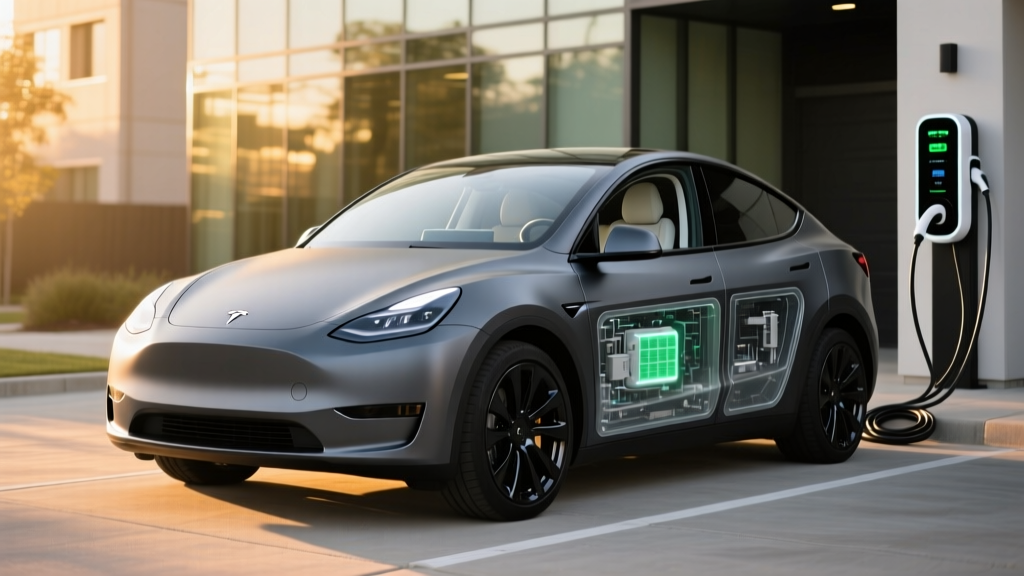
The Tesla Model Y remains the best-selling electric vehicle in the United States for good reason: it threads the needle between range, charging infrastructure, cargo practicality, and price. For 2026, the refreshed "Juniper" generation brings a quieter cabin, revised suspension tuning, updated front and rear styling, and a ventilated-seat option that was sorely missing from the pre-refresh cars. If you've been searching for a dark grey Tesla — specifically the Stealth Grey paint option that Tesla reintroduced with the Juniper update — you're looking at one of the most versatile EVs on the market. But versatility doesn't mean perfection. This review breaks down the exact numbers that matter: real-world range, charging curves, tax-credit eligibility, and where the Model Y still falls short against rivals like the Hyundai Ioniq 5 and Ford Mustang Mach-E.
2026 Tesla Model Y Stealth Grey: Quick Verdict
The Model Y Long Range AWD starts at $44,990 (before destination), and the Stealth Grey paint adds $0 — it's a standard color option for 2026, replacing the older Midnight Silver Metallic. The Performance trim sits at $48,990. Both qualify for the full $7,500 federal tax credit under IRS §30D when purchased by eligible buyers, bringing the effective Long Range price to approximately $37,490. That positions it squarely against the Ioniq 5 Limited AWD and well below the BMW iX. The Juniper refresh sharpens an already strong package, but charging speed and interior material quality remain areas where competitors edge ahead.
| Spec | Long Range AWD | Performance AWD |
|---|---|---|
| EPA Range | 320 miles | 298 miles |
| Battery (usable) | ~78 kWh (NMC) | ~78 kWh (NMC) |
| Drivetrain | Dual-Motor AWD | Dual-Motor AWD |
| Horsepower | 384 hp | 456 hp |
| 0–60 mph | 4.8 seconds | 3.5 seconds |
| Peak DC Fast Charge | 250 kW | 250 kW |
| 10–80% DC Time | ~25 minutes | ~25 minutes |
| Level 2 Home Charge | 11.5 kW (~44 mi/hr) | 11.5 kW (~44 mi/hr) |
| MPGe (combined) | 111 MPGe | 102 MPGe |
| Cargo (rear seats up) | 30.2 cu ft | 30.2 cu ft |
| Cargo (rear seats folded) | 72.1 cu ft | 72.1 cu ft |
| Base MSRP | $44,990 | $48,990 |
| Price after $7,500 Credit | ~$37,490 | ~$41,490 |
Real-World Range: What the EPA Sticker Doesn't Tell You
EPA Estimated: 320 miles (Long Range AWD)
Real-World Highway (70 mph, 72°F): ~270–285 miles
Real-World Highway (32°F, cold weather): ~220–245 miles
City / Mixed Commute: ~295–315 miles (regen-friendly driving recovers energy)
Source: Independent testing and owner-reported data aggregated by fueleconomy.gov.
The 320-mile EPA figure is achievable in mild conditions with a mix of city and suburban driving. On a flat, 70-mph highway run in 72°F weather, expect roughly 270–285 miles before you're hunting for a charger. Cold weather is the equalizer: at freezing temperatures, lithium-ion batteries face increased internal resistance, and cabin heating (even with the Model Y's standard heat pump) draws significant energy. Plan for 220–245 miles of real range on a winter road trip.
The Juniper generation carries over the 78 kWh (usable) NMC (nickel-manganese-cobalt) battery pack. Tesla does not currently offer an LFP (lithium iron phosphate) option in the Long Range or Performance trims — the base RWD model, where available, has historically used LFP chemistry, which allows routine 100% charging without degradation concerns but sacrifices roughly 30 miles of range and adds weight.
Charging Speed: Supercharger Network Advantage and Limitations
| Charging Level | Power / Rate | Miles Added per Hour | Typical Use Case |
|---|---|---|---|
| Level 1 (120V outlet) | ~1.4 kW | ~5 mi/hr | Emergency / overnight trickle |
| Level 2 (240V, 48A home) | 11.5 kW | ~44 mi/hr | Daily home charging |
| DC Fast Charge (Supercharger V3) | Peak 250 kW | Up to ~1,000 mi/hr (at peak) | Road trips |
| DC Fast Charge (Supercharger V4) | Peak 250 kW (capped by vehicle) | Same as V3 for this vehicle | Future-proofing |
The Model Y's peak DC fast-charge rate is 250 kW, which is competitive but not class-leading — the Hyundai Ioniq 5 and Kia EV6 accept up to 350 kW on 800-volt architectures, enabling 10–80% charges in roughly 18 minutes versus the Tesla's ~25 minutes. That seven-minute gap matters on road trips when you're making multiple stops.
However, raw peak kW only tells part of the story. The Model Y's charge curve is well-managed: it sustains close to 250 kW from roughly 10% to 35% State of Charge (SoC), then tapers progressively. By 60% SoC, you're typically seeing ~120 kW; by 80%, it drops to ~60 kW. This is standard behavior for NMC packs — charging slows above 80% to protect cell longevity. Always plan road-trip stops around the 10–80% window; charging from 80–100% at a DC fast charger is painfully slow and unnecessary for most trips.
For home Level 2 charging, a Wall Connector on a 60-amp circuit delivers 11.5 kW (48 amps continuous), adding roughly 44 miles of range per hour. A full 10–100% charge takes approximately 8 hours — plug in when you get home, and you'll wake up to a full battery every morning. If your home has a standard NEMA 14-50 outlet on a 50-amp circuit, you'll get roughly 32 miles per hour at 9.6 kW.
Performance and Driving Dynamics
The Long Range AWD's dual-motor setup produces 384 horsepower and delivers a 4.8-second 0–60 mph time — quick enough to merge confidently onto any freeway and satisfying in daily driving. The Performance trim drops that to 3.5 seconds with 456 hp, which is sports-car territory in a crossover. Both use Tesla's permanent-magnet synchronous rear motor and induction front motor, enabling the front motor to freewheel (disconnect) under light-load cruising for efficiency gains.
The Juniper refresh brought a retuned suspension with frequency-selective dampers, and the difference is immediately noticeable. Pre-2025 Model Ys had a reputation for transmitting every road imperfection into the cabin. The updated car is noticeably more compliant over expansion joints and rough pavement while maintaining controlled body motions. It's still firm compared to a Hyundai Ioniq 5 or Kia EV6, but it's no longer a dealbreaker for comfort-focused buyers.
Steering is precise and quick off-center, though it lacks the natural feedback of traditional hydraulic or well-tuned electric racks. The regenerative braking system is strong — Tesla offers a "Standard" regen setting that enables near-one-pedal driving, though unlike some competitors, the regen level is not adjustable beyond a binary on/off toggle in recent software versions.
Interior, Cargo, and Technology
The Juniper interior is a meaningful step up from the pre-refresh cabin. New materials include woven textile dash accents, ambient lighting strips that run the full width of the cabin, and improved seat cushioning. The Stealth Grey exterior pairs with either the standard black interior or the optional black-and-white ($1,000), which uses a more stain-resistant vegan leather. Ventilated front seats are now standard — a feature buyers demanded for years.
Cargo space: 30.2 cubic feet behind the second row and 72.1 cubic feet with the 60/40 split rear seats folded. That's among the most generous in the compact electric SUV segment. The rear frunk (front trunk) adds roughly 4.1 cubic feet — enough for a charging cable bag and a small grocery run. The power liftgate opens wide, and the load floor is flat and low, making it easy to slide in a stroller or large boxes.
Passenger space: Rear legroom measures 41.6 inches, which is excellent for the class and accommodates rear-facing child seats without requiring the front passenger to compromise their position. Headroom is generous at 41.0 inches front and 39.4 inches rear, though the panoramic glass roof (now with a power sunshade on Juniper models) can make the cabin feel airy and spacious.
Infotainment: The 15.4-inch center touchscreen handles everything — navigation, media, climate, vehicle settings, and even the glovebox release. There are no physical buttons for climate or volume, which frustrates some buyers. The Juniper adds an 8-inch rear touchscreen for rear-seat passengers to control climate and media. Navigation is excellent, with real-time Supercharger availability and automatic route planning that includes charging stops on long trips. Over-the-air (OTA) updates continue to add features; Tesla's software remains the industry benchmark for responsiveness and capability.
Driver Assistance: Basic Autopilot (Traffic-Aware Cruise Control and Autosteer) is standard and works well on well-marked highways. Full Self-Driving (Supervised) remains a $8,000 option or $99/month subscription. Despite the name, FSD is an SAE Level 2 system — the driver must remain fully engaged, hands on or near the wheel, and eyes on the road at all times. It handles complex urban intersections and stoplights with increasing competence, but it makes errors that require immediate driver intervention. It is not autonomous driving.
Pricing, Trims, and Federal Tax Credit Eligibility
| Trim | Base MSRP | Destination | As-Tested* | Est. After §30D Credit |
|---|---|---|---|---|
| Long Range AWD | $44,990 | $1,390 | $46,380 | ~$38,880 |
| Long Range AWD (Stealth Grey + FSD) | $44,990 | $1,390 | $54,380 | ~$46,880 |
| Performance AWD | $48,990 | $1,390 | $50,380 | ~$42,880 |
*As-tested prices vary based on options. Stealth Grey paint is included at no extra cost for 2026.
The $7,500 federal EV tax credit under IRS §30D is available for the Model Y, but eligibility is not universal. Key requirements for 2026:
- MSRP Cap: The vehicle's MSRP must not exceed $80,000 for SUVs — the Model Y clears this easily.
- Buyer Income Cap: Modified Adjusted Gross Income (MAGI) must not exceed $150,000 (single), $225,000 (head of household), or $300,000 (joint filers).
- Battery Sourcing: A percentage of critical minerals and battery components must be sourced from the U.S. or free-trade-agreement countries. Tesla's Fremont and Austin-built Model Ys currently meet these thresholds for the full $7,500.
- Point-of-Sale Transfer: Eligible buyers can transfer the credit to the dealer at purchase, reducing the purchase price by $7,500 at the time of sale rather than waiting to claim it on their tax return.
Rules can change. Always verify current eligibility on IRS.gov and consult a tax professional before relying on credit amounts for purchase decisions.
Pros, Cons, and Who Should Buy
✅ Pros
- Supercharger network — still the most reliable and widespread DC fast-charging network in North America
- 320-mile EPA range is competitive and real-world-usable
- Class-leading cargo volume (72.1 cu ft folded)
- Excellent OTA software and infotainment
- Strong performance even in the non-Performance trim
- Stealth Grey is a no-cost color option
- Heat pump standard — better cold-weather efficiency
- $7,500 federal tax credit eligible (with caveats)
❌ Cons
- 250 kW peak charge rate trails 800V competitors (Ioniq 5, EV6 at 350 kW)
- No physical buttons for climate/volume — touchscreen-only
- FSD (Supervised) is expensive and still Level 2, not autonomous
- Ride quality improved but still firmer than some rivals
- No Apple CarPlay or Android Auto — Tesla-only ecosystem
- Rear visibility is compromised by the sloping roofline
- Insurance premiums tend to run 15–25% higher than comparable non-Tesla SUVs
Who this EV suits best: The Model Y in Stealth Grey is ideal for suburban families and commuters who want a practical, fast-charging electric crossover with access to the Supercharger network for road trips. If you drive 30–60 miles daily, charge at home, and take 2–4 road trips per year, the Model Y's combination of range, charging infrastructure, and cargo space is hard to beat. It's also a strong choice for Uber/Lyft drivers in EV-eligible tiers thanks to its rear-seat space and low per-mile energy cost (~$0.04–$0.06/mile on residential electricity).
Look elsewhere if: You prioritize the fastest possible DC charging (consider the Ioniq 5 or EV6), you need Apple CarPlay, you want a softer ride (Mach-E or Ioniq 5), or you want a third row (Kia EV9).
Battery Warranty and Long-Term Ownership
Tesla covers the Model Y's battery and drive unit for 8 years or 120,000 miles (Long Range/Performance), whichever comes first, with a minimum 70% capacity retention guarantee. This is competitive with the industry standard (most manufacturers offer 8 years/100,000 miles). Real-world degradation data from Tesla's own fleet reports show the average Model Y battery retains approximately 85–90% of its original capacity after 100,000 miles — well within warranty thresholds.
The NMC chemistry in the Long Range is energy-dense but benefits from daily charging habits that avoid extremes: Tesla recommends setting your daily charge limit to 80% for routine use and charging to 100% only when needed for longer trips. The vehicle's built-in battery management system (BMS) handles thermal management and cell balancing automatically.
For total cost of ownership, the Model Y benefits from minimal scheduled maintenance (no oil changes, no transmission fluid, cabin air filter replacement every 2–3 years, and tire rotations). Expect to spend roughly $0.04–$0.06 per mile on electricity at residential rates, versus $0.12–$0.16 per mile on gasoline for a comparable 25-MPG gas crossover. Over five years and 75,000 miles, that's a fuel savings of approximately $6,000–$7,500, partially offset by higher insurance costs and potentially faster tire wear due to the vehicle's weight and instant torque.
Frequently Asked Questions
What is the real-world range of the dark grey Tesla Model Y?
The 2026 Model Y Long Range AWD carries a 320-mile EPA estimate. In real-world highway driving at 70 mph in mild weather, expect 270–285 miles. In freezing temperatures, plan for 220–245 miles. City driving with regenerative braking can return closer to the EPA sticker, around 295–315 miles.
How fast does the Tesla Model Y charge at home and on the road?
At home on a Level 2 Wall Connector (11.5 kW), the Model Y adds roughly 44 miles of range per hour, with a full charge taking about 8 hours. On a Tesla Supercharger V3 or V4, it peaks at 250 kW and charges from 10–80% in approximately 25 minutes. At non-Tesla CCS chargers (using the included NACS-to-CCS adapter where supported), speeds depend on the station but are capped at the vehicle's 250 kW maximum.
Does the 2026 Model Y qualify for the $7,500 federal tax credit?
Yes, the Model Y currently qualifies for the full $7,500 under IRS §30D, provided the buyer meets income caps ($300,000 joint / $150,000 single), the MSRP is under $80,000 (it is), and the battery meets critical-mineral and component sourcing thresholds (current U.S.-built Model Ys do). The credit can be applied at point of sale. Always verify current rules at IRS.gov.
Is the dark grey Tesla Model Y worth buying over the Ioniq 5 or Mach-E?
Choose the Model Y if you value Supercharger network access, cargo capacity (72.1 cu ft), and Tesla's software ecosystem. Choose the Hyundai Ioniq 5 if faster DC charging (350 kW peak, 18-min 10–80%) and a softer ride matter more. Choose the Ford Mustang Mach-E if you prefer a more traditional interior layout with physical controls and Apple CarPlay. All three are excellent — the decision comes down to your priorities.
Is Stealth Grey a premium paint color on the 2026 Model Y?
No. For the 2026 model year, Stealth Grey is a standard no-cost color option on the Model Y, replacing the previous Midnight Silver Metallic. Premium colors like Ultra Red and Quicksilver still carry a $1,000–$2,500 upcharge depending on the trim.
How long will the Model Y battery last before needing replacement?
Based on fleet data, Tesla's NMC batteries retain 85–90% capacity at 100,000 miles. The battery is warrantied for 8 years/120,000 miles at 70% minimum retention. A full battery replacement outside of warranty currently costs between $12,000 and $16,000 depending on the pack, though most owners will never need one within the typical ownership period. Proper charging habits (daily limit of 80%, avoiding prolonged storage at 0% or 100%) extend battery life significantly.