Why a Tesla Model 3 Long Range AWD Still Anchors the EV Conversation
Entrepreneur and content creator Dan Priestley has become one of the more visible voices in the EV-influencer space, and his Tesla Model 3 Long Range All-Wheel Drive has been central to that story. Priestley's build — a dual-motor Model 3 Long Range — represents the sweet spot that Tesla has spent years refining: long EPA range, fast DC charging on the Supercharger network, and a price point that, after incentives, undercuts most premium electric sedans. Whether you follow Priestley for his business content or his EV commentary, the underlying question is the same: does the 2026 Model 3 Long Range AWD still earn its reputation as the default EV recommendation?
This review dissects the exact configuration Priestley has championed, with the hard numbers, real-world caveats, and ownership economics that marketing materials leave out.
Spec Sheet: 2026 Tesla Model 3 Long Range AWD at a Glance
| Attribute | Value |
|---|---|
| EPA Range | 363 miles |
| Real-World Range (highway, moderate temps) | ~290–320 miles |
| Real-World Range (cold weather, <32°F) | ~240–270 miles |
| Battery Capacity (usable) | ~79 kWh |
| Battery Chemistry | NMC (Nickel Manganese Cobalt) |
| Drivetrain | Dual-motor AWD |
| Horsepower | ~346 hp (combined) |
| 0–60 mph | 4.2 seconds |
| Top Speed | 125 mph |
| MPGe (combined) | 131 MPGe |
| Efficiency | 26 kWh/100 mi |
| Max DC Fast-Charge Rate | 250 kW (peak) |
| 10–80% DC Fast Charge | ~25 minutes |
| Level 2 Home Charging (11.5 kW) | ~44 mi/hr |
| Base MSRP | $47,740 |
| As-Tested (w/ FSD, paint, wheels) | ~$57,240 |
| Battery Warranty | 8 years / 120,000 miles (≥70% retention) |
| Vehicle Warranty | 4 years / 50,000 miles (basic) |
Sources: EPA / fueleconomy.gov, Tesla.com Model 3 configurator.
Range and Efficiency: The Sticker vs. Reality
EPA estimate: 363 miles.
Real-world highway (65–75 mph, 70°F): expect ~290–320 miles.
Real-world cold weather (<32°F, highway): expect ~240–270 miles — a 25–35% reduction due to battery heating demand and cabin HVAC load.
City/regenerative-heavy driving: can approach or slightly exceed EPA in mild conditions.
The Model 3 Long Range AWD's 363-mile EPA figure is among the highest of any non-luxury electric sedan sold in the US. That number is achievable, but context matters. The EPA test cycle includes substantial low-speed and regenerative-braking segments that flatter EVs. On a sustained 70-mph interstate run in moderate temperatures, you'll see closer to 300–310 miles before hitting 0% State of Charge (SoC). In sub-freezing winter conditions — particularly without preconditioning — range drops to roughly 250 miles. The heat pump Tesla introduced on the refreshed Model 3 mitigates some cold-weather loss, but physics is physics: heating an 80 kWh NMC battery and the cabin simultaneously draws serious energy.
Efficiency at 26 kWh per 100 miles (131 MPGe combined, per fueleconomy.gov) is excellent for a dual-motor AWD sedan. For comparison, the Hyundai Ioniq 6 Long Range AWD posts 129 MPGe combined, and the BMW i4 xDrive40 lands at 109 MPGe. The Model 3's low drag coefficient (~0.219 Cd) and efficient inverter tuning contribute to its class-leading efficiency.
Charging Speed: Supercharger Network and Home Setup
| Charging Level | Power (kW) | Speed |
|---|---|---|
| Level 1 (120V household outlet) | ~1.4 kW | ~3–5 mi/hr |
| Level 2 (240V, 48A Wall Connector) | 11.5 kW | ~44 mi/hr |
| Level 2 (240V, 32A mobile connector) | 7.7 kW | ~30 mi/hr |
| DC Fast Charge (V3/V4 Supercharger) | Up to 250 kW peak | 10–80% in ~25 min |
| DC Fast Charge (CCS adapter at 3rd-party) | Up to 250 kW peak | Varies by station |
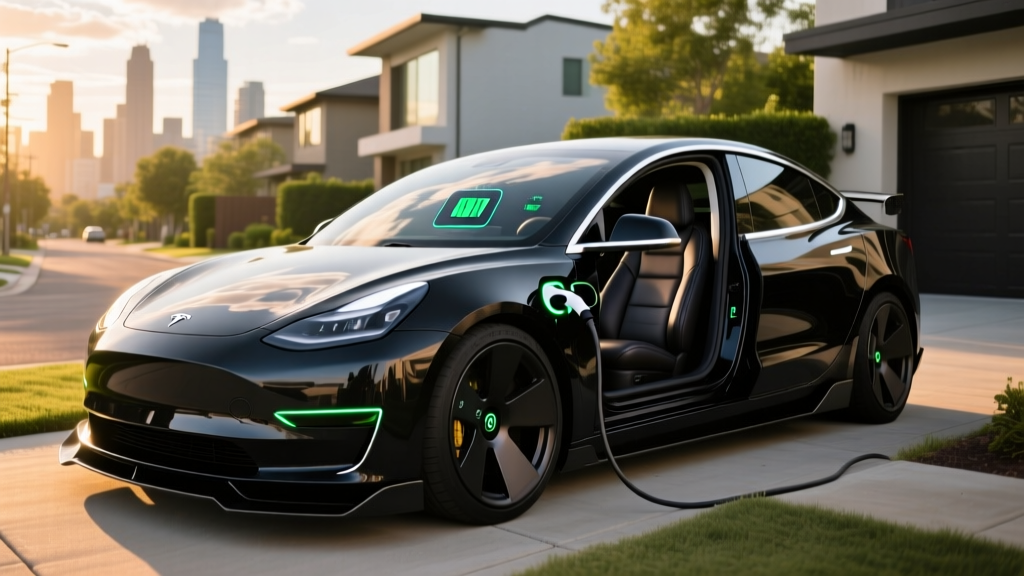
Tesla's V3 and V4 Superchargers deliver peak rates up to 250 kW to the Model 3 Long Range. In practice, you'll see 250 kW briefly between roughly 10–25% SoC, after which the charge curve tapers progressively. Sustained power from 20–80% averages closer to 140–160 kW, yielding a 10–80% session of approximately 25 minutes. This is the real number to plan road trips around — not the peak figure Tesla advertises.
Preconditioning is essential for fast charging. Navigate to a Supercharger in the car's navigation system and the battery thermal management will begin warming the pack 10–20 minutes before arrival. Skip this step (or use a third-party charger without preconditioning) and you may see peak rates capped at 100–120 kW, adding 10+ minutes to your session.
At home, the Tesla Wall Connector on a 60A circuit delivers 48A / 11.5 kW — enough to add roughly 44 miles of range per hour of charging. A full overnight charge (8 hours) replenishes ~350 miles, more than enough for daily use. Installation typically costs $500–$1,500 depending on panel proximity and local permit requirements, though older homes with 100A service panels may need a $2,000–$4,000 panel upgrade. Always consult a licensed electrician for final specs.
Performance, Ride, and Daily Drivability
The dual-motor AWD Model 3 Long Range hits 0–60 mph in 4.2 seconds with approximately 346 combined horsepower. That's brisk by any sedan standard — the BMW 330i xDrive does it in ~5.6 seconds — and the instant torque delivery makes it feel even quicker in real-world passing situations. The single-speed reduction gear means no shift lag, just linear acceleration from a stoplight to highway speed.
The 2024-refreshed "Highland" Model 3 significantly improved ride quality over the pre-refresh model. Revised dampers, new acoustic glass, and redesigned seats addressed the most common owner complaints: harsh ride over expansion joints and road noise at highway speeds. The 2026 model carries forward these refinements. Body roll is well-controlled thanks to the low center of gravity (battery pack mounted under the floor), though the sport-tuned suspension still communicates road imperfections more than a luxury sedan like the BMW i4.
Interior space is adequate for four adults: 40.3 inches of front legroom and 34.9 inches rear. Cargo volume is 23 cubic feet (trunk + frunk combined) — competitive with compact luxury sedans but less than a crossover. The minimalist interior (no physical buttons, 15.4-inch center touchscreen, rear 8-inch screen for passengers) polarizes opinion. Priestley and other creators have noted the learning curve, but most owners adapt within a week.
Tech, Driver Assistance, and SAE Automation Level
Tesla Autopilot and Full Self-Driving (Supervised) are SAE Level 2 driver-assistance systems. The driver must remain engaged, hands on or near the wheel, eyes on the road, and ready to take over at any moment. This is not self-driving. Only Level 4 services like Waymo operate without a human driver in geofenced areas.
The Model 3's infotainment runs Tesla's proprietary OS — responsive, over-the-air updatable, and tightly integrated with vehicle systems. Navigation, media, climate, and vehicle settings all flow through the central screen. The 2026 model includes AMD Ryzen processor hardware, delivering smooth UI performance and gaming capability while parked.
Autopilot (standard) provides adaptive cruise control and lane centering on marked highways. FSD (Supervised), currently a $8,000 one-time purchase or $99/month subscription, adds automatic lane changes, traffic light/stop sign recognition, and city-street navigation-assisted driving. FSD has improved substantially since 2023, but it still requires active supervision — it will occasionally misjudge construction zones, unprotected left turns, or faded lane markings. It's a convenience feature, not a replacement for attentive driving.
FSD (Supervised) does not handle all driving scenarios autonomously. Expect intervention needs in: construction zones, unmapped roads, heavy rain/snow, complex intersections, and when lane markings are absent or ambiguous. NHTSA continues to monitor Tesla's Autopilot/FSD safety record — check nhtsa.gov for current investigations.
Pricing, Tax Credits, and Total Cost
| Item | Cost |
|---|---|
| Base MSRP (Long Range AWD) | $47,740 |
| + Destination Fee | $1,390 |
| + Ultra Red paint | $2,500 |
| + 19" Nova wheels | $1,500 |
| + FSD (Supervised) | $8,000 |
| As-Tested Total | ~$61,130 |
| Federal Tax Credit (§30D, if eligible) | Up to $7,500 |
| Effective Price (after max credit) | ~$40,240–$53,630 |
The federal EV tax credit under IRS §30D offers up to $7,500, but eligibility is not automatic. The Model 3 Long Range AWD has historically qualified, but qualification depends on several factors that change periodically:
- MSRP cap: Sedans must be under $55,000 MSRP (including destination). The base Long Range AWD at $47,740 qualifies; heavily optioned builds may exceed the cap.
- Buyer income cap: Modified AGI must not exceed $150,000 (single), $225,000 (head of household), or $300,000 (married filing jointly).
- Battery sourcing: The credit splits into two halves — $3,750 for critical-minerals sourcing and $3,750 for battery-component manufacturing. Sourcing requirements tighten annually; check IRS.gov §30D rules for current-year eligibility before purchasing.
- Point-of-sale transfer: As of 2024, eligible buyers can transfer the credit to the dealer at purchase, reducing the out-of-pocket price immediately rather than waiting for tax filing.
For Priestley's typical build — a Long Range AWD with a few cosmetic options and no FSD — the MSRP usually stays under $55,000, preserving credit eligibility. Adding FSD pushes the as-tested price well above the cap, which is worth considering before checking that box.
Consult a tax professional to confirm your personal eligibility. Rules are subject to legislative change.
Pros and Cons: An Honest Assessment
- Class-leading 363-mi EPA range in the AWD sedan segment
- 250 kW Supercharger network — most reliable DC fast-charging ecosystem in the US
- 131 MPGe combined — among the most efficient dual-motor EVs available
- 4.2-sec 0–60 with instant torque, no performance degradation in daily use
- OTA updates continuously add features and refinements
- Strong resale value relative to EV segment average
- Highland refresh fixed the most common ride/NVH complaints
- $7,500 federal credit eligibility (base configuration, income permitting)
- Minimalist interior lacks physical controls — climate, mirrors, glovebox all on-screen
- Rear seat space tight for taller passengers (34.9" legroom)
- No Apple CarPlay or Android Auto — Tesla ecosystem only
- FSD ($8,000) pushes MSRP past $55K tax-credit cap
- NMC battery chemistry: Tesla recommends 80% daily charge limit (not 100% like LFP)
- No heads-up display
- Insurance premiums run 15–30% above comparable gas sedans
- Turn-signal stalks removed in Highland refresh — steering-wheel buttons instead
Who Should Buy This EV — and Who Shouldn't
Choose the Model 3 Long Range AWD if:
- You want maximum range in an AWD electric sedan under $50K
- You road-trip regularly and want access to the Supercharger network
- You value efficiency (low kWh/100mi) and fast home charging
- You're comfortable with a screen-centric interior and Tesla's ecosystem
- You qualify for the §30D credit and keep MSRP under $55K
- You need a spacious rear seat for adult passengers or car seats (consider Model Y or Ioniq 5)
- You require Apple CarPlay / Android Auto integration
- You prefer physical buttons and traditional vehicle controls
- You want a 100% daily-charge LFP battery (the RWD Model 3 uses LFP but has less range and no AWD)
- You tow — the Model 3 is not rated for towing
Priestley's use case — a tech-forward professional who commutes, creates content, and road-trips — is exactly the profile the Model 3 Long Range AWD serves best. The range handles most daily driving without charging, Supercharger access makes long trips practical, and the performance is a daily bonus. For families needing more cargo space, the Model Y Long Range is the logical step up. For buyers who prioritize interior luxury and don't mind a smaller charging network, the BMW i4 eDrive40 or Hyundai Ioniq 6 are worthy alternatives.
Frequently Asked Questions
What is the real-world range of the Tesla Model 3 Long Range AWD?
The EPA rates it at 363 miles. In real-world highway driving at 70 mph in moderate temperatures, expect 290–320 miles. In cold weather (below freezing), plan for 240–270 miles. City driving with regenerative braking can approach the EPA figure in mild conditions.
How fast does the Model 3 Long Range charge?
On a V3/V4 Supercharger, it peaks at 250 kW and charges from 10–80% in approximately 25 minutes. At home on a 48A Level 2 Wall Connector, it adds ~44 miles of range per hour (11.5 kW). A full overnight charge easily covers a week of commuting.
How much does the Model 3 Long Range AWD cost after tax credits?
Base MSRP is $47,740 plus $1,390 destination. If you qualify for the full $7,500 federal credit under §30D (income limits, MSRP cap under $55K, battery-sourcing compliance), the effective price drops to approximately $40,630. Options like premium paint or larger wheels add to the price but keep you under the cap. FSD ($8,000) pushes the total past $55K, potentially disqualifying you from the credit.
Does the Model 3 Long Range AWD qualify for the $7,500 federal EV tax credit?
The base configuration qualifies, provided the buyer meets IRS income caps ($150K single / $300K joint) and the vehicle's battery sourcing meets the current-year critical-minerals and component-manufacturing requirements. Always verify on IRS.gov before purchasing, as sourcing rules tighten annually.
Is the Model 3 Long Range AWD worth buying vs. competitors?
Against the Hyundai Ioniq 6 (361 mi EPA, $49,500 base), the Model 3 offers a slightly larger Supercharger network advantage and marginally better efficiency. Against the BMW i4 xDrive40 (282 mi EPA, $57,900 base), the Model 3 delivers far more range at a lower price, though the BMW wins on interior quality and traditional luxury. The Model 3 Long Range AWD remains the best all-around value in its segment for buyers who prioritize range and charging infrastructure.
What battery chemistry does the Model 3 Long Range use, and how should I charge it?
The Long Range AWD uses NMC (Nickel Manganese Cobalt) chemistry with approximately 79 kWh usable capacity. Tesla recommends setting the daily charge limit to 80% to preserve long-term battery health, charging to 100% only when needed for long trips. This differs from the RWD Model 3, which uses LFP chemistry and can be charged to 100% daily without degradation concerns.
What is the battery warranty?
Tesla covers the Model 3 Long Range battery and drive unit for 8 years or 120,000 miles, whichever comes first, with a guaranteed minimum 70% capacity retention. If degradation drops below that threshold within the warranty period, Tesla will repair or replace the battery at no cost.