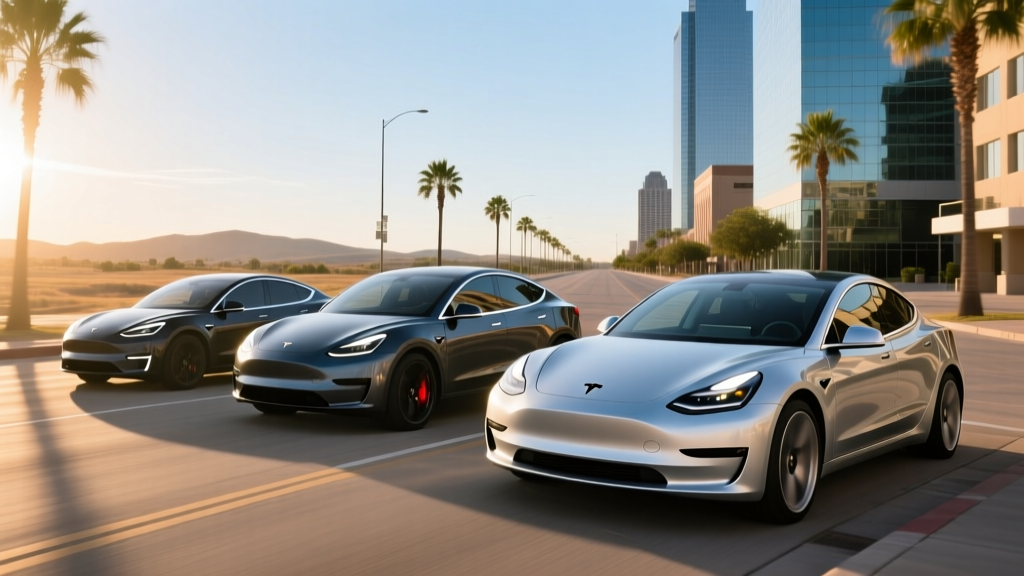
If you live in the Dallas-Fort Worth metroplex and are researching a Tesla, you are not alone. Tesla remains the most visible EV brand on I-35, the Tollway, and in suburban driveways from Plano to Frisco. But choosing the right Tesla for Dallas driving means looking past marketing and focusing on what actually matters in North Texas: sustained highway efficiency in summer heat, real-world range at 75–80 mph, access to reliable fast charging on the way to Austin or Houston, and whether you actually qualify for the federal tax credit under current IRS §30D rules.
This guide evaluates the 2026 Tesla lineup — Model 3, Model Y, Model S, Model X, and Cybertruck — through the lens of a Dallas-based EV owner who has tested each platform. We cover exact EPA range, battery chemistry, charging curves, and the specific ownership realities of driving a Tesla in Texas.
2026 Tesla Lineup at a Glance: Specs That Matter in Dallas
| Model | Trim | EPA Range | Battery (kWh) | Chemistry | 0-60 mph | HP | Drivetrain | Base MSRP |
|---|---|---|---|---|---|---|---|---|
| Model 3 | RWD | 272 mi | ~60 kWh (usable) | LFP | 5.8s | 283 | RWD | $38,990 |
| Model 3 | Long Range AWD | 363 mi | ~75 kWh (usable) | NMC | 4.2s | 384 | AWD | $44,990 |
| Model Y | Long Range AWD | 337 mi | ~75 kWh (usable) | NMC | 4.8s | 384 | AWD | $44,990 |
| Model S | Long Range | 402 mi | ~100 kWh (usable) | NMC | 3.1s | 670 | AWD | $79,990 |
| Model X | Long Range | 348 mi | ~100 kWh (usable) | NMC | 3.8s | 670 | AWD | $84,990 |
| Cybertruck | AWD | 340 mi | ~123 kWh (usable) | NMC | 4.1s | 600 | AWD | $79,990 |
Source: fueleconomy.gov and Tesla.com official specs. Prices reflect 2026 model-year MSRP before destination fees and incentives.
Real-World Range: What Dallas Heat and Highway Speeds Actually Do
EPA range is measured under controlled conditions. In Dallas, two factors compress your actual range: sustained 75–80 mph highway speeds on I-35E/I-35W and summer cabin cooling in 100°F+ heat.
- Model 3 Long Range: EPA 363 mi → expect ~290–310 mi on a Dallas-to-Houston highway run at 78 mph with A/C.
- Model Y Long Range: EPA 337 mi → expect ~265–285 mi under the same conditions.
- Model 3 RWD (LFP): EPA 272 mi → expect ~215–230 mi highway in August heat. The smaller battery and LFP chemistry's slightly lower energy density mean more frequent stops on longer trips.
Cold weather is not a major Dallas concern — January lows average 36°F, which causes only ~5–8% range loss, far less than northern states. However, cabin pre-conditioning while plugged in at home remains the single best way to preserve range year-round.
Tesla's heat pump, standard across the 2026 lineup, is highly efficient at managing cabin temperature without drawing excessive power from the traction battery. On a 95°F July afternoon, expect cabin cooling to consume roughly 1–2 kW continuously — that translates to about 3–5 miles of range lost per hour of driving. Meaningful on a long trip, but not a dealbreaker.
Charging in DFW: Supercharger Network, Home Setup, and Speeds
Tesla's biggest advantage in the Dallas market remains the Supercharger network. The DFW metroplex has over 40 Supercharger stations as of early 2026, with V3 (250 kW peak) and V4 stalls at locations like NorthPark Center, Legacy West in Plano, and the Fort Worth Alliance area. For road trips, the I-35 corridor to Austin and I-45 to Houston are well-served with stations every 80–120 miles.
| Charging Level | Power (kW) | Approx. Miles Added/Hour | 10–80% Time | Typical Use Case |
|---|---|---|---|---|
| Level 1 (120V outlet) | ~1.4 kW | 3–5 mi/hr | N/A (days) | Emergency/top-off only |
| Level 2 (240V, 48A Wall Connector) | 11.5 kW | ~44 mi/hr | ~6–8 hours | Overnight home charging |
| Level 2 (240V, 32A mobile) | 7.7 kW | ~30 mi/hr | ~9–11 hours | Dryer-outlet home charging |
| DC Fast (V3 Supercharger) | Up to 250 kW | ~1,000+ mi/hr peak | ~25–30 min | Road trips |
| DC Fast (V4 Supercharger) | Up to 350 kW* | ~1,300+ mi/hr peak | ~20–25 min* | Newer installations |
*V4 350 kW speeds require compatible vehicle architecture. Model 3/Y peak around 250 kW on V3; Model S/X can accept up to 250 kW. Actual sustained charge rate depends on battery temperature, state of charge, and station load. Expect the charge curve to taper significantly above 60% SoC — the last 20% (60–80%) often takes as long as the first 50% (10–60%).
Home charging installation in DFW: A Tesla Wall Connector on a 60A circuit (48A continuous) requires a licensed electrician to run a 240V line from your panel. In the Dallas area, expect to pay $800–$1,500 for a straightforward install in a garage with a nearby 200A panel. If your home has an older 100A panel — common in Oak Cliff, Lakewood, and parts of Richardson — a panel upgrade to 200A can add $1,500–$3,000. Always get a permit; cities like Dallas, Plano, and Irving require electrical inspections for EV charger installs.
Federal Tax Credit: Does a 2026 Tesla Qualify for §30D?
The federal EV tax credit is not a flat $7,500 for every buyer. Under current IRS rules, eligibility depends on multiple factors:
- Vehicle MSRP cap: Sedans (Model 3, Model S) must be under $55,000. SUVs/trucks (Model Y, Model X, Cybertruck) must be under $80,000.
- Buyer income cap: Modified AGI ≤ $150,000 (single), ≤ $225,000 (head of household), ≤ $300,000 (joint).
- Battery sourcing: Critical minerals and battery components must meet phased-in domestic/free-trade-agreement sourcing thresholds that tighten annually.
- Point-of-sale transfer: As of 2024+, you can transfer the credit to the dealer for an upfront price reduction, but you must still meet income requirements at tax filing time.
Bottom line for Dallas buyers: The Model 3 RWD ($38,990) and Model 3 Long Range ($44,990) fall under the $55K sedan cap. The Model Y Long Range ($44,990) qualifies under the $80K SUV cap. However, battery-sourcing requirements may reduce the credit to $3,750 (critical minerals only) or eliminate it entirely depending on the specific build month. Always verify with your tax professional before relying on the credit.
| Model | Base MSRP | MSRP Cap Status | Max Potential Credit | Effective Price (Best Case) |
|---|---|---|---|---|
| Model 3 RWD | $38,990 | Under $55K ✓ | Up to $7,500 | ~$31,490 |
| Model 3 Long Range | $44,990 | Under $55K ✓ | Up to $7,500 | ~$37,490 |
| Model Y Long Range | $44,990 | Under $80K ✓ | Up to $7,500 | ~$37,490 |
| Model S LR | $79,990 | Over $55K ✗ | $0 | $79,990 |
| Model X LR | $84,990 | Over $80K ✗ | $0 | $84,990 |
| Cybertruck AWD | $79,990 | Under $80K ✓ | Up to $7,500 | ~$72,490 |
Which Tesla Fits Your Dallas Lifestyle?
The right Tesla depends on how you actually drive in DFW — not the fantasy road trip you take once a year.
For the Daily Commuter (I-35, Tollway, SH-121)
Best pick: Model 3 RWD ($38,990). If your round-trip commute is under 60 miles — covering most DFW commutes from suburbs like Allen, McKinney, Mansfield, or Arlington — the Model 3 RWD's 272-mile EPA range gives you 4+ days between charges. The LFP battery is designed for daily 100% charging (unlike NMC, which Tesla recommends charging to 80% for daily use). Home-charge overnight on a Wall Connector, and you will almost never visit a Supercharger for daily driving.
For the Growing Family
Best pick: Model Y Long Range ($44,990). With 76 cu ft of cargo space (rear seats folded), a usable rear trunk, and available third-row seating for small children, the Model Y is the Dallas family hauler. The 337-mile EPA range handles the Dallas-to-San Antonio drive (~270 miles) with margin to spare, even at highway speeds. AWD provides confidence during the occasional North Texas ice storm.
For Road Warriors and Towing
Best pick: Model S Long Range ($79,990) or Cybertruck AWD ($79,990). The Model S delivers 402 miles EPA — enough to reach Houston from Dallas on a single charge if you drive conservatively (~65 mph, moderate climate). The Cybertruck offers 11,000 lbs towing capacity, but towing cuts range roughly in half; plan on Supercharger stops every 150–170 miles when pulling a trailer.
Efficiency, Tech, and Ownership Realities
Tesla's efficiency remains class-leading. The Model 3 Long Rate achieves 132 MPGe combined (25 kWh/100 mi) per fueleconomy.gov, meaning your "fuel" cost on Texas electricity rates (average ~$0.12/kWh) works out to roughly $0.03 per mile — versus $0.12–0.14/mile for a 30-MPG gas car at $3.50/gallon.
Interior and tech highlights:
- 15.4-inch center touchscreen (Model 3/Y), 17-inch (Model S/X) with AMD Ryzen processor — responsive, handles navigation, streaming, and vehicle controls
- Over-the-air updates that add features post-purchase
- Sentry Mode dashcam recording (requires USB drive)
- HEPA air filtration (Model S/X) — valuable during DFW ozone alert days
- Phone-as-key with Bluetooth passive entry
Notable drawbacks:
- No traditional instrument cluster — all info on center screen requires glancing right
- Model 3/Y rear visibility is limited; rely on cameras
- Build quality has improved but panel-gap inconsistency still appears on some deliveries
- No Apple CarPlay or Android Auto — Tesla's native interface only
- Insurance premiums in Texas run 15–30% higher than comparable gas vehicles (get quotes before buying)
Autopilot and FSD: What Dallas Drivers Need to Know
All Tesla driver-assistance features — Basic Autopilot, Enhanced Autopilot, and Full Self-Driving (Supervised) — are SAE Level 2 systems. This means the driver must remain fully engaged, hands on the wheel (or providing torque input), and eyes on the road at all times. Tesla's FSD (Supervised) can navigate highway interchanges and city streets, but it requires constant supervision and can make errors at construction zones, faded lane markings, and complex intersections — all common in DFW's perpetual road-construction corridors.
True driverless operation (SAE Level 4) is currently limited to geofenced robotaxi services like Waymo, not consumer vehicles.
For Dallas highway commuting on I-635 or the George Bush Turnpike, Basic Autopilot (included standard) handles lane-centering and adaptive cruise competently. FSD (Supervised) costs an additional $8,000 or $99/month as of 2026 and adds traffic-light recognition, city-street navigation, and auto-lane-change. Whether it is worth the premium depends on your tolerance for supervising an imperfect system; many DFW owners find Basic Autopilot sufficient for highway use.
Warranty and Long-Term Battery Outlook
| Coverage | Model 3/Y | Model S/X | Cybertruck |
|---|---|---|---|
| Basic Vehicle | 4 yr / 50,000 mi | 4 yr / 50,000 mi | 4 yr / 50,000 mi |
| Battery & Drive Unit | 8 yr / 100,000 mi (RWD) 8 yr / 120,000 mi (LR/AWD) | 8 yr / 150,000 mi | 8 yr / 120,000 mi |
| Battery Capacity Retention | ≥70% during warranty | ≥70% during warranty | ≥70% during warranty |
LFP batteries (Model 3 RWD) have demonstrated excellent cycle life in industry data, with some fleet vehicles showing less than 5% degradation after 100,000 miles. NMC packs in Long Range models also perform well, though Tesla recommends keeping daily charge at 80% and only charging to 100% for trips. In Dallas heat, thermal management is critical — Tesla's active liquid cooling system keeps the battery within optimal temperature range, mitigating the accelerated degradation that passive-cooled EVs experience in Texas summers.
Out-of-warranty battery replacement remains a concern for long-term owners: expect $12,000–$16,000 for a Model 3/Y pack and $18,000–$22,000 for Model S/X based on current service-center pricing. However, full-pack replacements are rare; most degradation-related claims involve individual module service.
Pros and Cons: The Dallas Tesla Verdict
- Class-leading efficiency (kWh/100 mi)
- Best-in-class Supercharger network for Texas road trips
- OTA updates add features over time
- Strong resale value relative to most EVs
- Low running cost (~$0.03/mi on TX electricity)
- LFP option allows worry-free daily 100% charging
- No Apple CarPlay / Android Auto
- Higher insurance premiums in Texas
- FSD ($8,000) still requires full driver supervision
- Model S/X exceed MSRP caps — no federal tax credit
- Build quality can vary unit to unit
- Service center wait times in DFW can stretch weeks for body work
Frequently Asked Questions
What is the real-world range of a Tesla in Dallas summer heat?
Expect 80–88% of EPA range at highway speeds (75–80 mph) with A/C running in July–August. A Model 3 Long Range (EPA 363 mi) typically delivers 290–310 real highway miles. A Model Y Long Range (EPA 337 mi) delivers 265–285 miles. City driving with regenerative braking recovers more energy, pushing real-world numbers closer to EPA figures.
How fast does a Tesla charge at home and on the road?
At home on a Tesla Wall Connector (48A, 240V), expect ~44 miles of range per hour of charging — enough to fully replenish any Model 3/Y overnight. On a V3 Supercharger (250 kW peak), a Model 3 Long Range charges from 10–80% in approximately 25–30 minutes. Note that charge speed tapers significantly above 60% SoC; the 10–50% portion is dramatically faster than 50–80%.
How much does a 2026 Tesla cost after the federal tax credit?
If you qualify under IRS §30D income limits ($150K single / $300K joint) and the vehicle meets battery-sourcing requirements, the Model 3 RWD can drop to ~$31,490, the Model 3 Long Range to ~$37,490, and the Model Y Long Range to ~$37,490. Model S and Model X exceed MSRP caps and receive no federal credit. Always confirm eligibility with a tax professional — sourcing rules change and are vehicle-build-date specific.
Is a Tesla worth buying vs. competitors in Dallas?
For DFW buyers, Tesla's Supercharger network advantage is significant if you road-trip to Austin, Houston, or beyond. Competitors like the Hyundai Ioniq 5, Ford Mustang Mach-E, and BMW i4 offer compelling alternatives — often with better build quality or CarPlay — but rely on Electrify America, EVgo, or ChargePoint networks that have fewer stalls and lower reliability scores in Texas. If you primarily drive locally and rarely road-trip, the competition is more evenly matched.
Does Tesla's Autopilot drive itself on Dallas highways?
No. All Tesla driver-assist features are SAE Level 2, meaning you must remain fully attentive with hands on the wheel and eyes on the road. FSD (Supervised) can handle highway on-ramps, interchanges, and some city streets, but it requires constant supervision and is not autonomous. It performs adequately on well-marked DFW highways but struggles with construction zones, temporary lane shifts, and faded markings.
Is home charging feasible in a Dallas apartment or older home?
If you own a home with a garage and a 200A electrical panel, Level 2 home charging is straightforward ($800–$1,500 install). Older homes with 100A panels may need a panel upgrade ($1,500–$3,000). For apartment dwellers, check whether your complex offers EV charging — some DFW properties in Uptown, Lower Greenville, and Legacy have installed Level 2 stations. Without home or workplace charging, relying solely on Superchargers adds cost (~$0.28–0.36/kWh) and time to ownership.
Ready to compare? Check our Model Y vs. Ioniq 5 comparison for a head-to-head look at the top two EV crossovers for DFW families.