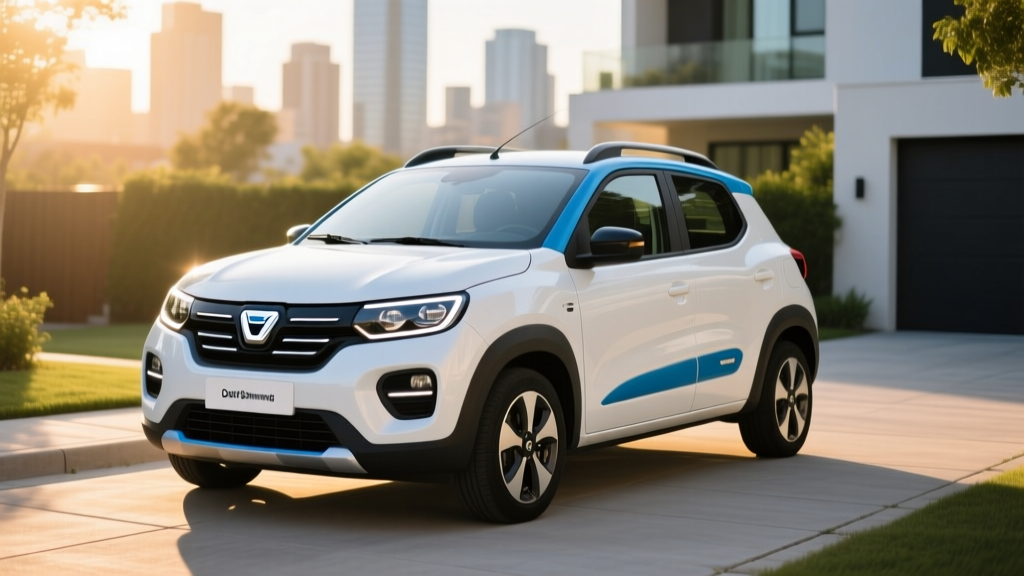
The Quick Verdict on the Dacia Spring Electric Car
The Dacia Spring is Europe's most affordable new electric car, priced from roughly €17,990 (approximately $19,500 USD) before incentives. It delivers a WLTP-rated 140 miles (225 km) of range from a 26.8 kWh LFP battery, with real-world highway range closer to 95–110 miles. DC fast charging peaks at just 30 kW, meaning a 10–80% session takes roughly 45 minutes. It is a compelling urban commuter for budget-minded drivers with home charging access, but its limited range, modest 65 hp motor, and slow charging make it unsuitable as a primary vehicle for anyone regularly driving beyond city limits.
The Dacia Spring occupies a unique space in the EV market: it is the cheapest way to get into a brand-new electric car in Europe, and Renault Group (Dacia's parent) has positioned it squarely as an urban runabout. For 2025–2026, the Spring received a facelift with a slightly revised interior and updated infotainment, but the core powertrain remains the same 26.8 kWh lithium iron phosphate (LFP) battery paired with a 65 hp (48 kW) electric motor. If you are considering the Dacia Spring electric car as a daily driver, this guide breaks down the real numbers behind range, charging, costs, and ownership practicality.
Range and Efficiency: EPA vs. Real-World Expectations
The Dacia Spring carries a WLTP combined range rating of 140 miles (225 km). Because the Spring is not sold in the United States, there is no EPA sticker figure — but WLTP tends to be 10–15% more optimistic than EPA testing. Translating to real-world conditions:
- City driving (mild weather): ~130–140 miles — regenerative braking in stop-and-go traffic maximizes efficiency
- Mixed suburban/highway (68°F/20°C): ~105–120 miles
- Sustained highway at 70 mph: ~85–100 miles
- Cold weather (32°F/0°C, city): ~95–110 miles — LFP chemistry loses ~15–25% range in freezing temperatures
- Cold weather + highway: ~70–85 miles — worst-case scenario
At 139 Wh/km (WLTP combined), the Spring is one of the most efficient EVs on the market by weight. The car weighs just 1,045 kg (2,304 lbs), which is the primary reason it extracts so many miles from a small battery. For context, a Tesla Model Y weighs over 4,300 lbs and carries a 75 kWh battery for roughly 310 EPA miles. The Spring proves that lightweight design matters as much as battery size.
| Vehicle | Battery (kWh usable) | WLTP Range | Efficiency (Wh/km) | Curb Weight |
|---|---|---|---|---|
| Dacia Spring (2025) | 26.8 | 140 mi / 225 km | 139 | 1,045 kg |
| Fiat 500e | 37.3 | 199 mi / 320 km | 145 | 1,290 kg |
| Renault Zoe (discontinued) | 52 | 238 mi / 383 km | 161 | 1,502 kg |
| Peugeot e-208 | 48 | 225 mi / 362 km | 155 | 1,455 kg |
Charging Speeds: The Spring's Biggest Limitation
If there is one area where the Dacia Spring electric car demands honest discussion, it is charging. The 30 kW DC fast-charging peak is among the slowest in the current EV market. Here is the full breakdown:
| Charging Level | Power (kW) | Time (10–80% or 0–100%) | Miles Added per Hour |
|---|---|---|---|
| Level 1 (Standard 120V/10A outlet) | ~1.8 kW | 0–100% in ~15 hours | ~8 mi/hr |
| Level 2 (Home Wallbox 7.4 kW) | 7.4 kW (max onboard) | 0–100% in ~4 hours | ~35 mi/hr |
| Level 2 (Public 22 kW AC) | 7.4 kW (limited by onboard charger) | 0–100% in ~4 hours | ~35 mi/hr |
| DC Fast Charge (CCS2) | 30 kW peak | 10–80% in ~45 minutes | ~70 mi/hr (at peak) |
What this means practically: The 7.4 kW onboard AC charger is adequate for overnight home charging — plug in at 10 PM and you will have a full battery by 6 AM. However, the 30 kW DC fast-charging speed means road-trip stops are painfully long. At a 150 kW station, the Spring will still only draw 30 kW maximum, so you are paying for infrastructure the car cannot use. For comparison, a Hyundai Ioniq 5 peaks at 240 kW and completes a 10–80% charge in roughly 18 minutes.
The Spring uses the CCS2 connector standard across Europe. There is no NACS (Tesla) compatibility, as NACS adoption is primarily a North American development. For European buyers, CCS2 is the universal standard and poses no access issues.
Cost Breakdown: Purchase, Charging, and Total Ownership
The Dacia Spring's headline appeal is price. Here is what ownership actually costs across the first five years, compared to a similarly priced gasoline city car like the Dacia Sandero.
| Cost Category | Dacia Spring (EV) | Dacia Sandero 1.0 TCe (Gas) |
|---|---|---|
| Purchase Price (base, before incentives) | €17,990 | €13,990 |
| Typical Incentive (varies by country) | –€3,000 to –€7,000 | €0 |
| Effective Purchase Price | €10,990–€14,990 | €13,990 |
| Fuel/Energy (12,000 km/yr × 5 yrs, 60,000 km total) | €1,440 (home charging @ €0.17/kWh) | €5,400 (@ €1.65/L, 6.0 L/100km) |
| Maintenance (5 yrs) | ~€600 (no oil, fewer brake replacements) | ~€1,800 (oil, filters, brake pads) |
| Insurance (avg. annual) | €450–€650/yr | €350–€500/yr |
| 5-Year Insurance Total | €2,250–€3,250 | €1,750–€2,500 |
| Estimated 5-Year Total | €15,280–€20,480 | €22,940–€23,690 |
Key takeaway: After incentives, the Dacia Spring electric car can actually cost less upfront than its gasoline sibling, and the fuel savings are dramatic — roughly €3,960 less in energy costs over five years at typical European electricity rates. Even without incentives, the break-even point against the Sandero arrives around year three for a driver covering 12,000 km annually.
However, there are caveats. Insurance tends to run 15–25% higher for the Spring due to EV repair cost structures. Home charging infrastructure requires an upfront investment of €500–€1,500 for a Level 2 wallbox installation. And resale values for budget EVs remain uncertain compared to established gasoline models.
Battery Technology and Longevity
The Spring uses a 26.8 kWh usable LFP (lithium iron phosphate) battery. LFP chemistry is a deliberate choice for a budget EV and carries specific trade-offs:
| Characteristic | LFP (Spring's Battery) | NMC (Most Premium EVs) |
|---|---|---|
| Energy Density | Lower (~160 Wh/kg cell-level) | Higher (~250 Wh/kg cell-level) |
| Cycle Life | 3,000–5,000+ cycles | 1,000–2,000 cycles |
| Cold-Weather Performance | Weaker (15–25% range loss below freezing) | Better (10–15% range loss) |
| Recommended Daily Charging | Yes — can charge to 100% regularly | No — 80% daily recommended for longevity |
| Cobalt/Nickel Content | None (lower supply-chain risk) | Contains cobalt and nickel |
| Cost | Lower per kWh | Higher per kWh |
For the Spring's use case — daily urban commuting — LFP is arguably the superior chemistry. The battery can be charged to 100% every night without accelerated degradation concerns. With a cycle life exceeding 3,000 full cycles, the battery should outlast the car itself. At 60,000 km over five years, you would consume roughly 300–400 partial cycles, leaving enormous headroom.
Warranty: Dacia provides an 8-year / 160,000 km battery warranty guaranteeing a minimum of 70% capacity retention. Given LFP's inherent longevity and the small battery size (which keeps thermal stress manageable), significant degradation within the warranty period is unlikely.
Performance and Driving Experience
The 65 hp (48 kW) electric motor delivers 114 Nm (84 lb-ft) of torque. The 0–100 km/h (0–62 mph) sprint takes 19.9 seconds — and yes, that is as leisurely as it sounds. This is not a car for highway merging confidence. Top speed is electronically limited to 125 km/h (78 mph).
However, in the city, the Spring feels peppy enough. Electric motors deliver maximum torque from 0 RPM, so the 0–50 km/h dash is reasonably quick. The car's light weight and tight turning circle make it nimble in parking lots and narrow European streets. Ride quality is firm — the budget suspension shows its limitations on rough roads — but the overall driving experience is perfectly adequate for its intended purpose.
Standard equipment includes a 7-inch infotainment screen (with Apple CarPlay and Android Auto on higher trims), manual air conditioning, rear parking sensors, and basic ADAS features including automatic emergency braking and lane departure warning. There is no adaptive cruise control, no highway driving assist, and no advanced Level 2 driver-assistance system. This is a no-frills vehicle.
Common Misconceptions: Myth vs. Fact
| Myth | Fact |
|---|---|
| "140 miles of range is useless." | The average European commute is under 30 km (19 miles) round-trip. For urban-only drivers with home charging, 140 WLTP miles covers 3–4 days of commuting between charges. |
| "It's too slow to be safe." | The Spring is slow by highway standards, but its city performance (0–50 km/h) is comparable to most gasoline city cars. It is designed for 50–80 km/h urban roads, not autobahns. |
| "The battery will need replacing in a few years." | LFP batteries routinely exceed 3,000 cycles with minimal degradation. At typical usage, the battery should last 15+ years. The 8-year warranty backs this up. |
| "Charging takes too long." | At home on a Level 2 wallbox, a full charge takes ~4 hours — plug in overnight and wake up full. The 45-minute DC fast charge is only relevant for rare longer trips. |
| "It doesn't qualify for any incentives." | Incentive eligibility varies by country. In France, the Spring has historically qualified for the bonus écologique (up to €4,000). Check your local government's current EV incentive program for exact amounts. |
Decision Framework: Is the Dacia Spring Right for You?
Choose the Dacia Spring Electric Car If:
- Your daily driving is under 60 km (37 miles) round-trip, mostly in the city
- You have access to home charging (garage, driveway, or dedicated parking with an outlet)
- You want the lowest possible purchase price for a new EV
- You already have a second vehicle for longer trips
- You live in a mild climate (Mediterranean, Western Europe) where cold-weather range loss is manageable
- You value low running costs over performance and highway comfort
Look Elsewhere If:
- You regularly drive more than 100 km (62 miles) per day
- You rely entirely on public DC fast charging (30 kW peak means long waits)
- You need a primary vehicle for highway commuting or road trips
- You live in a region with harsh winters (LFP cold-weather loss is significant)
- You want advanced driver-assistance features or premium interior quality
- You need seating for more than four adults (the rear seats are tight for anyone over 5'6")
For buyers who need more range but want to stay budget-conscious, the Fiat 500e (199 WLTP miles, ~€30,000) or the MG4 EV (218 WLTP miles, ~€28,000) offer substantially more versatility at roughly double the Spring's pre-incentive price. The right choice depends entirely on your driving pattern and charging access.
FAQ: Dacia Spring Electric Car
Is the Dacia Spring sold in the United States?
No. The Dacia Spring is sold exclusively in European and select international markets. Dacia does not operate in the US. American buyers looking for a similar budget EV should consider the used Chevrolet Bolt EV (259 EPA miles, available under the $4,000 used-EV tax credit) or the Nissan Leaf (149–212 EPA miles depending on battery).
How long does it take to charge the Dacia Spring at home?
On a standard household outlet (Level 1, ~1.8 kW), a full 0–100% charge takes approximately 15 hours. On a Level 2 home wallbox (7.4 kW), the same charge takes about 4 hours. Most owners will wake up to a full battery every morning with overnight Level 2 charging.
What is the real-world range of the Dacia Spring in winter?
In freezing temperatures (0°C / 32°F), expect range to drop to approximately 95–110 miles for city driving and 70–85 miles for highway driving. The LFP battery chemistry is more susceptible to cold-weather losses than NMC batteries. Preconditioning the battery (available via the My Dacia app on higher trims) can partially mitigate this loss when plugged in.
Can I take the Dacia Spring on a road trip?
Technically yes, but it requires planning and patience. With roughly 85–100 real-world highway miles between charges and a 45-minute DC fast-charge stop (10–80%), a 300 km trip will require at least two charging stops adding roughly 90 minutes. For occasional road trips, it is doable. For frequent long-distance driving, the Spring is not the right tool.
What is the Dacia Spring's safety rating?
The Dacia Spring received a 1-star Euro NCAP rating in its original 2021 testing, which drew significant criticism. The 2024–2025 facelift introduced additional standard safety features (including improved AEB), but structural safety remains a budget-car limitation. For buyers prioritizing crash safety, this is a meaningful consideration. Check Euro NCAP for the latest test results.
Does the Dacia Spring qualify for EV tax incentives?
Incentive eligibility varies by country and changes frequently. In France, the Spring has historically qualified for the bonus écologique. In Germany, the Umweltbonus program ended in 2023. Always check your national or regional government's current incentive program for exact eligibility and amounts before purchasing.
Sources: Dacia official specifications via dacia.com, Euro NCAP safety ratings, WLTP testing data. Incentive information varies by jurisdiction — consult your local government's official EV program page for current rules.