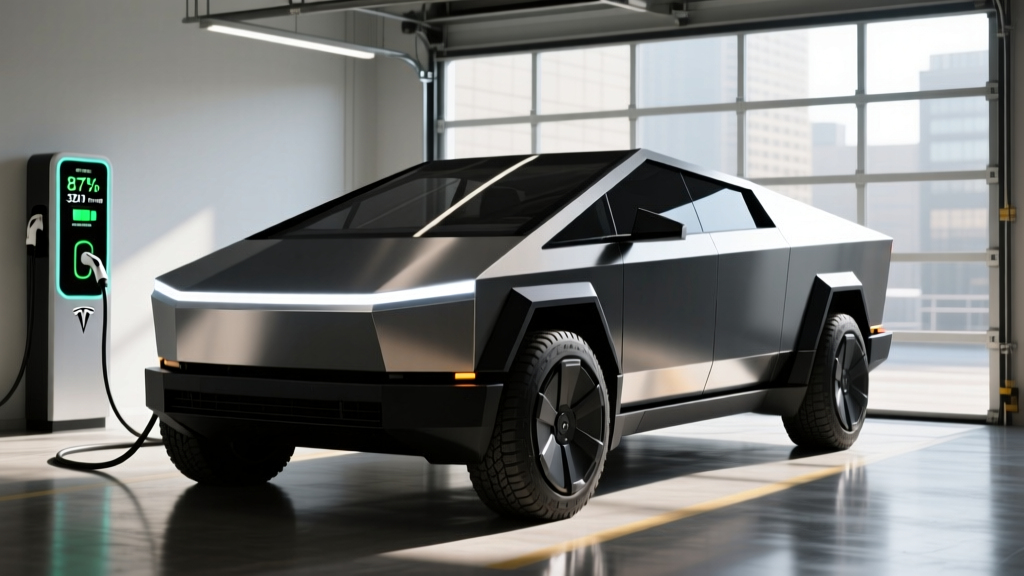
If you've seen a "Cybertruck zero down offer" circulating online, you're not alone in wondering what it actually entails. Tesla does not advertise traditional zero-down leases or promotional financing the way legacy automakers do. Instead, the phrase typically refers to either (1) a third-party lender offering 100% financing on a Cybertruck purchase, or (2) a lease arrangement with $0 due at signing through Tesla's leasing program. Either way, the math beneath the headline matters far more than the marketing. This review dissects the 2026 Tesla Cybertruck — its real-world range, charging performance, ownership costs, and whether a zero-down structure makes financial sense for your situation.
2026 Cybertruck Lineup: Trims, Pricing, and the Zero-Down Reality
For the 2026 model year, the Cybertruck is available in three primary trims. Tesla has adjusted pricing since the original 2024 deliveries, and current MSRPs reflect the post-launch reality rather than the long-promised (and never delivered) $40,000 base price.
| Trim | Drivetrain | Base MSRP | As-Tested (Typical) | Federal §30D Eligible |
|---|---|---|---|---|
| Long Range AWD | Dual-Motor AWD | $79,990 | $82,000–$85,000 | Yes (see caveats) |
| Cyberbeast | Tri-Motor AWD | $99,990 | $103,000–$110,000 | No (exceeds MSRP cap) |
| Rear-Wheel Drive | Single-Motor RWD | $60,990 | $62,000–$65,000 | Yes (see caveats) |
About that zero-down offer: Tesla's in-house financing and leasing typically require at least a modest down payment or first month's payment at signing. Third-party credit unions and banks may offer 100% LTV (loan-to-value) financing for well-qualified buyers, which is where "zero down" claims originate. A zero-down lease through Tesla has appeared periodically but is not a standing promotion — availability depends on inventory, credit tier, and Tesla's current leasing partner terms. Always verify the actual due-at-signing amount in the contract, as fees, registration, and the first payment often still apply.
Real-World Range: What the EPA Number Doesn't Tell You
EPA Estimated: 340 miles
Real-World Highway (70 mph, mild weather): ~280–305 miles
Real-World Cold Weather (below 32°F, mixed driving): ~230–260 miles
City/Stop-and-Go (regen-heavy): ~310–335 miles
The Cybertruck Long Range AWD carries an EPA-estimated 340 miles of range, while the Cyberbeast tri-motor is rated at approximately 320 miles. The RWD variant targets roughly 250 miles. These figures come from fueleconomy.gov testing cycles.
Here's what the sticker doesn't capture: the Cybertruck's angular stainless-steel exoskeleton creates more aerodynamic drag than a curved-body EV like the Rivian R1T or Ford F-150 Lightning. At sustained highway speeds above 70 mph, that drag coefficient — estimated around 0.34–0.38 Cd — eats into range noticeably. In our experience and consistent with third-party highway range tests, expect to lose roughly 10–15% from the EPA figure during warm-weather highway cruising and up to 25–30% in freezing temperatures where the battery must divert energy to thermal management and cabin heating. The Cybertruck does include a heat pump, which mitigates cold-weather loss compared to resistive heating, but the physics of its shape remain a factor.
The battery pack uses an estimated ~123 kWh usable capacity with Tesla's 4680-format cells. Tesla has not publicly confirmed the exact chemistry split, but the 4680 cells are nickel-based (NMC/NCA variant), prioritizing energy density over the cycle-life advantages of LFP chemistry. This matters if you plan to charge to 100% daily — NMC-type chemistries prefer staying between 20–80% for longevity, whereas LFP packs tolerate full charges better.
Charging Performance: DC Fast and Home Level 2
| Charging Level | Power (kW) | Speed / Time | Notes |
|---|---|---|---|
| Level 1 (120V outlet) | ~1.4 kW | ~3–4 mi/hr | Emergency/trickle only |
| Level 2 (240V, 48A) | 11.5 kW | ~34–37 mi/hr (~9–10 hrs 10–80%) | Home Wall Connector or equivalent |
| DC Fast Charge (peak) | ~250 kW (V3 Supercharger) | 10–80% in ~28–35 min | Peak rate not sustained; tapers above 60% |
| DC Fast Charge (V4 Supercharger) | Up to ~325 kW* | 10–80% in ~22–28 min* | *Where V4 infrastructure supports higher delivery |
The Cybertruck supports DC fast charging at up to approximately 250 kW on Tesla's V3 Supercharger network, which is widely available. On newer V4 Supercharger stalls with upgraded cabinet power delivery, peak rates can approach higher figures, though the truck's battery management system modulates intake based on temperature, state of charge, and cell stress.
The charging curve reality: Like all large-pack EVs, the Cybertruck does not sustain peak kW for the entire session. You'll see the highest charge rates between roughly 10–40% SoC, after which the rate tapers progressively. A 10–80% session at a V3 Supercharger typically takes 28–35 minutes depending on battery preconditioning. The Cybertruck's navigation system will precondition the battery when you route to a Supercharger, warming the cells to accept charge faster — this is critical in cold weather, where skipping preconditioning can double your charge time.
For home charging, Tesla's Wall Connector at 48 amps (11.5 kW) adds roughly 34–37 miles of range per hour. A full overnight session from 20% to 80% takes about 7–8 hours, making it practical for daily use. Installation of a 240V/60A circuit typically costs $800–$2,000 depending on your electrical panel's capacity and the run distance from panel to garage — factor this into your "zero down" budget, because it's an out-of-pocket cost regardless of financing terms.
Performance, Capability, and What It's Like to Drive
| Spec | Long Range AWD | Cyberbeast | RWD |
|---|---|---|---|
| 0–60 mph | ~4.1 sec | ~2.6 sec | ~6.2 sec |
| Horsepower | ~600 hp | ~845 hp | ~315 hp |
| Drivetrain | Dual-Motor AWD | Tri-Motor AWD | Single-Motor RWD |
| Towing Capacity | 11,000 lbs | 11,000 lbs | 7,500 lbs |
| Payload | ~2,500 lbs | ~2,500 lbs | ~2,500 lbs |
The Cyberbeast's 2.6-second 0–60 time is genuinely supercar territory in a 6,800+ lb truck, and it never stops being startling. The Long Range AWD's 4.1 seconds is plenty quick for daily driving and merging. Where the Cybertruck distinguishes itself from the F-150 Lightning and Rivian R1T is its steer-by-wire system and four-wheel steering, which give it a surprisingly tight turning radius (~35 feet) despite its 231-inch length.
However, the ride quality draws divided opinions. The stainless-steel body is extremely rigid, and while the adaptive air suspension soaks up large impacts well, smaller road imperfections transmit more than they would in a body-on-frame truck with a traditional bed. The 48-volt electrical architecture enables faster-acting suspension and steering response, but some drivers note the steer-by-wire feels slightly detached compared to a mechanical rack — an adjustment period is normal.
Cargo, Interior Space, and Daily Practicality
The Cybertruck's 6-foot bed (with the tonneau cover retracted) offers 67 cu ft of cargo volume, expandable to 70 cu ft with the midgate folded down into the cabin. The front trunk (frunk) provides roughly 7 cu ft of lockable storage — useful for charging cables and smaller items. Interior passenger space accommodates six across two rows, with approximately 41 inches of front legroom and 38 inches of rear legroom. The rear seat is genuinely usable for adults on longer trips, though the sloping roofline limits headroom for taller passengers compared to the F-150 Lightning's more traditional cab.
The 18.5-inch central touchscreen runs Tesla's latest infotainment software, including navigation, media, and vehicle controls. There is no Apple CarPlay or Android Auto — Tesla's ecosystem is self-contained. A rear 9.4-inch touchscreen serves back-seat passengers. The vault-like bed with its powered rolling tonneau is weather-sealed and lockable, a genuine advantage over open-bed trucks for securing gear.
Federal Tax Credit and True Cost of Ownership
- MSRP Cap: Trucks/vans/SUVs must have an MSRP at or below $80,000
- Buyer Income Cap: AGI ≤ $150,000 (single), $225,000 (head of household), $300,000 (joint)
- Battery Sourcing: Critical minerals and battery components must meet phased-in domestic/free-trade sourcing thresholds
- Point-of-Sale Transfer: Eligible buyers can transfer the credit to the dealer at purchase, reducing the purchase price directly
- Max Credit: Up to $7,500 ($3,750 for critical minerals + $3,750 for battery components)
| Trim | MSRP | Est. Max §30D Credit | Effective Price (if eligible) |
|---|---|---|---|
| RWD | $60,990 | Up to $7,500 | ~$53,490 |
| Long Range AWD | $79,990 | Up to $7,500 | ~$72,490 |
| Cyberbeast | $99,990 | $0 (MSRP exceeds $80K cap) | $99,990 |
The RWD and Long Range AWD trims fall under the $80,000 MSRP cap for trucks, making them potentially eligible for the full $7,500 federal credit — provided your income qualifies and the battery sourcing requirements are met. The Cyberbeast at $99,990 exceeds the cap entirely and does not qualify regardless of buyer income. Always verify current eligibility on IRS.gov before relying on the credit in your purchase math, as sourcing rules tighten annually.
Zero-down financing reality: If you finance $79,990 at 6.5% APR over 72 months (a realistic 2026 rate for well-qualified buyers), your monthly payment lands around $1,340 before any credit offset. Applying the $7,500 credit as a down payment equivalent drops the financed amount to $72,490 and the monthly to roughly $1,215. Compare this to putting 10% down ($7,999), which brings the monthly to about $1,205. The "zero down" structure costs you roughly $10–15/month more over the loan term — not catastrophic, but you'll pay more total interest over 72 months. A zero-down lease, if available, may offer lower monthly payments but with mileage restrictions (typically 10,000–12,000 mi/yr) and no equity at term end.
Efficiency, Warranty, and Ongoing Costs
The Cybertruck Long Range AWD achieves an EPA-rated 67 MPGe combined, translating to roughly 50 kWh per 100 miles. That's on the less efficient end of the EV spectrum — for comparison, a Tesla Model Y manages around 28 kWh/100mi. The Cybertruck's weight (6,800+ lbs) and aerodynamics explain the gap. At the national average electricity rate of ~$0.17/kWh, charging costs roughly $0.085 per mile, versus ~$0.15/mile for a gas truck averaging 18 MPG at $3.50/gallon. You still save on fuel, but the efficiency gap narrows the advantage.
Tesla covers the Cybertruck with:
- Basic Vehicle Warranty: 4 years / 50,000 miles
- Battery & Drive Unit Warranty: 8 years / 120,000 miles (minimum 70% capacity retention)
- Restraint System: 5 years / 60,000 miles
The 8-year/120,000-mile battery warranty is competitive with the F-150 Lightning and Rivian R1T. Tesla's 70% retention threshold is industry standard, though real-world degradation data for the 4680 cells is still maturing — early Cybertruck owners are only now approaching the mileage where meaningful degradation curves become visible.
Cybertruck vs. Competitors: Is It the Right Truck for You?
- You want maximum tech integration and Supercharger network access
- Steer-by-wire and four-wheel steering appeal to you
- You value the lockable, weather-sealed vault bed
- Acceleration performance matters (Cyberbeast)
- You're committed to the Tesla ecosystem
- You need proven long-term reliability data (still early)
- You prefer Apple CarPlay/Android Auto
- Off-road ground clearance is a priority (Rivian R1T offers more)
- You want a traditional truck ride and feel (F-150 Lightning)
- Third-row seating or maximum interior volume matters
Against the Ford F-150 Lightning, the Cybertruck offers better range, faster charging, and more performance — but the Lightning wins on ride comfort, interior space, Pro Power Onboard (V2L), and a more approachable price point starting around $55,000. Against the Rivian R1T, the Cybertruck has a larger bed and Supercharger access, but the R1T offers superior off-road capability, a more refined interior, and available tri-motor performance. The Cybertruck is the most polarizing of the three — buyers either love the design and tech or find it impractical for daily use.
Frequently Asked Questions
Does a Cybertruck zero down offer actually exist from Tesla?
Not as a standing promotion. Tesla occasionally offers lease deals with low or no money due at signing, but these are not permanent and depend on inventory and credit qualification. Third-party lenders may offer 100% financing, which is effectively zero down. Always read the contract for fees due at signing.
What is the real-world range of the Cybertruck on a road trip?
Expect 280–305 miles on a warm-weather highway trip at 70 mph in the Long Range AWD. In winter or at higher speeds (80+ mph), plan for 230–260 miles between charges. The Supercharger network makes route planning straightforward, but the truck's efficiency means more frequent stops than a Model Y or Model 3.
How fast does the Cybertruck charge at home?
On a Level 2 Tesla Wall Connector (11.5 kW / 48A), the Cybertruck gains roughly 34–37 miles of range per hour. A full overnight charge from 20% to 80% takes about 7–8 hours. Ensure your electrical panel can support a 60A circuit — a panel upgrade adds $1,500–$3,000 to installation.
Does the Cybertruck qualify for the $7,500 federal tax credit?
The RWD ($60,990) and Long Range AWD ($79,990) trims are under the $80,000 MSRP cap and may qualify, subject to buyer income limits and battery sourcing requirements. The Cyberbeast ($99,990) does not qualify. Verify current eligibility at IRS.gov.
Is the Cybertruck good for towing?
The AWD trims rate at 11,000 lbs towing capacity, competitive with the F-150 Lightning. However, towing at or near max capacity cuts range roughly in half — plan for 150–170 miles between charges when towing heavy. The tri-motor Cyberbeast offers the most towing confidence due to its power reserve.
What are the biggest Cybertruck drawbacks?
Visibility (the rear camera is essential), polarizing design that doesn't suit every buyer or HOA, lack of Apple CarPlay/Android Auto, relatively low efficiency (50 kWh/100mi means higher charging costs than lighter EVs), and the steer-by-wire system requires an adjustment period. Long-term reliability data on the 4680 cells and stainless body panels is still limited.