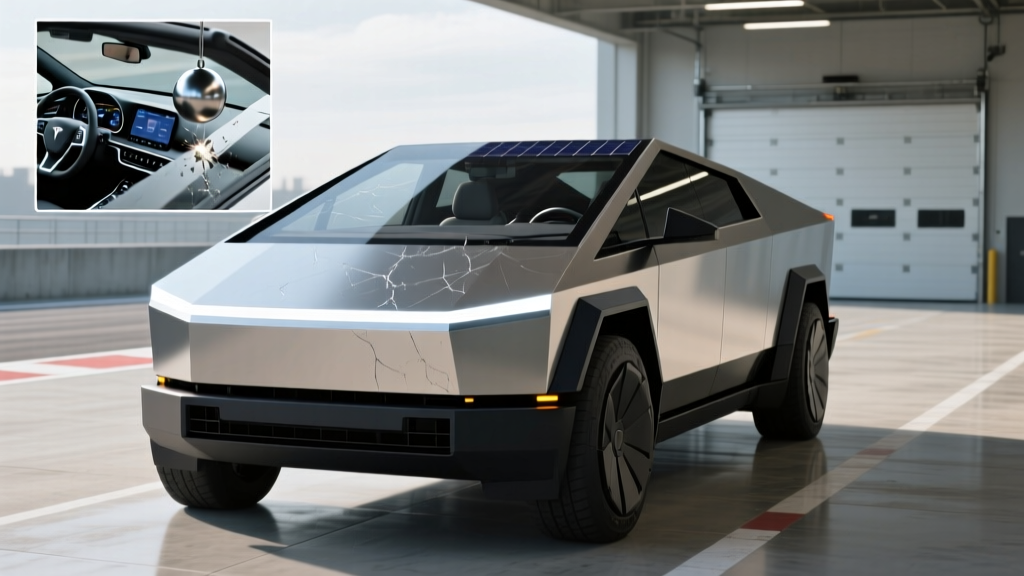
The Tesla Cybertruck's angular stainless-steel exoskeleton grabs headlines, but it's the Cybertruck windshield — a massive, curved slab of what Tesla calls "Armor Glass" — that draws the most scrutiny. After the infamous 2019 demo where a metal ball shattered the prototype's windows, buyers and onlookers alike have questioned whether the production glass lives up to its armored billing. This review covers everything you need to know about the Cybertruck's windshield and glass technology, alongside a complete 2026 ownership profile including real-world range, charging speeds, pricing, and tax-credit eligibility.
What Exactly Is the Cybertruck Windshield Made Of?
The production Cybertruck uses a multi-layer laminated glass system that Tesla refers to as Armor Glass. Unlike the flat panes on conventional trucks, the Cybertruck windshield is a single, deeply curved piece that spans the entire width of the cabin and integrates seamlessly into the roofline. The construction involves layers of glass bonded with a polymer interlayer — similar in principle to the laminated safety glass used in aircraft and armored vehicles, but formed to Cybertruck's extreme geometry.
In production vehicles delivered from late 2023 onward, the glass has proven significantly more resilient than the prototype suggested. Tesla revised the composition and manufacturing process after the demo incident. The windshield is designed to resist impacts from road debris, hail, and moderate projectile strikes. However, it is not bulletproof in the military sense, and Tesla does not claim ballistic certification for civilian models.
Cybertruck Glass: Replacement Cost and Real-World Durability
The Cybertruck windshield's size, curvature, and integration with the vehicle's ADAS sensor suite make it one of the most expensive windshields in the consumer truck segment. Based on owner reports and Tesla service center estimates through early 2026:
- Windshield replacement cost: $1,800–$2,500+ (parts and labor, depending on sensor recalibration requirements)
- Side-window replacement: $600–$900 per panel
- Insurance considerations: Comprehensive coverage typically covers glass replacement minus your deductible. Some insurers classify the Cybertruck's windshield as a specialty part, which can affect claims processing time.
The integrated housing for the forward-facing cameras (used by Autopilot and FSD Supervised) sits behind the windshield near the rearview mirror. Any replacement requires recalibration of these cameras at a Tesla service center, adding labor time and cost. Owners in regions with frequent gravel-road driving or severe hail should factor glass coverage into their insurance decisions.
For comparison, a Ford F-150 Lightning windshield replacement typically runs $400–$800, and a Rivian R1T comes in around $900–$1,300. The Cybertruck's premium reflects the custom tooling required for its unique geometry.
Full Cybertruck Specs: Range, Battery, and Efficiency
| Spec | AWD (Dual-Motor) | Cyberbeast (Tri-Motor) |
|---|---|---|
| EPA Range | 340 miles | 320 miles |
| Battery Capacity | ~123 kWh usable (NMC) | ~123 kWh usable (NMC) |
| Horsepower | 600 hp | 845 hp |
| 0–60 mph | 3.9 seconds | 2.6 seconds |
| Drivetrain | Dual-motor AWD | Tri-motor AWD |
| Efficiency | ~58 MPGe / 58 kWh/100mi | ~54 MPGe / 62 kWh/100mi |
| Max DC Fast Charge | 250 kW (peak) | 250 kW (peak) |
| 10–80% DC Charge | ~30 minutes | ~30 minutes |
| Level 2 Home Charge | 11.5 kW (~34 mi/hr) | 11.5 kW (~34 mi/hr) |
| Towing Capacity | 11,000 lbs | 11,000 lbs |
| Cargo (Bed) | ~67 cu ft (6' x 4' bed) | ~67 cu ft (6' x 4' bed) |
| Frunk | ~7 cu ft | ~7 cu ft |
| Rear Legroom | ~38.4 inches | ~38.4 inches |
Sources: EPA fueleconomy.gov, Tesla Cybertruck specs
Charging Speed and Infrastructure: What Owners Actually Experience
The Cybertruck uses a NACS (North American Charging Standard) connector natively — unsurprising given its Tesla origins. It charges on Tesla's Supercharger network, which remains the most reliable DC fast-charging ecosystem in the U.S.
| Level | Power | Miles Added Per Hour | Use Case |
|---|---|---|---|
| Level 1 (120V) | ~1.4 kW | ~3–4 mi/hr | Emergency / trickle top-up |
| Level 2 (240V, 48A) | 11.5 kW | ~34 mi/hr | Daily home charging (full overnight) |
| DC Fast (V3 Supercharger) | 250 kW peak | ~200+ mi in 15 min | Road trips, 10–80% in ~30 min |
Charging curve reality: The Cybertruck peaks at 250 kW only at a low state of charge (roughly 5–15% SoC) and with a preconditioned battery. The rate tapers progressively — by 50% SoC you'll see roughly 150–170 kW, and above 80% it drops sharply to protect the NMC cells. This is why Tesla and most EV analysts recommend charging to 80% for daily use and only going to 100% when you need the full range for a trip. A 10–80% session at a V3 Supercharger takes approximately 30 minutes under ideal conditions; add 5–10 minutes in cold weather if the battery isn't fully preconditioned.
For home charging, a Tesla Wall Connector on a 60-amp circuit delivers the full 11.5 kW (48 amps continuous). That translates to roughly 34 miles of range per hour of charging, or a full 0–100% charge in about 10–11 hours. Installation of a 240V/60A circuit typically costs $800–$2,000 depending on your panel capacity and conduit run — factor in a potential panel upgrade ($1,500–$3,000) if your home has a 100-amp service.
Pricing, Trims, and Federal Tax Credit Eligibility
| Trim | Base MSRP | §30D Credit Eligible? | Effective Price (if eligible) |
|---|---|---|---|
| AWD (Dual-Motor) | ~$79,990 | No (exceeds $80K truck MSRP cap) | ~$79,990 |
| Cyberbeast (Tri-Motor) | ~$99,990 | No (exceeds $80K truck MSRP cap) | ~$99,990 |
Critical tax-credit detail: Under IRS §30D rules, pickup trucks classified as SUVs or trucks must have an MSRP at or below $80,000 to qualify for the up-to-$7,500 federal clean vehicle credit. The Cybertruck AWD's MSRP of approximately $79,990 places it right at the threshold, but destination fees and any dealer-installed options can push the final sticker above the cap, disqualifying it. The Cyberbeast at ~$99,990 is firmly ineligible. Additionally, buyers must meet income caps ($300K joint / $225K head of household / $150K individual modified AGI) and the vehicle must satisfy critical-mineral and battery-component sourcing requirements that have tightened through 2025–2026. Always verify current eligibility on IRS.gov §30D guidance and confirm with a tax professional before purchase.
As-tested pricing for a well-equipped AWD model with the Foundation Series package (when available) or premium options can reach $90,000–$105,000+. The Cyberbeast with full options routinely exceeds $110,000.
Performance, Tech, and Daily Livability
The Cybertruck's performance figures are extraordinary for a vehicle weighing roughly 6,600–6,800 pounds. The Cyberbeast's 2.6-second 0–60 mph time makes it one of the quickest production trucks ever built, rivaling supercars from a decade ago. Even the dual-motor AWD's 3.9-second run demolishes most gas-powered performance trucks.
Drivetrain and handling: Both trims feature all-wheel drive with torque vectoring. The Cyberbeast adds a third motor on the rear axle for its 845-hp output. Rear-wheel steering (up to 10 degrees) gives the 18.4-foot-long truck a surprisingly tight turning circle of about 40 feet — comparable to a midsize sedan. Air suspension adjusts ride height by several inches, aiding both off-road clearance and highway aerodynamics.
Infotainment and controls: Nearly all vehicle functions route through the 18.5-inch front touchscreen. There are no physical stalks for turn signals — they're integrated into the yoke-style steering wheel, which remains a polarizing design choice. A rear 9.4-inch touchscreen serves back-seat passengers. The system runs Tesla's latest UI, which is responsive but requires menu-diving for basic climate and mirror adjustments.
Driver assistance: The Cybertruck ships with Tesla's Enhanced Autopilot and offers FSD (Supervised) as a subscription or outright purchase. FSD remains an SAE Level 2 system — the driver must remain fully attentive, with hands on the yoke and eyes on the road at all times. It is not autonomous driving. The system handles highway lane-keeping, on-ramp-to-off-ramp navigation, and some city-street scenarios, but requires constant supervision and can behave unpredictably in construction zones, heavy rain, or unmapped areas.
Cargo and utility: The 6-foot bed (Tesla calls it a "vault") offers approximately 67 cubic feet of lockable storage with the motorized tonneau cover closed. The bed features built-in 120V and 240V outlets capable of powering tools or appliances — up to 11.5 kW of continuous output, enough to run a welder or power portions of a home during an outage (with appropriate transfer equipment). The ~7 cu ft frunk adds secure front storage. Rear-seat legroom of 38.4 inches is adequate for adults but not class-leading compared to a full-size crew cab like the F-150 Lightning's 43.6 inches.
Warranty Coverage and Long-Term Ownership
Tesla provides the following warranty coverage for the Cybertruck:
- Basic vehicle warranty: 4 years / 50,000 miles
- Battery and drive unit: 8 years / 120,000 miles (with minimum 70% capacity retention)
- Armor Glass (windshield and windows): Covered under basic warranty for defects; impact damage falls under comprehensive insurance
The 123 kWh NMC battery pack is one of the largest in any consumer EV. Tesla's 70% retention threshold at 8 years/120K miles means the pack should still hold roughly 86 kWh even at warranty end — translating to approximately 238+ miles of EPA range. Real-world degradation data from high-mileage Model S and Model X owners suggests NMC packs typically lose 10–15% capacity over 150,000–200,000 miles when properly maintained (avoiding repeated 100% charges and frequent DC fast-charging to full).
Out-of-warranty battery replacement for a pack this size would likely cost $15,000–$25,000+ based on current Tesla service pricing, though costs are expected to decline as battery manufacturing scales further.
Pros, Cons, and the Verdict: Is the Cybertruck Worth It?
Pros
- Class-leading acceleration (2.6s Cyberbeast, 3.9s AWD)
- 11,000-lb towing capacity with integrated bed power
- Massive 123 kWh battery for strong range baseline
- NACS native — full Supercharger network access
- Stainless-steel body resists dents and corrosion
- Rear-wheel steering improves low-speed maneuverability
- 240V bed outlet enables job-site and emergency power use
Cons
- Windshield replacement cost ($1,800–$2,500+) is very high
- No federal tax credit due to MSRP cap exceedance
- Real-world highway range 15–20% below EPA sticker
- Yoke steering and touchscreen-only controls are divisive
- Rear-seat legroom trails full-size crew-cab competitors
- Poor rearward visibility; relies heavily on cameras
- High insurance premiums due to repair cost and performance
- Stainless-steel panels show fingerprints and can dent at crease points
Decision Framework: Who Should Buy the Cybertruck?
Choose the Cybertruck if: You need a high-performance electric truck with serious towing capability, want Supercharger network access for road trips, value the stainless-steel body's durability, and can absorb the premium price without a tax credit. It suits tech-forward buyers, job-site power users, and those who prioritize acceleration and utility over traditional truck comfort.
Look elsewhere if: You need maximum rear-seat space for a family (Rivian R1T or F-150 Lightning offer more), want federal tax-credit savings (R1T and Lightning may qualify depending on trim and sourcing), prefer physical controls over touchscreen-only operation, or are concerned about high glass-repair costs in hail-prone or gravel-road regions.
Cybertruck vs. Key Competitors
| Attribute | Tesla Cybertruck AWD | Rivian R1T (Dual-Motor Max) | Ford F-150 Lightning (Ext. Range) |
|---|---|---|---|
| EPA Range | 340 mi | 410 mi | 320 mi |
| Base MSRP | ~$79,990 | ~$87,000 | ~$69,995 |
| 0–60 mph | 3.9s | ~3.5s | ~3.8s |
| Towing | 11,000 lbs | 11,000 lbs | 10,000 lbs |
| Max DC Charge | 250 kW | ~220 kW | ~150 kW |
| Windshield Repl. Est. | $1,800–$2,500+ | $900–$1,300 | $400–$800 |
| §30D Credit? | Borderline / Unlikely | Trim-dependent | Eligible trims available |
The Cybertruck wins on charging speed (Supercharger network dominance), raw acceleration, and bed-power capability. The Rivian R1T leads in EPA range and traditional truck ergonomics. The F-150 Lightning offers the lowest entry price and the best chance at federal tax-credit savings, plus a more conventional driving experience that requires no learning curve.
Frequently Asked Questions
Is the Cybertruck windshield bulletproof?
No. Tesla's "Armor Glass" is a multi-layer laminated composite designed for high impact resistance against road debris, hail, and similar hazards. It is not ballistically rated and Tesla does not claim bulletproof certification for production vehicles.
How much does it cost to replace a Cybertruck windshield?
Expect to pay $1,800–$2,500+ for a full windshield replacement including ADAS camera recalibration. This is significantly higher than most competitors due to the custom curved glass and integrated sensor housing. Comprehensive auto insurance typically covers this minus your deductible.
Does the Cybertruck qualify for the $7,500 federal EV tax credit?
Likely not. Under current IRS §30D rules, trucks must have an MSRP at or below $80,000. The AWD trim at ~$79,990 sits at the limit, but destination fees and options typically push it over. The Cyberbeast at ~$99,990 is well above the cap. Income limits and battery-sourcing requirements add further restrictions. Verify on IRS.gov before purchasing.
What is the real-world range of the Cybertruck on a road trip?
On a highway trip at 70–80 mph in moderate temperatures, expect 270–300 miles from the AWD trim (EPA-rated 340). In cold weather (below freezing), plan for 220–260 miles. Towing at or near the 11,000-lb maximum can reduce range to 170–200 miles. Always use Tesla's trip planner and precondition the battery before Supercharger stops.
How fast does the Cybertruck charge at home?
On a Level 2 Tesla Wall Connector (240V, 48A), the Cybertruck charges at 11.5 kW, adding approximately 34 miles of range per hour. A full 0–100% charge takes roughly 10–11 hours. Most owners charge overnight and wake up to a full battery daily.
Is the yoke steering wheel safe and practical?
The Cybertruck's yoke replaces the traditional steering wheel and integrates turn-signal and gear-selection buttons. Some drivers adapt quickly; others find hand-over-hand maneuvers (parking, tight U-turns) awkward. Tesla offers a round steering wheel option in some markets — check current availability. The yoke does provide an unobstructed view of the instrument display.
For the latest Cybertruck pricing, availability, and tax-credit updates, consult Tesla's official Cybertruck page and the IRS Clean Vehicle Credits page.