The Tesla Cybertruck's angular stainless-steel exoskeleton and massive windshield make it one of the most recognizable vehicles on the road — and one of the most expensive to repair. If you've searched for Cybertruck windshield cost figures, you've likely encountered eye-popping estimates. This review covers the real numbers behind glass replacement, plus every spec a prospective buyer needs: range, charging, pricing, and whether the truck qualifies for federal tax credits in 2026.
Why the Cybertruck Windshield Costs So Much to Replace
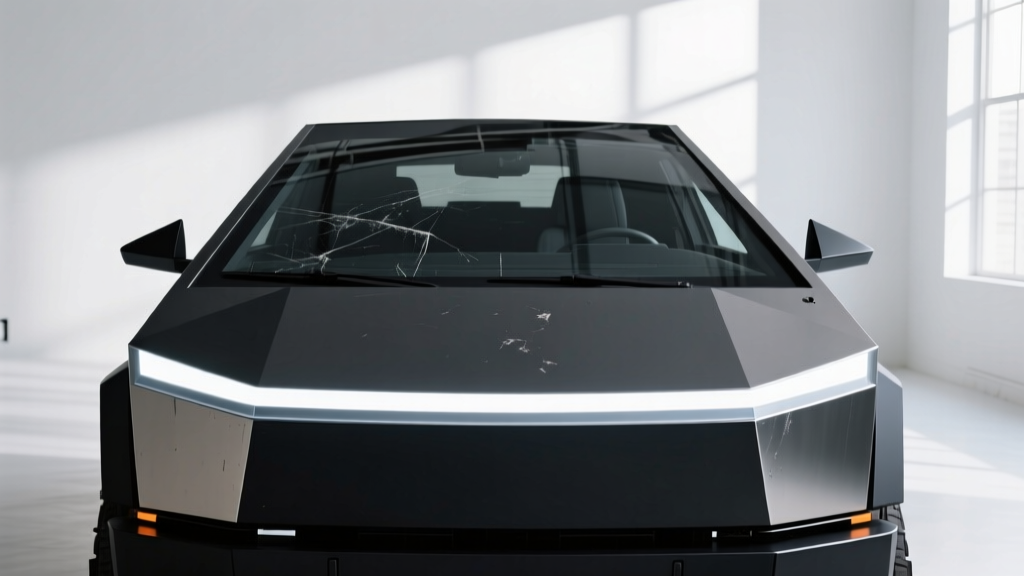
The Cybertruck's windshield isn't a standard curved automotive glass panel. It's an enormous, flat laminated unit that stretches from the base of the A-pillars nearly to the rear roofline — what Tesla calls an "armor glass" windshield. Its sheer size (roughly 35 square feet of glass surface), flat geometry, and integrated sensor housing for Autopilot cameras make it a specialty part with limited aftermarket supply.
Based on owner reports and Tesla service center estimates in 2025–2026, a Cybertruck windshield replacement typically costs between $1,500 and $2,500+, depending on:
- Part availability: Tesla's supply chain for Cybertruck-specific glass has been inconsistent, sometimes extending wait times to several weeks.
- Calibration: The windshield houses forward-facing Autopilot cameras that require recalibration after replacement — adding $200–$400 in labor.
- Labor complexity: Removing and reinstalling the massive flat panel requires specialized equipment and two or more technicians.
- Insurance coverage: Comprehensive coverage generally applies, but deductibles of $500–$1,000 are common. Some insurers have raised Cybertruck premiums specifically because of glass-repair frequency and cost.
Rock chips are the most common issue. The flat windshield angle means debris strikes at a more direct impact angle than on raked windshields, increasing the likelihood of cracks rather than small chips. Unlike conventional windshields, flat-panel cracks tend to propagate quickly, often requiring full replacement rather than resin repair.
Cybertruck Specs: Range, Battery, and Efficiency
Beyond glass repair, the fundamentals matter. Here's what the 2026 Tesla Cybertruck lineup delivers across its available trims.
| Spec | AWD (Dual Motor) | Cyberbeast (Tri-Motor) |
|---|---|---|
| EPA Range | 340 miles | 320 miles |
| Battery Capacity (usable) | ~123 kWh (estimated, NMC) | ~123 kWh (estimated, NMC) |
| Efficiency | ~54 MPGe / ~56 kWh/100mi | ~50 MPGe / ~60 kWh/100mi |
| 0–60 mph | 4.1 seconds | 2.6 seconds |
| Horsepower | 600 hp | 845 hp |
| Drivetrain | Dual-motor AWD | Tri-motor AWD |
| Towing Capacity | 11,000 lbs | 11,000 lbs |
| Payload Capacity | 2,500 lbs | 2,500 lbs |
| Cargo (Bed + Frunk) | ~67 cu ft bed + ~7 cu ft frunk | ~67 cu ft bed + ~7 cu ft frunk |
Charging Speed: DC Fast Charge and Home Level 2
The Cybertruck uses an 800-volt-class architecture, which enables strong DC fast-charging performance — though the charge curve tapers significantly above 80% state of charge (SoC), as is typical for large NMC battery packs.
| Charging Level | Power / Rate | Time / Miles Added |
|---|---|---|
| Level 1 (120V household) | ~1.4 kW | ~3–4 miles per hour |
| Level 2 (240V, 48A Wall Connector) | 11.5 kW | ~33–37 miles per hour; full charge in ~11–12 hours |
| DC Fast Charge (Tesla Supercharger V4) | Peak ~250 kW | 10–80% in ~30 minutes; ~175 miles in 15 min |
| DC Fast Charge (CCS adapter, Electrify America) | Peak ~200 kW (adapter-limited) | 10–80% in ~38 minutes |
Charging-curve reality: The Cybertruck peaks near 250 kW only at low SoC (roughly 10–25%). By 50% SoC, the rate typically drops to 150–170 kW, and above 80% it slows dramatically to under 50 kW. Plan road-trip stops around the 10–80% window for the fastest experience. Tesla's battery preconditioning feature — activated when you navigate to a Supercharger — warms the pack to optimize charge acceptance, which is especially important in cold weather.
Pricing, Trims, and Federal Tax Credit Eligibility
The Cybertruck's pricing has shifted since its 2023 launch. As of early 2026, here's where the trims stand, along with the impact of the federal §30D EV tax credit.
| Trim | Base MSRP | §30D Credit Eligibility | Effective Price (if eligible) |
|---|---|---|---|
| AWD (Dual Motor) | $79,990 | Ineligible — exceeds $80,000 truck MSRP cap | $79,990 |
| Cyberbeast (Tri-Motor) | $99,990 | Ineligible — exceeds $80,000 truck MSRP cap | $99,990 |
Tax credit reality check: Under IRS §30D rules, pickup trucks classified as light trucks must have an MSRP at or below $80,000 to qualify for the up-to-$7,500 federal tax credit. The AWD trim at $79,990 sits right at the threshold — however, any added options, destination fees, or trim upgrades that push the MSRP above $80,000 eliminate eligibility. Additionally, buyers must meet income caps ($150,000 single / $300,000 joint AGI), and the vehicle must satisfy critical-mineral and battery-component sourcing requirements that have tightened through 2026. As of this writing, the Cybertruck's battery sourcing compliance remains uncertain, meaning most buyers should not count on receiving the federal credit. Always verify current eligibility on the IRS Clean Vehicle Provisions page or consult a tax professional before purchasing.
Insurance, Windshield Repair, and Total Ownership Cost
The windshield isn't just a repair concern — it's an insurance-cost driver. Multiple Cybertruck owners have reported annual insurance premiums in the $3,500–$5,500 range (varying by state, driving record, and coverage level), significantly higher than a comparably priced F-150 Lightning or Rivian R1T. Insurers cite the windshield replacement frequency, stainless-steel body repair complexity, and limited collision-shop familiarity as cost factors.
Tesla's own insurance product, available in select states, sometimes offers more competitive rates for Cybertruck owners because it uses real-time driving data rather than vehicle-repair-cost actuarial tables. If you're in a state where Tesla Insurance is offered, it's worth quoting alongside traditional carriers.
Warranty coverage: The Cybertruck comes with a 4-year/50,000-mile basic vehicle warranty and an 8-year/120,000-mile battery and drive unit warranty (with a minimum 70% capacity retention threshold). The windshield is covered under the basic warranty only for manufacturing defects — rock chips and road-debris damage fall under comprehensive insurance, not warranty.
Technology, Driver Assists, and Daily Usability
The Cybertruck's interior is minimalist even by Tesla standards: an 18.5-inch front touchscreen handles nearly all vehicle functions, with a smaller 9.4-inch rear screen for passengers. There are no physical stalks — turn signals are on the steering wheel, and gear selection is via the touchscreen (with a backup overhead panel).
Standout features:
- Steer-by-wire system with variable ratio — fewer than a full turn lock-to-lock
- 48-volt electrical architecture (a first for a production light-duty truck)
- Bidirectional charging capability (PowerShare): V2L (vehicle-to-load) for powering tools/campsites and V2H (vehicle-to-home) with Tesla Powerwall integration
- Adaptive air suspension with up to 16 inches of ground clearance in Off-Road mode
- Vault bed with motorized retractable tonneau cover rated to 300 lbs of load on top
Notable drawbacks:
- Windshield vulnerability and replacement cost (as detailed above)
- Stainless-steel exterior panels resist dents but show fingerprints and are difficult to repair if deeply scratched
- Rear visibility is compromised by the bed vault design; the camera-based digital rear mirror is essential
- Garage fitment: at 223.7 inches long and 79.9 inches wide (mirrors folded), the Cybertruck exceeds the dimensions of many standard garage bays
- Turn-signal buttons on the steering wheel (no stalk) require an adjustment period and draw consistent criticism
Who Should Buy the Cybertruck (And Who Shouldn't)
- You want a conversation-starting electric truck with genuine off-road capability and 11,000-lb towing
- You value V2L/V2H capability for job sites, camping, or backup home power
- You're a Tesla ecosystem user (Supercharger network, Powerwall, solar) and want seamless integration
- You accept higher insurance premiums and windshield repair costs as part of ownership
- You need a sub-$60,000 electric truck — consider the Ford F-150 Lightning or Chevrolet Silverado EV
- You prioritize proven reliability and easy body-shop repairs — the Rivian R1T has a more established service network
- You garage-park in a tight space and can't accommodate the Cybertruck's 224-inch footprint
- You depend on the $7,500 federal tax credit to make the math work
Pros
- Tri-motor Cyberbeast delivers supercar-level 2.6-sec 0–60 in a 6,800-lb truck
- 800V architecture enables ~250 kW peak DC charging
- 11,000-lb towing and 2,500-lb payload rival gas heavy-duty trucks
- V2L and V2H bidirectional power capability
- Access to Tesla's Supercharger network (17,000+ stalls in North America)
- Stainless-steel exoskeleton is dent-resistant
Cons
- Windshield replacement costs $1,500–$2,500+ and is prone to cracking from debris
- Likely ineligible for the $7,500 federal tax credit (MSRP cap + sourcing rules)
- Insurance premiums run $3,500–$5,500/year in many markets
- No steering stalks — turn signals and wipers via buttons/screen require adaptation
- Real-world highway range drops to ~270–295 miles; worse when towing
- Limited third-party body-shop familiarity with stainless-steel panel repair
Frequently Asked Questions
How much does a Cybertruck windshield cost to replace in 2026?
Expect to pay between $1,500 and $2,500+ for a full Cybertruck windshield replacement, including the glass panel, labor, and Autopilot camera recalibration. Prices vary by region and whether you go through a Tesla Service Center or an approved third-party glass specialist. Comprehensive auto insurance typically covers the cost minus your deductible.
Can a Cybertruck windshield be repaired for rock chips instead of replaced?
Small bullseye chips (under 1 inch) can sometimes be resin-repaired for $100–$200, but the flat windshield geometry and direct-impact debris angle mean cracks are more common than small chips. Long cracks almost always require full replacement because they propagate rapidly across the flat surface.
What is the real-world range of the Tesla Cybertruck?
The EPA rates the AWD at 340 miles and the Cyberbeast at 320 miles. In real-world highway driving at 70–75 mph, expect roughly 270–295 miles. In cold weather (below 30°F), range can drop to 220–250 miles. Towing a 7,000-lb trailer reduces range to approximately 150–200 miles.
Does the Cybertruck qualify for the federal EV tax credit?
Most likely not. The §30D credit requires a truck MSRP at or below $80,000, buyer income under $150K (single) or $300K (joint), and compliance with battery-sourcing and critical-mineral rules. The AWD trim at $79,990 sits at the cap, but any options pushing MSRP above $80,000 disqualify it. Battery-component sourcing requirements have also tightened. Verify current status at irs.gov before purchase.
How fast does the Cybertruck charge at home?
Using a Tesla Wall Connector on a 240V/60A circuit, the Cybertruck charges at up to 11.5 kW, adding roughly 33–37 miles of range per hour. A full charge from near-empty takes about 11–12 hours. On a standard 120V outlet (Level 1), expect only 3–4 miles per hour — useful for overnight top-offs but not for daily recharging of a large pack.
Is the Cybertruck worth buying versus the F-150 Lightning or Rivian R1T?
It depends on priorities. The Cybertruck offers the most distinctive design, tri-motor performance (Cyberbeast), and Tesla Supercharger access. The Ford F-150 Lightning starts lower, qualifies for the tax credit in certain trims, and has a more conventional (and easier-to-repair) body. The Rivian R1T offers a more refined interior, a growing service network, and better off-road articulation — though at a similar or higher price. If windshield repair costs and insurance premiums concern you, the Lightning's conventional glass and body panels make it the lower-risk ownership proposition.
What battery chemistry does the Cybertruck use?
The Cybertruck uses an NMC (nickel-manganese-cobalt) lithium-ion battery pack with an estimated usable capacity of approximately 123 kWh. Tesla has not published an official kWh figure, but teardown analyses and range/efficiency calculations support this estimate. NMC chemistry offers high energy density suited to the truck's large pack, though it is more sensitive to sustained high-SoC storage than LFP chemistry — Tesla recommends daily charging to 80–90% and only charging to 100% for long trips.