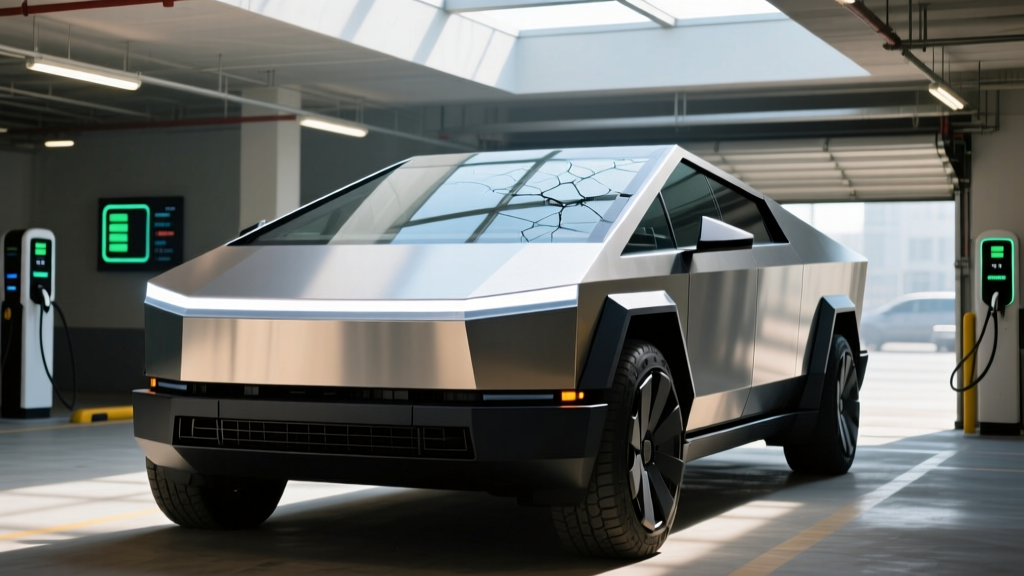
The moment a steel ball shattered the Tesla Cybertruck's "armor glass" on stage in 2019, the Cybertruck window break became one of the most meme'd moments in automotive history. Years later, with the stainless-steel pickup now in driveways across the country, the real question isn't whether the demo went wrong — it's whether the production glass actually holds up to daily use, rock strikes, and the rigors of truck ownership.
This review goes beyond the viral clips. We break down what Tesla's armor glass actually is, how it performs in the real world, and whether the 2026 Cybertruck's specs — from its 320-mile EPA range to its 250 kW DC fast-charging — make it a practical electric truck or a polarizing experiment.
The Cybertruck Window Break: What Actually Happens in Production
Tesla's armor glass is a multi-layer laminate consisting of a high-strength glass outer layer bonded to a polymer composite inner layer. Unlike conventional tempered automotive glass that shatters into small cubes on impact, armor glass is designed to absorb energy and retain structural integrity even when cracked.
In real-world ownership, Cybertruck windows can break — but not easily. Reports from owners and independent testers show:
- Small rock impacts: The outer glass layer may chip or develop a spider-web crack, but the polymer backing prevents penetration. Many owners report surviving highway debris that would have punctured standard glass.
- Concentrated high-force impacts: A direct strike from a heavy, pointed object at sufficient velocity can crack through both layers. The window won't shatter and fall out like tempered glass, but it will require replacement.
- The stage demo explained: Franz von Holzhausen's steel ball test broke the demo glass because an earlier sledgehammer strike to the door had pre-stressed the panel. In isolation, the glass withstood the ball drop in pre-show testing.
Range, Battery, and Efficiency: The Real Numbers
The 2026 Cybertruck is available in three configurations, each with distinct range and performance profiles. Tesla uses an NMC (nickel manganese cobalt) lithium-ion battery pack across all trims, prioritizing energy density over the LFP chemistry found in the base Model 3.
| Spec | Long Range AWD | Cyberbeast (Tri-Motor) |
|---|---|---|
| EPA Range | 340 miles | 320 miles |
| Battery Capacity (usable) | ~123 kWh | ~123 kWh |
| Battery Chemistry | NMC | NMC |
| Drivetrain | Dual-Motor AWD | Tri-Motor AWD |
| Horsepower | 600 hp | 845 hp |
| 0-60 mph | 4.1 seconds | 2.6 seconds |
| MPGe (combined) | 67 MPGe | 64 MPGe |
| Efficiency (kWh/100 mi) | 50 kWh | 53 kWh |
| Top Speed | 112 mph | 130 mph |
| Towing Capacity | 11,000 lbs | 11,000 lbs |
| Base MSRP | $81,630 | $101,630 |
According to fueleconomy.gov, the Cybertruck's combined MPGe places it behind more aerodynamic EVs like the Rivian R1T (73 MPGe combined for the Standard Battery), but competitive among full-size electric pickups.
Charging Speed: DC Fast, Level 2, and the NACS Advantage
The Cybertruck uses Tesla's NACS (North American Charging Standard) connector natively and accesses the full Supercharger network — the most reliable DC fast-charging ecosystem in North America.
| Charging Level | Power (kW) | Speed | Notes |
|---|---|---|---|
| Level 1 (120V) | ~1.4 kW | ~4 mi/hr | Emergency/trickle only |
| Level 2 (240V, 48A) | 11.5 kW | ~34 mi/hr | Home Wall Connector; full overnight charge in ~12 hrs |
| DC Fast (V3 Supercharger) | Peak 250 kW | 10–80% in ~30 min | Sustained rate tapers above 60% SoC |
| DC Fast (V4 Supercharger) | Peak 250+ kW | 10–80% in ~28 min | Newer cabinet; limited availability |
The ~123 kWh battery means even at peak 250 kW, a 10–80% charge takes roughly 30 minutes. This is slower than the Hyundai Ioniq 5 (which charges 10–80% in ~18 minutes at 240 kW with its smaller 77.4 kWh pack), but the Cybertruck compensates with access to over 6,000 Supercharger stalls across the U.S. that consistently deliver rated speeds.
Charging curve reality: The Cybertruck sustains near-peak charge rates up to approximately 50–60% State of Charge, then tapers progressively. Charging from 80–100% on DC fast charge adds another 25–30 minutes — plan accordingly on road trips and charge to 80% unless you need the full battery.
Pricing, Tax Credits, and Total Cost
The 2026 Cybertruck starts at $81,630 for the Long Range AWD (including destination) and $101,630 for the Cyberbeast tri-motor. Tesla discontinued the previously announced rear-wheel-drive base model that had been listed at $61,630.
| Trim | Base MSRP | As-Tested (typical options) | §30D Credit Eligible? |
|---|---|---|---|
| Long Range AWD | $81,630 | $85,000–$90,000 | Up to $7,500 (if income/sourcing rules met) |
| Cyberbeast | $101,630 | $105,000–$110,000 | Up to $7,500 (if income/sourcing rules met) |
- Buyer income caps: AGI ≤ $150,000 (single), ≤ $300,000 (joint filing)
- Battery sourcing: Critical minerals and battery component requirements phase in annually; check the IRS clean vehicle credit page for current-year compliance
- Point-of-sale transfer: Eligible buyers can transfer the credit to the dealer at purchase for an immediate price reduction
Performance, Cargo, and Livability
The Cyberbeast's 2.6-second 0–60 mph time makes it one of the fastest production pickups ever built. But beyond straight-line speed, the dual- and tri-motor powertrains deliver precise torque vectoring that aids traction in mud, snow, and sand — Tesla's steer-by-wire system (replacing the mechanical steering column) contributes to a surprisingly tight turning radius for a 235-inch-long vehicle.
Cargo and dimensions:
- Bed length: 6 feet (72 inches) with the tonneau closed; extendable with the tailgate down
- Bed volume: 67 cu ft (behind rear seats in the vault)
- Front trunk (frunk): 7.1 cu ft — lockable, drainable, useful for charging cables or groceries
- Rear legroom: 41.2 inches — adequate for adults on short trips, tighter than the F-150 Lightning's 43.5 inches
- Ground clearance: Up to 17.4 inches (Extract Mode on air suspension)
- Approach/departure angles: 35°/33° — competitive for off-road use
Standout tech:
- 18.5-inch front touchscreen with full vehicle controls (no physical buttons for climate, mirrors, or glovebox)
- 9.4-inch rear touchscreen for passengers
- Tesla Autopilot (SAE Level 2) standard; Full Self-Driving (Supervised) available as a $8,000 add-on or $99/month subscription
- 120V and 240V bed outlets (Powershare) — can run tools, camp equipment, or provide emergency home backup
- Stainless-steel exoskeleton requires no paint — eliminates paint chips but shows fingerprints and requires specific cleaning products
Warranty and Long-Term Ownership
Tesla provides the following warranty coverage for the 2026 Cybertruck:
- Basic vehicle: 4 years / 50,000 miles
- Battery and drive units: 8 years / 120,000 miles (whichever comes first), with a minimum 70% capacity retention threshold over the warranty period
- Armor glass: Covered under the basic 4-year/50,000-mile warranty for manufacturing defects; impact damage is not covered (file under comprehensive insurance)
Battery replacement cost out of warranty remains a concern for long-term owners. Based on current Tesla service estimates, a full Cybertruck battery pack replacement would cost approximately $15,000–$22,000 including labor. However, Tesla's NMC packs historically show 10–15% degradation over 150,000 miles based on fleet data from Model S/X vehicles — most owners will never need a full replacement.
Cybertruck vs. Rivian R1T vs. F-150 Lightning
| Attribute | Tesla Cybertruck LR AWD | Rivian R1T Dual-Motor | Ford F-150 Lightning Lariat |
|---|---|---|---|
| EPA Range | 340 mi | 352 mi (Max Pack) | 320 mi (Ext. Range) |
| Starting MSRP | $81,630 | $71,700 | $62,995 |
| 0-60 mph | 4.1 sec | 4.5 sec | 3.8 sec (Ext. Range) |
| Towing Capacity | 11,000 lbs | 11,000 lbs | 10,000 lbs |
| Bed Length | 6 ft | 4.5 ft (+ Gear Tunnel) | 5.5 ft |
| Max DC Charge | 250 kW | 220 kW | 150 kW |
| Charging Network | Tesla Supercharger (NACS) | NACS adapter (Supercharger access) | NACS adapter (Supercharger access) |
| Off-Road Capability | Good (air susp.) | Excellent (quad-motor option) | Moderate |
The Rivian R1T offers a more refined interior, superior off-road geometry, and a clever Gear Tunnel for enclosed storage. The F-150 Lightning wins on price, conventional truck familiarity, and dealer service accessibility. The Cybertruck's advantages are its Supercharger-native charging, extreme performance (Cyberbeast), and the stainless-steel body that eliminates paint maintenance.
Pros and Cons
Pros
- Best-in-class Supercharger network access (NACS native)
- Cyberbeast performance: 2.6-sec 0–60, 845 hp
- Stainless-steel exoskeleton: no paint to chip or fade
- Armor glass resists impacts that break conventional windows
- 240V Powershare bed outlet for tools and backup power
- 11,000-lb towing capacity
- Air suspension with Extract Mode (17.4" ground clearance)
Cons
- Starting price above $81,000 — tax credit eligibility uncertain at MSRP cap boundary
- Highway efficiency suffers from angular aerodynamics (~260–290 mi real-world highway)
- Steer-by-wire requires adaptation; no mechanical backup
- Rear visibility is poor; relies heavily on cameras
- Sharp exterior edges raise pedestrian-safety concerns
- Interior minimalism isn't for everyone (no physical buttons)
- Armor glass replacement is expensive ($1,200–$1,800 windshield)
Who Should Buy the Cybertruck?
Choose the Cybertruck if:
- You want a high-performance electric truck with Supercharger-native road-trip capability
- You value the stainless-steel body's durability and zero-paint maintenance
- You need 240V outlet capability for job-site tools or camping
- You prioritize acceleration and tech over traditional truck refinement
Look elsewhere if:
- Budget is a primary concern — the F-150 Lightning starts $20,000 lower
- You need maximum rear-seat space for regular adult passengers
- You prefer physical controls and a conventional steering column
- You want a proven off-road platform (Rivian R1T Quad-Motor excels here)
Frequently Asked Questions
Does the Cybertruck window break easily?
No. The production armor glass is a laminated composite that resists impacts far better than standard tempered auto glass. It can crack under extreme force, but it won't shatter or fall out. Small rock chips may spider-web the outer layer without compromising visibility or safety.
What is the real-world range of the Cybertruck?
The EPA rates the Long Range at 340 miles and the Cyberbeast at 320 miles. Real-world highway driving at 75 mph yields approximately 260–290 miles. In freezing weather, expect 220–250 miles. Mixed suburban driving typically achieves 290–320 miles.
How fast does the Cybertruck charge?
On a V3 Supercharger, the Cybertruck peaks at 250 kW and charges from 10–80% in approximately 30 minutes. At home on a Level 2 Tesla Wall Connector (11.5 kW / 48A), it adds about 34 miles per hour — a full charge takes roughly 12 hours from empty.
Does the Cybertruck qualify for the $7,500 federal tax credit?
Possibly. The Long Range AWD at $81,630 sits at the IRS MSRP cap boundary for trucks ($80,000). Buyer income must not exceed $150,000 (single) or $300,000 (joint). Battery critical-mineral and component sourcing rules also apply. Confirm with a tax professional and check the IRS §30D guidelines before purchasing.
Is the Cybertruck worth buying over the F-150 Lightning or Rivian R1T?
The Cybertruck wins on performance, Supercharger-native charging, and body durability. The F-150 Lightning wins on price, dealer service, and conventional truck feel. The Rivian R1T wins on off-road capability, interior quality, and innovative storage. Your choice depends on which trade-offs matter most to your use case.
How much does armor glass replacement cost?
A Cybertruck windshield replacement through Tesla Service costs approximately $1,200–$1,800. Side windows are less expensive. Damage from road debris is covered under comprehensive auto insurance, not the manufacturer warranty.