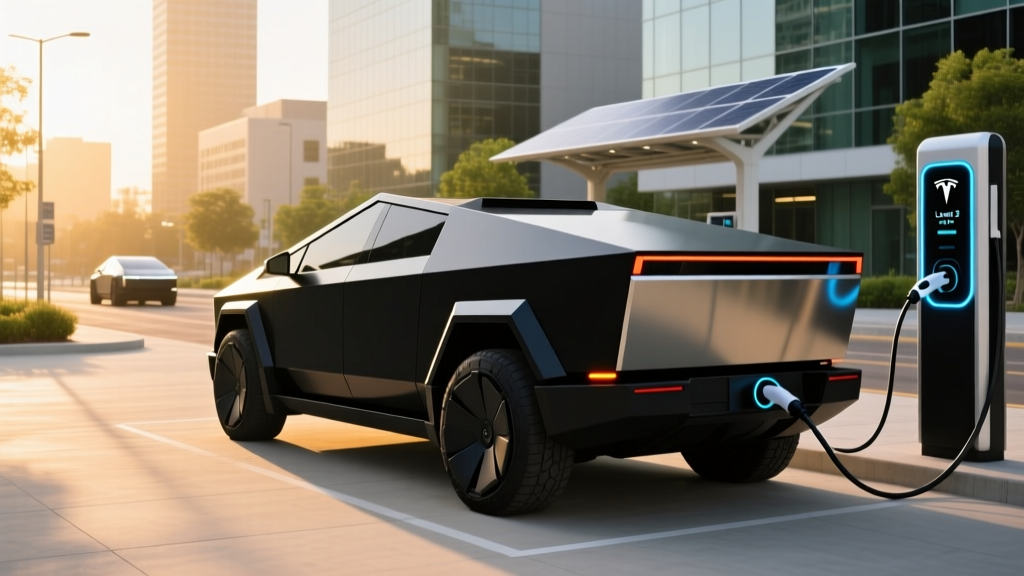
Searching for a comprehensive Tesla Cybertruck wiki? This guide consolidates everything you need to know about Tesla's polarizing electric pickup—from EPA range and 800V charging architecture to real-world efficiency, federal tax credit eligibility, and how it stacks up against the Ford F-150 Lightning and Rivian R1T in 2026.
2026 Tesla Cybertruck: Complete Spec Table
| Specification | AWD (Dual-Motor) | Cyberbeast (Tri-Motor) |
|---|---|---|
| EPA Range | 340 miles | 320 miles |
| Battery Capacity | ~123 kWh usable (NMC) | ~123 kWh usable (NMC) |
| Max DC Fast Charge | 250 kW (800V architecture) | 250 kW (800V architecture) |
| 10-80% Charge Time | ~15 minutes (peak) | ~15 minutes (peak) |
| Level 2 Home Charging | 11.5 kW (~44 mi/hr) | 11.5 kW (~44 mi/hr) |
| 0-60 mph | 3.9 seconds | 2.6 seconds |
| Horsepower | 600 hp | 845 hp |
| Drivetrain | Dual-motor AWD | Tri-motor AWD |
| Towing Capacity | 11,000 lbs | 11,000 lbs |
| Cargo Bed Volume | 67 cu ft | 67 cu ft |
| Front Trunk (Frunk) | 7 cu ft | 7 cu ft |
| EPA Efficiency | 2.0 kWh/mi (50 MPGe) | 2.1 kWh/mi (48 MPGe) |
| Base MSRP (2026) | $79,990 | $99,990 |
| Federal Tax Credit (§30D) | Eligible up to $7,500* | Eligible up to $7,500* |
| Battery Warranty | 8 years / 120,000 miles | 8 years / 120,000 miles |
Real-World Range vs. EPA Estimates
EPA Sticker: 340 miles (AWD) / 320 miles (Cyberbeast)
Real-World Expectation: 260-300 miles highway; 220-260 miles in cold weather (32°F or below)
The Cybertruck's angular stainless-steel exoskeleton creates significant aerodynamic drag (Cd ~0.38), which hammers efficiency at highway speeds. In EPA testing, the dual-motor AWD achieves 340 miles—but that's a mixed-cycle estimate with generous city/regen assumptions.
On a 70-mph highway road trip at moderate temperatures (65-75°F), expect 260-300 miles before hitting 10% State of Charge. In winter conditions, lithium-ion battery chemistry becomes less efficient, and cabin heating (even with a heat pump) draws substantial energy. Cold-weather highway range drops to 220-260 miles. If you frequently tow, range collapses further—towing a 5,000-lb trailer can cut range by 40-50%, yielding 130-170 miles.
The 123 kWh battery pack uses NMC (nickel manganese cobalt) chemistry, which offers high energy density but is more susceptible to cold-weather losses than LFP (lithium iron phosphate). Tesla's thermal management system preconditioning helps mitigate this when navigating to a Supercharger, but you'll still see 15-25% range reduction in sub-freezing temperatures.
Charging Speed: 800V Architecture & Supercharger Network
| Charging Level | Power (kW) | Miles Added per Hour | Notes |
|---|---|---|---|
| Level 1 (120V) | 1.4 kW | ~3 mi/hr | Emergency only; 100+ hours for full charge |
| Level 2 (240V, 48A) | 11.5 kW | ~44 mi/hr | Home Wall Connector; 8-10 hours for full charge |
| DC Fast (V3 Supercharger) | 250 kW peak | ~200 mi in 15 min | 800V architecture; tapers above 80% SoC |
| DC Fast (V4 Supercharger) | 250 kW peak | ~200 mi in 15 min | Newer stations with cable-cooled connectors |
The Cybertruck uses an 800V electrical architecture, which enables faster charging at lower current (reducing heat and cable weight). At a V3 or V4 Tesla Supercharger, the truck peaks at 250 kW—but like all EVs, it doesn't sustain that rate. The charge curve is aggressive from 10-40% SoC, then tapers progressively. A 10-80% charge takes roughly 15 minutes under optimal conditions (battery preconditioned, ambient temp 60-80°F).
Above 80% SoC, charging slows dramatically to protect battery longevity. Going from 80-100% can take another 25-30 minutes. For road trips, plan to charge in 15-20 minute bursts and skip the top-off unless you need maximum range for a long stretch.
At home, a Level 2 Tesla Wall Connector (48A, 11.5 kW) adds about 44 miles of range per hour. A full 0-100% charge takes 10-12 hours, so overnight charging is practical. If your electrical panel supports 60A, you can install a 48A circuit; older 100A panels may require a $1,500-$3,000 upgrade to a 200A service.
Connector note: The Cybertruck uses Tesla's proprietary NACS (North American Charging Standard) connector, which is now the de facto industry standard. Adapters are available for CCS1 networks (Electrify America, EVgo), but Supercharger access remains the primary advantage.
Performance: Tri-Motor Cyberbeast vs. Dual-Motor AWD
The Cybertruck's performance defies its 6,800-lb curb weight. The tri-motor Cyberbeast produces 845 hp and rockets from 0-60 mph in 2.6 seconds—supercar territory in a pickup truck. The dual-motor AWD model still delivers 600 hp and a 3.9-second 0-60 time.
Both trims feature adaptive air suspension with 16 inches of ground clearance (adjustable from 9-16 inches), torque vectoring, and rear-wheel steering for tighter turning radius. The Cyberbeast adds a third motor on the rear axle for enhanced traction and launch control.
Towing capacity is rated at 11,000 lbs for both trims, competitive with the F-150 Lightning (10,000 lbs) and Rivian R1T (11,000 lbs). However, as noted earlier, towing slashes range dramatically. If you tow frequently, the Cybertruck's large battery helps, but plan for 130-170 miles between charges with a heavy trailer.
Pricing, Trims & Federal Tax Credit Eligibility
| Trim | Base MSRP | Federal Tax Credit (§30D) | Effective Price* |
|---|---|---|---|
| AWD (Dual-Motor) | $79,990 | Up to $7,500 | $72,490 |
| Cyberbeast (Tri-Motor) | $99,990 | Up to $7,500 | $92,490 |
*Effective price assumes full $7,500 credit eligibility. Actual credit varies based on income, battery sourcing, and tax liability. See IRS §30D guidelines.
The Cybertruck qualifies for the federal EV tax credit under IRS §30D, but eligibility is not automatic. Here are the key constraints:
- MSRP Cap: The Cybertruck is classified as a pickup truck, so the MSRP cap is $80,000. The AWD trim ($79,990) clears this threshold, but the Cyberbeast ($99,990) exceeds it and is ineligible for the credit.
- Income Limits: Adjusted gross income must be ≤$150,000 (single), ≤$225,000 (head of household), or ≤$300,000 (joint filers).
- Battery Sourcing: The credit is split into two $3,750 components—one for critical minerals and one for battery components. Tesla's supply chain sourcing determines partial or full eligibility, and rules tighten annually through 2032.
- Point-of-Sale Transfer: As of 2024, you can transfer the credit to the dealer at purchase, reducing your upfront cost rather than waiting for a tax refund.
Bottom line: The AWD Cybertruck may qualify for the full $7,500 credit if you meet income requirements and Tesla's battery sourcing complies with current-year rules. The Cyberbeast is ineligible due to the $80,000 MSRP cap. Consult a tax professional or check the fueleconomy.gov tax credit tracker for the latest eligibility data.
Interior, Cargo & Tech Features
The Cybertruck's cabin is minimalist and utilitarian, dominated by an 18.5-inch central touchscreen running Tesla's latest software. There's no instrument cluster—speed and range data appear on the touchscreen's left edge. The steering yoke (standard) takes adaptation, and some drivers find it awkward for low-speed maneuvers.
Seating is configured for five passengers, with 41.5 inches of front legroom and 38.2 inches in the rear. The rear seat is flat and firm, optimized for cargo flexibility over comfort. Behind the rear seats, the 67-cu-ft bed features a motorized tonneau cover, integrated ramps, and 120V/240V outlets for job-site power or camping.
The 7-cu-ft front trunk (frunk) is lockable and weather-sealed, useful for groceries or charging cables. However, the frunk is smaller than the F-150 Lightning's 14-cu-ft "Mega Power Frunk," which can double as a cooler or workspace.
Standout tech:
- Autopilot / FSD (Supervised): Tesla's Level 2 driver-assist system includes adaptive cruise, lane-keeping, and automatic lane changes. FSD (Supervised) adds traffic-light recognition and city-street navigation, but requires constant driver attention. This is not autonomous driving—only Waymo-style robotaxis operate at Level 4.
- Bioweapon Defense Mode: A HEPA air filtration system pressurizes the cabin and filters 99.97% of particulates.
- Armor Glass: The windshield and windows use ultra-hardened glass (though early production models had lamination issues).
- Steer-by-Wire: No mechanical connection between the yoke and wheels; enables variable steering ratios and tighter turns.
Notable drawbacks:
- Visibility: The angular design and thick A-pillars create significant blind spots. The rearview camera is essential for lane changes.
- Build quality: Early Cybertrucks had panel-gap inconsistencies, trim rattles, and software glitches. Tesla's Fremont factory has improved, but quality control remains a concern.
- Insurance costs: The Cybertruck's stainless-steel body and specialized parts drive insurance premiums 30-50% higher than comparable pickups.
Pros & Cons at a Glance
Pros
- Class-leading 0-60 performance (2.6s Cyberbeast)
- 800V architecture enables 250 kW DC fast charging
- Access to Tesla Supercharger network (16,000+ stalls in North America)
- 11,000-lb towing capacity with integrated trailer brake controller
- Stainless-steel exoskeleton resists dents and corrosion
- Over-the-air software updates add features post-purchase
Cons
- Real-world highway range 260-300 mi (vs. 340 mi EPA)
- Aerodynamic drag hammers efficiency at 70+ mph
- Cyberbeast trim ineligible for federal tax credit (>$80k MSRP)
- Yoke steering and lack of instrument cluster require adaptation
- Build quality inconsistencies in early production
- Insurance premiums 30-50% higher than F-150 Lightning
Who Should Buy the Cybertruck?
Best for: Tech-forward buyers who prioritize performance, Supercharger network access, and Tesla's software ecosystem. If you commute 50-100 miles daily, charge at home, and take occasional road trips, the Cybertruck's 260-300 mile real-world range is manageable. The 11,000-lb towing capacity suits boat or camper trailers, but expect 130-170 miles of range when towing.
Consider alternatives if:
- You need maximum range: The Rivian R1T (Dual-Motor, 149 kWh Max Pack) offers 410 miles EPA, though at $97,000+.
- You want traditional pickup ergonomics: The Ford F-150 Lightning has a conventional cabin, 14-cu-ft frunk, and starts at $54,995 (eligible for full $7,500 credit).
- You tow frequently: The GMC Sierra EV (440-mile range, 20,000-lb towing) is better optimized for heavy-duty work, though it costs $75,000+.
Cybertruck FAQ
What is the real-world range of the Tesla Cybertruck?
The EPA rates the dual-motor AWD at 340 miles and the Cyberbeast at 320 miles, but real-world highway driving yields 260-300 miles. In cold weather (32°F or below), expect 220-260 miles. Towing a 5,000-lb trailer cuts range to 130-170 miles.
How fast does the Cybertruck charge?
At a Tesla Supercharger (250 kW peak), the Cybertruck charges from 10-80% in about 15 minutes. At home with a Level 2 Wall Connector (11.5 kW), it adds 44 miles per hour, taking 10-12 hours for a full charge.
Does the Cybertruck qualify for the $7,500 federal tax credit?
The AWD trim ($79,990) may qualify for the full $7,500 credit if you meet income limits (≤$150k single, ≤$300k joint) and Tesla's battery sourcing complies with 2026 rules. The Cyberbeast ($99,990) exceeds the $80,000 MSRP cap for pickups and is ineligible.
Is the Cybertruck worth buying vs. the F-150 Lightning or Rivian R1T?
The Cybertruck excels in performance (2.6s 0-60), Supercharger access, and tech features, but lags in real-world range and traditional pickup ergonomics. The F-150 Lightning is more affordable ($54,995), has a larger frunk, and qualifies for the full tax credit. The Rivian R1T offers 410-mile range (Max Pack) but costs $97,000+. Choose the Cybertruck if you value Tesla's ecosystem and don't mind the yoke steering and visibility compromises.
What's the biggest drawback of the Cybertruck?
Real-world range falls short of the EPA estimate due to aerodynamic drag, and the Cyberbeast trim is ineligible for the federal tax credit. Build quality inconsistencies, high insurance costs, and the learning curve of yoke steering are also common complaints.