The Tesla Cybertruck was built around a single, uncompromising idea: rethink the pickup truck from the battery pack up. For truck buyers, the conversation inevitably turns to the bed — or as Tesla calls it, the "vault." But a futuristic composite bed is only as useful as the powertrain beneath it. This review examines the Cybertruck's truck bed utility in the context of its real-world range, charging architecture, and total cost of ownership in 2026, giving you the exact numbers needed to decide if this electric pickup fits your work or lifestyle.
Cybertruck Truck Bed: Dimensions, Payload, and the Vault Explained
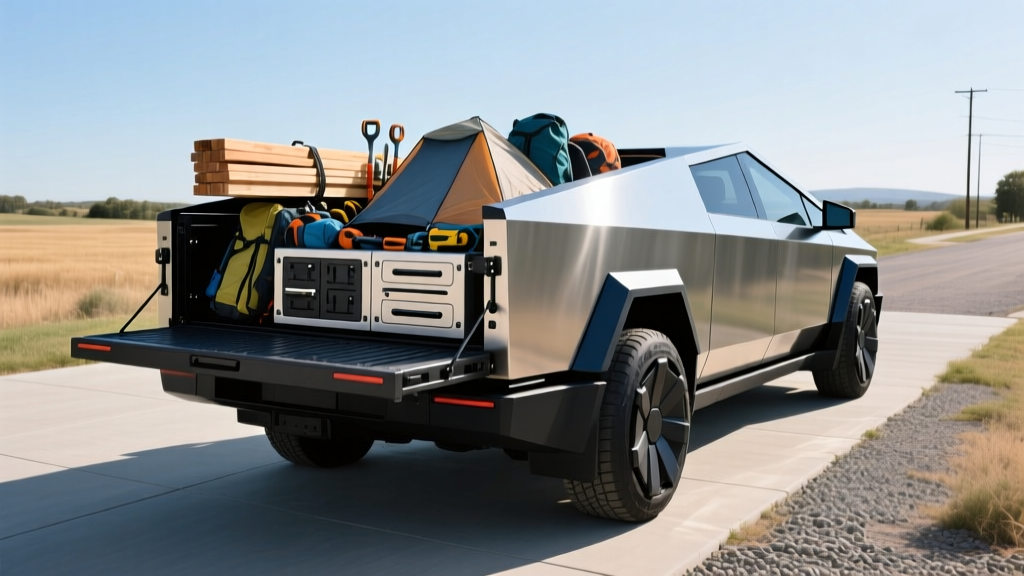
The Cybertruck's bed measures 6 feet long by 4 feet wide between the wheel wells, yielding approximately 67 cubic feet of enclosed cargo volume when the powered tonneau cover is deployed. Unlike traditional open beds, the vault is a fully sealed, lockable space with integrated LED lighting, two 120V outlets, and one 240V outlet capable of powering tools or appliances directly from the truck's massive battery pack.
The powered roll-up tonneau cover is rated to support up to 300 lbs of distributed weight on top — useful for rooftop tent setups or additional gear. Inside, the composite bed floor is scratch-resistant and requires no bed liner. Tesla includes built-in tie-down points and a ramp system integrated into the tailgate for loading ATVs or motorcycles.
| Specification | Value |
|---|---|
| Bed Length | 6 ft (72 in) |
| Bed Width (between wells) | 4 ft (48 in) |
| Cargo Volume (vault enclosed) | 67 cu ft |
| Frunk Volume | 7.1 cu ft |
| Max Payload | 2,500 lbs |
| Max Towing Capacity | 11,000 lbs (AWD) |
| Bed Outlets | 2× 120V, 1× 240V |
| Tonneau Cover Load Rating | 300 lbs distributed |
Compared to a Ford F-150's 5.5-foot Styleside bed (~52.8 cu ft), the Cybertruck vault offers more enclosed volume, but the trade-off is vertical clearance. The tonneau limits tall cargo to roughly 33 inches of height. For contractors hauling lumber or tall equipment upright, a traditional open bed still has advantages. For everyone else — campers, tailgaters, gear-heavy commuters — the sealed vault is a significant upgrade in security and weather protection.
EPA Range and Real-World Efficiency: What the Numbers Actually Mean
The 2026 Cybertruck lineup spans three configurations, each with distinct range profiles. The dual-motor AWD remains the volume seller, while the tri-motor Cyberbeast trades some range for supercar-level acceleration.
| Trim | EPA Range | Real-World Highway | Cold Weather (20°F) |
|---|---|---|---|
| Long Range AWD | 340 mi | ~270–290 mi | ~220–250 mi |
| AWD (Standard) | 318 mi | ~255–275 mi | ~200–230 mi |
| Cyberbeast (Tri-Motor) | 301 mi | ~240–260 mi | ~190–220 mi |
Highway driving at 75+ mph reduces range by 15–20% versus the EPA combined cycle. Cold weather compounds this with an additional 15–25% loss due to battery heating demands. Towing at max capacity can cut range by 40–50%.
Efficiency varies by trim. The AWD model achieves approximately 66 MPGe combined (roughly 51 kWh/100 mi), while the Cyberbeast drops to about 58 MPGe (58 kWh/100 mi). These figures are typical for a full-size electric pickup — the Rivian R1T and Ford F-150 Lightning sit in a similar band. The Cybertruck's stainless steel exoskeleton creates more aerodynamic drag than smoother designs, which shows up most at sustained highway speeds.
Battery, Chemistry, and the 800-Volt Advantage
Tesla equips the Cybertruck with an estimated ~123 kWh usable battery pack (gross capacity slightly higher) using NMC (nickel manganese cobalt) chemistry in a structural 4680-cell configuration. The structural pack serves as a stressed member of the chassis, reducing overall vehicle weight and improving torsional rigidity.
The defining electrical feature is the 800-volt architecture — a first for Tesla's consumer lineup. This higher voltage system enables faster DC charging with less heat generation, reducing charge time and improving sustained power delivery. It also allows the Cybertruck to accept higher-power Level 2 charging from compatible 48-amp or 80-amp home circuits.
| Spec | AWD | Cyberbeast |
|---|---|---|
| Battery Chemistry | NMC (4680 structural) | NMC (4680 structural) |
| Usable Capacity | ~123 kWh | ~123 kWh |
| Architecture | 800V nominal | 800V nominal |
| Drivetrain | Dual-Motor AWD | Tri-Motor AWD |
| Horsepower | 600 hp | 845 hp |
| 0–60 mph | 3.9 sec | 2.6 sec |
| Battery Warranty | 8 yr / 120,000 mi | 8 yr / 120,000 mi |
NMC chemistry offers higher energy density than LFP (lithium iron phosphate), which is why Tesla chose it for a vehicle this size. The trade-off: NMC degrades slightly faster over thousands of cycles and is more sensitive to sustained 100% state of charge. Tesla recommends daily charging to 80–90% for longevity, reserving 100% for road trips. The 8-year/120,000-mile battery warranty guarantees at least 70% capacity retention — consistent with industry norms for NMC packs.
Charging Speed: DC Fast, Home Level 2, and the Supercharger Network
The Cybertruck's 800V architecture unlocks charging speeds that were previously exclusive to the Porsche Taycan and Hyundai Ioniq 5. On a compatible V4 Supercharger or third-party 350 kW station, the Cybertruck peaks at approximately 250+ kW, though sustained rates depend on state of charge and battery temperature.
| Charging Level | Max Power | Speed | Notes |
|---|---|---|---|
| Level 1 (120V household) | ~1.4 kW | ~3 mi/hr | Emergency/trickle only |
| Level 2 (240V / 48A) | 11.5 kW | ~25 mi/hr | Standard home install |
| Level 2 (240V / 80A) | 19.2 kW | ~42 mi/hr | Requires 100A circuit + Wall Connector |
| DC Fast (V4 Supercharger) | ~250+ kW | 10–80% in ~20 min | Preconditioning required for peak rate |
| DC Fast (350 kW CCS/NACS) | ~250 kW | 10–80% in ~20–22 min | Charge curve tapers above 80% |
A critical ownership note: to achieve the peak 10–80% charge time of roughly 20 minutes, you must precondition the battery. This happens automatically when you navigate to a Supercharger via the built-in routing system. If you pull up to a charger cold — especially in winter — expect the initial charge rate to be significantly lower until the thermal management system warms the pack.
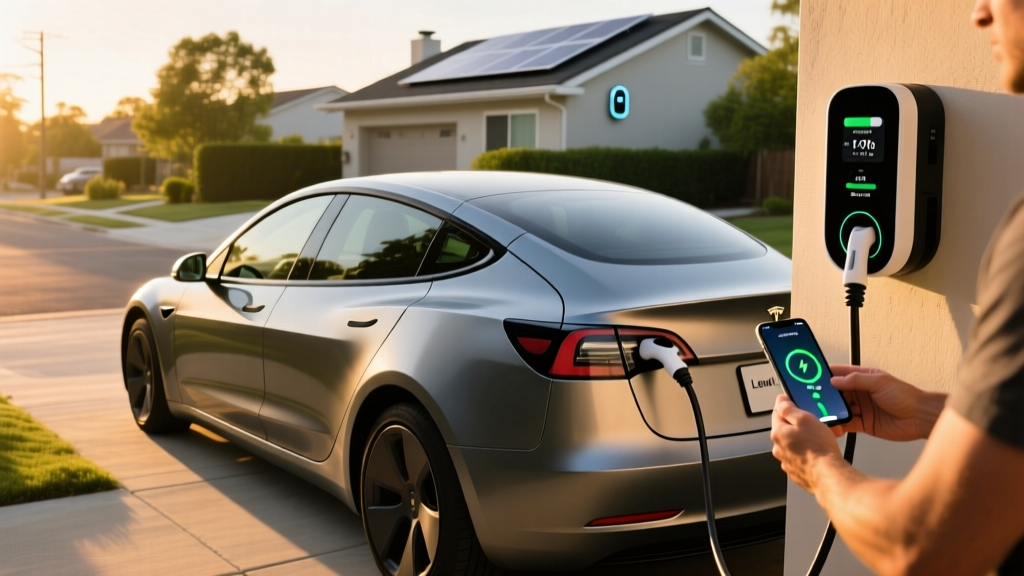
Home charging is where the Cybertruck excels. With a Tesla Wall Connector on a 60-amp circuit (48A continuous), you'll add about 25 miles of range per hour — enough to fully replenish overnight. An 80-amp circuit pushes this to ~42 mi/hr, meaning even a depleted pack can recharge in a single night. For most owners, a properly installed Level 2 home charger eliminates any need for daily public charging.
Pricing, Trims, and Federal Tax Credit Eligibility
The 2026 Cybertruck lineup has stabilized after initial production-year pricing adjustments. Tesla offers three main configurations, with the RWD (rear-wheel drive) base model expected in limited availability later in the model year.
| Trim | Base MSRP | §30D Credit Eligibility | Est. Net Price |
|---|---|---|---|
| RWD (upcoming) | ~$60,990 | Eligible (under $80K truck cap) | ~$53,490* |
| AWD (Long Range) | $79,990 | Eligible (at $80K truck cap) | ~$72,490* |
| Cyberbeast | $99,990 | NOT eligible (exceeds $80K truck cap) | $99,990 |
*Net price assumes full $7,500 §30D credit. Eligibility depends on buyer income (AGI ≤ $150K single / $300K joint), battery critical-mineral sourcing, and point-of-sale transfer. Verify current rules at IRS.gov.
The federal §30D Clean Vehicle Credit applies up to $7,500 for qualifying EVs, but trucks face an $80,000 MSRP cap (lower than the $55,000 sedan cap). The AWD Long Range model sits right at this threshold, making it credit-eligible in base form but not with most option packages. The Cyberbeast, at nearly $100K, does not qualify. Buyer income limits also apply: modified AGI cannot exceed $150,000 (single) or $300,000 (married filing jointly). The credit can now be transferred to the dealer at point of sale, functioning as an immediate price reduction rather than a tax-time refund. Battery sourcing and critical-mineral requirements continue to evolve — always verify current-year rules before purchasing.
Tech, Driver Assistance, and Interior Practicality
The Cybertruck's cabin is minimalist by design. A single 18.5-inch touchscreen handles infotainment, climate, and vehicle controls. There are no physical buttons for mirrors, glove box, or even the turn signal stalk — everything is integrated into the steering wheel or screen. This creates a clean aesthetic but demands a learning curve, especially for passengers.
Tesla's Autopilot comes standard, providing adaptive cruise control, lane centering, and automatic emergency braking. Full Self-Driving (Supervised) is available as a $8,000 add-on or $99/month subscription, adding automated lane changes, traffic light recognition, and city-street navigation.
Both Autopilot and FSD (Supervised) are SAE Level 2 driver-assistance systems. The driver must remain fully attentive, hands on the steering wheel, and ready to take over at any moment. These systems do not make the Cybertruck autonomous. Only Level 4 services like Waymo operate without a human driver — and those are limited to mapped urban areas in select cities.
Interior space is generous for a midsize-to-full-size pickup. Front legroom measures 41.5 inches, with rear legroom at 38.2 inches — adequate for adults on longer trips. The rear seats fold flat to extend cargo capacity into the cabin when the vault is full. A HEPA air filtration system (Bioweapon Defense Mode) is standard, and the powered frunk adds 7.1 cu ft of secure front storage.
Who the Cybertruck Suits — and Who Should Look Elsewhere
The Cybertruck occupies a unique position in the EV truck market. Its sealed vault, vehicle-to-load power capability, and 800V charging make it compelling for specific buyers. Its size, polarizing design, and price point make it a poor fit for others.
- Sealed, lockable vault with integrated power (120V/240V)
- 800V architecture enables ~20 min 10–80% DC fast charging
- Up to 11,000 lbs towing (AWD)
- Stainless steel body requires no paint — no scratches, no rust
- Access to Tesla Supercharger network (17,000+ stalls in North America)
- 845 hp Cyberbeast outperforms most sports cars to 60 mph
- Cyberbeast exceeds $80K MSRP cap — no federal tax credit
- Bed height limited by tonneau; tall cargo won't fit upright
- Real-world highway range drops to ~240–270 mi depending on trim
- Towing at max capacity cuts range by 40–50%
- Stainless steel panels show fingerprints and are difficult to repair
- Turn signals and mirror controls on touchscreen require adaptation
Consider the Ford F-150 Lightning or Rivian R1T if: You need a traditional open bed for tall cargo, you want a more conventional interior layout, your budget is under $60K (Lightning Pro), or you need more refined off-road capability (R1T quad-motor).
Frequently Asked Questions
What is the real-world range of the Cybertruck?
The EPA rates the AWD at 318 miles and the Cyberbeast at 301 miles. In real-world highway driving at 70–80 mph, expect 255–275 miles (AWD) or 240–260 miles (Cyberbeast). Cold weather below freezing reduces these figures by an additional 15–25%. Towing near max capacity can cut range to 150–180 miles.
How fast does the Cybertruck charge at home and on the road?
On a 48-amp Level 2 home charger (240V), the Cybertruck adds ~25 miles of range per hour, fully charging overnight. At a V4 Supercharger or 350 kW DC fast station, it charges from 10–80% in approximately 20 minutes with battery preconditioning. Charge rate tapers significantly above 80% SoC.
Does the Cybertruck qualify for the $7,500 federal tax credit?
The AWD Long Range at $79,990 MSRP qualifies in base form under the §30D truck cap of $80,000. The Cyberbeast at $99,990 does not qualify. All buyers must meet income limits ($150K single / $300K joint AGI) and the vehicle must meet battery critical-mineral sourcing requirements. The credit can be applied as a point-of-sale discount. Always verify current eligibility at IRS.gov before purchasing.
Can the Cybertruck bed handle standard 4×8 plywood sheets?
Yes, with the tailgate down. The vault interior is 4 feet wide between the wheel wells and 6 feet long with the tailgate closed. A standard 4×8 sheet of plywood fits flat with the tailgate lowered and secured. The powered tonneau must be fully retracted for this.
Is the Cybertruck worth buying over the F-150 Lightning or Rivian R1T?
It depends on your priorities. The Cybertruck wins on DC charging speed (800V architecture), sealed cargo security, and raw acceleration. The F-150 Lightning offers a more traditional truck experience, a lower starting price (~$55K), and an open bed. The Rivian R1T excels in off-road capability and interior refinement but charges slower and costs more at equivalent trims. Test-drive all three before deciding.
What is the Cybertruck's towing range penalty?
Towing at or near the 11,000-lb maximum reduces range by approximately 40–50%, bringing effective range down to 150–180 miles for the AWD trim. Lighter trailers (5,000–6,000 lbs) reduce range by roughly 25–30%. Plan charging stops accordingly and use the truck's built-in route planner, which factors in trailer weight and terrain.