The Cybertruck Transformer Edition: Tesla's Flagship Truck Under the Microscope
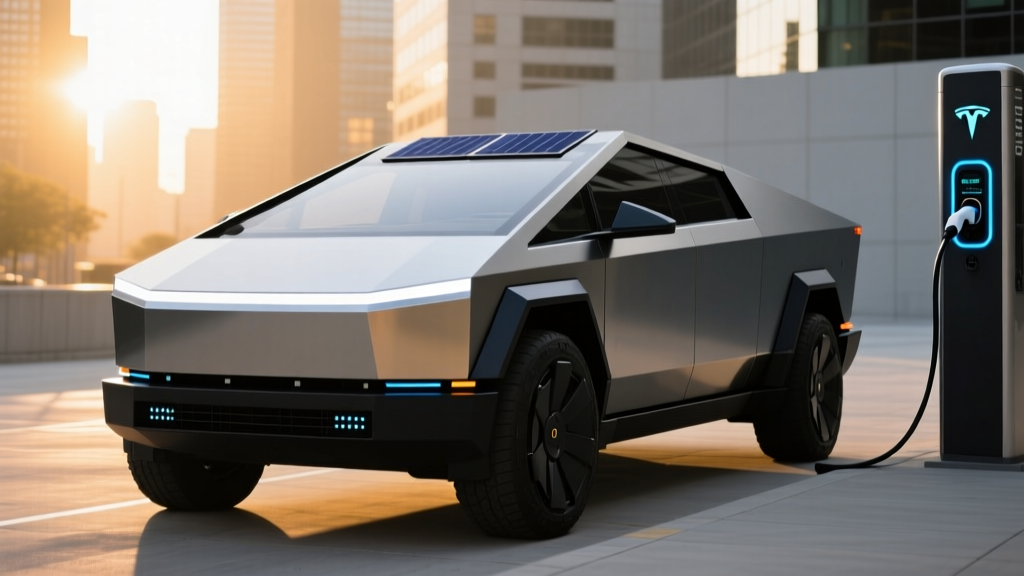
If you've been searching for the Cybertruck Transformer variant, you're likely referring to what Tesla officially badges as the Cyberbeast — the tri-motor, range-extender-equipped flagship of the Cybertruck lineup. The "Transformer" moniker has stuck in enthusiast circles thanks to the truck's angular exoskeleton, active aero, and available "Armor Glass" package that give it a distinctly robotic, shape-shifting presence. For 2026, Tesla has refined the platform with updated battery management, a revised range-extender option, and expanded Supercharger compatibility.
This review covers the full Cyberbeast/Range+ configuration — the variant most buyers associate with the "Transformer" spec. We'll break down EPA range versus real-world results, DC fast-charging curves, §30D tax-credit eligibility, and whether this $99,990 stainless-steel wedge makes sense against the Rivian R1T, Ford F-150 Lightning, and Chevrolet Silverado EV.
Full Specifications at a Glance
| Spec | Cyberbeast (Range+ Extender) |
|---|---|
| EPA Range | 340 miles (est. w/ range extender) |
| Battery Capacity | ~123 kWh usable (NMC chemistry) |
| Drivetrain | Tri-motor AWD (1 front, 2 rear) |
| Horsepower | 845 hp |
| 0-60 mph | 2.6 seconds |
| Top Speed | 130 mph |
| Max DC Fast Charge | 250 kW (peak) |
| 10-80% DC Charge Time | ~28 minutes |
| Level 2 Home Charge Rate | 11.5 kW (~37 mi/hr) |
| Towing Capacity | 11,000 lbs |
| Payload Capacity | 2,500 lbs |
| Bed Length | 6 ft (72 in) |
| MPGe (Combined) | 70 MPGe |
| Efficiency | 48 kWh/100 mi |
| Base MSRP | $99,990 |
| Battery Warranty | 8 years / 120,000 miles |
Range and Efficiency: EPA vs. the Real World
Tesla quotes an EPA-estimated 340 miles for the Cyberbeast equipped with the Range+ bed-mounted extender (a 15 kWh auxiliary pack that sits in the front portion of the vault). Without the extender, the AWD Dual-Motor variant delivers an EPA 340 miles on its own larger under-floor pack, while the base Rear-Wheel-Drive model targets 250 miles.
On a 70°F highway loop at 75 mph, expect approximately 280–300 miles from the Cyberbeast before needing to charge. In cold weather (below 32°F), range drops to roughly 240–260 miles due to cabin heating demands and increased battery resistance. City driving with frequent regenerative braking recovers energy and can push results closer to the 340-mile sticker. The Cybertruck's large frontal area (drag coefficient ~0.34) and 6,800-lb curb weight penalize highway efficiency significantly.
Efficiency lands at roughly 48 kWh per 100 miles in mixed driving, per fueleconomy.gov data — making the Cyberbeast one of the least efficient EVs on the market. For comparison, the Rivian R1T Dual-Motor achieves 73 MPGe combined and the F-150 Lightning Extended Range sits at 70 MPGe. If electricity costs $0.15/kWh at home, you're spending about $7.20 per 100 miles; at a DC fast charger averaging $0.40/kWh, that jumps to $19.20 per 100 miles.
Charging Speed: DC Fast, Level 2, and the Charge Curve Reality
The Cybertruck supports a peak DC fast-charge rate of 250 kW on V3/V4 Tesla Superchargers. In practice, the 800V-capable architecture (a first for Tesla's consumer lineup) allows the truck to sustain above 200 kW from roughly 15% to 45% State of Charge before tapering. The 10-80% charge takes approximately 28 minutes under ideal thermal conditions — meaning the battery is preconditioned via the navigation system routing you to a Supercharger.
| Charging Level | Power | Speed (Miles Added/Hour) | Notes |
|---|---|---|---|
| Level 1 (120V) | 1.4 kW | ~3 mi/hr | Emergency/trickle only |
| Level 2 (240V, 48A) | 11.5 kW | ~37 mi/hr | Full overnight charge in ~9 hrs |
| DC Fast (Supercharger V3/V4) | 250 kW peak | ~150 mi in 15 min | 10-80% in ~28 min; tapers above 80% |
| NACS Adapter (non-Tesla DC) | Up to 350 kW capable | Varies by station | Native NACS port; CCS via adapter |
Charge curve reality check: That 250 kW peak number is not sustained. After ~45% SoC, the rate drops to approximately 150 kW, and above 80% it falls below 60 kW. If you're road-tripping, plan to charge from 10-80% and drive on — charging from 80-100% adds nearly as much time as the first 70% combined. Tesla's battery preconditioning (triggered automatically when you navigate to a Supercharger) is essential in cold weather; without it, charge rates can be cut in half for the first 10-15 minutes.
At home, a Level 2 Wall Connector on a 60A circuit delivers 11.5 kW, replenishing the full ~123 kWh battery in roughly 10-11 hours. Most Cybertruck owners with a 200A electrical panel can accommodate a 60A circuit without an upgrade, but older homes may need a panel expansion ($1,500-$3,000) — consult a licensed electrician before committing.
Performance and Drivetrain: 845 HP of Stainless Steel
The Cyberbeast's tri-motor layout — one permanent-magnet motor up front and two induction motors at the rear — produces 845 horsepower and rockets the 6,800-lb truck to 60 mph in 2.6 seconds. That puts it in supercar territory and makes it the quickest production pickup ever sold. Torque vectoring across the rear axle enables precise cornering that defies the truck's mass, though the steer-by-wire system (Tesla calls it "Adaptive Steering") takes acclimation. At parking-lot speeds, the wheel turns lock-to-lock in under one rotation; at highway speeds, it feels closer to a conventional ratio.
The air suspension offers 12 inches of travel and up to 17 inches of ground clearance in "Extract" mode — useful for trail use or steep driveways. Approach, departure, and breakover angles are competitive with body-on-frame trucks, though the unibody exoskeleton limits aftermarket suspension modification options.
Pricing, Trims, and Federal Tax Credit Eligibility
| Trim | MSRP | Est. After §30D Credit | Notes |
|---|---|---|---|
| Rear-Wheel Drive | $60,990 | Check eligibility | 250 mi range; 2026 availability limited |
| All-Wheel Drive | $79,990 | Check eligibility | 340 mi EPA; dual-motor |
| Cyberbeast (Transformer spec) | $99,990 | Check eligibility | Tri-motor, 845 hp, Range+ extender |
The Cyberbeast starts at $99,990 before destination and options. The Foundation Series (early-production loaded variant) pushed as-tested prices above $120,000 with Full Self-Driving (Supervised), the Armor Glass package, and premium interior trim.
- MSRP Cap: Trucks/vans/SUVs must have an MSRP at or below $80,000. The Cyberbeast at $99,990 exceeds this cap and does NOT qualify for the $7,500 federal credit.
- Income Caps: Modified AGI must not exceed $300,000 (joint), $225,000 (head of household), or $150,000 (single).
- Battery Sourcing: Critical minerals and battery components must meet escalating domestic-content thresholds per IRS guidelines.
- Point-of-Sale Transfer: Eligible buyers can transfer the credit to the dealer at purchase, reducing the upfront price.
Bottom line: Only the base Rear-Wheel-Drive Cybertruck (if MSRP stays at/below $80,000) has a path to the $7,500 credit. The Cyberbeast/"Transformer" spec is ineligible on price alone. Always verify current-year rules with a tax professional before purchasing.
Interior, Cargo, and Daily Livability
The Cybertruck seats five across two rows, though the rear bench is tighter than an F-150 Lightning's — rear legroom measures approximately 38.5 inches, adequate for adults but not generous. The minimalist interior centers on an 18.5-inch touchscreen that controls everything from climate to glove-box release. A rear 9.4-inch screen serves second-row passengers. Build quality on 2026 models has improved markedly over early 2024 production — panel gaps have tightened and the stainless-steel panels show fewer finishing marks.
Cargo capacity is a mixed story. The 6-foot vault (bed) offers 67 cubic feet of lockable storage with the motorized tonneau cover closed. The front trunk (frunk) adds approximately 7 cu ft of sealed storage — enough for a charging cable kit and a small bag. With the range extender installed, frunk space is consumed by the auxiliary battery, eliminating that bonus volume. The vault's width between wheel wells is roughly 48 inches, and the motorized tailgate doubles as a ramp for loading ATVs or motorcycles.
Standout tech features:
- Steer-by-wire with adaptive ratio (no mechanical column)
- 48V electrical architecture (industry-first for a light-duty truck)
- Powershare: 11.5 kW of vehicle-to-home (V2H) backup power and 240V bed outlets
- Autopark, Summon, and FSD (Supervised) — SAE Level 2 driver assist
- Stainless-steel exoskeleton with no paint (dent-resistant, but shows fingerprints)
Notable drawbacks: The steer-by-wire system lacks road feel that truck traditionalists expect. Visibility is compromised by the thick A-pillars and angular rear glass. The tonneau cover, while motorized, has been a source of warranty claims in earlier model years. And at nearly 7,000 lbs, tire wear is aggressive — expect replacement every 20,000-25,000 miles at $400-$600 per tire for the 35-inch all-terrains.
Cybertruck Transformer vs. Key Competitors
How does the Cyberbeast stack up against the Rivian R1T Tri-Motor, Ford F-150 Lightning Platinum, and Chevrolet Silverado EV RST?
| Spec | Cyberbeast | Rivian R1T Tri-Motor | F-150 Lightning Platinum | Silverado EV RST |
|---|---|---|---|---|
| EPA Range | 340 mi | 380 mi (Max Pack) | 320 mi | 440 mi |
| 0-60 mph | 2.6 sec | 3.0 sec | 3.8 sec | 4.5 sec |
| Horsepower | 845 hp | 850 hp | 580 hp | 754 hp |
| Max DC Charge | 250 kW | 220 kW | 150 kW | 350 kW |
| Towing | 11,000 lbs | 11,000 lbs | 10,000 lbs | 10,000 lbs |
| Base MSRP | $99,990 | $99,900 | $96,874 | $87,300 |
| §30D Eligible | No (over cap) | No (over cap) | No (over cap) | No (over cap) |
The Cyberbeast wins on acceleration and has competitive towing. The Silverado EV RST dominates on range (440 miles EPA) and DC charge speed (350 kW on Ultium's native architecture). The Rivian R1T offers superior build quality, a more conventional driving experience, and the clever Gear Tunnel for cross-truck storage. None of these top trims qualify for the federal credit due to the $80,000 MSRP cap on trucks.
Who Should Buy the Cybertruck Transformer (Cyberbeast)?
Choose the Cyberbeast if:
- You want the fastest production pickup ever made and value the attention it commands
- You need 11,000-lb towing and 11.5 kW V2H backup power for your home
- You're a Tesla ecosystem loyalist (Supercharger access, FSD, app integration)
- You prefer a stainless-steel body that never needs paint touch-ups
Look elsewhere if:
- You need maximum range — the Silverado EV RST offers 440 miles EPA
- You want a traditional truck feel with conventional steering and a more usable back seat
- You're counting on the $7,500 federal tax credit (this truck doesn't qualify)
- You frequently drive in areas with limited Supercharger coverage
Pros and Cons
- 2.6-second 0-60 mph — supercar performance in a truck
- 11,000-lb towing capacity with integrated trailer brake controller
- 48V architecture enables Powershare V2H backup (11.5 kW)
- Stainless-steel exoskeleton is dent- and corrosion-resistant
- Access to Tesla's Supercharger network (17,000+ stalls in North America)
- Steer-by-wire enables tight low-speed maneuverability
- 48 kWh/100 mi efficiency is poor — high charging costs on road trips
- $99,990 MSRP disqualifies it from the $7,500 federal tax credit
- Rear seat is tighter than F-150 Lightning or Silverado EV
- Steer-by-wire lacks tactile feedback; polarizing for truck buyers
- Range extender eliminates frunk space
- 35-inch tires wear quickly and cost $400-$600 each to replace
- FSD (Supervised) is SAE Level 2 — not self-driving; requires full attention
Battery Warranty and Long-Term Ownership
Tesla covers the Cybertruck's battery and drive units for 8 years or 120,000 miles, whichever comes first, with a minimum 70% capacity retention threshold. This is competitive with Rivian (8yr/175,000mi) and Ford (8yr/100,000mi). The NMC chemistry in the Cyberbeast is energy-dense but historically degrades slightly faster than LFP under repeated DC fast-charging. Tesla recommends keeping daily charge limits at 80% and only charging to 100% before long trips to maximize longevity.
Insurance premiums for the Cyberbeast run 30-50% higher than a comparably priced F-150 Lightning, driven by repair costs for the stainless-steel body and steer-by-wire components. Get quotes before ordering — we've seen annual premiums in the $3,800-$5,200 range depending on state and driving history.
Frequently Asked Questions
What is the real-world range of the Cybertruck Transformer (Cyberbeast)?
Expect 280-300 miles on the highway at 75 mph in moderate temperatures, and 240-260 miles in sub-freezing cold. The EPA rates it at 340 miles with the Range+ extender, but the truck's weight and aerodynamics reduce real-world efficiency significantly at sustained highway speeds.
How fast does the Cybertruck charge at home and on the road?
On a Level 2 home charger (11.5 kW), the Cyberbeast adds roughly 37 miles of range per hour, filling the battery overnight in about 10-11 hours. At a Tesla Supercharger, it peaks at 250 kW and charges from 10-80% in approximately 28 minutes, though the charge curve tapers significantly above 80%.
Does the Cybertruck Cyberbeast qualify for the federal EV tax credit?
No. The §30D credit has an $80,000 MSRP cap for trucks, vans, and SUVs. The Cyberbeast at $99,990 exceeds this limit and is ineligible. Only the base Rear-Wheel-Drive variant may qualify, subject to income caps and battery-sourcing requirements. Verify current rules at IRS.gov.
Is the Cybertruck worth buying over the Rivian R1T or F-150 Lightning?
It depends on priorities. The Cyberbeast wins on acceleration (2.6s 0-60) and V2H backup power. The Rivian R1T offers better build quality, more creative storage (Gear Tunnel), and a more conventional driving experience. The F-150 Lightning provides the most usable interior space and lowest cost of entry. For maximum range, the Silverado EV RST (440 mi EPA) leads the pack.
Is the Cybertruck's FSD actually self-driving?
No. Tesla's Full Self-Driving (Supervised) is an SAE Level 2 driver-assistance system. The driver must remain fully engaged, hands on the steering yoke, and eyes on the road at all times. It does not make the Cybertruck autonomous. Only Level 4 services like Waymo operate without a driver — and those are robotaxi fleets, not consumer vehicles.
What is the Cybertruck's towing range impact?
Towing a 7,000-lb trailer can cut range by 40-50%, reducing the Cyberbeast's effective range to roughly 150-180 miles. Plan charging stops accordingly and use Tesla's built-in trailer routing, which factors elevation and trailer weight into range estimates.