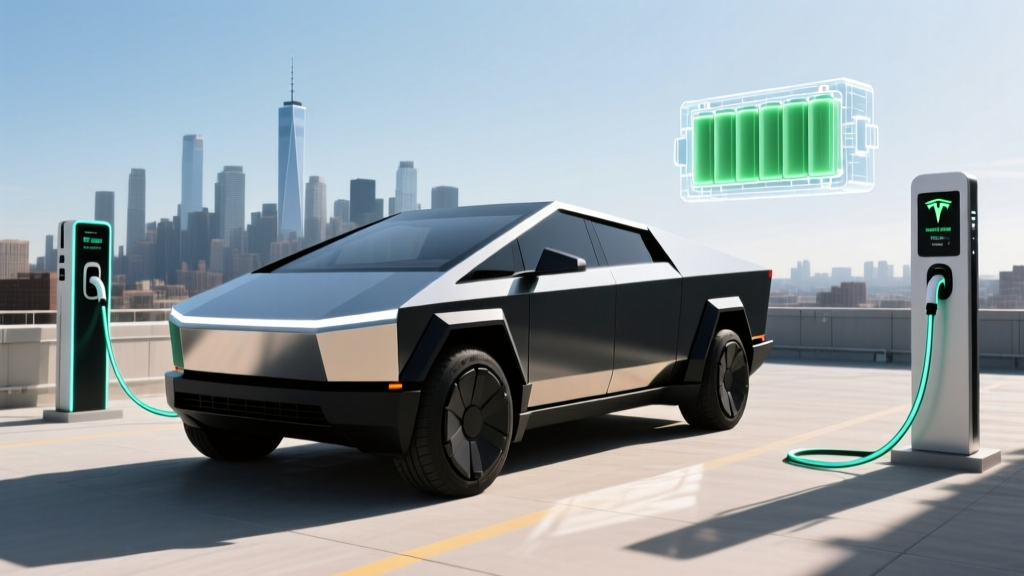
The Tesla Cybertruck has polarized the EV truck market since deliveries began, and by 2026, early adopters are facing a critical decision: hold onto their stainless-steel pickup or explore a Cybertruck trade-in to recoup value before depreciation accelerates. Whether you're weighing an upgrade to a refreshed model, switching to a competitor like the Rivian R1T or Ford F-150 Lightning, or simply cashing out, understanding the Cybertruck's real-world ownership economics is essential.
This review breaks down the Cybertruck's range, charging performance, pricing, tax-credit implications, and residual value factors that directly impact what you'll get on a trade-in. We'll also assess whether the truck's unique strengths—towing, off-road capability, and tech—justify holding onto it versus moving on.
Cybertruck Specs at a Glance: What You're Trading
| Attribute | Specification |
|---|---|
| EPA Range | 340 miles (AWD), 320 miles (Cyberbeast) |
| Battery Capacity | ~123 kWh usable (NMC chemistry) |
| Max DC Fast Charge | 250 kW peak (V3 Supercharger) |
| 10-80% Charge Time | ~28 minutes (DC fast) |
| Level 2 Home Charging | 11.5 kW (~34 miles/hr) |
| 0-60 mph | 4.1 sec (AWD), 2.6 sec (Cyberbeast) |
| Horsepower | 600 hp (AWD), 845 hp (Cyberbeast) |
| Drivetrain | Dual-motor AWD (tri-motor Cyberbeast) |
| Towing Capacity | 11,000 lbs |
| Cargo Volume (Bed) | 67 cu ft (with tonneau closed) |
| Efficiency | 2.0 kWh/mile (~50 MPGe combined) |
| Base MSRP (AWD) | $79,990 |
| Cyberbeast MSRP | $99,990 |
| Battery Warranty | 8 years / 120,000 miles |
Real-World Range: EPA Sticker vs. Highway Reality
EPA Estimated Range: 340 miles (AWD dual-motor), 320 miles (Cyberbeast tri-motor)
Real-World Expectation: Expect 270-300 miles on highway road trips at 70-75 mph. In cold weather (below 32°F), range drops 20-30%, yielding 230-270 miles. City driving with regenerative braking can approach or exceed EPA figures.
The Cybertruck's aerodynamic profile—despite its angular design—and heavy curb weight (~6,800 lbs) mean highway efficiency suffers. On a 300-mile road trip from Los Angeles to Las Vegas, you'll likely arrive with 10-15% state of charge remaining, requiring a fast-charge stop. Cold-weather testing in Colorado showed a 25% range penalty at highway speeds, consistent with other large EV pickups.
For daily commuting under 100 miles round-trip, the Cybertruck's range is more than adequate, and you'll rarely need to charge beyond 80% at home. But if your trade-in calculus depends on road-trip viability, know that the real-world range gap is significant.
Charging Performance: Fast Enough for Road Trips?
| Charging Level | Power (kW) | Miles Added per Hour | Notes |
|---|---|---|---|
| Level 1 (120V outlet) | 1.4 kW | ~4 miles/hr | Emergency/trickle only |
| Level 2 (240V home) | 11.5 kW | ~34 miles/hr | Full charge in ~11 hours |
| DC Fast (Tesla V3 Supercharger) | 250 kW peak | ~180 miles in 15 min | 10-80% in ~28 min; tapers above 80% |
| DC Fast (CCS adapter, non-Tesla) | 150-200 kW typical | Varies | Requires Tesla CCS adapter (included) |
The Cybertruck's 250 kW peak charge rate is solid but not class-leading—the Rivian R1T and Ford F-150 Lightning both support 200-220 kW, while the GMC Hummer EV peaks at 350 kW on compatible chargers. The charge curve tapers noticeably above 80% state of charge, so plan to charge to 80% and go rather than waiting for a full top-up.
At home, an 11.5 kW Level 2 charger (48-amp circuit, 60-amp breaker) adds about 34 miles of range per hour. A full overnight charge from 20% to 100% takes roughly 9-10 hours. Installation costs for a home Level 2 setup range from $800-$2,500 depending on panel capacity and wiring distance, per Tesla's home charging guide.
Pricing, Tax Credits, and Trade-In Value
| Trim | Base MSRP | Federal Tax Credit (§30D) | Effective Price (if eligible) |
|---|---|---|---|
| AWD Dual-Motor | $79,990 | $0 (exceeds MSRP cap) | $79,990 |
| Cyberbeast Tri-Motor | $99,990 | $0 (exceeds MSRP cap) | $99,990 |
Critical tax credit note: The Cybertruck does not qualify for the $7,500 federal EV tax credit under IRS §30D rules. The credit caps MSRP at $80,000 for trucks, and the Cybertruck AWD starts at $79,990—but destination fees and typical options push it over the threshold. The Cyberbeast, at $99,990, is ineligible regardless. Additionally, buyer income caps ($150,000 single / $300,000 joint) and battery-sourcing requirements apply.
For trade-in value, expect significant depreciation. Early Cybertrucks (2024-2025 models) have seen 25-35% value loss within the first two years, driven by high initial MSRP, limited tax incentives, and niche appeal. A 2024 AWD model with 30,000 miles might fetch $55,000-$62,000 on trade-in, depending on condition and market demand. Private-party sales can yield 10-15% more than dealer trade-ins.
Performance and Capability: What You're Giving Up
The Cybertruck's acceleration is brutal in the best way: 4.1 seconds to 60 mph in the AWD trim, and a supercar-rivaling 2.6 seconds in the Cyberbeast. The adaptive air suspension provides 12 inches of ground clearance in off-road mode and can lower for highway efficiency. Towing capacity is 11,000 pounds, competitive with the F-150 Lightning (10,000 lbs) and Rivian R1T (11,000 lbs).
The 6.5-foot bed (67 cu ft with the powered tonneau) is shorter than a traditional full-size pickup, but the stainless-steel exoskeleton and integrated ramp-like tailgate offer unique utility. The frunk adds 7 cu ft of lockable storage. However, the bed's narrow width (49 inches between wheel wells) limits sheet goods transport, and the tonneau's weight capacity is limited to 300 pounds distributed.
Driver-assist tech includes Tesla's Autopilot (SAE Level 2) and optional Full Self-Driving (Supervised), which handles highway lane-keeping and navigation but requires constant driver attention. It is not autonomous driving—only Level 4 robotaxi services like Waymo operate without human oversight.
Pros and Cons: The Trade-In Decision Framework
Reasons to Keep It
- Unmatched acceleration for a pickup (2.6 sec Cyberbeast)
- 11,000-lb towing with integrated trailer brake controller
- Stainless-steel body resists dents and corrosion
- Tesla Supercharger network reliability (17,000+ V3 stalls)
- Over-the-air updates add features (e.g., off-road modes, range improvements)
- 8-year/120,000-mile battery warranty (70% capacity retention)
Reasons to Trade In
- No federal tax credit eligibility (MSRP cap)
- Real-world highway range 20% below EPA (270-300 mi vs. 340 mi)
- High depreciation (25-35% in first 2 years)
- Bed narrower than competitors; tonneau weight limit
- Polarizing design limits resale buyer pool
- Insurance premiums 30-50% higher than F-150 Lightning
- Build-quality inconsistencies (panel gaps, 12V battery issues in early models)
Who Should Keep the Cybertruck (and Who Should Trade)
Keep it if: You tow frequently (boats, trailers, campers) and value the Cybertruck's 11,000-lb capacity and integrated towing tech. You live in a region with dense Supercharger coverage (West Coast, Texas, Florida) and take regular road trips. You use the truck for off-road recreation and appreciate the air suspension's 12-inch clearance. You bought at MSRP or below and can absorb the depreciation hit over 5+ years of ownership.
Trade it in if: You primarily commute under 50 miles daily and don't need a pickup bed—a Tesla Model Y or Hyundai Ioniq 5 offers better efficiency and lower operating costs. You're leasing and face mileage penalties or steep buyout costs. You need a full-size bed for work (construction, landscaping) and the Cybertruck's 6.5-foot bed is limiting. You're upside-down on financing and can roll negative equity into a more practical vehicle.
Cybertruck vs. Competitors: Trade-In Alternatives
| Attribute | Tesla Cybertruck AWD | Rivian R1T Dual-Motor | Ford F-150 Lightning Lariat |
|---|---|---|---|
| EPA Range | 340 mi | 352 mi (Max Pack) | 320 mi (Extended Range) |
| Base MSRP | $79,990 | $75,900 | $69,995 |
| Federal Tax Credit | $0 | $7,500 (if eligible) | $7,500 (if eligible) |
| 0-60 mph | 4.1 sec | 4.5 sec | 4.0 sec |
| Towing | 11,000 lbs | 11,000 lbs | 10,000 lbs |
| Bed Length | 6.5 ft | 4.5 ft (+ Gear Tunnel) | 5.5 ft |
| DC Fast Charge | 250 kW | 200 kW | 150 kW |
The Rivian R1T offers better range (with the Max Pack), qualifies for the federal credit, and has a more conventional pickup aesthetic—but its 4.5-foot bed is even shorter than the Cybertruck's, offset by the lockable Gear Tunnel. The F-150 Lightning is the value play: lower MSRP, tax credit eligibility, and a familiar full-size truck form factor, though its charging speed lags. If you're trading in a Cybertruck, the Lightning is the most financially rational switch, while the R1T appeals to adventure-focused buyers willing to pay a premium.
Frequently Asked Questions
What is the real-world range of the Tesla Cybertruck?
EPA estimates 340 miles for the AWD and 320 miles for the Cyberbeast, but real-world highway driving yields 270-300 miles. Cold weather (below freezing) reduces range by 20-30%, so expect 230-270 miles in winter conditions. City driving with regenerative braking can approach EPA figures.
How fast does the Cybertruck charge at home and on road trips?
At home on a Level 2 (240V, 11.5 kW) charger, it adds ~34 miles of range per hour, fully charging in ~11 hours. On DC fast chargers (Tesla V3 Supercharger), it peaks at 250 kW, reaching 10-80% in ~28 minutes. Above 80%, charging slows significantly to protect battery health.
Does the Cybertruck qualify for the federal EV tax credit?
No. Under IRS §30D rules, the Cybertruck exceeds the $80,000 MSRP cap for trucks (destination fees and options push the AWD trim over). Buyer income limits ($150,000 single / $300,000 joint) and battery-sourcing requirements also apply, but the MSRP cap is the primary disqualifier.
What is a Cybertruck worth on trade-in in 2026?
Expect 25-35% depreciation from MSRP for 2024-2025 models. A 2024 AWD with 30,000 miles might trade for $55,000-$62,000, depending on condition and market. Private-party sales can yield 10-15% more. High-mileage or damaged examples will see steeper losses.
Is it worth keeping the Cybertruck or trading it in?
Keep it if you tow frequently, use off-road capability, and plan to own it 5+ years to ride out depreciation. Trade it in if you primarily commute (a smaller EV is more efficient), need a larger bed for work, or are leasing with unfavorable terms. The F-150 Lightning offers better value and tax credit eligibility.
What are the biggest Cybertruck drawbacks?
No federal tax credit, real-world range 20% below EPA, high depreciation, narrow bed (49 inches between wheel wells), 300-lb tonneau weight limit, polarizing design limiting resale demand, and higher insurance costs (30-50% above F-150 Lightning). Early models had build-quality issues (panel gaps, 12V battery failures).
For official EPA range and efficiency data, see fueleconomy.gov. For NHTSA safety ratings and crash-test results, visit nhtsa.gov.