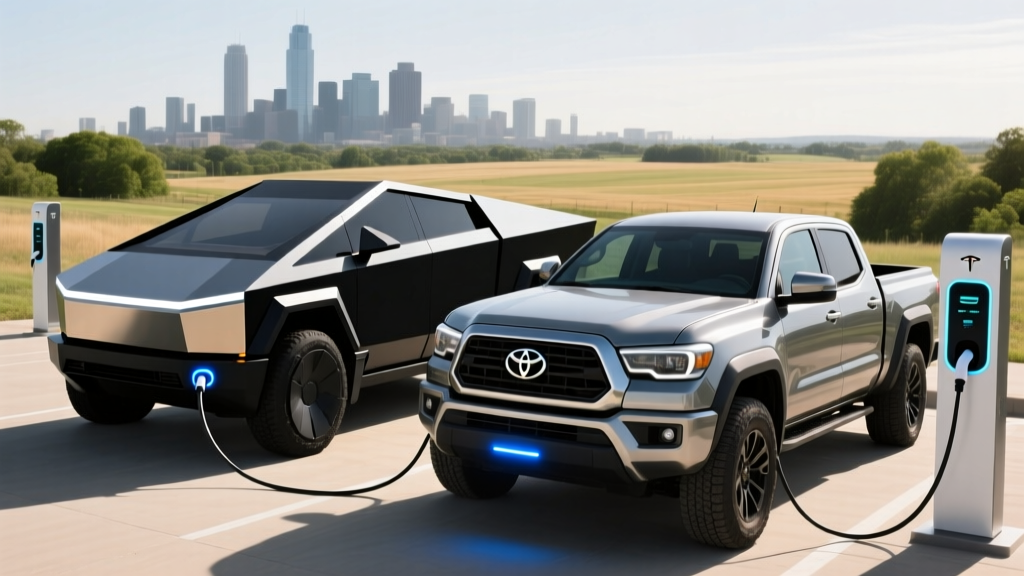
When buyers search for "cybertruck toyota," they're usually weighing Tesla's polarizing stainless-steel pickup against Toyota's legendary truck lineage — specifically the all-electric Tacoma EV, which Toyota confirmed for production in late 2025 with first deliveries beginning in early 2026. These two trucks target overlapping but distinct buyers: the Cybertruck leans tech-forward and performance-oriented, while the Tacoma EV banks on off-road credibility, dealer service networks, and Toyota's reliability reputation. Below, we break down every spec that matters to an EV truck buyer in 2026.
Range and Efficiency: EPA Stickers vs Real-World Miles
The Cybertruck's range story depends heavily on trim. The Dual Motor AWD carries an EPA-estimated 340 miles, while the tri-motor Cyberbeast drops to 320 miles due to its higher output and weight. The rear-wheel-drive base model (limited availability) targets 310 miles. Efficiency lands at approximately 48 MPGe combined, or roughly 70 kWh/100 miles — not class-leading, but respectable for a 6,800-pound stainless-steel wedge.
Toyota entered the EV truck segment with the 2026 Tacoma EV, built on its new electric body-on-frame platform. The standard-range pack targets an EPA-estimated 280 miles, while the extended-range battery pushes to approximately 330 miles. Efficiency figures hover near 52 MPGe combined (about 65 kWh/100 miles), aided by a more conventional aerodynamic profile than the Cybertruck's angular design.
Cybertruck AWD: EPA 340 mi — expect 270–290 mi at sustained 75 mph highway speeds, and 220–250 mi in sub-freezing weather without preconditioning. The stainless-steel exoskeleton retains cold, increasing cabin heating load.
Tacoma EV Extended Range: EPA 330 mi — expect 265–285 mi highway, 215–245 mi in cold weather. The Tacoma's more traditional shape yields slightly less aero drag penalty at speed than early Cybertruck prototypes showed, though real-world testing is still emerging for the 2026 model year.
Battery, Chemistry, and Longevity
Tesla equips the Cybertruck with an NMC (nickel-manganese-cobalt) structural battery pack with approximately 123 kWh of usable capacity. NMC offers higher energy density, critical for fitting enough cells into the Cybertruck's platform to hit 340 miles. However, NMC is more sensitive to sustained 100% state-of-charge storage and extreme heat exposure over time.
Toyota has not published exact kWh figures for the Tacoma EV at launch, but industry reports and teardown analysis suggest an extended-range pack near 105–110 kWh usable, likely using a mix of NMC and LFP chemistry depending on trim. Toyota's hybrid battery experience (over 25 years) informs its thermal management approach, and the company historically over-engineers battery buffers to minimize degradation. Toyota offers an 8-year/100,000-mile battery warranty with a 70% capacity retention threshold — matching Tesla's 8-year/120,000-mile warranty on the Cybertruck.
| Spec | Tesla Cybertruck AWD | Toyota Tacoma EV Ext. Range |
|---|---|---|
| EPA Range | 340 mi | ~330 mi (estimated) |
| Battery (usable) | ~123 kWh, NMC | ~105–110 kWh, NMC/LFP |
| Efficiency | 48 MPGe / 70 kWh/100mi | 52 MPGe / 65 kWh/100mi |
| Peak DC Charge | 250 kW | ~175 kW |
| 10–80% DC Time | ~28 min | ~35 min (est.) |
| Level 2 Rate | 11.5 kW (~44 mi/hr) | ~11 kW (~40 mi/hr) |
| 0–60 mph | 3.9 sec (AWD) | ~6.5 sec (est.) |
| Horsepower | 600 hp | ~380 hp (est.) |
| Drivetrain | Dual Motor AWD | Dual Motor AWD |
| Towing Capacity | 11,000 lbs | ~7,500 lbs (est.) |
| Bed Length | 6 ft (vault) | 5 ft (standard) |
| Cargo Volume (bed) | 74 cu ft | ~55 cu ft |
| Base MSRP | $79,990 (AWD) | ~$55,000 (est.) |
| Battery Warranty | 8 yr / 120,000 mi | 8 yr / 100,000 mi |
Charging Speed: DC Fast and Home Level 2
The Cybertruck supports up to 250 kW on Tesla's V3/V4 Superchargers and, with its NACS connector, can access the broader Supercharger network natively. In real-world testing, the Cybertruck peaks near 250 kW briefly around 15–20% SoC, then tapers significantly. Expect a 10–80% session in roughly 28 minutes under ideal thermal conditions. Preconditioning is essential — arriving at a Supercharger without navigation-routed battery prep can add 10+ minutes to your session.
The Tacoma EV launches with a CCS1 port, though Toyota has committed to adopting NACS on future models (likely 2027+). Peak DC charging is estimated at 175 kW, yielding a 10–80% time around 35 minutes. This is slower than the Cybertruck, but adequate for most road-trip scenarios when paired with the Tacoma's slightly smaller battery.
| Charging Level | Cybertruck | Tacoma EV |
|---|---|---|
| Level 1 (120V / 12A) | ~1.4 kW / ~3 mi/hr | ~1.4 kW / ~3 mi/hr |
| Level 2 (240V / 48A) | 11.5 kW / ~44 mi/hr | ~11 kW / ~40 mi/hr |
| DC Fast (peak) | 250 kW | ~175 kW |
| 10–80% DC Time | ~28 min | ~35 min |
| Connector | NACS (native) | CCS1 (adapter needed for NACS) |
| Network Access | Tesla Supercharger (17,000+ stalls) | Electrify America, EVgo, ChargePoint |
Home charging on a 48-amp Level 2 circuit (requiring a 60-amp breaker) will fully replenish the Cybertruck overnight in roughly 10–11 hours. The Tacoma EV, with its smaller pack, needs approximately 9–10 hours. If your electrical panel is already near capacity, budget $1,500–$3,000 for a panel upgrade before installing a hardwired Level 2 charger — a cost many buyers overlook.
Performance, Towing, and Off-Road Capability
The Cybertruck AWD's dual-motor setup delivers 600 horsepower and a 3.9-second 0–60 mph time — sports-car territory in a pickup. The Cyberbeast (tri-motor, 845 hp) drops that to 2.6 seconds. Towing capacity peaks at 11,000 pounds, though towing at max weight will cut range by 40–50% based on real-world truck-towing tests. The steer-by-wire system and rear-wheel steering give the Cybertruck a surprisingly tight turning radius for its size.
Toyota positions the Tacoma EV squarely in the off-road and lifestyle-adventure segment. Estimated output sits around 380 horsepower with a 0–60 time near 6.5 seconds — quick, but not Cybertruck-quick. Towing is estimated at 7,500 pounds. Where the Tacoma fights back is ground clearance (expected 12+ inches on TRD Off-Road trim), approach/departure angles, and a locking rear differential — credentials the Cybertruck's air suspension can match on paper but hasn't yet proven on trails at scale.
Pricing, Tax Credits, and Total Cost
The Cybertruck AWD starts at $79,990, with the Cyberbeast at $99,990. At these prices, the Cybertruck exceeds the IRS §30D MSRP cap of $80,000 for trucks — meaning the AWD trim barely qualifies (base MSRP just under the cap, but adding options pushes it over). Buyer income limits also apply: $300,000 for joint filers, $225,000 for heads of household, $150,000 for single filers. Battery sourcing and critical mineral requirements further complicate eligibility. Always verify current-year rules at IRS.gov before counting on a credit.
The Tacoma EV's estimated starting price of $55,000 (extended range likely $60,000–$65,000) falls comfortably under the $80,000 truck MSRP cap, making it a much stronger candidate for the full $7,500 federal credit — provided the buyer meets income limits and the battery sourcing requirements are satisfied at time of purchase. Point-of-sale transfer is available, allowing dealers to apply the credit directly as a price reduction.
| Cybertruck AWD | Tacoma EV Ext. Range | |
|---|---|---|
| Base MSRP | $79,990 | ~$62,000 (est.) |
| As-Tested (well-equipped) | $92,000+ | ~$68,000 (est.) |
| Federal §30D Credit | $0–$7,500 (MSRP cap risk) | Up to $7,500 (if sourcing rules met) |
| Effective Price (after max credit) | $72,490 (best case) | ~$54,500 (best case) |
| 5-Yr Charging Cost (15k mi/yr) | ~$5,250 | ~$4,875 |
| Estimated Insurance (annual) | $3,200–$4,500 | $1,800–$2,400 |
Insurance is a significant differentiator. Cybertruck premiums are among the highest in the EV segment due to repair costs for the stainless-steel body and limited collision-shop familiarity. The Tacoma EV should benefit from Toyota's established parts and service network, keeping insurance more in line with conventional midsize trucks.
Interior, Tech, and Daily Usability
The Cybertruck's cabin is minimalist and divisive. An 18.5-inch center touchscreen handles all vehicle functions (including glove-box access and mirror adjustment). There are no physical stalks — turn signals live on the yoke-style steering wheel, a choice that generates strong opinions. Rear-seat legroom is adequate at 38.4 inches, but the low roofline and steep bed wall make the rear seat feel more enclosed than a traditional crew cab. The 6-foot bed (Tesla calls it a "vault") includes 74 cubic feet of lockable storage plus a front trunk (frunk).
Toyota's approach is more conventional: physical knobs for climate and volume, a 14-inch infotainment screen, wireless Apple CarPlay and Android Auto, and a TRD-tuned off-road display with pitch/roll/inclinometer readouts. Crew-cab rear legroom is expected near 40 inches. The 5-foot bed trades capacity for maneuverability. Toyota's Safety Sense 3.0 suite (adaptive cruise, lane-keep, pre-collision) is standard — proven and reliable, if less flashy than Tesla's Autopilot.
Tesla's Autopilot and FSD (Supervised) are SAE Level 2 systems — the driver must remain fully attentive with hands on the wheel (or torque applied to the yoke) at all times. FSD can navigate on-ramps, stop lights, and parking, but it is not autonomous. Toyota Safety Sense is also Level 2. Neither system replaces an engaged driver.
Who Should Buy Which Truck?
- You need maximum towing capacity (11,000 lbs) and straight-line performance
- You live near Supercharger corridors and value native NACS network access
- Tech-forward features (steer-by-wire, air suspension, Powershare V2L/V2H) are priorities
- You accept higher insurance costs and polarizing styling as trade-offs
- Off-road capability, ground clearance, and trail credibility matter most
- You want a lower purchase price and stronger federal tax credit eligibility
- Dealer service access and predictable insurance costs are important
- You prefer conventional controls and Toyota's long-term reliability track record
- Best-in-class towing (11,000 lbs) and acceleration
- Native Supercharger access; no adapter needed
- Stainless-steel body resists dents and corrosion
- Steer-by-wire enables tight 35-foot turning circle
- High MSRP; tax credit eligibility uncertain
- Insurance premiums 40–80% above segment average
- Stainless steel shows fingerprints; cold to touch in winter
- Yoke steering and screen-only controls polarize owners
- Lower price; stronger §30D credit likelihood
- Proven off-road platform (TRD heritage)
- Conventional controls; easy service network
- Lower insurance and total ownership cost
- Slower DC charging (~175 kW peak)
- CCS1 port requires adapter for NACS chargers
- Lower towing capacity (~7,500 lbs)
- First model year — long-term reliability unproven for EV variant
Frequently Asked Questions
What is the real-world range of the Cybertruck vs the Tacoma EV?
The Cybertruck AWD delivers approximately 270–290 miles at highway speeds (75 mph) in moderate weather, dropping to 220–250 miles in freezing temperatures. The Tacoma EV extended range should achieve 265–285 miles highway, with similar cold-weather reduction. Always precondition the battery before long drives to minimize range loss.
How fast does each truck charge at home and on the road?
On a 48-amp Level 2 home charger, the Cybertruck adds roughly 44 miles per hour of charging; the Tacoma EV adds about 40 miles per hour. On DC fast chargers, the Cybertruck peaks at 250 kW (10–80% in ~28 minutes), while the Tacoma EV peaks near 175 kW (10–80% in ~35 minutes).
Does the Cybertruck qualify for the $7,500 federal EV tax credit?
It depends. The Cybertruck AWD's base MSRP of $79,990 is just under the IRS §30D $80,000 truck cap, but adding options or selecting the Cyberbeast ($99,990) exceeds the cap, disqualifying those configurations. Buyer income limits and battery critical-mineral sourcing rules also apply. Verify eligibility at IRS.gov and consult a tax professional.
Is the Tacoma EV worth buying over the Cybertruck?
For most buyers prioritizing value, off-road use, and predictable ownership costs, the Tacoma EV is the more practical choice. The Cybertruck wins on towing, performance, and charging infrastructure access — but at a significant price and insurance premium. Your use case (daily commuter vs. weekend trail rig vs. work truck) should drive the decision.
Can I charge a Tacoma EV at a Tesla Supercharger?
As of 2026, the Tacoma EV uses a CCS1 connector. Tesla has begun opening select Superchargers to non-Tesla EVs via the Magic Dock adapter, but full NACS compatibility requires a CCS-to-NACS adapter (available from Ford, Rivian, and third-party manufacturers). Toyota is expected to adopt NACS natively in 2027+.
How does cold weather affect these trucks?
Expect 25–35% range loss in sub-freezing temperatures for both trucks, primarily from cabin heating and battery chemistry slowdown. The Cybertruck's stainless-steel body retains cold more than aluminum or composite panels, increasing initial heating demand. Preconditioning while plugged in is the most effective mitigation — always enable scheduled departure in the vehicle's app.
For the latest EPA efficiency data, consult fueleconomy.gov, and for safety ratings as they become available, check NHTSA.gov and IIHS.org. Both trucks represent serious commitments to electric trucking — just aimed at different definitions of what a truck should be.