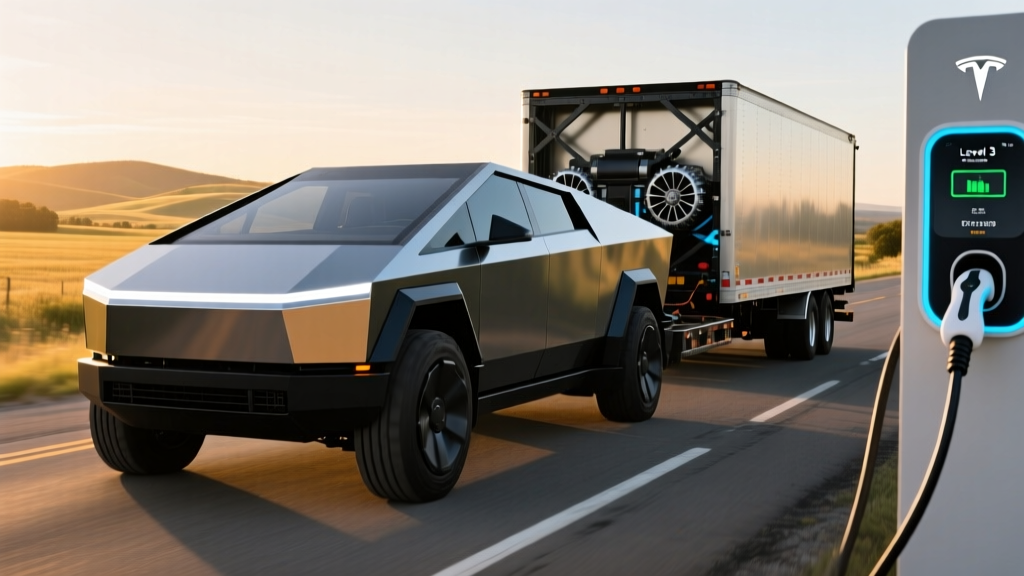
The Tesla Cybertruck has never been short on headlines, but the viral cybertruck towing fail clips — trucks struggling up grades, range collapsing on highway pulls, and trailers swaying on descents — deserve a hard, data-driven look. Below, we profile the 2025/2026 Cybertruck lineup (AWD and Cyberbeast; the long-delayed RWD trim remains unreleased) with exact EPA figures, battery chemistry, charging curves, and a no-spin take on what towing actually does to range, efficiency, and daily usability.
Real-World Range vs. EPA Sticker
EPA estimate: 340 miles (AWD), 320 miles (Cyberbeast) on 20-inch all-terrain tires.
Expect in practice: ~270–290 miles highway at 70 mph in mild weather; towing a 6,000-lb trailer, expect 140–180 miles before you're hunting for a Supercharger. Cold weather (below 32°F) shaves another 15–25% off unloaded range.
Range, Efficiency, and the Towing Reality
The Cybertruck AWD carries a usable battery capacity of approximately 123 kWh (NMC chemistry, 4680-format cells in a structural pack). Its EPA efficiency is rated at roughly 54 MPGe combined, which translates to about 60 kWh per 100 miles — among the least efficient light-duty EVs on sale, a direct consequence of its 6,600+ lb curb weight and angular stainless-steel aero profile.
That viral cybertruck towing fail footage is largely explained by physics, not a defect. Towing pushes consumption to 110–140 kWh/100mi depending on trailer weight, grade, and speed. At 75 mph with a 7,500-lb trailer, 340 EPA miles compresses to under 150 real miles. Tesla's own tow-range estimator (built into the nav) usually predicts this honestly — the "fail" videos tend to be drivers ignoring it or attempting mountain passes with a cold battery.
| Spec | AWD | Cyberbeast |
|---|---|---|
| EPA Range | 340 mi | 320 mi |
| Battery (usable) | ~123 kWh, NMC | ~123 kWh, NMC |
| MPGe (combined) | 54 | 52 |
| kWh / 100 mi | 60 | 63 |
| 0–60 mph | 3.9 sec | 2.6 sec |
| Horsepower | 600 hp | 845 hp |
| Drivetrain | Dual-motor AWD | Tri-motor AWD |
| Max Tow Rating | 11,000 lb | 11,000 lb |
| Payload | 2,500 lb | 2,500 lb |
Charging Speed: Supercharger and Home
Cybertruck uses the native NACS connector and is 800V-architecture capable, which lets it accept very high DC power. Peak rate is rated at ~350 kW at a V4 Supercharger, though the sustained curve is what matters: expect roughly 10–80% in 25–30 minutes at a 350 kW post, tapering sharply above 80% (as with all NMC packs).
At home on a Tesla Wall Connector (Level 2, 48A / 11.5 kW on a 60A circuit), you'll add about 30–33 miles per hour of charging. A full 0–100% on Level 2 takes roughly 11–13 hours — plan overnight top-offs, not quick midday refills, especially after a tow day.
| Level | Power | Speed | Typical Use |
|---|---|---|---|
| Level 1 (120V) | ~1.4 kW | ~4 mi/hr | Emergency / trickle |
| Level 2 (240V, 48A) | 11.5 kW | ~31 mi/hr | Home daily |
| DC Fast (V4 Supercharger) | up to 350 kW | 10–80% in ~27 min | Road trips, tow recovery |
Performance and Drivetrain
The AWD dual-motor setup delivers 600 hp and a 3.9-second 0–60 — absurd for a truck this heavy, and genuinely useful when merging with a trailer. Cyberbeast's tri-motor 845 hp and 2.6-second sprint is a party trick you'll almost never use. Both use torque-vectoring rear motors and steer-by-wire (48V architecture), which gives sharp low-speed maneuverability but an unusual on-center feel that takes a week to trust.
Towing stability is acceptable but not class-leading. The short bed (6-ft) and rear-biased weight distribution mean a heavy tongue load is critical; invest in a quality weight-distribution hitch. Regen braking on descents is excellent — one-pedal-style slowdown with a trailer is a genuine safety win versus an ICE truck's brake fade.
Pricing, Trims, and the §30D Tax Credit
For 2026, the Cybertruck lineup starts at $79,990 (AWD) and $99,990 (Cyberbeast), destination included. The long-promised RWD single-motor trim (~$60,990 MSRP) remains unreleased and is not currently orderable — treat any availability claim as preliminary.
Federal tax credit eligibility is the painful part. Under IRS §30D rules, the Cybertruck does not qualify for the new-vehicle credit:
- MSRP cap for vans/SUVs/pickups: $80,000. AWD trim technically squeezes under at $79,990, but…
- Battery component & critical-mineral sourcing: as of 2025/2026, Tesla's 4680 NMC pack does not meet the combined sourcing thresholds required for either the $3,750 component credit or the $3,750 mineral credit.
- Buyer income caps: $150k single / $300k MFJ — many Cybertruck buyers exceed these regardless.
Bottom line: budget the full MSRP. A used Cybertruck (2+ years old, under $25k — unlikely for years) could theoretically qualify for the up-to-$4,000 used-EV credit, but that market is effectively nonexistent today.
| Trim | Base MSRP | §30D Credit | Net Cost |
|---|---|---|---|
| AWD | $79,990 | $0 (sourcing) | $79,990 |
| Cyberbeast | $99,990 | $0 (MSRP + sourcing) | $99,990 |
| RWD (unreleased) | ~$60,990 | TBD | N/A |
Cargo, Interior, and Daily Practicality
The 6-ft vault (bed) offers 67 cu ft of lockable, weather-sealed space, plus a front trunk (frunk) with roughly 7 cu ft. Rear-seat legroom is generous at 41+ inches; headroom is tight for anyone over 6'2" due to the sloped roofline. The 18.5-inch center touchscreen runs Tesla's current infotainment stack, and the rear passengers get their own 9.4-inch touchscreen — a genuine differentiator for families.
Drawbacks are real: the stainless-steel body is a fingerprint magnet and expensive to repair; panel gaps remain inconsistent; visibility rearward is poor (the bed-mounted camera helps); and the steer-by-wire system has no mechanical backup, which unsettles some owners. NHTSA and IIHS ratings remain limited as of this writing — check both before purchase.
Pros
- Class-leading 11,000-lb tow rating on paper
- 350 kW peak DC charging — best-in-class
- Excellent regen braking with trailer
- Stainless vault is secure and weatherproof
- Tri-motor Cyberbeast performance is unmatched
Cons
- Real-world tow range is brutal (~150 mi)
- No federal §30D credit eligibility
- High curb weight hurts efficiency (60 kWh/100mi)
- Steer-by-wire takes adjustment
- Short bed limits conventional 5th-wheel/gooseneck use
Who Should Buy the Cybertruck (and Who Shouldn't)
Buy it if: you want a daily-drivable, high-performance electric truck for light-to-moderate towing (boat, small camper under 5,000 lb), you have reliable home Level 2 charging, and you accept ~150-mile tow-day range with planned Supercharger stops. It's also the right pick if the stainless design and tech-forward cabin genuinely appeal — no competitor matches the aesthetic or the screen real estate.
Skip it if: you regularly tow 7,500+ lb over 200-mile legs (consider a Ford F-150 Lightning Extended Range or a diesel for now), you need the $7,500 credit to justify the purchase, or you want proven long-term reliability data — the 4680 pack and steer-by-wire are still early in their lifecycle.
Warranty and Battery Longevity
Tesla covers the Cybertruck with a 4-year/50,000-mile basic warranty and an 8-year/120,000-mile battery and drive-unit warranty with a minimum 70% capacity retention threshold. That's competitive with the F-150 Lightning's 8/100,000 and slightly more generous on miles. NMC chemistry degrades faster than LFP if habitually charged to 100% — for daily use, set the limit to 80% and reserve 100% for tow days and road trips.
Frequently Asked Questions
What causes the cybertruck towing fail videos?
Most clips show range collapse, not mechanical failure. Towing at highway speed with a heavy trailer doubles or triples energy consumption, cutting a 340-mile EPA truck to ~150 real miles. Drivers who ignore the truck's built-in tow range estimator or attempt mountain passes without preconditioning end up stranded. It's a planning problem, not a powertrain defect.
Can the Cybertruck actually tow 11,000 lb?
Yes, mechanically — the motors, frame, and brakes are rated for it. The limitation is range: at 11,000 lb on a flat highway, expect under 100 miles between charges. For heavy towing, plan Supercharger stops every 80 miles or drop speed to 55–60 mph.
Does the Cybertruck qualify for the $7,500 federal tax credit?
No, as of 2026. The AWD trim's $79,990 MSRP technically fits the $80k pickup cap, but the battery's critical-mineral and component sourcing does not meet current IRS §30D thresholds. Budget the full MSRP and consult a tax professional for any state-level incentives.
How long does it take to charge a Cybertruck at home?
On a 48A Level 2 Wall Connector (~11.5 kW), a full charge takes roughly 11–13 hours, adding ~31 miles of range per hour. After a tow day that drains the pack, plan a full overnight charge.
Is Cybertruck better for towing than the F-150 Lightning?
On paper, Cybertruck has a higher tow rating (11,000 vs. 10,000 lb). In practice, the F-150 Lightning Extended Range (320 mi EPA, ~131 kWh usable) offers similar real-world tow range (~140–160 mi) with a more conventional truck layout, a longer bed, and — crucially — full §30D credit eligibility on qualifying trims. For serious towing, the Lightning is the more pragmatic choice today.