The Quick Verdict: Cybertruck Towing Capacity Explained
If you've been searching for exactly how much the Cybertruck can tow, the short answer is 11,000 pounds — but only on the AWD and Cyberbeast trims. The rear-wheel-drive base model, when it becomes broadly available, drops to 7,500 pounds. Those are impressive numbers on paper, rivaling full-size gas trucks like the Ford F-150 and Chevy Silverado 1500. But towing in an electric truck is a fundamentally different experience than towing in a gas truck, and the Cybertruck's unique architecture — stainless steel exoskeleton, 48-volt electrical system, and steer-by-wire — creates a set of trade-offs that every prospective buyer needs to understand before hitching up.
This review covers the Cybertruck's towing capability alongside the full ownership picture: real-world range (with and without a trailer), charging infrastructure, battery specs, pricing after federal tax credits, and how it stacks up against the Rivian R1T and Ford F-150 Lightning.
Full Cybertruck Spec Sheet: Range, Battery, Charging & Performance
| Specification | AWD (Dual Motor) | Cyberbeast (Tri Motor) |
|---|---|---|
| EPA Estimated Range | 340 miles | 320 miles |
| Real-World Range (highway/cold) | ~270–290 mi (highway); ~230–250 mi (cold) | ~255–275 mi (highway); ~220–240 mi (cold) |
| Battery Capacity (usable) | ~123 kWh (estimated, NMC) | ~123 kWh (estimated, NMC) |
| Max DC Fast Charge | 250 kW (V4 Supercharger) | 250 kW (V4 Supercharger) |
| 10–80% DC Charge Time | ~30 minutes | ~30 minutes |
| Level 2 Home Charging | 11.5 kW (~44 mi/hr) | 11.5 kW (~44 mi/hr) |
| 0–60 mph | 3.9 seconds | 2.6 seconds |
| Horsepower | 600 hp | 845 hp |
| Drivetrain | Dual Motor AWD | Tri Motor AWD |
| Max Towing Capacity | 11,000 lbs | 11,000 lbs |
| Payload Capacity | 2,500 lbs | 2,500 lbs |
| Bed Length | 6 ft (72 in) | 6 ft (72 in) |
| Cargo Volume (bed + frunk) | ~67 cu ft bed + ~7 cu ft frunk | ~67 cu ft bed + ~7 cu ft frunk |
| MPGe (combined) | ~79 MPGe (est.) | ~74 MPGe (est.) |
| Efficiency | ~48 kWh/100 mi | ~51 kWh/100 mi |
| Base MSRP (2026) | $79,990 | $99,990 |
| Battery/Powertrain Warranty | 8 years / 120,000 miles | 8 years / 120,000 miles |
Towing Deep Dive: What 11,000 Pounds Actually Looks Like
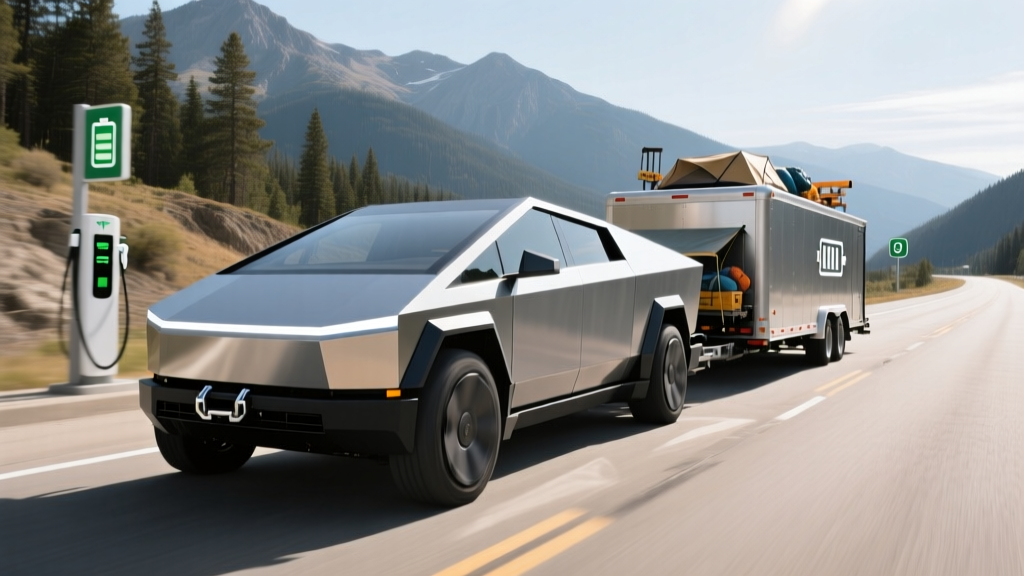
The Cybertruck's 11,000-pound maximum tow rating applies to the AWD and Cyberbeast trims and requires the integrated trailer hitch receiver. Tesla includes a Class IV hitch and a 7-pin connector as standard equipment. Here's how that capacity translates to real-world trailers:
- Small utility trailer (1,500–2,500 lbs): Minimal range impact, roughly 200–240 miles achievable.
- Mid-size travel trailer (4,000–6,000 lbs): Range drops to approximately 160–200 miles. This is the sweet spot for most Cybertruck owners towing a camper.
- Large travel trailer or boat (7,000–9,000 lbs): Expect 130–170 miles of range. Charging infrastructure near campgrounds becomes critical.
- Maximum-rated loads (10,000–11,000 lbs): Range falls to roughly 100–140 miles. Suitable for short hauls to a job site or dump station, not cross-country trips.
The Cybertruck's low center of gravity — the battery pack sits beneath the floor — gives it a stability advantage over body-on-frame gas trucks when towing. The adaptive air suspension automatically levels the truck when a trailer is connected, and the regenerative braking system helps slow the combined rig on descents, reducing brake wear.
However, there's a charging-infrastructure gap that no amount of engineering can solve: most DC fast-charging stations are not designed for pull-through towing. You will likely need to unhitch your trailer at many Supercharger and Electrify America stations, which adds 15–20 minutes to every stop. Tesla's V4 Supercharger cabinets are being deployed with some pull-through stalls, but availability remains limited as of 2026.
Charging Speed and Infrastructure: DC Fast, Home, and Towing Logistics
| Charging Level | Power (kW) | Miles Added per Hour | Typical Use Case |
|---|---|---|---|
| Level 1 (120V household) | ~1.4 kW | ~5 mi/hr | Emergency/trickle only |
| Level 2 (240V home) | 11.5 kW | ~44 mi/hr | Daily overnight charging |
| DC Fast (Tesla V4 Supercharger) | Up to 250 kW | ~600+ mi/hr (peak) | Road trips; 10–80% in ~30 min |
| DC Fast (CCS adapter at EA/others) | Up to 150–350 kW | Variable | Non-Tesla networks with NACS adapter |
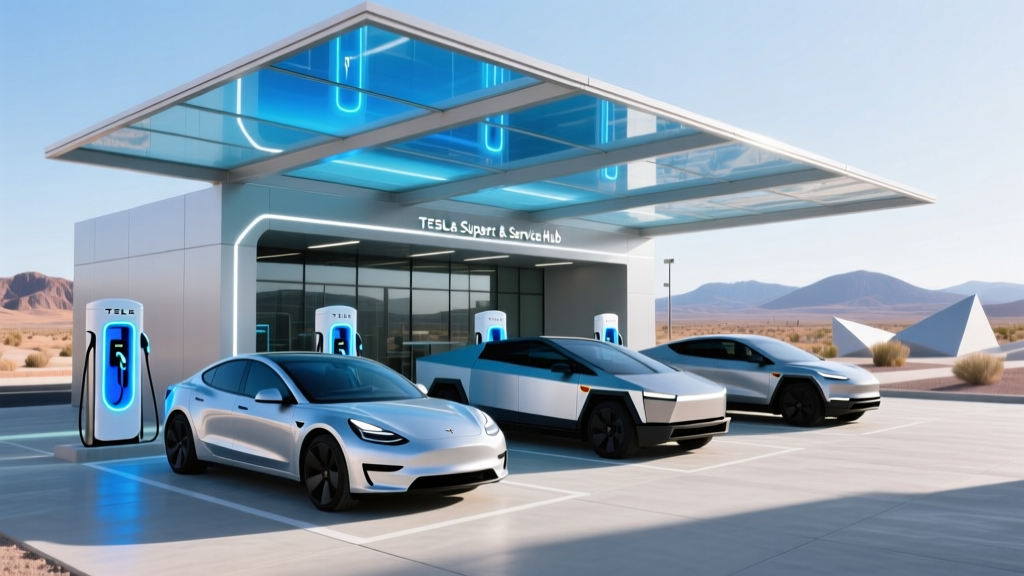
The Cybertruck uses Tesla's NACS (North American Charging Standard) connector natively. This is now the dominant standard in North America, and as of 2025–2026, most major automakers have adopted it. The Cybertruck can charge at Tesla Superchargers without an adapter and can access Electrify America, EVgo, and other networks using a CCS-to-NACS adapter (included with some trims or available separately).
A critical nuance for buyers: the Cybertruck's charge curve tapers significantly above 80% state of charge. The peak 250 kW rate is sustained roughly from 10% to 45% SoC; from 45–80%, the rate drops progressively to around 80–100 kW. Charging from 80–100% at a DC fast charger can take as long as the 10–80% portion. For daily driving, Tesla recommends setting the charge limit to 80% to preserve long-term battery health — the 123 kWh NMC battery will degrade less if you avoid routine 100% charges.
For home charging, a Level 2 wall connector on a 60-amp circuit (48-amp continuous) delivers the full 11.5 kW, replenishing the battery from empty in roughly 11 hours. Most owners who drive 40–60 miles daily will only need 3–5 hours of overnight charging. Installation costs for a home Level 2 charger typically range from $500 to $2,000 depending on panel capacity and wiring distance — consult a licensed electrician to assess whether your panel needs an upgrade to 200 amps.
Performance, Tech, and Daily Livability
The Cybertruck's performance figures border on absurd for a 6,800-pound vehicle. The Cyberbeast's 2.6-second 0–60 mph time beats most sports cars, and even the AWD model's 3.9 seconds is quicker than a base Porsche Cayenne. The tri-motor Cyberbeast uses one motor on the front axle and two on the rear, enabling torque vectoring that makes the truck feel nimble on twisty roads despite its mass.
The steer-by-wire system — there is no mechanical connection between the yoke and the wheels — is the most polarizing feature. At low speeds, the yoke requires very little rotation (roughly 340 degrees lock-to-lock), which makes parking lots easy but takes genuine adaptation. At highway speeds, the system firms up and feels precise. Most owners report adjusting within a week, but test-drive it before committing.
Inside, the 18.5-inch center touchscreen handles virtually every function — climate, media, navigation, vehicle settings, and even a front-row ventilated-seat toggle. The rear passengers get their own 9.4-inch touchscreen. The stainless steel interior trim and minimalist design won't appeal to everyone, but build quality on 2025–2026 models has improved significantly over the early 2024 production units that drew criticism for panel gaps and finish issues.
Cargo practicality: the 6-foot bed is shorter than a full-size F-150's 6.5-foot standard bed, but the motorized tonneau cover (standard) and lockable tailgate create a secure, weatherproof cargo area. The front trunk (frunk) holds about 7 cubic feet — enough for charging cables and a soft-sided cooler. The vault-style bed with integrated ramps can accommodate an ATV or dirt bike with the tailgate down.
On driver assistance, the Cybertruck ships with Tesla Autopilot (SAE Level 2) standard, which includes Traffic-Aware Cruise Control and Autosteer. Full Self-Driving (Supervised) is available as a paid add-on or subscription, but it remains a Level 2 system — the driver must keep hands on the yoke and eyes on the road at all times. It is not autonomous driving.
Pricing, Trims, and Federal Tax Credit Eligibility
| Trim | Base MSRP | Federal §30D Credit | Effective Price (if eligible) |
|---|---|---|---|
| AWD (Dual Motor) | $79,990 | $0 (exceeds MSRP cap) | $79,990 |
| Cyberbeast (Tri Motor) | $99,990 | $0 (exceeds MSRP cap) | $99,990 |
Here is where the Cybertruck faces a structural disadvantage: it does not qualify for the $7,500 federal EV tax credit under IRS §30D. The reason is straightforward — the IRS imposes an MSRP cap of $80,000 for vans, SUVs, and pickup trucks. The AWD Cybertruck at $79,990 squeaks under the cap on paper, but once destination fees and mandatory options are added, the effective price typically exceeds the threshold. The Cyberbeast at $99,990 is well above the limit.
Additionally, the §30D credit has buyer income caps (adjusted gross income of $150,000 single / $300,000 joint for 2026) and battery sourcing requirements for critical minerals and battery components that phase in progressively. Even if a Cybertruck trim fell under the MSRP cap, buyers must independently verify sourcing compliance on IRS.gov or with a tax professional.
The previously announced base RWD Cybertruck (estimated at ~$60,990) would likely qualify for the credit, but Tesla has delayed broad availability of this trim. As of early 2026, the AWD and Cyberbeast are the primary purchase options.
Cybertruck vs. Rivian R1T vs. Ford F-150 Lightning: Towing & Ownership Compared
If towing is your priority, here's how the Cybertruck stacks up against its two main electric-truck competitors:
- Tesla Cybertruck AWD: 11,000 lbs max tow, 340 mi EPA range, ~$79,990 base, no federal credit. Best for tech-forward buyers who want Supercharger network access and don't mind the yoke.
- Rivian R1T Dual Max: 11,000 lbs max tow, ~352 mi EPA range (Max Pack), ~$87,000+ base. Offers a more traditional truck experience, excellent off-road capability with quad-motor option, and a conventional steering wheel. No federal credit on most trims due to MSRP cap.
- Ford F-150 Lightning Lariat (Extended Range): 10,000 lbs max tow, ~320 mi EPA range, ~$69,995 base. Qualifies for the $7,500 federal credit on eligible trims, bringing the effective price to ~$62,495. Best value proposition for traditional truck buyers who want familiar ergonomics and dealer support. Check fueleconomy.gov for the latest EPA figures.
The F-150 Lightning's tax credit advantage is significant — a $7,500 price gap that the Cybertruck cannot close with performance alone. However, Tesla's Supercharger network remains the most reliable and extensive DC fast-charging ecosystem in North America, which matters heavily if you tow on road trips. Rivian sits in the middle: the R1T is the most capable off-roader and adventure vehicle, but its charging network relies on third-party providers plus Tesla access via adapter.
Pros, Cons, and Who the Cybertruck Is Really For
✅ Pros
- 11,000-lb towing capacity matches full-size gas trucks
- Supercharger network access — best DC charging ecosystem
- 2.6–3.9 second 0–60 mph performance is supercar-quick
- Stainless steel exoskeleton is dent- and corrosion-resistant
- Adaptive air suspension self-levels under trailer load
- 48-volt architecture enables future accessory integration
- 8-year/120,000-mile battery and drive unit warranty
❌ Cons
- No federal tax credit due to MSRP cap
- Range drops 50–60% when towing heavy trailers
- Steer-by-wire yoke requires adaptation and polarizes drivers
- 6-foot bed is shorter than most full-size trucks
- DC fast-charging stations rarely accommodate trailers (unhitching required)
- Premium pricing: $80K–$100K+ with no credit offset
- Early-production build quality issues may linger in perception
Who should buy the Cybertruck? Tech-enthusiast truck owners who want class-leading acceleration, Supercharger convenience, and a design statement — and who tow occasionally (5,000–7,000 lb campers or boats) rather than daily. If you tow heavy loads for work every day and need maximum value, the F-150 Lightning with its tax credit and dealer network is the pragmatic choice. If you want the best off-road adventure truck, the Rivian R1T earns that title.
Choose the Cybertruck if:
- You value Tesla's Supercharger network and software ecosystem
- You tow mid-size trailers (under 7,000 lbs) on weekends, not daily
- You want sports-car acceleration in a truck body
- You're comfortable with steer-by-wire and minimalist interiors
Choose the F-150 Lightning if:
- Federal tax credit eligibility matters ($7,500 savings)
- You prefer a traditional steering wheel, physical buttons, and dealer service
- You need a longer bed and maximum towing range per dollar
Choose the Rivian R1T if:
- Off-road capability and adventure touring are top priorities
- You want a conventional truck feel with modern EV performance
Frequently Asked Questions
What is the real-world range of the Cybertruck when towing?
Without a trailer, expect 270–290 miles on the highway in moderate weather (AWD trim). With a 5,000–7,000 lb travel trailer, range drops to roughly 150–180 miles. Heavier loads near the 11,000-lb maximum can push range below 140 miles. Aerodynamics of the trailer matter enormously — a boxy travel trailer creates more drag than a low-profile boat or flatbed.
How fast does the Cybertruck charge at home and on the road?
At home on a Level 2 charger (240V, 48A), the Cybertruck adds about 44 miles of range per hour, reaching a full charge in roughly 11 hours. On a Tesla V4 Supercharger at 250 kW peak, a 10–80% charge takes approximately 30 minutes, though the charge curve tapers significantly above 60% SoC — expect the 60–80% portion to be noticeably slower than the 10–40% portion.
Does the Cybertruck qualify for the $7,500 federal EV tax credit?
As of 2026, effectively no. The IRS §30D credit imposes an $80,000 MSRP cap on pickup trucks. The AWD Cybertruck's $79,990 base price technically falls under the cap, but destination charges and required options typically push the final sticker price above $80,000, disqualifying it. The Cyberbeast at $99,990 is well above the limit. Always verify current rules at IRS.gov and consult a tax professional before relying on credit eligibility.
Is the Cybertruck worth buying over the F-150 Lightning or Rivian R1T?
It depends on your priorities. The Cybertruck wins on acceleration, Supercharger network access, and futuristic design. The F-150 Lightning wins on value (federal tax credit, lower base price, dealer support) and traditional truck ergonomics. The Rivian R1T wins on off-road capability and adventure versatility. For pure towing capacity, all three are within 1,000 lbs of each other — the decision comes down to budget, charging preferences, and how you use the truck daily.
What is the Cybertruck's battery chemistry and warranty?
The Cybertruck uses an NMC (nickel manganese cobalt) lithium-ion battery pack with an estimated usable capacity of approximately 123 kWh. Tesla has not published the exact figure, but independent teardowns and range calculations support this estimate. The battery and drive unit are covered by an 8-year / 120,000-mile warranty, with Tesla guaranteeing a minimum of 70% capacity retention over that period. NMC chemistry offers higher energy density than LFP (lithium iron phosphate), which is why Tesla chose it for a vehicle that needs to balance range with a heavy curb weight and towing demands.
Can I use a weight-distribution hitch with the Cybertruck?
Tesla's official documentation for the Cybertruck permits the use of weight-distribution hitches, which are recommended for trailers above 5,000 lbs to maintain proper axle loading and steering feel. The air suspension system works in conjunction with the hitch to keep the truck level. Always follow the hitch manufacturer's torque specifications and the Cybertruck owner's manual guidelines for trailer wiring and brake controller setup.