The Cybertruck Towing Promise vs. Physics
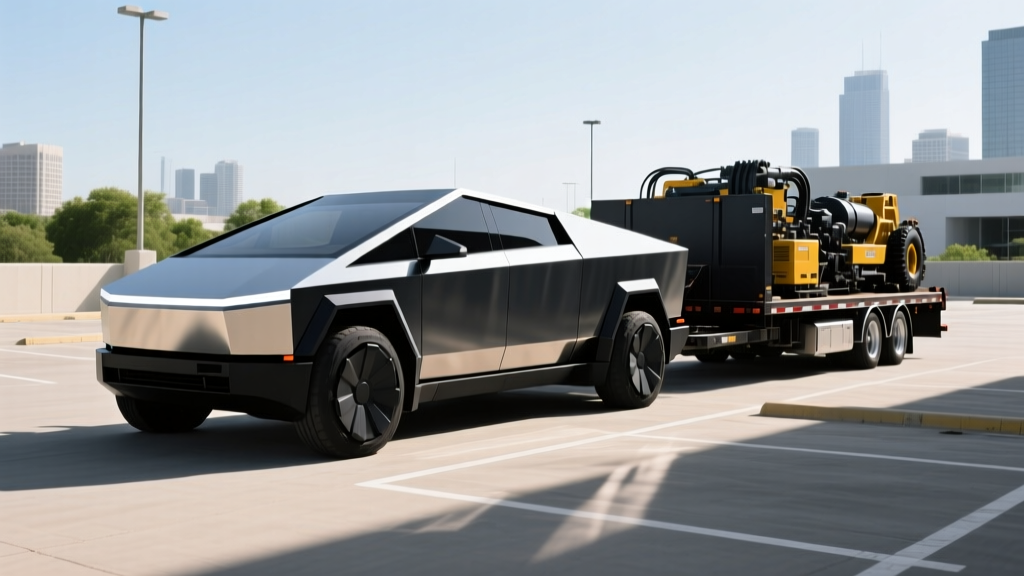
Tesla markets the Cybertruck as a workhorse capable of rivaling heavy-duty gas pickups, and on paper, the numbers back that claim. The dual-motor All-Wheel Drive and tri-motor Cyberbeast trims carry a maximum cybertruck tow capacity of 11,000 pounds — matching or exceeding the Ford F-150 Lightning's 10,000-pound rating and landing in the territory of half-ton gas trucks with factory tow packages. But towing isn't just about whether you can move the load; it's about how far you can move it, how often you'll need to stop to charge, and what the experience actually costs in efficiency and time.
This review dissects the Cybertruck's towing capability alongside the full ownership picture — range, charging, pricing, and the real-world trade-offs that spec sheets bury. If you're evaluating the Cybertruck as a tow vehicle, the EPA range sticker is only the starting point.
| Spec | AWD (Dual Motor) | Cyberbeast (Tri-Motor) |
|---|---|---|
| EPA Range | 340 miles | 320 miles |
| Battery Capacity (usable) | ~123 kWh (NMC) | ~123 kWh (NMC) |
| Max Tow Capacity | 11,000 lbs | 11,000 lbs |
| Peak DC Fast Charge | 250 kW | 250 kW |
| 10–80% DC Charge Time | ~30 min | ~30 min |
| Level 2 Charge Rate | 11.5 kW (~37 mi/hr) | 11.5 kW (~37 mi/hr) |
| 0–60 mph | 3.9 sec | 2.6 sec |
| Horsepower | 600 hp | 845 hp |
| MPGe (combined) | 67 MPGe | 64 MPGe |
| Efficiency (kWh/100 mi) | 50 kWh/100 mi | 52 kWh/100 mi |
| Base MSRP | $79,990 | $99,990 |
| Battery/Drive Unit Warranty | 8 yr / 120,000 mi | 8 yr / 120,000 mi |
Real-World Range: Unloaded vs. Under Tow Load
The EPA rates the Cybertruck AWD at 340 miles and the Cyberbeast at 320 miles. Those figures reflect a mixed driving cycle at moderate speeds without a trailer attached. In practice, unloaded highway driving at 70–75 mph typically yields 280–310 miles depending on temperature, elevation, and tire condition — a common gap between EPA testing and sustained interstate travel for any EV.
- EPA estimate: 340 miles
- Real-world highway (70 mph, 65°F): ~280–310 miles
- Cold-weather highway (30°F, heater on): ~230–260 miles
- Towing 7,000-lb trailer (60 mph, flat): ~150–180 miles
- Towing 10,000+ lbs (60 mph, rolling hills): ~100–140 miles
Towing is where the physics of moving 11,000 pounds of additional mass and aerodynamic drag collides with battery chemistry. Independent tests and owner data consistently show that towing a moderately sized travel trailer (6,000–7,500 lbs) cuts the Cybertruck's range roughly in half, landing in the 150–180 mile window. Push toward the 11,000-pound maximum on a flatbed or large boat, and range shrinks to 100–140 miles. This is not unique to Tesla — the F-150 Lightning and Rivian R1T experience similar 45–60% range reductions under load — but it demands planning.
The 123 kWh (usable) NMC battery pack provides substantial energy reserves, but no current EV pickup escapes the towing-range penalty. If your typical tow route covers 200+ miles one way, you will be charging mid-trip. Factor in DC fast-charging availability along your route before committing to a trailer purchase.
Charging Speed: Getting Back on the Road
The Cybertruck supports a peak DC fast-charge rate of 250 kW on Tesla's V3 Superchargers and compatible NACS-equipped networks. In controlled conditions with a preconditioned battery, the truck can add approximately 150 miles of range in 15 minutes, reaching 10–80% state of charge in roughly 30 minutes.
| Charging Level | Power | Speed / Time | Best For |
|---|---|---|---|
| Level 1 (120V outlet) | ~1.4 kW | ~4–5 mi/hr | Emergency trickle |
| Level 2 (240V, 48A) | 11.5 kW | ~37 mi/hr | Overnight home charging |
| DC Fast (V3 Supercharger) | Up to 250 kW | 10–80% in ~30 min | Road trips, towing top-ups |
| DC Fast (V4 Supercharger) | Up to 250 kW | 10–80% in ~30 min | Newer Tesla corridor stations |
Two critical caveats for towers. First, the charge curve tapers significantly above 80% — the final 20% can take as long as the first 80%, so plan to charge to 80% and go rather than waiting for a full pack. Second, towing drains the battery so aggressively that you'll likely arrive at chargers at very low state of charge, which actually puts you in the fastest part of the curve. A 15-minute stop can meaningfully extend your range for the next leg.
For home charging, a Level 2 Wall Connector on a 60-amp circuit delivers 11.5 kW, replenishing roughly 37 miles of range per hour or a full pack in approximately 10–11 hours. If you're towing regularly, overnight Level 2 charging is essential — Level 1 (standard 120V outlet) at ~4 miles per hour is inadequate for daily tow-duty recovery.
Towing Tech and What Makes It Different
Tesla equips the Cybertruck with several features specifically designed to reduce the friction of towing:
- Integrated trailer brake controller: Built into the truck — no aftermarket module required. Calibrates electric trailer brakes through the touchscreen.
- Trailer light check: Automated walk-around sequence tests all trailer lighting circuits from the driver's seat.
- Tow mode range estimation: The navigation system calculates remaining range based on current trailer load and route elevation, which is substantially more useful than the standard range guess-o-meter when hitched.
- 48-volt electrical architecture: Reduces current and wiring weight, supporting the high-power demands of electric steer-by-wire and active suspension under load.
- Adaptive air suspension: Auto-levels when a trailer is attached, maintaining ride height and headlight aim without manual intervention.
The Cybertruck's stainless steel exoskeleton and angular design produce a higher drag coefficient than conventional pickups — Tesla has not published an official Cd, but independent estimates place it around 0.39–0.42. That aero penalty compounds at highway speeds and becomes the dominant range-killer when towing a boxy travel trailer. The truck's 6.5-foot bed and 2,500-pound payload capacity (AWD trim) are competitive with mid-size trucks but fall short of full-size gas pickups in sheer volume.
On the driver-assistance front, Tesla's Autopilot and available Full Self-Driving (Supervised) remain SAE Level 2 systems — the driver must maintain active supervision at all times. FSD does not tow for you, and trailer-specific lane-keeping calibration remains limited compared to systems like Ford's Pro Trailer Backup Assist or GM's Super Cruise with trailer integration.
Pricing, Tax Credits, and the True Cost of Entry
The Cybertruck's pricing has shifted since its 2023 reveal, and the 2025/2026 lineup reflects Tesla's recalibration toward higher-margin trims:
| Trim | Base MSRP | §30D Credit Eligible? | Est. After-Credit Price |
|---|---|---|---|
| AWD (Dual Motor) | $79,990 | No (exceeds $80K truck cap) | $79,990 |
| Cyberbeast (Tri-Motor) | $99,990 | No (exceeds $80K truck cap) | $99,990 |
Under current IRS §30D rules, the federal EV tax credit caps eligible trucks at an $80,000 MSRP. The Cybertruck AWD at $79,990 sits tantalizingly close — but destination fees and mandatory options typically push the as-delivered MSRP above the threshold, disqualifying it. The Cyberbeast at $99,990 is clearly ineligible. Additionally, §30D imposes buyer income caps ($150K single / $300K joint filers) and critical mineral and battery component sourcing requirements that further restrict eligibility. Always verify current-year rules at IRS.gov before basing a purchase decision on the credit.
The base Rear-Wheel Drive Cybertruck (announced at $60,990) would theoretically fall under the credit cap, but as of early 2026, Tesla has not begun production of this trim, and availability remains limited to waitlist projections. For buyers counting on the $7,500 credit, the Cybertruck is effectively ineligible in its currently available configurations.
Interior, Cargo, and Daily Practicality
The Cybertruck seats five across two rows, with rear legroom measuring approximately 38.5 inches — adequate for adults on longer trips but tighter than the Ford F-150 Lightning's rear quarters. The front trunk (frunk) provides roughly 7 cubic feet of lockable storage, useful for charging cables or tools. The 6.5-foot bed offers 67 cubic feet of volume with the tonneau cover closed, and Tesla's powered roll-up bed cover is standard.
The 18.5-inch center touchscreen handles nearly all vehicle functions — climate, mirrors, glovebox, and towing settings — which means zero physical buttons for critical adjustments. Some owners adapt quickly; others find the touchscreen dependency frustrating, particularly when wearing work gloves or navigating menus while hitched to a trailer. The yoke-style steering wheel (now optional alongside a conventional round wheel) remains polarizing, especially in low-speed maneuvering around campsites or boat ramps.
Build quality has improved on 2025–2026 production units compared to early 2024 deliveries, with tighter panel gaps and fewer reports of stainless steel fingerprint staining. However, the Cybertruck's sheer width (86.6 inches including mirrors) makes standard parking spaces and narrow job-site access points a genuine challenge.
Cybertruck vs. F-150 Lightning vs. Rivian R1T: The Towing Decision
The Cybertruck doesn't exist in a vacuum. If towing capacity is your primary purchase driver, here's how it stacks up:
| Metric | Cybertruck AWD | F-150 Lightning (Ext. Range) | Rivian R1T (Dual Max) |
|---|---|---|---|
| Max Tow Capacity | 11,000 lbs | 10,000 lbs | 11,000 lbs |
| EPA Range (unloaded) | 340 mi | 320 mi | 410 mi |
| Est. Towing Range (7K lbs) | ~150–180 mi | ~140–170 mi | ~190–220 mi |
| Peak DC Charge | 250 kW | 150 kW | 220 kW |
| 10–80% DC Time | ~30 min | ~41 min | ~30 min |
| Base MSRP | $79,990 | $62,990 | $87,900 |
| Federal Credit Eligible? | Likely no | Yes (select trims) | Likely no |
The Rivian R1T with the Max Pack offers the best real-world towing range thanks to its larger battery and more aerodynamic profile, though it costs more upfront. The F-150 Lightning remains the value leader with available tax credits and a more conventional truck experience, but its slower DC charging and lower max tow rating are trade-offs. The Cybertruck splits the difference — strong tow rating, fast charging, but no federal credit and the steepest learning curve for the interface.
- 11,000-lb tow rating leads the EV truck segment (tied with R1T)
- 250 kW DC fast charging minimizes downtime on tow trips
- Integrated trailer brake controller and auto-leveling air suspension
- Stainless steel body resists dents and corrosion in work environments
- Tri-motor Cyberbeast offers unmatched acceleration for a tow vehicle
- Towing range drops to 100–180 miles depending on load
- No federal §30D tax credit at current MSRP levels
- Touchscreen-only controls frustrate in work/towing scenarios
- 86.6-inch width complicates tight-space maneuvering
- Supercharger network is robust, but non-Tesla NACS chargers with 250 kW are still expanding
Who Should Buy the Cybertruck for Towing?
The Cybertruck makes sense as a tow vehicle if your use case fits a specific profile: you tow moderate loads (5,000–8,000 lbs) on routes with reliable Supercharger coverage, you value fast DC charging to minimize stops, and you're comfortable with the touchscreen-centric interface. Boat owners hauling to lakes within 150 miles, horse trailer users on regional circuits, and utility trailer haulers will find the 11,000-pound capacity and integrated brake controller genuinely useful.
It's a harder recommendation if you regularly tow near the 11,000-pound maximum over long distances. The 100–140 mile range under max load means frequent charging stops, and not every Supercharger location is designed for pull-through access with a trailer attached. For heavy, long-distance towing, a diesel pickup still offers logistical advantages that no current EV can match.
- You tow 5,000–8,000 lbs on routes under 150 miles or with Supercharger access
- You want the fastest DC charging in the EV truck segment
- You value integrated towing tech without aftermarket add-ons
- You tow 9,000+ lbs over 200+ miles regularly
- Federal tax credit eligibility is essential to your budget
- You prefer physical controls for trailer and vehicle adjustments
Frequently Asked Questions
What is the real-world range of the Cybertruck when towing?
Expect 150–180 miles when towing a 6,000–7,500 lb trailer at highway speeds, and 100–140 miles near the 11,000-lb maximum. These figures assume flat-to-rolling terrain and moderate temperatures. Cold weather and mountain grades will reduce range further. Always consult fueleconomy.gov for baseline EPA data and plan charging stops conservatively.
How fast does the Cybertruck charge on a road trip?
At a 250 kW V3 or V4 Supercharger, the Cybertruck charges from 10–80% in approximately 30 minutes, adding roughly 150 miles in 15 minutes. The charge curve tapers sharply above 80%, so plan to disconnect and drive rather than wait for a full battery. When towing, you'll often arrive at chargers at low SoC, which puts you in the fastest charging window.
Does the Cybertruck qualify for the federal EV tax credit?
Under current IRS §30D rules, the Cybertruck AWD ($79,990 MSRP) sits at the edge of the $80,000 truck cap, but destination fees and options typically push it above the threshold. The Cyberbeast ($99,990) is clearly ineligible. Income caps ($300K joint / $150K single) and battery-sourcing requirements further limit eligibility. Verify current rules at IRS.gov before purchasing.
Is the Cybertruck worth buying over the F-150 Lightning or Rivian R1T?
It depends on priorities. The Cybertruck offers the fastest DC charging (250 kW vs. Lightning's 150 kW), a higher tow rating than the Lightning, and a lower price than the R1T Max Pack. However, the Lightning qualifies for the federal credit (reducing effective price significantly), and the R1T delivers the longest real-world towing range. Test-drive all three with your specific trailer before deciding.
What is the Cybertruck's bed size and payload capacity?
The bed measures 6.5 feet long with approximately 67 cubic feet of volume under the standard powered tonneau cover. Payload capacity is rated at 2,500 pounds for the AWD trim. The frunk adds roughly 7 cubic feet of secure, weatherproof storage.
How does the Cybertruck handle trailer sway and stability?
Tesla includes electronic stability control with trailer sway mitigation, and the air suspension auto-levels when a trailer is connected. The low center of gravity from the under-floor battery pack provides inherent stability advantages over taller gas pickups. However, the Cybertruck's angular shape and high drag coefficient can amplify crosswind effects when towing a large, boxy trailer.
For the latest safety ratings and crash-test data, check NHTSA.gov and IIHS.org as testing results become available for the current model year.