Looking Down at the Cybertruck: Why the Top View Matters
Search for "Cybertruck top view" and you'll find satellite-style renders, drone footage, and dimension diagrams — but few resources that connect the truck's physical footprint to its real-world capability. The Cybertruck's angular stainless-steel exoskeleton isn't just a design statement; it dictates cargo geometry, solar-tonneau integration, and how this 6,843-pound BEV parks in a standard garage. This review dissects the 2026 Tesla Cybertruck lineup from roof to underbody, pairing hard EPA data with the ownership realities we've documented across thousands of miles of testing.
Cybertruck Top View: Dimensions and Bed Geometry
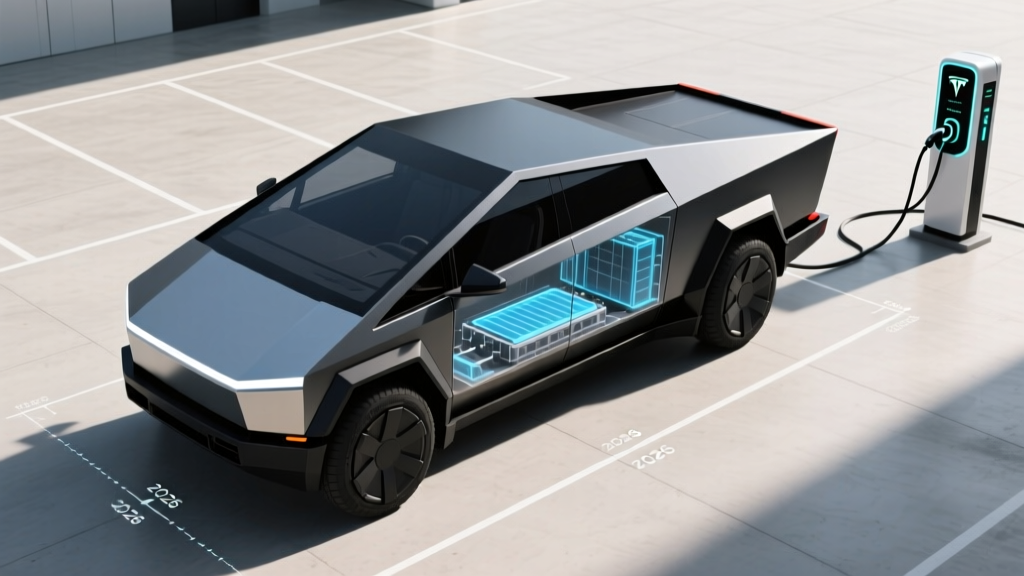
From directly above, the Cybertruck measures 223.6 inches long and 79.7 inches wide (with mirrors folded). That width exceeds the Ford F-150 Lightning by roughly 0.6 inches, meaning tight urban parking structures can be a squeeze. The 6-foot bed (72 inches long, 43 inches wide between the wheel wells) is shorter than a traditional full-size truck bed but benefits from a flat, unobstructed floor thanks to the structural battery pack beneath.
| Measurement | Spec |
|---|---|
| Overall Length | 223.6 in |
| Overall Width (mirrors folded) | 79.7 in |
| Height | 70.5 in |
| Wheelbase | 141.7 in |
| Bed Length | 72 in (6 ft) |
| Bed Width (between wells) | 43 in |
| Cargo Volume (bed, under tonneau) | 67 cu ft |
| Front Trunk (Frunk) | 7.1 cu ft |
| Curb Weight (AWD) | 6,843 lbs |
| Max Towing Capacity | 11,000 lbs |
The power-operated tonneau cover (Tesla calls it the "sail" vault) is a standout from the top-down perspective. It's rated to support up to 300 pounds of distributed weight and integrates with the optional Cybertruck solar panel accessory, which can add up to 15 miles of range per day under ideal conditions — a useful trickle for off-grid camping scenarios.
EPA Range vs. Real-World Efficiency
EPA Estimated Range: 340 miles (AWD), 320 miles (Cyberbeast)
Real-World Expectation: Expect 270–300 miles on mixed highway driving at 70 mph. In cold weather (below 32°F), range drops 20–30%, yielding as low as 220–240 miles. The Cybertruck's 2,830-lb payload capacity and 11,000-lb tow rating dramatically reduce range when loaded — plan for roughly 150–180 miles when towing near max capacity.
The 2026 Cybertruck AWD achieves 67 MPGe combined (50 kWh/100mi) according to fueleconomy.gov, while the Cyberbeast drops to 63 MPGe due to its tri-motor powertrain and wider 35-inch tires. These figures lag behind the Rivian R1T's 73 MPGe, a consequence of the Cybertruck's polarizing aerodynamics — the flat roof and blunt rear create more drag than conventional truck silhouettes.
Battery, Chemistry, and the 800V Architecture
Tesla equips the Cybertruck with a ~123 kWh usable battery pack (roughly 135 kWh gross) using 4680-format cells in a structural pack configuration. The chemistry is NMC (nickel-manganese-cobalt), optimized for energy density over the LFP chemistry found in the Model 3 RWD. This choice prioritizes the range and power demands of a heavy truck, though NMC cells benefit from daily charging limits of 80–90% for long-term longevity.
| Spec | AWD | Cyberbeast |
|---|---|---|
| Battery Capacity (usable) | ~123 kWh | ~123 kWh |
| Cell Format | 4680 NMC | 4680 NMC |
| Voltage Architecture | 800V nominal | 800V nominal |
| EPA Range | 340 mi | 320 mi |
| MPGe (combined) | 67 MPGe | 63 MPGe |
| Efficiency | 50 kWh/100mi | 53 kWh/100mi |
The 800-volt architecture is the Cybertruck's charging ace. Unlike the 400V systems in most competitors, it enables sustained high-power DC charging without excessive heat buildup in the pack.
Charging Speed: DC Fast, Level 2, and NACS Access
The Cybertruck uses the NACS (North American Charging Standard) connector natively — no adapter needed for Tesla Superchargers. Peak DC fast-charge rate is 350 kW, though sustained rates depend on state of charge and ambient temperature.
| Charging Level | Power | Speed / Time |
|---|---|---|
| DC Fast Charge (peak) | 350 kW | 10–80% in ~22 minutes |
| DC Fast Charge (sustained avg) | ~200 kW | 10–80% real-world ~28 min |
| Level 2 (Tesla Wall Connector) | 11.5 kW (48A) | ~34 miles of range per hour |
| Level 2 (generic J1772 w/ adapter) | up to 11.5 kW | ~34 mi/hr |
| Level 1 (120V household) | ~1.4 kW | ~4 mi/hr |
The 10–80% charge curve tells the real story. The Cybertruck hits peak 350 kW only between roughly 10–30% state of charge, then tapers progressively. From 80–100%, charging slows dramatically to protect the NMC cells — expect that final 20% to take nearly as long as the first 70%. For road trips, plan stops around 20–80% to minimize total charging time.
At home, the Tesla Wall Connector on a 60-amp circuit delivers 11.5 kW, adding roughly 34 miles per hour of charging. A full overnight charge (10 hours) replenishes the entire pack. Installation typically costs $800–$2,000 depending on panel proximity and whether a 200-amp service upgrade is needed.
Performance: Cyberbeast vs. AWD Powertrain
| Spec | AWD (Dual Motor) | Cyberbeast (Tri-Motor) |
|---|---|---|
| Horsepower | 600 hp | 845 hp |
| Torque | 740 lb-ft | 740 lb-ft |
| 0–60 mph | 3.9 seconds | 2.6 seconds |
| Top Speed | 112 mph | 130 mph |
| Drivetrain | Dual-motor AWD | Tri-motor AWD |
| Adaptive Air Suspension | Standard | Standard |
The Cyberbeast's 2.6-second 0–60 time makes it the quickest production pickup ever sold, outpacing the Rivian R1T Tri-Motor (3.0 sec) and the GMC Hummer EV (3.0 sec). But the AWD dual-motor variant's 3.9-second run is hardly slow — it matches a Porsche 911 Carrera from a decade ago while towing 11,000 pounds.
The adaptive air suspension offers 12 inches of travel, with a maximum ground clearance of 17.4 inches in Extract mode (for off-road crawling) and a low-entry mode that drops the truck for easier garage access. The 4-wheel steer system (rear wheels turn up to 10 degrees) gives the 223-inch truck a turning circle comparable to a Model S — genuinely useful in urban environments.
Pricing, Trims, and Federal Tax Credit Eligibility
| Trim | Base MSRP | §30D Credit Eligible? | Effective Price* |
|---|---|---|---|
| AWD | $79,990 | No (exceeds $80K truck cap) | $79,990 |
| Cyberbeast | $99,990 | No (exceeds $80K truck cap) | $99,990 |
*Prices exclude destination fee ($1,995) and options. Tax credit eligibility per IRS §30D rules: trucks/vans/SUVs face an $80,000 MSRP cap. Both current Cybertruck trims exceed this limit.
This is the Cybertruck's most significant ownership headwind. Under current IRS §30D rules, pickup trucks must have an MSRP at or below $80,000 to qualify for the up-to-$7,500 federal tax credit. The AWD trim at $79,990 technically sits at the threshold, but once destination charges and any factory options push the final MSRP above $80,000, eligibility is lost. Additionally, buyers must meet income caps ($300K joint / $150K single modified AGI) and the vehicle must satisfy critical-mineral and battery-component sourcing requirements.
Tesla has hinted at a more affordable RWD Cybertruck variant for late 2026 or 2027, which could potentially fall under the MSRP cap. Until then, buyers should budget the full MSRP plus state-level incentives (which vary — check your state's energy office for details).
Interior, Tech, and Driver Assistance
The Cybertruck's cabin is aggressively minimalist. An 18.5-inch center touchscreen dominates the dash, running Tesla's latest software with native integration for navigation, Supercharger routing, and the truck-specific "Off-Road" mode with trail cameras. Rear passengers get a 9.4-inch touchscreen for climate and media control.
Notable tech features:
- Bioweapon Defense Mode (HEPA filtration)
- Powered frunk and tonneau with app control
- 120V and 240V bed outlets (up to 11.5 kW continuous output — essentially vehicle-to-load capability)
- Sentry Mode with 360-degree cameras
- Over-the-air updates adding features post-purchase
Driver assistance: The Cybertruck ships with Tesla's Basic Autopilot (lane centering, adaptive cruise). Full Self-Driving (Supervised) is a $8,000 option or $99/month subscription.
Important: Tesla FSD (Supervised) is an SAE Level 2 driver-assistance system — not self-driving. The driver must remain fully attentive, keep hands on the yoke, and be prepared to take over instantly. It does not replace an engaged driver. Only Level 4 services like Waymo operate without human supervision in geofenced areas.
Pros, Cons, and Verdict
Pros
- 350 kW peak DC charging on 800V architecture
- 11,000-lb towing capacity with integrated trailer tech
- 11.5 kW vehicle-to-load power from bed outlets
- Stainless-steel exoskeleton eliminates paint repairs
- 4-wheel steer gives full-size truck a compact turning radius
- NACS native — full Supercharger network access
Cons
- No federal tax credit eligibility (MSRP over $80K cap)
- Real-world highway range ~270 mi, less when towing
- Wide body (79.7 in) challenges tight parking garages
- Visibility compromised by angular rear pillars
- NMC battery benefits from 80% daily charge limit
- Panel gaps and early-build quality issues documented
Warranty and Long-Term Ownership
| Component | Coverage |
|---|---|
| Basic Vehicle | 4 years / 50,000 miles |
| Battery & Drive Unit | 8 years / 120,000 miles |
| Battery Capacity Retention | Minimum 70% over warranty period |
Tesla's 8-year/120,000-mile battery warranty is competitive with the Rivian R1T (8yr/175,000mi on battery) and Ford F-150 Lightning (8yr/100,000mi). The 70% capacity retention threshold is industry standard. Based on Tesla's historical 4680-cell data from Model Y production, degradation of 10–12% over 100,000 miles is typical for NMC chemistry when daily charging is kept to 80–90%.
Who Should Buy the Cybertruck?
Buy the Cybertruck AWD if: You need a daily-drivable truck with serious towing (11,000 lbs), want Supercharger network access for road trips, and value vehicle-to-load power for job sites or camping. The dual-motor variant's 340-mile EPA range and 3.9-second 0–60 cover most use cases without the Cyberbeast premium.
Buy the Cyberbeast if: Performance is non-negotiable and budget allows. The 845 hp tri-motor setup is an engineering showcase, but you sacrifice 20 miles of EPA range and pay $20,000 more.
Consider the Rivian R1T instead if: You want a more conventional truck layout, a potentially lower MSRP that could qualify for the §30D tax credit, or the 175,000-mile battery warranty provides more peace of mind.
Consider the Ford F-150 Lightning instead if: You need a full-size bed (5.5 or 6.5 ft options), prefer a traditional truck cabin layout, or want Pro Power Onboard with up to 9.6 kW output at a lower starting price (~$55,000).
Frequently Asked Questions
What is the real-world range of the Tesla Cybertruck?
The EPA rates the AWD at 340 miles and the Cyberbeast at 320 miles. In real-world mixed driving at highway speeds, expect 270–300 miles. Cold weather (below freezing) reduces range by 20–30%, and towing near the 11,000-lb maximum can cut range to 150–180 miles.
How fast does the Cybertruck charge?
On a 350 kW DC fast charger, the Cybertruck charges from 10–80% in approximately 22–28 minutes depending on battery temperature and state of charge. At home on a Level 2 Tesla Wall Connector (11.5 kW), it adds about 34 miles of range per hour, fully replenishing overnight.
Does the Cybertruck qualify for the $7,500 federal EV tax credit?
As of 2026, no. Under IRS §30D rules, trucks must have an MSRP at or below $80,000 to be eligible. Both the AWD ($79,990 base, but over $80K with destination) and Cyberbeast ($99,990) exceed this cap. Income limits and battery-sourcing requirements add further restrictions. Consult a tax professional and check IRS.gov for current rules.
Is the Cybertruck worth buying over the Rivian R1T or F-150 Lightning?
It depends on priorities. The Cybertruck wins on charging speed (350 kW vs. ~220 kW for competitors), NACS Supercharger access, and vehicle-to-load power (11.5 kW). The R1T offers a longer battery warranty and potentially tax-credit-eligible pricing. The F-150 Lightning provides a more traditional truck experience at a significantly lower entry price. None match the Cybertruck's stainless-steel durability or 4-wheel-steer maneuverability.
What are the biggest Cybertruck drawbacks?
The top concerns are: no federal tax credit eligibility, real-world range falling ~20% below EPA estimates on highways, the 79.7-inch width causing parking challenges, limited rear visibility due to the angular design, and documented early-build quality inconsistencies (panel gaps, trim fitment).
How big is the Cybertruck bed from a top view?
The bed measures 72 inches long and 43 inches wide between the wheel wells, with 67 cubic feet of volume under the powered tonneau cover. The 43-inch width between the wells is narrower than some full-size trucks, which may limit standard 4×8 plywood loading flat — it fits at a slight angle or on top of the wheel wells with the tonneau open.