Cybertruck Overview: What You're Covering
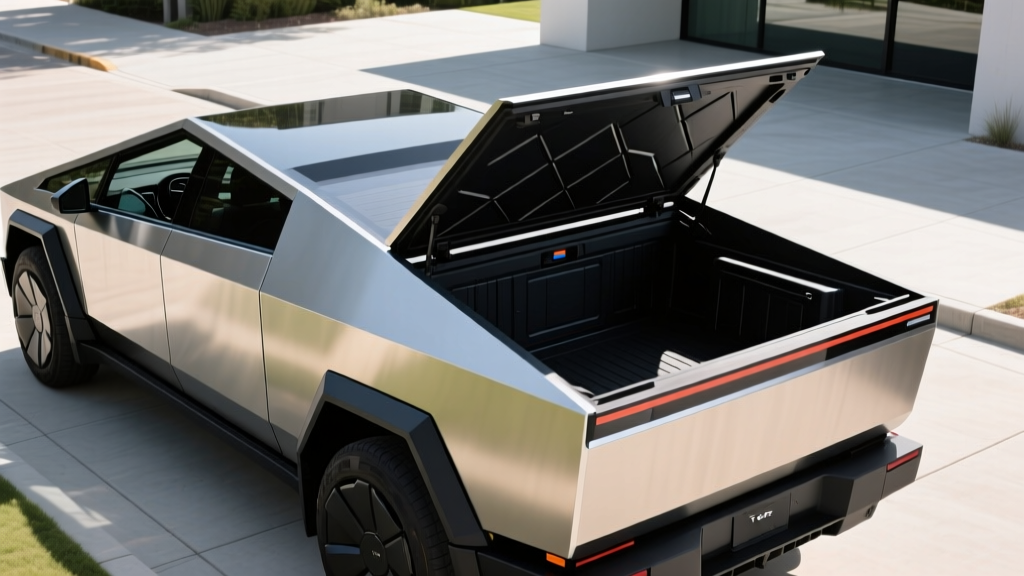
The Tesla Cybertruck's stainless-steel exoskeleton and angular vault bed demand a tonneau cover engineered for its specific geometry. Unlike conventional pickups with standardized 5.5- or 6.5-foot beds, the Cybertruck's 6.5-foot bed (74.3 inches long, 48.9 inches wide between wheel wells) pairs with a motorized retractable cover as standard on most trims. Aftermarket options must clear the sail-pillar architecture and accommodate the 48-volt electrical system routed through the bed rails. This guide maps every 2026 Cybertruck variant's specs—range, charging, pricing, tax-credit eligibility—so you can weigh whether the stock cover suffices or an aftermarket upgrade justifies its cost against real-world utility gains.
| Spec | AWD | Cyberbeast |
|---|---|---|
| EPA Range | 340 miles | 320 miles |
| Battery (usable) | ~123 kWh, NMC | ~123 kWh, NMC |
| Peak DC Charge | 250 kW | 250 kW |
| 10–80% DC Time | ~30 min | ~30 min |
| Level 2 Rate | 11.5 kW (44 mi/hr) | 11.5 kW (44 mi/hr) |
| 0–60 mph | 3.9 sec | 2.6 sec |
| Horsepower | 600 hp | 845 hp |
| Drivetrain | Dual-motor AWD | Tri-motor AWD |
| MPGe (combined) | 67 MPGe | 65 MPGe |
| Towing Capacity | 11,000 lb | 11,000 lb |
| Bed Length | 74.3 in | 74.3 in |
| Base MSRP | $79,990 | $99,990 |
Real-World Range vs. EPA Sticker
EPA Estimate: 340 miles (AWD), 320 miles (Cyberbeast)
Real-World Expectation: Expect 270–300 miles on highway-heavy trips at 70–75 mph; cold-weather (below 32°F) can reduce range by 20–30%, dropping effective range to 220–250 miles without preconditioning. The truck's 6,600–6,800 lb curb weight and 0.34 Cd drag coefficient penalize efficiency at sustained highway speeds. Towing near max capacity cuts range roughly in half.
The EPA's fueleconomy.gov listing rates the AWD at 67 MPGe combined (2.0 kWh/mile). In mixed driving, owners report 1.8–2.2 kWh/mile depending on terrain and climate-control use. The tri-motor Cyberbeast's extra front motor and performance tuning drop efficiency slightly to 65 MPGe.
Charging Speed: DC Fast, Level 2, and the Charge Curve
The Cybertruck peaks at 250 kW on V3 Superchargers, but sustained rate matters more than peak. The charge curve holds above 200 kW only between 10–35% state of charge, then tapers progressively—dropping to ~100 kW by 60% and below 50 kW past 80%. A 10–80% session takes roughly 30 minutes under ideal thermal conditions; cold-soaked batteries without preconditioning can stretch this to 45+ minutes.
| Charging Level | Power (kW) | Miles Added per Hour | Typical Use |
|---|---|---|---|
| Level 1 (120V) | 1.4 kW | ~4 mi/hr | Emergency top-up |
| Level 2 (240V, 48A) | 11.5 kW | ~44 mi/hr | Home overnight |
| DC Fast (V3 Supercharger) | 250 kW peak | ~800 mi/hr (peak) | Road trips |
Home charging on a 60-amp circuit (48A continuous) replenishes ~350 miles overnight—more than enough for daily use. The Cybertruck uses the NACS connector natively, so no adapter is needed at Tesla Superchargers. CCS networks like Electrify America require a NACS-to-CCS adapter (sold separately, ~$200).
Stock Tonneau Cover vs. Aftermarket Options
The factory motorized retractable tonneau cover is standard on AWD and Cyberbeast trims. It locks automatically, integrates with the truck's alarm, and supports up to 300 lb of dynamic load on its rails—enough for crossbars and rooftop tents. The cover retracts into a canister behind the cab, sacrificing ~6 inches of forward bed depth but preserving the full 74.3-inch floor length.
Aftermarket alternatives remain limited in 2026 due to the Cybertruck's unique sail-pillar geometry and 48V wiring harness routed through the bed rails. Brands like Extang and BAK Industries have released Cybertruck-specific hard-folding covers ($1,200–$1,800), but these require drilling into the composite bed rails and may void Tesla's bed warranty. The factory cover's integration with the vehicle's security system and app-based controls gives it a functional edge that third-party options cannot replicate without CAN-bus reverse engineering.
Pricing, Trims, and Federal Tax Credit Eligibility
| Trim | Base MSRP | As-Tested (typical) | §30D Credit Eligible? |
|---|---|---|---|
| AWD | $79,990 | $82,000–$85,000 | No (MSRP cap $80,000 for trucks, but battery sourcing rules may disqualify) |
| Cyberbeast | $99,990 | $102,000+ | No (exceeds $80,000 truck MSRP cap) |
Under IRS §30D rules, the Cybertruck faces two hurdles: the $80,000 MSRP cap for trucks/vans/SUVs, and the critical-minerals and battery-component sourcing requirements that phase in through 2026. The AWD trim's $79,990 base technically clears the MSRP cap, but destination charges and mandatory options often push the window sticker above $80,000, disqualifying it. The Cyberbeast exceeds the cap outright. Buyer income limits also apply: $300,000 joint / $150,000 single filers. Always verify current-year eligibility with a tax professional before relying on the credit.
Who the Cybertruck Suits (and Who Should Look Elsewhere)
Best for: Tech-forward buyers who prioritize acceleration, towing, and bed security over traditional truck refinement. The motorized tonneau cover and 11,000-lb towing capacity make it viable for contractors hauling tools or families towing campers. The tri-motor Cyberbeast appeals to performance enthusiasts who want supercar-rivaling 0–60 times in a pickup.
Consider alternatives if: You need a sub-$50,000 truck, prioritize rear-seat legroom (the Cybertruck's 38.4 inches trails the F-150 Lightning's 41.1), or live in a region with sparse Supercharger coverage. The Rivian R1T offers more rear-seat space and a ~$70,000 entry point; the Ford F-150 Lightning starts below $55,000 and qualifies for the full $7,500 credit on eligible trims.
Pros
- Motorized tonneau cover standard, app-controlled, 300-lb rail capacity
- 250-kW peak DC charging with extensive Supercharger network
- 11,000-lb towing, 6.5-ft bed with integrated ramps
- Stainless-steel exoskeleton resists dents and corrosion
- Tri-motor Cyberbeast: 2.6-sec 0–60, 845 hp
Cons
- MSRP pushes past §30D tax-credit cap on most builds
- Real-world highway range drops to ~270–300 mi; worse when towing
- Rear-seat legroom (38.4 in) lags F-150 Lightning
- Aftermarket tonneau options limited by proprietary geometry
- Cold-weather range loss significant without preconditioning
Warranty and Long-Term Ownership
Tesla covers the Cybertruck's battery and drive units for 8 years / 120,000 miles (whichever comes first), with a minimum 70% capacity retention threshold. The vehicle limited warranty runs 4 years / 50,000 miles. The motorized tonneau cover falls under the 4-year bumper-to-bumper warranty; motor or track failures have been reported in early 2024 builds, though Tesla issued a service bulletin addressing rail alignment. Stainless-steel body panels carry the same 4-year coverage but are exempt from corrosion perforation claims due to the material's inherent rust resistance.
Frequently Asked Questions
Can I install an aftermarket tonneau cover on the Cybertruck?
Yes, but options are limited. The Cybertruck's sail pillars and 48V bed-rail wiring require model-specific designs. Drilling into composite rails may void Tesla's bed warranty. The factory motorized cover remains the most integrated option in 2026.
Does the Cybertruck qualify for the $7,500 federal tax credit?
Unlikely in most configurations. The AWD's base MSRP ($79,990) barely clears the $80,000 truck cap, but destination fees and options typically push it over. The Cyberbeast exceeds the cap. Battery-sourcing rules further restrict eligibility. Confirm with a tax professional and the IRS §30D guidance.
How does cold weather affect Cybertruck range?
Below 32°F, expect 20–30% range loss due to battery resistance and cabin heating demands. Preconditioning the battery while plugged in mitigates this. The heat pump (standard) improves efficiency versus resistive heating but cannot eliminate cold-weather penalties entirely.
Is the Cybertruck worth buying over the F-150 Lightning or R1T?
If you prioritize performance (2.6-sec 0–60 Cyberbeast), Supercharger access, and the integrated motorized tonneau, yes. If you need lower cost, tax-credit eligibility, or more rear-seat space, the F-150 Lightning or Rivian R1T are stronger choices.
What's the real cost to charge a Cybertruck at home?
At the US average electricity rate of $0.16/kWh, fully charging the ~123-kWh battery costs ~$19.70, yielding ~300 real-world miles. That's roughly $0.065 per mile versus $0.15–$0.20/mile for a gas truck at $3.50/gallon and 18 MPG.