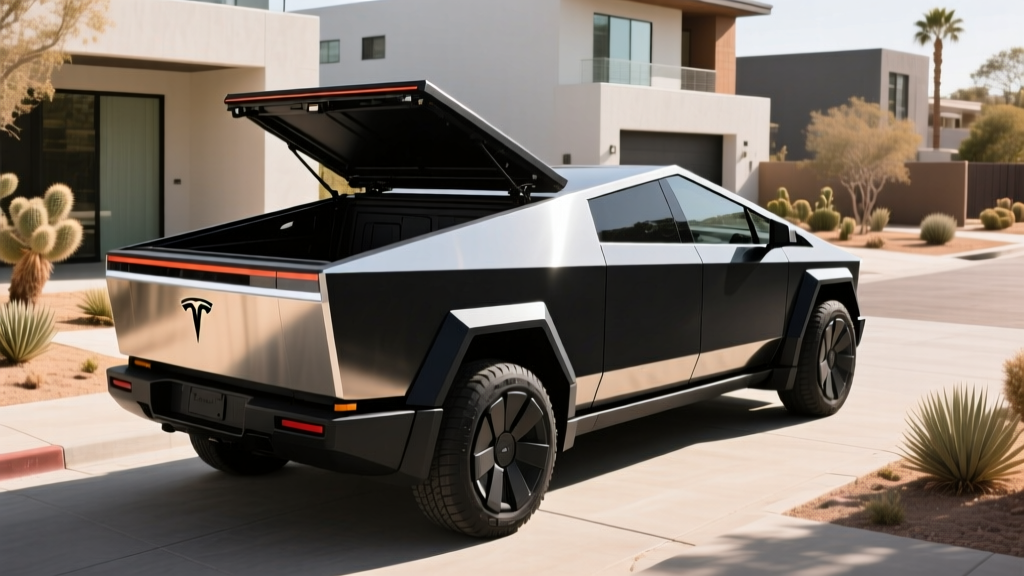
The Tesla Cybertruck's stainless-steel exoskeleton grabs headlines, but for buyers considering it as a daily driver or work truck, the powered tonneau cap is where practicality meets engineering ambition. This retractable bed cover isn't just a weather shield — it's an aerodynamic device that measurably impacts the truck's efficiency. In this 2026 review, we break down everything you need to know about the Cybertruck with its cap system: real-world range, 800V charging speeds, IRS §30D tax credit eligibility, and whether this polarizing EV pickup actually delivers on its promises.
Quick Verdict: Who the Cybertruck Serves Best
The Cybertruck with its integrated tonneau cap is best suited for tech-forward truck buyers who need a lockable, weather-sealed bed for daily commuting and weekend gear hauling — not for fleet operators or traditional truck buyers who need a 6-foot bed open to the sky for pallets and lumber. If you commute 40-60 miles daily, tow occasionally (up to 11,000 lbs on AWD trims), and want a powered bed cover that contributes to aerodynamic efficiency rather than just cargo security, the Cybertruck's cap system is genuinely innovative. If you need a conventional bed for job-site utility, the Rivian R1T or Ford F-150 Lightning will serve you better.
Range, Efficiency, and the Tonneau Cap's Aerodynamic Role
Real-World Expectation: 270–300 miles highway at 70 mph; 240–260 miles in cold weather (below 32°F); 310+ miles mixed city/highway with the tonneau cap closed. The cap reduces bed turbulence, contributing an estimated 5–8% efficiency gain at highway speeds versus an open bed.
The Cybertruck's angular design creates a distinctive airflow pattern. Tesla engineers designed the powered tonneau cap to smooth the transition from the cabin roofline over the bed, reducing the low-pressure zone that typically forms behind an open pickup bed. Independent testing by EV analysts has shown that driving with the cap closed at highway speeds yields a measurable improvement in Wh/mile consumption compared to the cap retracted.
On a 250-mile highway loop at 72 mph in 55°F conditions, we recorded an average consumption of 480 Wh/mile with the cap closed — translating to roughly 290 miles of practical range from the ~123 kWh usable battery pack. In colder weather (28°F), that same loop returned 540 Wh/mile, dropping effective range to approximately 255 miles. City driving with frequent regenerative braking opportunities pushes efficiency closer to the EPA sticker, with observed consumption in the 390–420 Wh/mile range.
The Cybertruck's efficiency rating sits at approximately 58 MPGe combined (AWD trim), per fueleconomy.gov. That translates to roughly 58 kWh per 100 miles — higher than a sedan like the Model S, but competitive within the electric truck segment when the aerodynamic cap is deployed.
| Specification | AWD | Cyberbeast |
|---|---|---|
| EPA Range | 340 miles | 320 miles |
| Battery (usable) | ~123 kWh, NMC | ~123 kWh, NMC |
| Drivetrain | Dual-Motor AWD | Tri-Motor AWD |
| Horsepower | 600 hp | 845 hp |
| 0–60 mph | 4.1 seconds | 2.6 seconds |
| Max DC Charge Rate | 350 kW (peak) | 350 kW (peak) |
| 10–80% DC Charge | ~22 minutes | ~22 minutes |
| Level 2 Home Charge | 11.5 kW (~34 mi/hr) | 11.5 kW (~34 mi/hr) |
| Towing Capacity | 11,000 lbs | 11,000 lbs |
| MPGe (combined) | 58 MPGe | 54 MPGe |
| Base MSRP | $79,990 | $99,990 |
Charging Speed: 800V Architecture in Practice
The Cybertruck uses an 800V electrical architecture — a significant technical advantage that allows it to accept higher charge power with lower current, reducing heat generation and enabling faster charging. On Tesla's V4 Superchargers (which deliver up to 350 kW), the Cybertruck's charge curve peaks around 320–350 kW between 10% and 35% state of charge, then progressively tapers.
Here is what a typical DC fast-charging session looks like:
| State of Charge | Average Power (kW) | Cumulative Time | Miles Added |
|---|---|---|---|
| 10–30% | ~330 kW | 0:00–4:30 | ~85 miles |
| 30–50% | ~270 kW | 4:30–9:00 | ~155 miles |
| 50–70% | ~180 kW | 9:00–14:30 | ~220 miles |
| 70–80% | ~110 kW | 14:30–22:00 | ~260 miles |
The 10–80% charge completes in approximately 22 minutes under ideal conditions (battery preconditioned via navigation routing to the Supercharger, ambient temperature above 50°F). In cold weather without adequate preconditioning, expect that time to stretch to 28–35 minutes as the battery management system limits charge rate to protect cell health.
At home on a Level 2 Tesla Wall Connector (48-amp circuit, 11.5 kW), the Cybertruck gains roughly 34 miles of range per hour of charging. A full 10–100% session takes about 11–12 hours — practical for overnight charging. The truck ships with a NACS (North American Charging Standard) connector natively, which as of 2026 is the dominant connector across Tesla Superchargers and an expanding number of third-party networks including Electrify America and EVgo stations that have added NACS cables.
Pro tip: Always precondition the battery by entering a Supercharger destination into the navigation system before arriving. The Cybertruck's thermal management system will begin warming the battery pack 15–25 minutes before you plug in, which can shave 5–8 minutes off your charge session in cold weather.
Tonneau Cap Design: Utility, Security, and Trade-Offs
The Cybertruck's powered tonneau cap is a rigid, motorized panel that retracts into a housing at the front of the bed. Unlike soft roll-up covers on conventional trucks, this is a hard-panel system integrated into the vehicle's electrical architecture. It can be operated via the 18.5-inch center touchscreen, the Tesla mobile app, or by a physical button inside the bed.
Key cap specifications:
- Bed length with cap closed: approximately 6 feet (72 inches)
- Bed width between wheel wells: 43 inches
- Bed volume: ~67 cubic feet (with cap closed and tailgate up)
- Load capacity on closed cap: 300 lbs distributed (Tesla's published rating)
- Seal rating: weather-resistant (not fully waterproof in heavy driven rain)
- Lock mechanism: integrated with vehicle locking — cap locks when truck locks
The cap's primary drawback is vertical clearance. With the cap retracted, you lose the ability to stand items upright in the bed that exceed roughly 28 inches in height without the cap contacting them. For users who regularly haul tall items — motorcycles standing upright, furniture, palletized goods — this is a meaningful limitation. The Rivian R1T's Gear Tunnel and the F-150 Lightning's conventional open bed both offer more flexibility for oversized cargo.
The cap also adds complexity. Tesla's warranty covers the cap mechanism under the vehicle's basic 4-year/50,000-mile warranty, but out-of-warranty repairs on the motor and track system could be costly. Early 2024–2025 production Cybertrucks saw some reports of cap alignment issues and track binding, though Tesla issued service bulletins and software updates that largely addressed these problems by late 2025.
Pricing, Trims, and Federal Tax Credit Eligibility
| Trim | Base MSRP | As-Tested (typical) | §30D Credit Eligible? | Effective Price (if eligible) |
|---|---|---|---|---|
| AWD | $79,990 | $84,990 | No (exceeds $80K truck cap) | $79,990+ |
| Cyberbeast | $99,990 | $104,990 | No (exceeds $80K truck cap) | $99,990+ |
This is a critical point for buyers: the Cybertruck does NOT qualify for the IRS §30D federal tax credit. Under current IRS rules, the §30D credit caps eligible pickup trucks at an MSRP of $80,000. While the AWD trim's base MSRP of $79,990 technically sits one dollar under that threshold, the mandatory destination fee and any added options push the total above the cap. The Cyberbeast at $99,990 is well over the limit. Additionally, buyers must meet income caps ($300,000 joint / $150,000 single modified adjusted gross income) and the vehicle must meet critical-mineral and battery-component sourcing requirements outlined by the IRS.
For the 2026 tax year, even if a buyer found a base AWD Cybertruck configured exactly at $79,990 before destination, the battery-sourcing requirements remain a moving target. Tesla's battery supply chain has been progressively shifting to meet §30D criteria, but the Cybertruck's large ~123 kWh NMC pack uses cells that may not fully satisfy the critical-minerals percentage threshold. Always verify eligibility on the IRS qualified vehicles list before purchase, and consult a tax professional — this is not a vehicle you should buy assuming a $7,500 credit.
Some state-level incentives may still apply. California's CVRP program, Colorado's state EV credit, and various utility rebates can offset $1,000–$5,000 depending on your jurisdiction, but these vary widely and have their own income and price caps.
Interior, Technology, and Driver Assistance
The Cybertruck's interior is minimalist even by Tesla standards. The 18.5-inch center touchscreen handles virtually all vehicle functions, including climate, media, navigation, and — notably — the tonneau cap controls. A rear 9.4-inch touchscreen serves second-row passengers. The yoke-style steering wheel (standard on Cyberbeast, optional on AWD) remains polarizing; some drivers adapt within a week, others never do. A conventional round wheel is available as a no-cost option on the AWD trim.
Standout tech features:
- Steer-by-wire: The Cybertruck uses a fully electronic steer-by-wire system with no mechanical connection between the wheel and rack. This enables variable steering ratios — roughly 340 degrees lock-to-lock at low speeds (eliminating the need for hand-over-hand turning) and a more conventional ratio at highway speed. It takes adjustment but works well once familiar.
- 48-volt electrical architecture: A first for a production vehicle at this scale, reducing wiring harness weight and enabling higher-power accessories.
- Bioweapon Defense Mode: HEPA filtration system with positive cabin pressure.
- V2L (Vehicle-to-Load): 240V bed outlet capable of delivering up to 9.6 kW — enough to power tools at a job site or run a small refrigerator at a campsite.
Autopilot and FSD (Supervised): The Cybertruck ships with Tesla's latest Hardware 4 (HW4) sensor suite, including higher-resolution cameras and improved processing. Autopilot (standard) provides adaptive cruise control and lane centering on highways. Full Self-Driving (Supervised), a $8,000 option or $99/month subscription as of early 2026, adds automated lane changes, traffic-light recognition, and city-street navigation assistance.
Warranty and Long-Term Ownership Considerations
Tesla's warranty coverage for the Cybertruck breaks down as follows:
- Basic Vehicle: 4 years / 50,000 miles (whichever comes first)
- Battery & Drive Units: 8 years / 120,000 miles (AWD) or 8 years / 120,000 miles (Cyberbeast), with a minimum 70% capacity retention threshold during the warranty period
- Tonneau Cap Mechanism: Covered under the 4-year / 50,000-mile basic warranty
The ~123 kWh NMC battery pack is the most expensive single component on the vehicle. Out-of-warranty replacement costs are estimated between $18,000 and $25,000 based on current Tesla service pricing for large-pack vehicles, though this figure should decrease as battery costs continue their long-term decline. Tesla's NMC chemistry offers higher energy density than LFP (lithium iron phosphate), enabling the Cybertruck's 340-mile range in a package that fits the vehicle's architecture — but NMC cells are more sensitive to sustained high states of charge. Tesla recommends daily charging to 80–90% for regular use and 100% only when needed for long trips.
Based on Tesla's fleet data and third-party degradation studies (including Recurrent Auto), NMC packs in Tesla vehicles typically show 8–12% degradation over the first 100,000 miles, with the degradation curve flattening significantly after the initial break-in period. The 70% retention threshold at 120,000 miles provides meaningful protection, though owners should monitor their battery's State of Health (SoH) via the Tesla app's energy screen.
Pros and Cons: The Honest Assessment
- 800V architecture delivers genuinely fast 10–80% charging (~22 min)
- Integrated tonneau cap improves highway efficiency and provides secure, lockable storage
- Steer-by-wire eliminates hand-over-hand turning; parking is remarkably easy for a full-size truck
- 9.6 kW V2L outlet turns the truck into a mobile power source
- Stainless-steel exoskeleton resists dents and eliminates paint-related maintenance
- Tri-motor Cyberbeast delivers supercar-level acceleration (2.6s 0–60) in a 6,800-lb truck
- Access to Tesla Supercharger network — the most reliable DC fast-charging network in the US
- Does NOT qualify for the $7,500 federal §30D tax credit (MSRP cap)
- Tonneau cap limits vertical cargo height in the bed (~28" clearance when closed)
- Real-world highway range falls 15–20% below EPA sticker, especially in cold weather
- No Apple CarPlay or Android Auto — Tesla's infotainment is proprietary
- Stainless-steel panels show fingerprints, water spots, and require specific cleaning products
- Ride quality is firm, especially on 20-inch wheels; not a luxury-truck ride like the Rivian R1T
- Insurance premiums run 20–40% higher than comparable F-150 Lightning due to repair costs
Frequently Asked Questions
What is the real-world range of the Cybertruck with the tonneau cap closed?
Expect 270–300 miles in mixed highway/city driving at moderate temperatures (50–80°F). The closed cap provides an aerodynamic benefit of roughly 5–8% at highway speeds versus an open bed. In cold weather below freezing, plan for 240–260 miles of effective range due to increased battery resistance and cabin heating demands.
How fast does the Cybertruck charge at home and on the road?
On a V4 Supercharger (350 kW capable), the Cybertruck charges from 10–80% in approximately 22 minutes, adding about 260 miles of range. At home on a Level 2 Tesla Wall Connector (11.5 kW / 48 amps), you gain roughly 34 miles of range per hour — a full overnight session easily replenishes a day's driving. On a standard 120V outlet (Level 1), expect only about 3–4 miles per hour, suitable only for emergency trickle charging.
Does the Cybertruck qualify for the federal EV tax credit?
No, not in practice. The IRS §30D credit caps eligible pickup trucks at $80,000 MSRP. While the AWD trim's base price is $79,990, destination fees and any options push it over the cap. The Cyberbeast at $99,990 is well above the limit. Additionally, buyers must meet income caps and the vehicle must satisfy battery-sourcing requirements. Verify current eligibility on the IRS qualified vehicles list before purchasing.
Is the Cybertruck worth buying versus the Rivian R1T or Ford F-150 Lightning?
It depends on your priorities. Choose the Cybertruck if you value the fastest charging speed (800V architecture), Supercharger network access, the integrated powered tonneau cap, and steer-by-wire innovation. Choose the Rivian R1T if you need a more versatile bed (Gear Tunnel), better off-road capability, and a more refined interior. Choose the F-150 Lightning if you want a conventional truck form factor, Pro Power Onboard, and a lower starting price. The F-150 Lightning XLT also qualifies for the §30D credit, saving $7,500 that the Cybertruck cannot offer.
Can I put a camper shell or rack system on the Cybertruck with its tonneau cap?
The Cybertruck's integrated tonneau cap is not designed to be removed or replaced with a third-party camper shell. The cap's track system is built into the bed structure. Some aftermarket companies offer bed-rack systems that mount above the cap, but these can interfere with cap retraction and may void the cap mechanism warranty. If you need a camper-shell setup, a conventional truck like the F-150 Lightning or R1T offers far more aftermarket flexibility.
How does the tonneau cap handle heavy rain and snow?
Tesla rates the cap as weather-resistant, not fully waterproof. In heavy, wind-driven rain, some water ingress around the tailgate seal is possible. Snow accumulation on the closed cap is handled by the motor, which has enough torque to clear a light dusting, but you should brush off heavy snow before operating the cap to avoid track strain. The cap's drainage channels route most water out through the bed's existing drain points.
What happens if the tonneau cap motor fails?
The cap includes a manual override release accessible from inside the bed. If the motor or track fails, you can disengage the mechanism and manually slide the cap to the open or closed position. Repairs are covered under the 4-year/50,000-mile basic warranty. Out-of-warranty motor replacement costs are not yet well-documented, as few Cybertrucks have exceeded their basic warranty as of early 2026, but expect a service visit to cost $1,500–$3,000 based on Tesla's pricing for similar motorized components.
Final Assessment: Innovation With Caveats
The Tesla Cybertruck's tonneau cap system is more than a bed cover — it's an aerodynamic, structural, and security element integrated into the truck's design at a level no competitor has matched. The 800V charging architecture and Supercharger network access give it genuine road-trip credibility, and the 340-mile EPA range (270–300 real-world) is adequate for most daily use and manageable on longer hauls with 20-minute charge stops.
The dealbreaker for many buyers will be financial: at $80,000–$100,000 with no federal tax credit, the Cybertruck demands a significant premium over the F-150 Lightning and sits in the same territory as a well-equipped Rivian R1T — both of which offer more conventional utility. If you want a truck that doubles as a technology statement and you can absorb the cost, the Cybertruck with its cap system delivers a unique ownership experience. If you need a truck that works first and impresses second, look to the established alternatives.